
Without doubt my favorite bread, but it is a pain to make (heh, heh.) This bread takes about 7 hours, start to finish, with hands on about every 20 minutes for the first 5 hours, but it’s so worth every minute.
Pain de Cristal is “Glass Bread” developed in the Catalan region of Spain. It has a crispy thin crust that fractures like glass. The interior has large air pockets and an amazingly light, soft, chewy crumb, perfect to dipping in oil and vinegar. This is another addition to our QC Cadre Gathering, and may be my best bake of this bread ever!
It’s a 100% hydration bread, meaning equal parts water and flour. Initially, it looks like pancake batter, but after a few folds and coils begins to exhibit some structure. It is alway fragile so a tender touch is required to may this tender bread.
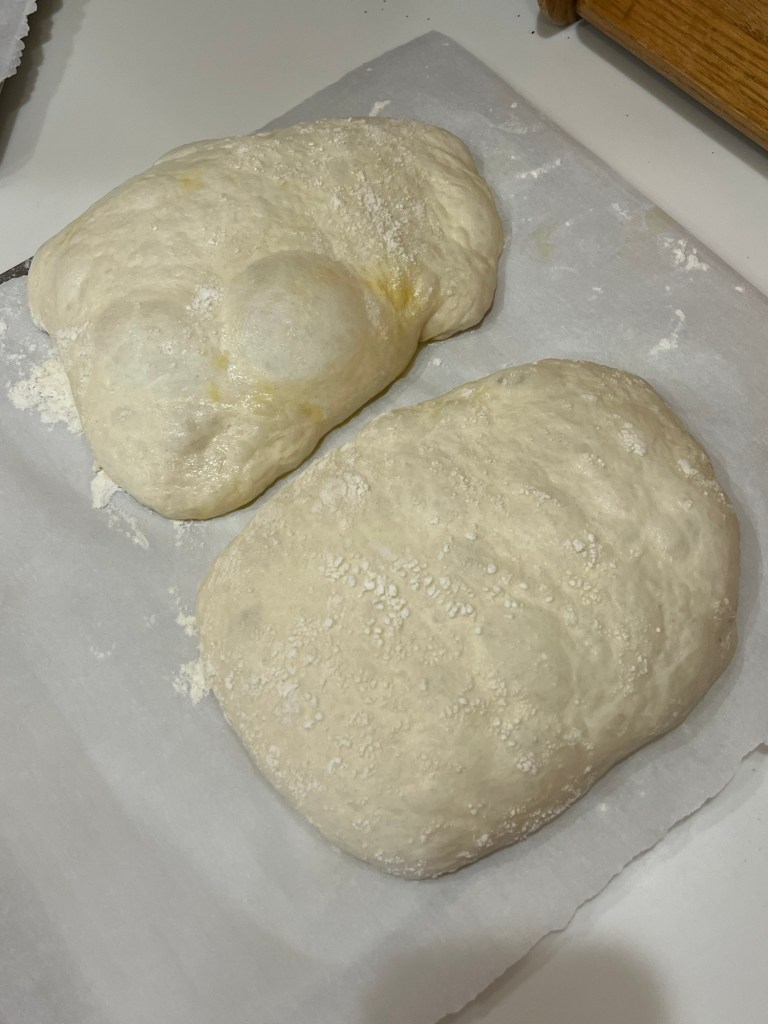

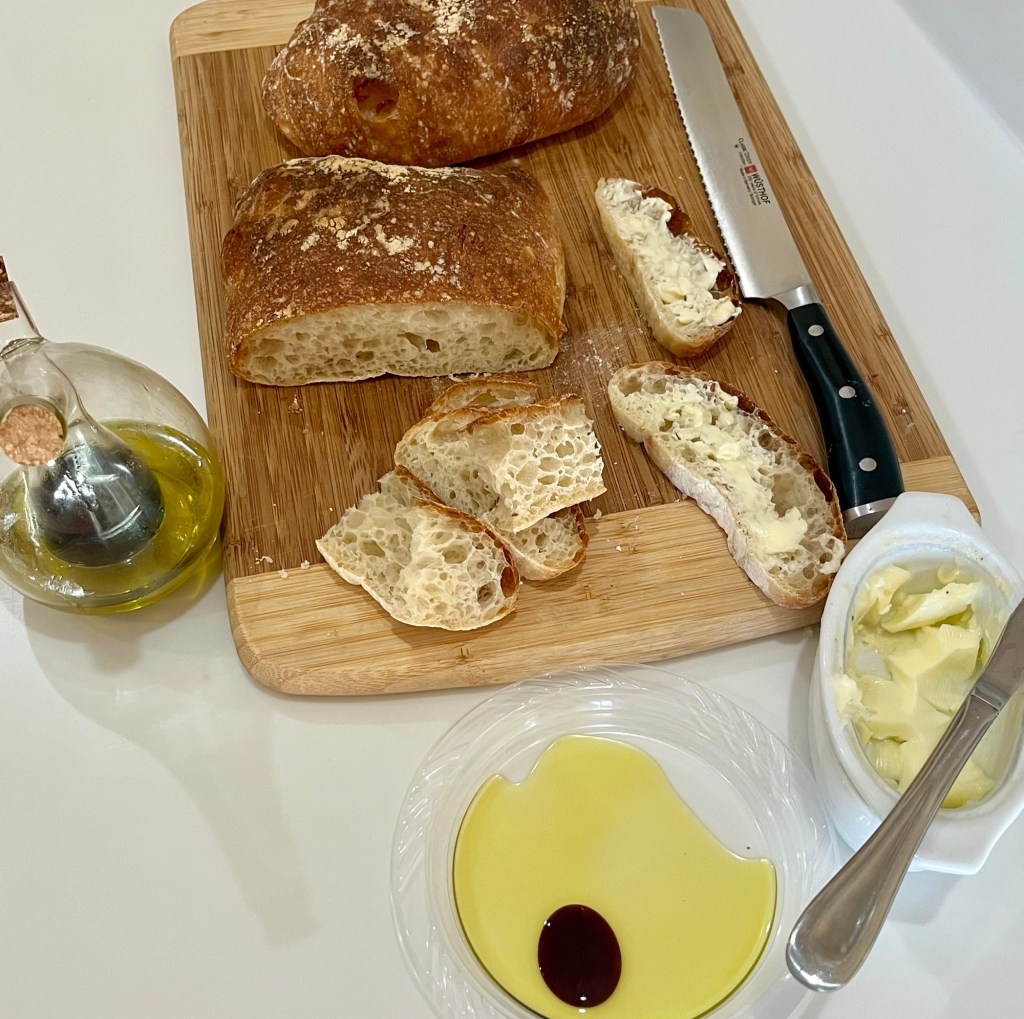
Pain de Cristal
INGREDIENTS
• 500g water (80 F in warm weather, 100F if cold)
• 500g Bread Flour
• 3 g (1 tsp) instant yeast
• 10g salt
• 15g olive oil (for the casserole pan)
METHOD
This is KAB’s method
- To make the dough: Weigh your flour.
- In a medium bowl, mix the water, flour, yeast, and salt until thoroughly combined and homogenous. Note: The dough starts off very slack and wet and resembles pancake batter. It will transform itself through time and folds.
- Oil a two-quart rectangular baking dish, or casserole pan, (10” x 7”) with the olive oil. The sides should be greater than 1.5” high.
- Pour the dough into the pan. Check the dough’s temperature by inserting a digital thermometer into the center. If it’s less than 72°F, move the pan to a warmer spot, e.g., your oven with the light turned on. The dough MUST ferment at a constant 72-78 F.
- Cover the pan and allow the dough to rest for 20 minutes. (Elapsed time: 30 minutes)
- Start with a bowl fold: Use your wet hands to grab a section of dough from one side, lift it up, then press it down into the middle. Repeat 8 to 12 times going around the periphery of the baking dish 2 or 3 times.
- Cover the dish and allow the dough to rest for 20 minutes. (Elapsed time: 70 minutes)
- Next do a coil fold: With wet hands, reach under the dough and stretch the middle upward until the dough releases from the dish. Roll it forward off your hands, allowing it to fold over (or “coil”) on itself. Rotate the dish 90 degrees (a quarter turn) and repeat. Continue performing this folding action until the dough will stretch and elongate easily, usually four to five times initially.
- Cover the pan and allow the dough to rest for 20 minutes. (Elapsed time: 90 minutes)
- Repeat the coil fold: Note: Do coil folds three more times, covering each time, to build strength and developing the dough. (60 more minutes.) (Elapsed time: 150 minutes)
- At this point, the dough should be easier to handle and feel tighter. Repeat the coil fold using only two or three folds this time. Cover the bowl and allow the dough to rest for 20 minutes. (Elapsed time: 170 minutes)
- Repeat the coil fold one last time, (5th coil fold) using only one or two folds if the dough is relatively strong and large bubbles should have formed. Transfer the dough to a larger, oil coated dish, cover the dish and allow the dough to rest for about 80 minutes. It should about triple in size. (After this rest 4 hours 10 minutes should have elapsed.)
- Divide the dough: Coat the top of the dough with flour. Use a bowl scraper to gently release the dough from the sides of the pan.
- As gently as possible, turn the dough out onto a heavily floured surface, keeping the rectangle or square shape – be careful not to deflate the delicate dough. Sprinkle a generous amount of flour on top of the dough, leaving no exposed sticky spots.
a. For four small loaves: Working as gently as possible, use a bench knife or other sharp knife to divide it into four pieces. Gently place two pieces on a piece of parchment, leaving space between them.
b. For two long loaves: lay two pieces of parchment paper, overlapping 2”. Carefully divide the dough in half lengthwise. Using a bench knife carefully slide some flour under each loaf and shape into regular rectangles. As gently as possible slide the loaves onto separate pieces of parchment paper. (Elapsed time: 5 hours)
c. Allow the loaves to rest at room temperature for 1 hour, uncovered until large bubbles appear on the sides and surface. While the loaves are resting, preheat the oven to 475°F with a baking stone on a lower rack. The loaves are ready for the oven when there are a few large bubbles on the surface of each loaf, and they feel light and airy. (Elapsed time: 6 hours) - To bake the bread: Carefully slide the two loaves (still resting on the parchment) into the oven onto the preheated stone or steel. If space is tight and the full sheet of parchment won’t fit on the stone or steel, cut the parchment between the two loaves and arrange them as best you can. Allow the other two loaves to continue to rest.
a. Bake the loaves for 15 minutes, then transfer them, from the stone or steel, directly onto a rack in the upper third of the oven for an additional 13 to 15 minutes. Moving them allows the baking stone or steel to become hot again in preparation for the next two loaves. After a total of 30 minutes of baking, remove the loaves from the oven and allow them to cool on a rack. (Elapsed time: 6 ½ hours) - Repeat the process with the two remaining loaves or loaf. Cool the bread fully before slicing.
- Storage information: Wrap the bread loosely and store it at room temperature for up to several days; freeze for longer storage.
 aBatteredOldSuitcase