This will be my last Gluten Free recipe (at least for now.) It is a sandwich bread from White Gold Gluten Free flour.
I used their recipe with minimal changes (Calcium free milk and butter replacing the original ingredients.) I also use an egg-white wash rather than a full egg wash.
The crumb and texture are excellent and the flavor approaches a wheat flour loaf. Use a digital thermometer and remove from oven when the interior temp reaches 200F.
(Tent the bread when it browns at about 20 minutes of baking.)
Gluten Free Sandwich Bread (White Gold)
INGREDIENTS: • 1 package (1.1 Lb) Extra White Gold gluten free bread flour • 1 Tbsp. dry yeast (1 envelope) • 2 tablespoons honey • 3 eggs • 1 c. lukewarm almond milk • 3 Tbl softened butter (replacing ¼ cup vegetable oil) • ½ tsp salt (replacing 1 ½ tsp. salt) • 1 egg for egg wash • Sesame seeds (optional)
METHOD:
Add the flour, honey and yeast to a stand mixer bowl. Mix for 3 minutes with a paddle attachment.
Add the eggs and almond milk and mix for 3 minutes. (NOTE: I used ¼ cup heavy cream and ¾ c 2% calcium free milk.)
Add butter (or vegetable oil) and salt and mix on low speed for 4 minutes. The dough should be sticky.
Let it rise for 90 minutes, in the mixer bowl, covered, in a warm dry place. (Such as a proofing oven)
Pour/scape the dough in a bread loaf. (A narrower bread pan will help shape the bread.)
Let the dough rise for 20 minutes.
Pre-heat the oven to 375 deg. Place a shallow dish in the lower part of the oven
Brush the bread gently with an egg wash and sprinkle sesame seeds (optional).
Place the bread pan on a center rack and pour 1 cup of water into the shallow dish.
Bake for 40-45 minutes, until golden brown. (Don’t over bake!)
Continuing the thread of gluten free bakes, this one provides a nice gluten free snack or breakfast without being “breads.”
The only changes I made to the original recipe are including xanthan gum and substituting milk and cream for almond milk.
Gluten Free Berry Drop Scones
INGREDIENTS
2 1/2 cups Bob’s Red Mill Gluten Free AP flour
1 tablespoon baking powder • 3/4 teaspoon kosher salt • 1/3 cup sugar • 1 ½ tsp xanthan gum (optional) • Zest of 1 small lemon • 1/2 cup vegetable shortening chilled and cut into cubes • 150-175g fresh raspberries • 1 cup almond milk (See NOTE below) • Coarse or turbinado sugar for topping
METHOD
Preheat oven to 400F. Line a baking sheet with parchment paper.
In the bowl of a food processor, add the flour, baking powder, xanthan gum (optional), salt, sugar and zest. Pulse a few times to incorporate.
Add the cubed Crisco and pulse to incorporate. The mixture should resemble very coarse sand.
Empty the flour mixture into a mixing bowl. Add the almond milk and stir until just barely incorporated. (NOTE: I use ¼ c heavy cream and ¾ c 2% calcium free milk)
Gently fold in the berries. It’s fine if the raspberries break up a little – it adds a nice pink stain to the dough. The dough should just be moist, not wet, but also not crumbly or powdery looking. If it looks too dry, add a tablespoon of cold water.
Spoon (I used my hands, wetted if necessary to form small balls of dough) the dough into 9-12 equally sized pieces on the parchment lined baking sheet. Sprinkle some coarse or turbinado sugar over the top, if desired.
Bake for 16-19 minutes, rotating the pan halfway through. The scones should be lightly golden and cooked through.
Cool in the pan for 5-10 minutes then carefully remove to a cooling rack.
Thanks to my friend Beth here is a new chocolate chip cookie recipe. I can’t even tell you how long Beth and I have been friends. Our parents were life long friends before us and we simply continued the relationship.
This recipe has slightly different ingredient ratios than my “go-to” recipe. Plus it doesn’t use light brown sugar but substitutes turbinado sugar for the white granulated sugar, which adds a light caramel flavor. The author did not specify what kind of sugar to use, but the video showed a non-white sugar. The turbinado would add some of he flavor removed by not using the light brown sugar. (Full disclosure, I didn’t have any turbinado but did have some demarara which is similar to turbinado but a little darker and coarser.)
This author (Emojoie) only made 4 cookies (mine were 123g each) whereas next time I will make a dozen (~40g each) or so.
Chocolate Chip Cookies Best Ever from YouTube
INGREDIENTS • 100g butter, softened. • 80g Demerara or turbinado sugar • 1g salt • 50 g (1 large egg) • ½ tsp vanilla extract • 160g all-purpose flour • 3g baking soda • 100 g (3/4 c) chocolate chips • 50g hazelnuts (optional)
METHOD
Preheat oven to 375° F.
Beat by hand: butter, sugar and salt in large bowl until creamy. (Don’t over beat.)
Fork whip the egg and add in two additions mixing to incorporate after each addition
Add vanilla and mix well
Gradually add flour mixture mixing by hand. (Again, don’t over beat.) it should form one large ball between wet and dry dough.
Stir in morsels and optional hazelnuts and mix by hand.
Chill in the fridge for 30 minutes.
Divide the dough into 135 g portions
Form into balls with hands and add more chocolate to the top
Bake for 13 – 14 minutes or until golden brown. Do NOT overbake!
Cool on baking sheets for 2 minutes; remove to wire racks to cool completely.
Continuing my gluten free string, this is an artisan bread recipe (mostly) from Kim, the creator of Kim’s Gluten Free Bread Flour.
While preparing the dough I was skeptical of the outcome. The dough was VERY wet (why wouldn’t it be with 100% hydration?) It fermented well and rose as expected but the shaping and proofing was… challenging.
I forgot that the best way to prepare the dough for proofing is to stretch and fold it in a bowl, rather than knead it on a floured surface. I made the change to Kim’s method below.
I also thought that after proofing the dough was very wet and wouldn’t score well, but I was wrong. I also thought that the scored bread wouldn’t have any oven spring, but was also wrong. I also, also thought that adding an extra 10 minutes to the baking time would be sufficient, but was also, also wrong. It probably needed another 30, or even 40 minutes for a total of 90-100 minutes. Not an also, but I should have taken the breads temperature near the end of the bake, but I didn’t, resulting in an underbaked center.
The taste was good, definitely LIKE bread, but certainly not like a typical wheat/gluten bread. The crumb and texture was good, just different. For our gluten free friend, she thought it was wonderful, besides all its faults because it was, indeed bread.
Gluten Dairy Soy Free Artisan Bread
INGREDIENTS • 3 cups (420 g) Kim’s gluten free bread flour blend • 1½ tsp xanthan gum (in addition to what’s already in the blend) • 1 ½ tsp psyllium husk powder • 1 tbsp (9 g) instant/rapid rise/fast-acting yeast (not active dry yeast) • 1 tsp kosher salt • 1¾ cups (420 ml) water* • 2 tbsp (26 ml) olive oil • 1 tbsp (21 g) honey
METHOD
In the bowl of a stand mixer fitted with the dough hook, add all dry ingredients and whisk using a handheld wire whisk. Add the honey, olive oil, and water. Place on mixer and mix briefly to incorporate. Turn the mixer up to medium high and knead for 5 minutes. Remove the dough hook and scrape the dough into a cohesive mass using a plastic dough scraper or a rubber spatula (or scrape into another bowl). Cover and place the bowl in a warm, draft-free area and allow it to rise (proof) for 1-2 hours, or until doubled in volume.
Refrigerate for at least 6 hours, preferably overnight, but up to 10 days.
On baking day, remove the dough from refrigerator and dump it out onto well-floured surface.
Loosely cover with plastic wrap (the piece that covered the bowl in the fridge.) Let the dough warm to room temperature.
Place the dough in a medium sized bowl and stretch and fold until fairly smooth, wetting your fingers as necessary. It will be a somewhat sticky dough so keep a small bowl of water on hand to wet your fingers.
To shape into a boule, simply form into a round ball, pulling the dough up and under the ball and pinching on the bottom. Place on parchment paper. To shape into a baguette, smooth the dough and roll into a rope shape, tapering it at the ends, adding more flour as necessary. Roll out as thick or thin as you’d like and as long as you’re able to fit in your oven (make sure it will fit on your pizza steel or stone). Place it on a sheet of parchment paper.
Place the loaf or loaves, covered loosely with plastic wrap, in a warm, draft-free area to rise until visibly puffed and slightly larger, but not doubled in size, about 1/2 to 1 hour. This time will vary depending on the warmth of your proofing area. DO NOT over proof!
BAKING STEEL OR STONE METHOD: Set up your oven for baking. Place a baking steel or stone (or overturned baking sheet) onto the middle rack with a shallow pan on a rack underneath. Preheat the oven to 450° F.
DUTCH OVEN METHOD: Place a Dutch oven with a tight-fitting lid into the oven and preheat it to 500° F. You won’t need the shallow pan with steam as enough steam will be created in the Dutch oven once the bread goes in. NOTE: This will only work with boules or loaves that can fit into the Dutch oven. If you’re making a longer batard or baguette, you’ll need to use the first method.
When the dough has finished rising and is visibly puffed, run a serrated knife under hot tap water and cut slits in the dough swiftly but uniformly, about ½-¾ inch deep.
BAKING STEEL OR STONE METHOD: Fill a measuring cup with one cup of very hot water (from the tap is fine). Using a pizza peel (paddle), slide the loaf (or loaves) onto the baking steel (or stone), parchment and all. Immediately pour the cup of very hot tap water into the shallow pan. Quickly shut the oven door.
DUTCH OVEN METHOD: Remove the lid carefully and carefully lower the dough, parchment and all, into the Dutch oven. Replace the lid and shut the oven door. Immediately reduce the temperature down to 450° F.
BAKING STEEL OR STONE METHOD: Bake for about 30 minutes for baguettes, or about 40 minutes for boules, OR longer for larger boules (some larger boules can take up to an HOUR or more). If the loaves are getting too browned, you can cover them loosely with foil. The loaves will look crusty and done on the outside, but will feel light when picked up. If they feel heavy, they’re not done yet. Allow them to bake for another 5-10 minutes and then check again, picking up the loaf with two gloved hands. If they’re still feeling heavy, allow them to bake for another 5 minutes and check again.
DUTCH OVEN METHOD: Bake the bread for 60 minutes with the lid on. Remove the cover and continue to bake for another 20 minutes. Check for doneness with a digital thermometer. The bread will be done when the temperature in the center is 200-205F..
Remove from the oven and place on a cooling rack. Allow to cool COMPLETELY before cutting (or it will be gummy on the inside).
Kim’s Gluten Free Bread Flour Blend
Yield: 700g (5 c)
INGREDIENTS • 285g Bob’s Red Mill potato starch • 250g superfine white rice flour (DON’T use regular rice flour, ie Bob’s Red Mill) • 75g Tapioca flour • 75g Whey protein isolate or egg white protein. • 15g Xanthan gum
METHOD
Weigh all ingredients and add to a stand mixer bowl
QC asked if I could bake something for a friend of ours who is gluten intolerant. I instantly thought of these key lime tartlets. They are delicious. I’m also baking a loaf of gluten free artisan bread and while searching for the recipes I found one for gluten free berry scones. Bingo!
For brevity I am posting each bake under a different title. Otherwise the post would be looooonnnnnggggg,
Adding the juice of a lime to the filling adds some acidity and tartness that really makes the bake.
Key Lime Tartlets Using Kim’s Bread Flour
INGREDIENTS SHELL • 100 g cold butter cut into small cubes • 60 g icing sugar • 200 g Kim’s Bread flour • ½ tsp vanilla • ¼ tsp salt • 2 eggs – 1 for the dough and the other 1 reserved for an egg wash
FILLING (For the tart, double the amount filling.) • zest (grated rind) of 1 lime • 4 large egg yolks • 14-ounce can (397g) sweetened condensed milk, (1 1/4 cups) • 3/4 cup (170g) Key lime juice • Juice of 1 lime
METHOD SHELL
Mix butter with sugar until well incorporated 3-5 min
Add salt then vanilla.
Add egg and mix 3-5 min
Stir in flour. Mix by hand until incorporated and forms a thick smooth(ish) sticky dough
Cover with plastic and refrigerate for 30 min.
Butter or lightly spray tartlet pans or use non-stick pans.
Roll dough between parchment paper to about ⅛” thick
Pre-heat oven to 350 degrees
Refrigerate rolled dough still between parchment paper until firm: 20 – 30 minutes
Remove from fridge and while still firm, cut dough to rounds about 1” larger diameter than the mold. Cut all the rounds at once while still firm. If necessary, return to the fridge to firm up. Again, if necessary, use an offset spatula to remove the circles from the parchment paper. Keep the spatula clean.
Lay tart dough circles over molds. This allows the dough to thaw slightly and be pressed into the molds and fill all crevices.
Return to fridge for 15 – 20 min to firm up the shell
Prick holes in bottom of formed dough
Place a mini cupcake paper in each tart and fill with with pastry weights (or beans)
Paint edges of the tartlet with an egg-white wash. (Whisk one egg white with 1 Tbl water)
Bake in preheated oven 350 deg F (175 C) for 8 min until edges are dry
Remove pastry weights and bake an additional 4-6 minutes to dry the bottoms. Bake until the edges begin to turn light brown and the bottom is nearly dry.
Immediately remove from pans and cool on a wire rack
FILLING
Whisk the lime zest and egg yolks at high speed of an electric mixer for about 4 minutes. The mixture will lighten in color and thicken somewhat, appearing similar to Hollandaise sauce.
Stir in the sweetened condensed milk, mixing until smooth. Beat at high speed for 3 minutes; the filling will become slightly thicker and gain a bit of volume.
Add the lime juice, stirring just to combine. The mixture will thicken again. Add lime oil to taste.
PIPE the filling into the crust and return the tart (on the baking sheet) to the oven. Bake the tart for 12 to 18 minutes, until it appears set around the edges though still a bit wobbly in the center. The center should read about 145°F on a digital thermometer.
Remove the tart from the oven and cool to room temperature. Refrigerate for several hours before serving.
Once chilled, serve the key lime pies cold with whipped cream, or merengue and a lime slice or zest, if desired.
Store leftover pies in the refrigerator (covered) for up to 1 week. If they last that long!
ITALIAN MERINGUE (NOTE: Alternatively use whipped cream)
INGREDIENTS • 80g (or 0.4 cup or 6.5 Tbl) granulated sugar • 30ml (or 1/8 cup) water • 60g (or ¼ cup) egg whites (about 2 large egg whites) • 20 g icing sugar
METHOD
Whisk the egg whites into a light and fluffy foam, using an electric (stand) mixer.
Add the icing sugar and continue whipping until you’ve got a glossy stable foam. It should stay in place if you turn the bowl upside down. Set aside.
Add the granulated sugar and water to a pan and bring to a boil. Once all the sugar has dissolved, refrain from stirring. Continue boiling at moderate/high heat while continuously keeping an eye on the temperature.
Once the solution has reached 121°C (250°F), take it from the heat immediately*.
While SLOWLY beating the egg whites, gently pour the hot sugar solution into the whipped egg whites (this is where the stand mixer comes in handy!).
Once all the sugar syrup is in, turn up the speed to high and continue whisking until the foam is lukewarm.
Use the meringue immediately to top whatever it is you want to cover.
Kim’s Gluten Free Bread Flour Blend
Yield: 700g (5 c) INGREDIENTS
285g Bob’s Red Mill potato starch
250g superfine white rice flour (DON’T use regular rice flour, ie Bob’s Red Mill)
75g Tapioca flour
75g Whey protein isolate or egg white protein.
15g Xanthan gum
METHOD
Weigh all ingredients and add to a stand mixer bowl
The GGBO is a very bad influence. I saw this cake (again) and thought it would be a great summer dessert. (It is.) Once again, Mary Berry does not disappoint. Maybe I should stop re-watching the show…
This is a pretty technical bake with lots of steps requiring careful timing. The genoise needs to be baked and cooled. The strawberry syrup needs to be heated twice. The agar has to be microwaved to boiling, then added to the pastry cream as it begins to boil but not before it thickens too much. The finished pastry cream must be room temperature before the whipped cream is added or it will melt the whipped cream.
Other than that, it’s pretty straightforward.
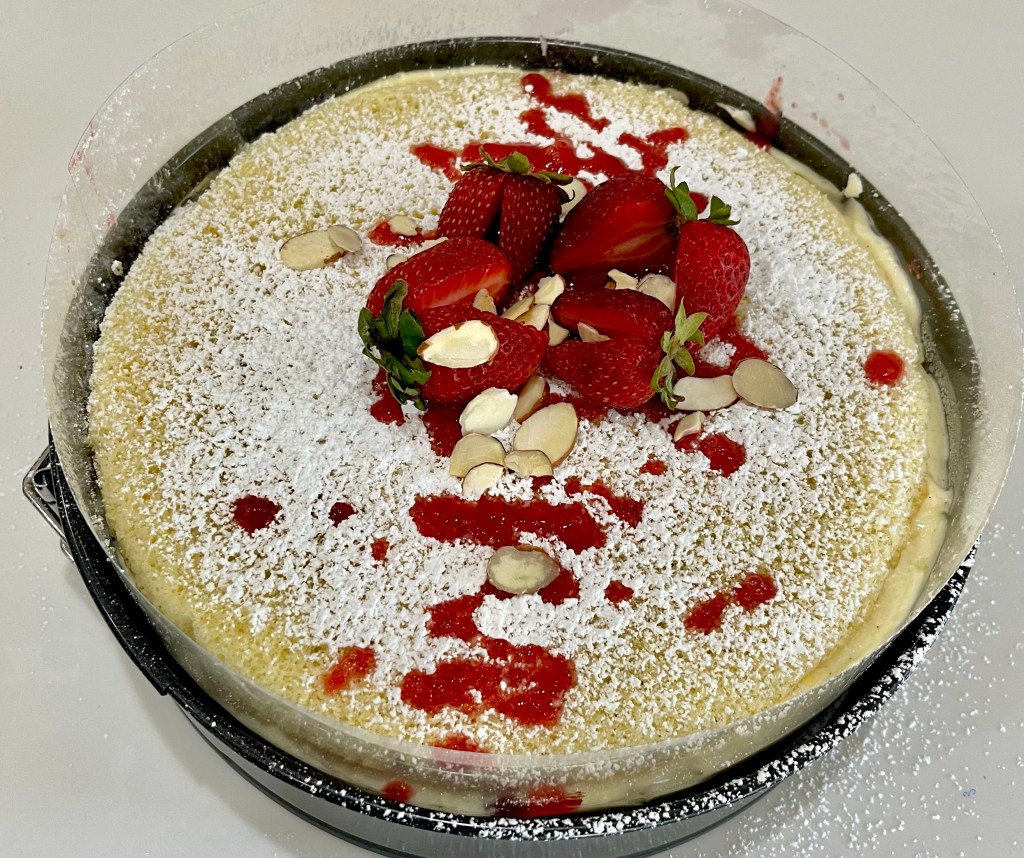
Still in the springform pan.It held together after removing the acetate!And it cut and held its layers well.
Fraisier Cake
INGREDIENTS Genoise Sponge • 4 Eggs • 60 g (1/4 c) Caster Sugar • 100 g (2/3 c) Plain Flour • 20 g (2 ½ Tbl) Cornstarch Strawberry Syrup • 120 g Fresh Strawberries • 118 g (1/2 c) Water • 90 g (6 Tbl) Caster Sugar Crème Diplomat • 500 ml (2 c) Full Cream Milk • 1 tsp Vanilla Paste – or 1 fresh Vanilla Bean • 1 tsp Orange extract – optional • 4 Egg Yolks • 30 g (2 Tbl) Caster Sugar • 35 g (1/4 c) Cornstarch • 1 tsp Agar-Agar Powder • 4 Tbl of water • 250 ml (1 c) Whipping Cream + 1 Tbl cornstarch Cake Filling • 500 g (about 1 pound) Fresh Strawberries – or more to taste • 20 g (1/4 c) Flaked Almonds – optional Cake Toppings • Icing Sugar – to taste • Fresh Strawberries – to taste • Flaked Almonds – to taste • Mint Leaves – to taste
METHOD
Genoise Sponge
Preheat your oven on 160’C/325’F. Line two 8” round springform pans with parchment paper and set aside.
In the bowl of a stand mixer, whisk the eggs and caster sugar on medium/high speed for 5 to 8 minutes, or until very pale, frothy and doubled in size.
Sift the flour and cornstarch over the sugar/eggs and gently fold in with a spatula until it’s all incorporated. Pour over the lined springform pans and gently spread with an offset spatula to level the batter. Weigh each pan/batter to assure they are the same weight and therefore size.
Bake for 10 to 12 minutes or until puffed and golden. Transfer over a cooling rack and leave to cool down completely before releasing the pan and removing the baking paper.
Strawberry Syrup
Blend the strawberries (thawed if using frozen) then place the strawberry puree, water and sugar into a small pot on low to medium heat. Cook for about 5 minutes, occasionally stirring, or until the sugar has dissolved and the liquid has started to slightly thicken.
Sieve the mixture through a fine sieve to remove everything except the liquid.
Set aside to cool.
(NOTE: After coating one side of both genoise sponges return the syrup to the heat and cook until it thickens. Then cool, covered with plastic wrap directly on the syrup.)
Crème Diplomat
Mix agar-agar and water in a small bowl. Microwave for 30 seconds and mix until it is a clear gelatinous liquid. Let cool to the touch, but still warm.
Whisk eggs and milk together and add to all other ingredients (except extracts and agar-agar gel) to a medium saucepan.
Bring to boil whisking constantly
Add the still warm agar-agar gel to the pastry cream
Cook until thickened (it will look lumpy, its ok)
Sieve lumpy mixture into a bowl, add extracts whisk until dissolved and combined. Transfer the pastry cream into a clean bowl or tray, cover with plastic wrap touching the surface and place in the fridge to cool down.
Once the pastry cream has reached room temperature, start whipping the cold cream until you reach stiff peaks.
Whisk the pastry cream to loosen it then gently fold in the whipped cream in 3 or 4 portions. Transfer into a piping bag with large round piping tip (Wilton #A1.)
Assembling the Cake
Pick strawberries that have about the same height to create the edges of the cake. Remove the stems and slice them in half to form a triangle. Cut the rest of the strawberries into small cubes and set aside.
Surround the interior of a 8×2 inch springform pan with an Acetate Strip.
Put the first layer of genoise at the bottom of the ring and brush it with strawberry syrup.
Place the strawberries sliced in half around the edges of the cake, sliced side facing out. Try to place them as tightly against each other as possible.
Pipe the crème diplomat between each strawberry, going as high as the pastry ring. Add about half the of the crème over the genoise and spread with an offset spatula if needed.
Cover the cream with the cubed strawberries and almond flakes (optional). Gently press on them to avoid any large air pockets.
Pipe the rest of the crème diplomat over the cubed strawberries and almonds, going all the way to the edges of the pastry ring (and over the strawberries on the edges).
Brush the second layer of genoise with the strawberry syrup (on one side only) and cover the cream with it, brushed side facing in. Gently press on it to even it out.
Place in the fridge to set for 2 to 3 hours, or overnight.
Cake Toppings
To finish the cake, sprinkle icing sugar over the genoise. Use the thickened and cooled strawberry syrup to drizzle a design on the genoise.
Add some slices of fresh strawberries in the centre of the cake with fresh mint leaves and flaked almonds.
Carefully remove the pastry ring and acetate strip before serving.
Carefully remove the pastry ring and acetate strip before serving.
This past week we bought a baguette at a local supermarket with the intent to have some baguette, Brie and jam snacks. Sadly, we had to replace the first less than acceptable baguette with one from a more “upscale” market. (You get what you pay for.) It was a good move and the snack quality increased substantially. Unfortunately, half of the baguette was lost to being stale the second day.
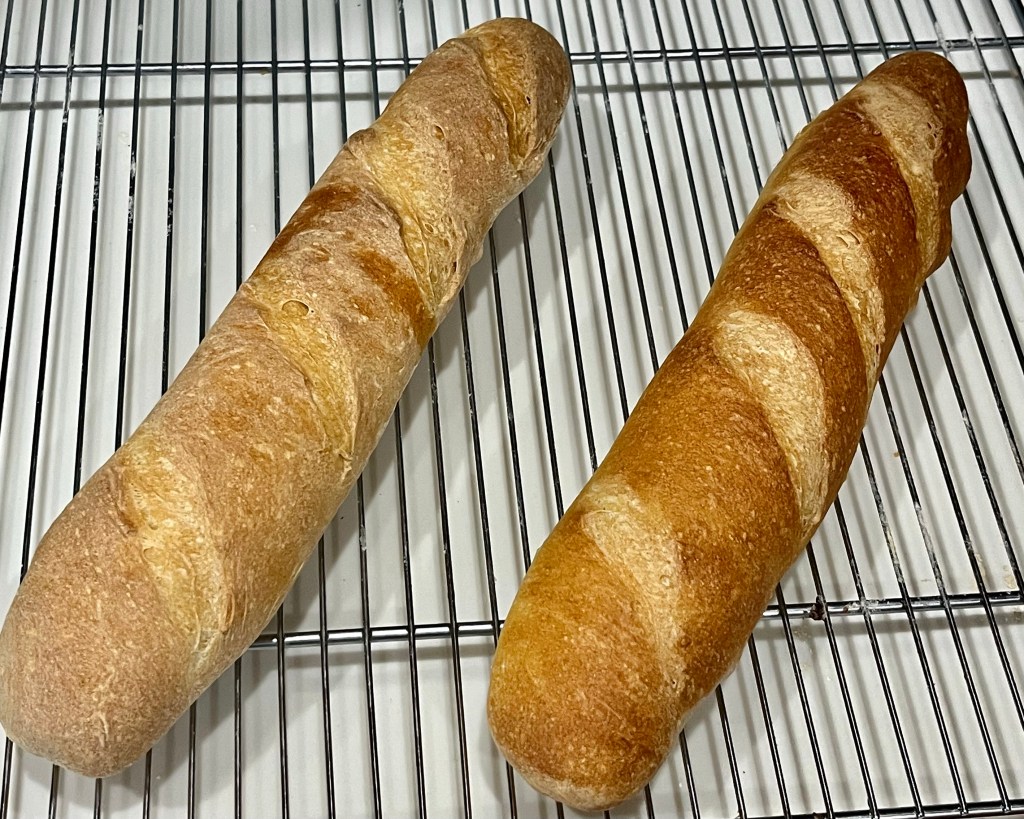
Baguettes before modificationsEgg wash on rightI made some minor modifications to the baguette method. The new method is shown below. Mainly, adding an egg white wash and scoring before proofing is complete.
Today, I made my own baguettes, and in all humility, they were better than either of the store bought. Of course, they were fresh and warm, which never hurts.
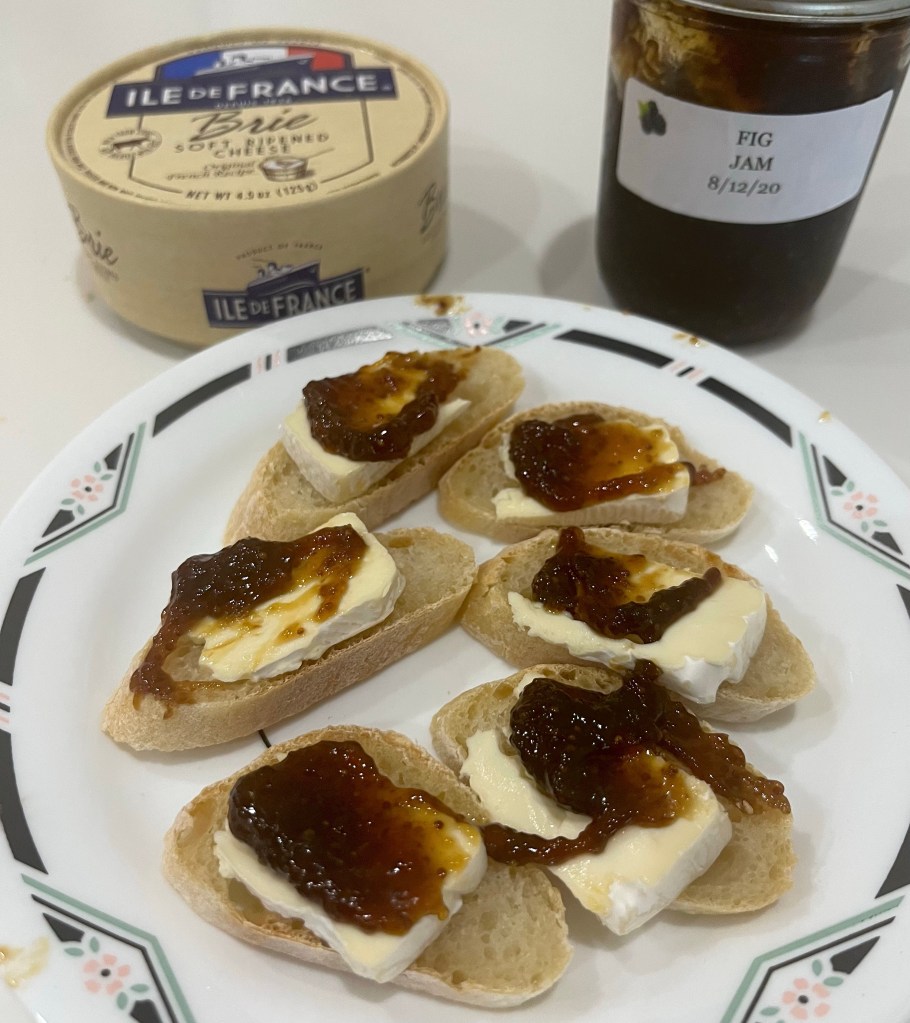
Paired with some home made jam from our fig tree and a fresh wheel of Brie we had a great treat this afternoon. (And perhaps tonight!)
Fig Jam
Makes approx 10 half pint jars
Ingredients • 3 pounds fresh figs (washed, stems removed) (6#) • 2 cups granulated sugar (4 cups) • ½ cup water (1 cup) • 1 (2 Tbl) lemon (juice and finely grated zest) (4 Tbl)
METHOD
In a large, heavy-bottomed saucepan, combine the figs, sugar, water,lemon juice, and lemon zest.
Bring to a simmer over medium-low heat, stirring constantly. Cover and simmer over low heat for 1 hour, stirring occasionally.
Remove the cover, attach a candy thermometer to the side of the pan making sure the bottom of the thermometer doesn’t touch the pan’s bottom, and continue simmering, stirring frequently, until the mixture thickens. When the mixture gets quite thick, begin to stir constantly to keep from scorching.
Cook to 220 F and remove from the heat. Or, test a small amount on a very cold saucer by putting the saucer in the freezer for a few minutes, put a little of the fig mixture on it, then returning it to the freezer for 1 minute. When a good gel stage is reached (220 F), the surface of the fruit mixture will wrinkle slightly when pushed with a finger.
While figs are cooking, prepare the jars and lids. Put the glass jars in a boiling water canner about half-filled with water. Bring to a boil, reduce heat, and keep jars in the water.
Put water in a separate saucepan, bring to a simmer, reduce heat to low, and add the jar lids. Keep in the hot water until ready to use. Do not boil.
Fill the jars with the hot fig jam mixture, leaving 1/2-inch headspace. Wipe jar rims and threads with a wet paper towel. Place lids on jars using tongs or a jar magnet then screw on the rings.
Place on a rack in the hot water in the canner. Lower into the water and add enough hot or boiling water to bring the water level to 1 to 2 inches above the jars. Bring jars to a boil for 10 minutes.
Using canning tongs, remove the jars to a clean towel on a flat work surface. Listen for the popping sound which indicates a good seal and tighten the rings.
Baguettes
INGREDIENTS
Starter (poolish) • 1/2 cup (113g) cool water • 1/16 teaspoon active dry yeast or instant yeast • 1 cup (120g) AP Flour Dough • 1 1/2 teaspoons active dry yeast or instant yeast • 1 cup + 2 tablespoons (255g) lukewarm water • all of the starter • 3 1/2 cups (418g) AP flour • 2 teaspoons salt Egg wash • 1 egg white • 1 Tbl water • Pinch of salt
METHOD
To make the starter: Mix everything together to make a soft dough. Cover and let rest at room temperature for about 14 hours, overnight works well. The starter should have expanded and become bubbly.
To make the dough: Mix and knead everything (including the poolish) together for about 4 minutes on medium-low speed (speed 2 on a KitchenAid); the finished dough should stick a bit at the bottom of the bowl.
Place the dough in a lightly greased medium-sized bowl, cover the bowl, and let the dough rest and rise for 45 minutes. Gently deflate the dough and fold its edges into the center, then turn it over in the bowl before letting it rise for an additional 45 minutes, until it’s noticeably puffy.
Turn the dough out onto a lightly greased work surface. Gently deflate it and divide into three equal pieces. (They should be about 310g each.)
Round each piece of dough into a rough ball by pulling the edges into the center. Cover with greased plastic wrap and let rest for 15 minutes; or for up to 1 hour, if that works better with your schedule.
Working with one piece at a time, flatten the dough slightly then fold it nearly (but not quite) in half, sealing the edges with the heel of your hand. Turn the dough around, and repeat: fold, then flatten. Repeat this whole process again; the dough should have started to elongate itself.
With the seam side down, cup your fingers and gently roll the dough into a 16″ log. Your goal is a 15″ baguette, so 16″ allows for the slight shrinkage you’ll see once you’re done rolling. Taper each end of the log slightly to create the baguette’s typical “pointy” end.
Place the logs seam-side down onto a lightly greased or parchment-lined sheet pan or pans; or into the folds of a heavily floured cotton dish towel (or couche). Cover them with lightly greased plastic wrap and allow the loaves to rise until they’re slightly puffy. The loaves should certainly look lighter and less dense than when you first shaped them but won’t be anywhere near doubled in bulk. After 20 minutes egg wash the loaves (if doing this)
Using a baker’s lame (a special curved blade) or a very sharp knife held at about a 45° angle, make three to five long lengthwise slashes in each baguette, re-cover and let continue proofing for another 12 minutes or until the oven reaches temperature.
At this time, preheat your oven to 450°F with a cast iron pan on the floor of the oven, or on the lowest rack. If you’re using a baking stone, place it on a middle rack. Start to heat 1 1/2 cups water to boiling. When the over temperature is above 300F add the water to the pan.
If your baguettes have risen in a dish towel or couche, gently roll them (seam side down) onto a lightly greased (or parchment-lined) baking sheet. If you plan on baking them on a baking stone, roll them onto a piece of parchment, and lift the parchment onto a baker’s peel.
Load the baguettes into the oven. If you’re baking on a stone, use a baker’s peel to transfer the baguettes, parchment and all, onto the hot stone. Carefully spray the inside of the oven with water. The billowing steam created by the boiling water and sprat will help the baguettes rise, and give them a lovely, shiny crust.
Bake the baguettes — on the pan, or on a stone — for 24 to 28 minutes, or until they’re a very deep golden brown. Remove them from the oven and cool them on a rack. Or, for the very crispiest baguettes, turn off the oven, crack it open about 2″, and allow the baguettes to cool completely in the oven, until both baguettes and oven are at room temperature.
Store any leftover baguettes in a paper bag overnight; freeze for longer storage. Thaw and reheat just before serving.
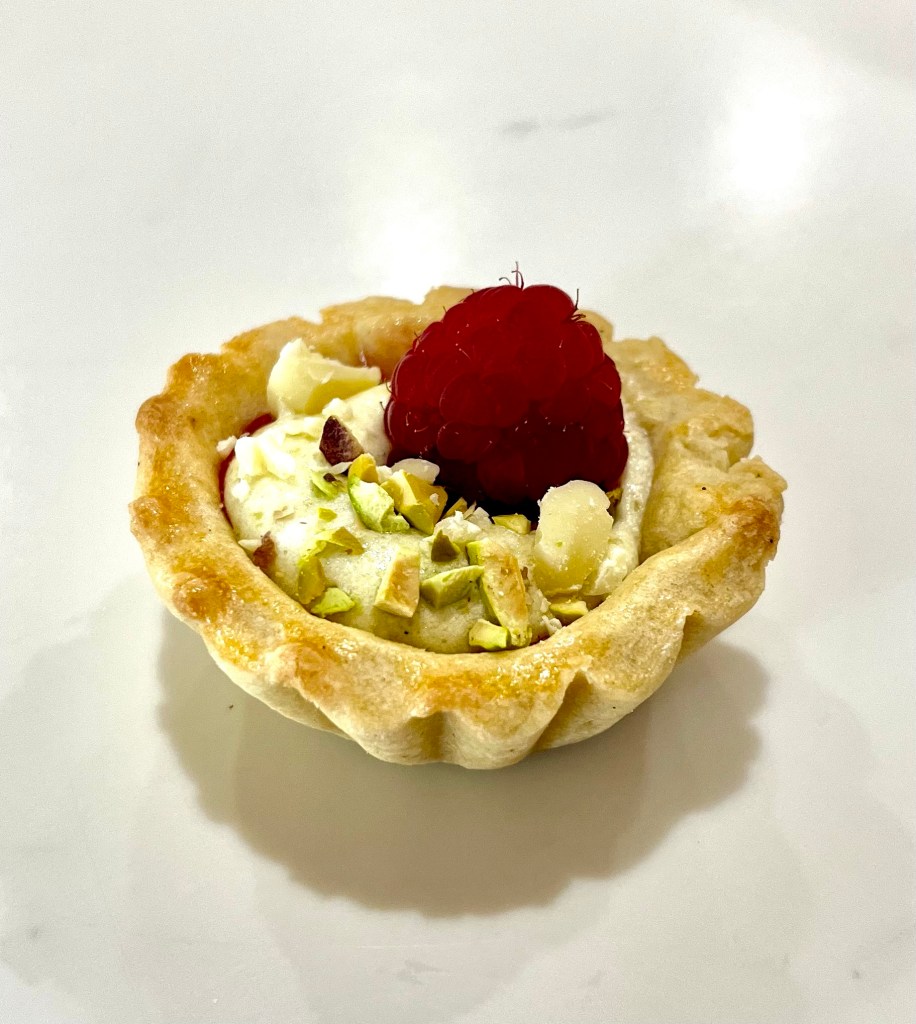
I made a slightly larger version of these tartlets a couple of weeks ago. In that version, I combined crème patisserie and buttercream to make the filling. This time I combined the same crèmepat with Italian meringue to create a creme chiboust for a lighter filling. Unfortunately, it didn’t set as well. They looked great and tasted even better but the texture of the filling was off.
I see three options here: first go back to the buttercream version, or use less than the recommended Italian meringue in an attempt to keep the creme chiboust firmer OR use agar agar to set the crèmepat firmer. (I never use gelatin in baking.)
Stay tuned, I have 5 hours to make a decision. (That’s when the second 4th of July party begins.
Raspberry Pistachio Chiboust Tartlets
INGREDIENTS Crust: • 2 cups all-purpose unbleached flour, plus extra for dusting • 3 tablespoon sugar • ½ teaspoon baking powder • ¼ teaspoon salt • ¾ cup (1½ sticks) unsalted butter, cold and cut into cubes • 1 egg, separated • 2 tablespoon cold water • 1-2 tablespoon heavy cream • ½ cup seedless raspberry jam Crème Patisserie: • 240 mL full-fat milk 1 c • ¼ tsp sea salt • 25 g sugar ~ 2 generous Tbl • 4 egg yolks from large eggs (save the egg whites from these eggs for the meringue) • 30 g cornstarch – 4 Tbl • 1.5 tsp vanilla extract • 30 g butter 2 Tbl • 3 tablespoon pistachio oil • 1-2 drops green food coloring (optional) Italian meringue: • 4 egg whites at room temperature • 150 g white sugar – ¾ cup • 80 g water – ⅓ cup Garnish: • fresh raspberries • chopped white chocolate • chopped pistachios
METHOD
Crème Patisserie
Whisk eggs and milk together then add to all other ingredients (except vanilla) to a medium saucepan.
Bring to a gentle boil, whisking constantly
Cook until it slightly thickens (it will look lumpy, its ok)
Sieve lumpy mixture into a bowl and add vanilla, and pistachio oil and green food coloring (if using) mix thoroughly
When incorporated, cover with plastic directly on the crème patisserie and cool about an hour.
Crust
In a large bowl, combine the flour, sugar, baking powder, and salt.
Using a pastry blender, cut in the butter until it resembles coarse sand.
Make a well in the middle of the pastry and pour in the ice water and egg yolk {save the white for later}; work it in with your hands until no longer overly wet and sticky. If the dough is overly crumbly, add in the heavy cream a little at a time until the pastry is relatively pliable and no longer floury.
Pat into a circle, wrap in plastic wrap, and refrigerate for about 30 minutes.
Lightly flour a clean work surface and use a rolling pin to roll out a large rectangle with the dough. Divide the dough evenly among 6 tartlet pans {you can also use one large tart pan}, pressing down the bottom and up the sides. Prick the bottoms with a fork, then top with a piece of foil. Fill the crust with pie weights or dry beans. Place in fridge for another 10 minutes.
Preheat the oven to 350F.
Bake tartlets for 15 minutes. Remove foil and weights, spoon 1-2 tablespoon of jam in the bottom of each and brush the sides of the crust with the reserved egg white. Bake for 10-12 more minutes, until lightly golden but not brown. Set aside to cool.
Italian meringue
In a medium-sized saucepan, combine the sugar and water. Heat over low heat, stirring until the sugar has dissolved. Once the sugar has dissolved, turn the heat to medium-high and allow the syrup to come to a boil without stirring.
In the meantime, add the egg whites to a medium-sized, heatproof bowl and mix (with a mixer fitted with the whisk attachment) until foamy and the whites are almost able to hold soft peaks.
Once the syrup is boiling, clip on a candy (or sugar) thermometer.
Cook until the syrup reaches 116°C/240°F, then take the pan off the heat and slowly drizzle the hot syrup into the bowl with the foamy egg whites, mixing continuously. Don’t pour the syrup onto the whisk, or the syrup may splatter against the sides of the bowl (or into your face!). Instead, aim for a spot close to the whisk.
Once all the syrup has been added, keep mixing until the bottom of the bowl feels cool to the touch and the meringue has cooled down to body temperature.
Assembly
When ready to assemble, take the pastry cream from the fridge. Whisk until smooth and creamy, then add 1/3 of the meringue and fold gently. Add another 1/3 and again fold then add the remainder and gently fold until all the white meringue is incorporated.
Pipe the cream evenly among the prepared tartlets, then refrigerate at least 2-3 hrs but optimally overnight.
Just before serving, top tarts with raspberries, white chocolate, and pistachios. Serve chilled!









 aBatteredOldSuitcase