Grease! No, Actually Greece…Bread

So, I recently forgot about Greek bread but rectified the omission today. I made Greek Country Bread. This is a whole grain bread made with a shorter than usual knead but pretty standard fermentation and proof.

In rural Greece bakers were limited to the grains available to mill into flour. The whole grain flour used here gives the loaf a rustic appearance and more earthy taste. If you don’t have whole wheat flour handy, you can use most any grain, think barley or semolina.

Coating the top of the loaf with water before baking and after 30 minutes yields a beautiful, crunchy crust and the whole wheat flour provides a wonderful crumb and flavor.

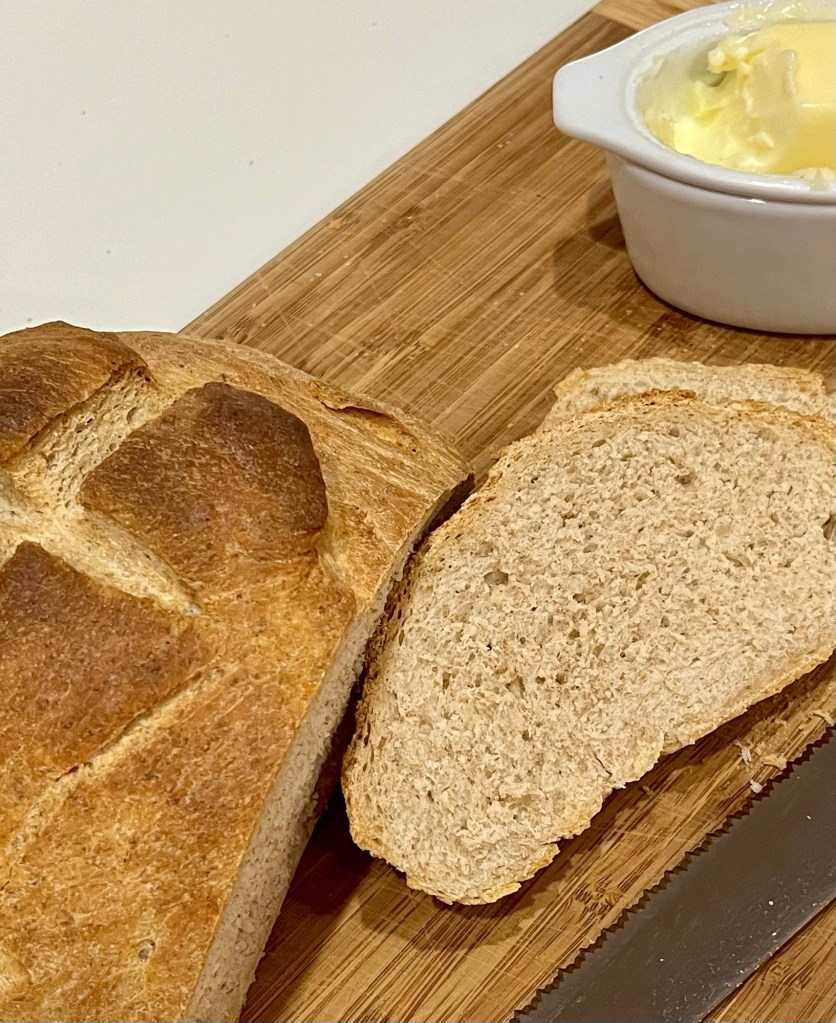
Greek Country Bread (Whole Grain) Recipe

INGREDIENTS
• 2 ¼ tsp active dry yeast
• 1 tsp sugar
• 1 c whole wheat flour
• 1 c warm water (~100⁰ F)
• 2 c unbleached all-purpose flour
• 1 ½ tsp salt
• 2 Tbl olive oil, plus extra for the baking sheets
• Extra all-purpose flour for your hands and the work surface

METHOD

  1. Add the yeast, sugar, ¼ cup of the whole wheat flour, and the water to a small bowl and mix together well using a whisk. Leave the mixture uncovered and set it aside in a warm place until it has a spongy appearance. You can let the mixture sit for up to 1 ½ hours, depending on how sour you want the dough to taste.
  2. Add the all-purpose flour, salt, and the rest of the whole wheat flour to a large bowl and whisk well with a clean, dry whisk. Pour the yeast mixture on top of the dry ingredients and stir well with a wooden spoon. When the dough starts to come together, knead the dough for 5 minutes, continuing to add small amounts of all-purpose flour until the dough is smooth and no longer sticky.
  3. Wipe the large bowl clean and coat it with oil. Place the dough in bowl and flip it over to coat top of the dough with oil. Cover the pan with plastic wrap or a large, clean towel and set aside in a warm place until the dough doubles in size, ~ 2 ½ hours.
  4. Punch down the dough after it rises and lightly flour the work surface once again. Knead for about 2 minutes, or until the dough is elastic. Spray a baking sheet with nonstick cooking spray. Form the dough into a round loaf shape and place on the baking sheet. Coat the top of the loaf with more olive oil. Set the baking sheet aside until the loaf doubles in size.
  5. Slice the top of the loaf with a lame or sharp knife.
  6. When the loaf is ready to bake, preheat the oven to 400⁰ F. Brush the top of the loaf with water and place the baking sheet in the center of the oven and bake for 30 minutes. Remove the loaf from the oven and brush it again with water. Place the loaf back in the oven and cook for an additional 15 minutes. You’ll know the loaf is done because when you knock on it with your knuckles, it will sound hollow. Remove the loaf from the oven and let it cool on the counter for at least 5 minutes before cutting into it.

Bolas de Mafra Rolls – Portugal

The Pão de Mafra has a soft and fluffy interior and a crispy crust. Proper baking requires specific times of kneading and baking. This will provide the honeycomb structure and a crunchy, golden crust. (Full disclosure: this attempt did not have a fluffy interior, but a great flavor and nice crust.)

To be “true” Mafra bread it should be made with wild yeast native to the Mafra region of Portugal and traditionally the flour is artisanal ground, which really means it was processed locally by whatever means were available in Mafra (west central Portugal.)

This is a very high hydration (~78%) bread. It is supposed to have a short knead and rise. This results in a very slack dough, even after rising, portioning and resting. I tried to just wet my hand and form the dough into boules. It was just too wet and wouldn’t form a ball. I ended up dusting my work surface with some extra flour and dusted the tops of each boule. I was able to tension the rolls to provide some shape.

Next time I may do a stretch and fold rather than standard kneading. I doubt any Portuguese will be critiquing them anyway.

Bolas de Mafra Rolls – Portugal

INGREDIENTS
Starter
4 g (½ tsp) active dry yeast
37 g water
63 g bread flour

Mafra bread dough
400 g water
100 g starter
500 g bread flour
1 Tbl salt
7 g (2 ¼ tsp) active dry yeast

METHOD
Starter

  1. Mix 37 g of ~100º F water and ½ tsp of yeast and let rest for 10 min.
  2. Then add 63 g of flour and mix
  3. Cover with a clean and damp cloth and let it rest until it doubles in size.
    Mafra bread dough
  4. Mix 100 g water at ~100º F and 20 g yeast and rest for 10 min.
  5. Mix in 100 g of flour until well combined
  6. Add the remaining 400 g flour, the starter, salt and water.
  7. Knead with a dough hook for 8 minutes in a stand mixer
  8. Transfer the dough to a large lightly oiled bowl and let it rise for about 1 hour or until doubled.
  9. Preheat the oven to 400º F
  10. Shape the dough into a boule or ball and let it rest for another 15 minutes (I like to mold in the ball shape).
  11. Bake for 30 – 45 minutes until the internal temperature reaches 200º F.

Zopf – Sounds Like a SciFi Characters Name

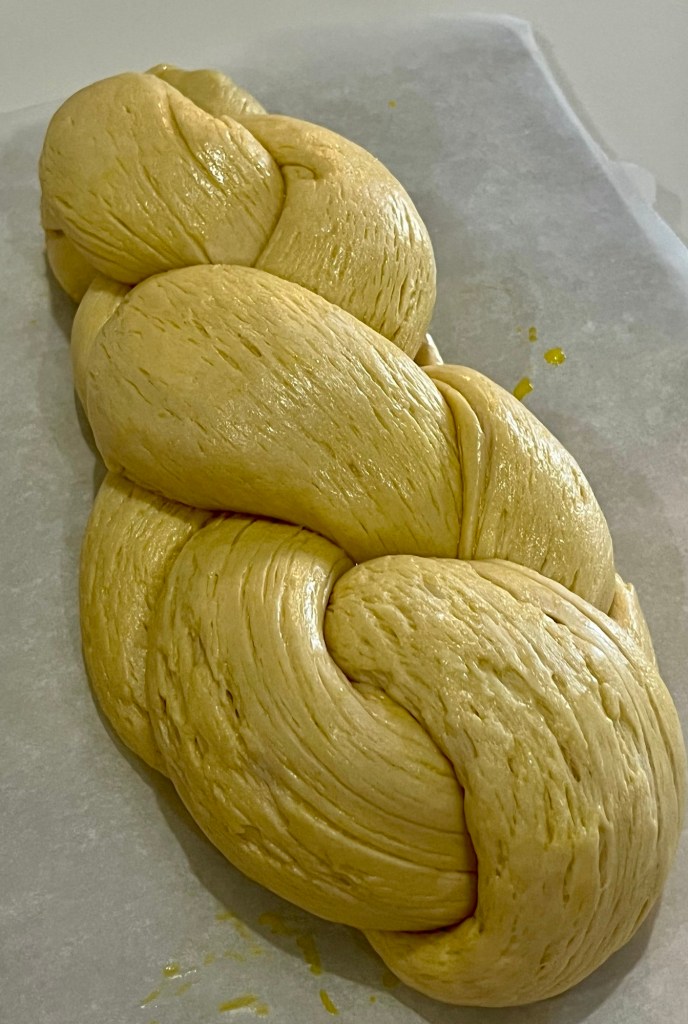
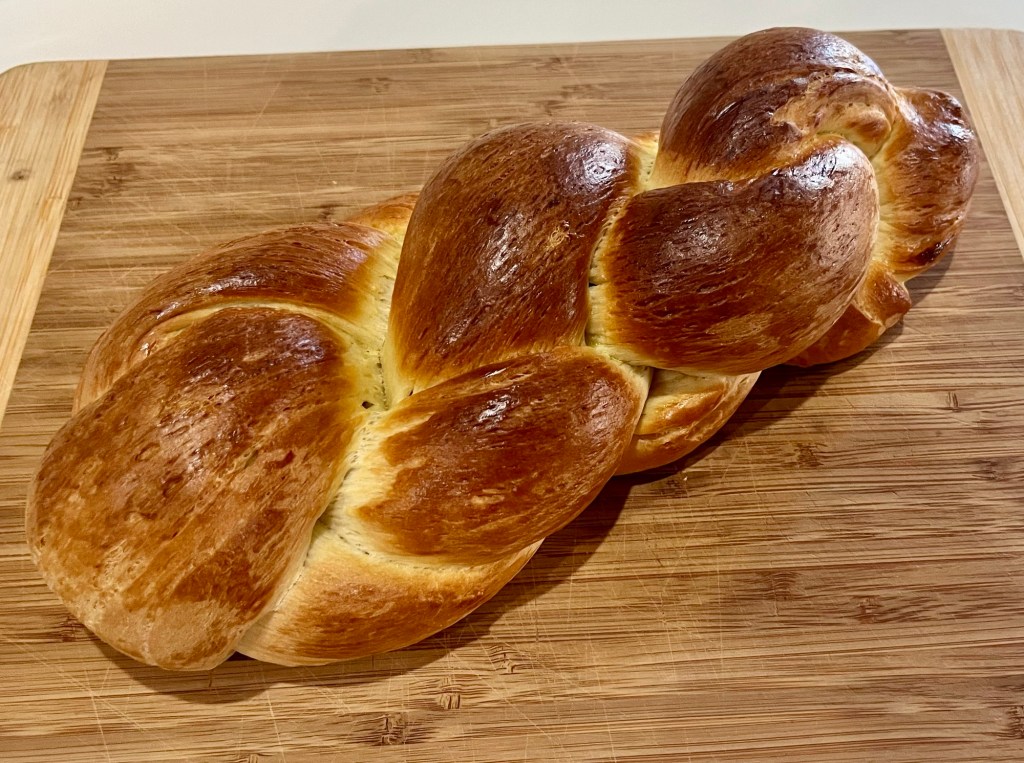
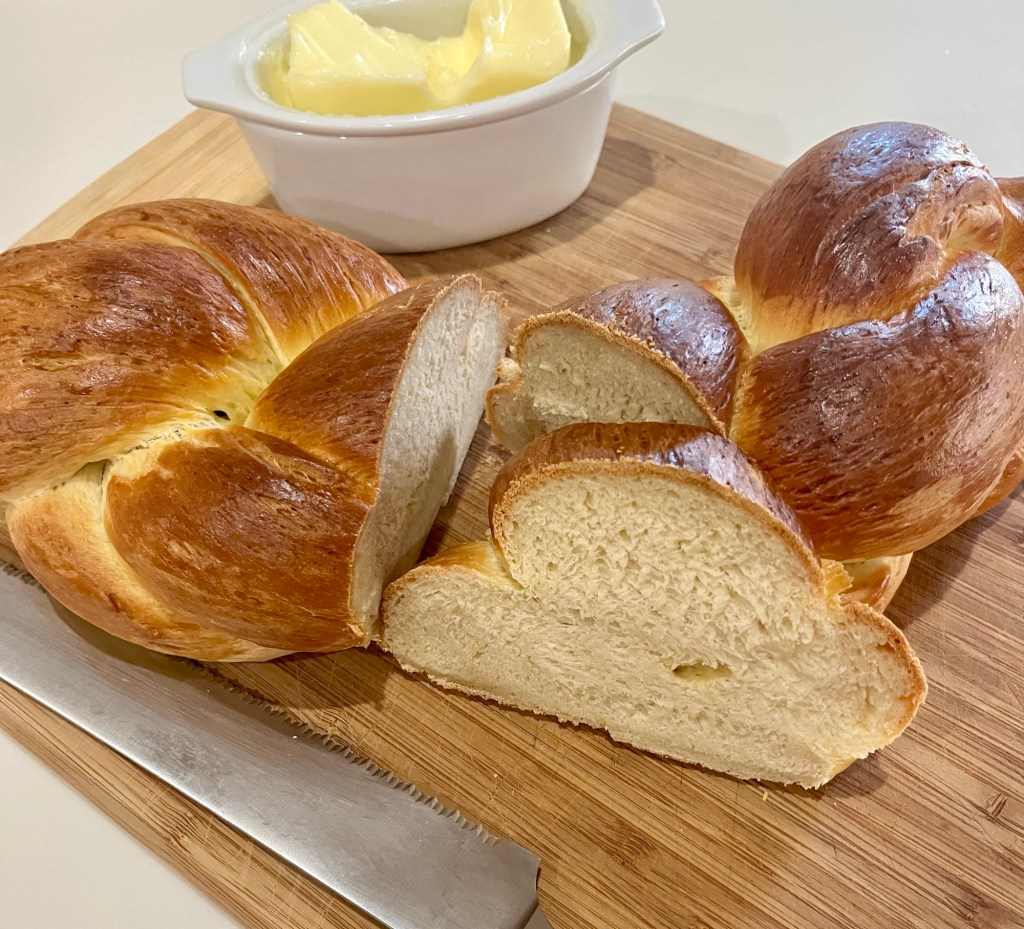
Well, the bread journey ends soon. Today is what is reportedly the most popular bread in Switzerland, Zopf . This is an enriched braided dough which is fairly easy to make and is delicious.

Irish Soda Bread remains to be baked.

Zopf – Swiss Loaf

INGREDIENTS
• 560g (4 c) bread flour
• 1 1/2 tsp salt
• 2 ¼ tsp dry yeast (1 packet)
• 1 tsp sugar
• 72g (5 Tbl) melted butter
• 1 c + 2 Tbl milk (more or less)
• 1 egg yolk mixed with 1 Tbsp milk or water to brush on the dough

METHOD

  1. Melt the butter and add milk. Mixture should be lukewarm, ~100
  2. Add yeast and sugar, stir to dissolve
  3. Add flour and salt to a mixer with a bread hook, start the mixer and add most of the milk, mix on low speed for 10-15 minutes. If necessary, add more milk to make it a smooth dough
  4. Cover the bowl with plastic and let it rise for 1-2 hours at room temp.
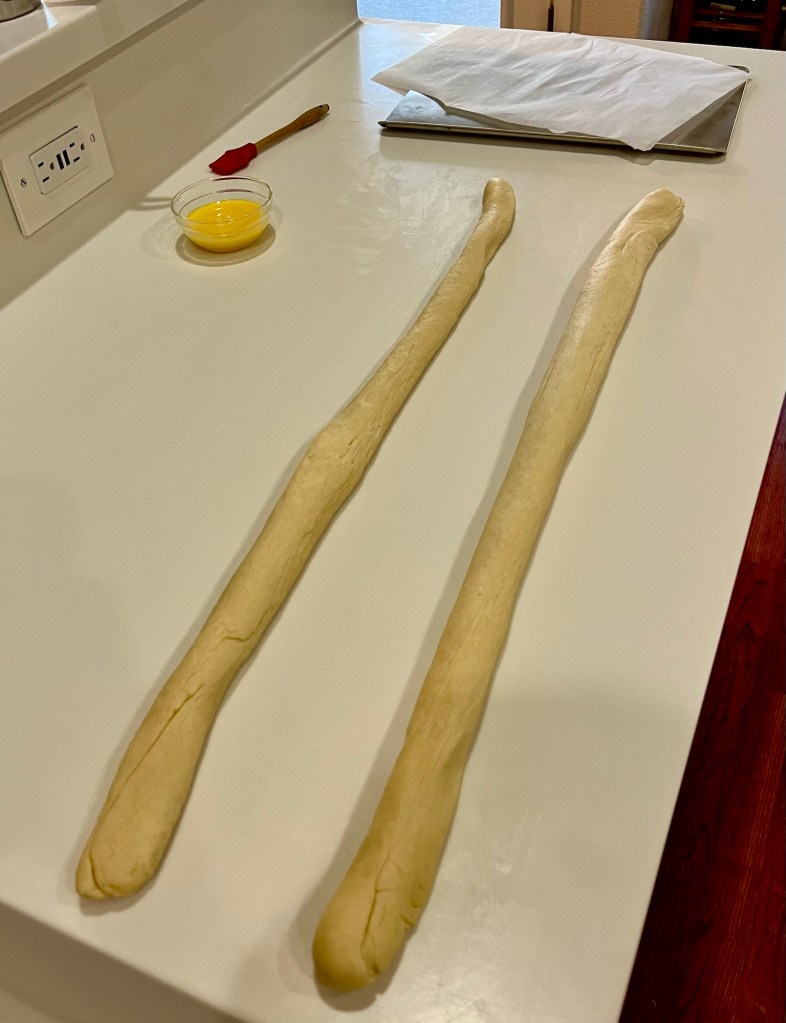
  5. Cut the dough in half, roll into about 2 ft long lengths and braid (you can braid it anyway you like, but Helvetic Kitchen braiding Zoph has an easy video showing a traditional Zopf braid). Roll each portion out to thin roles. The gluten is tight and the ropes will shrink back and fight you, Don’t worry. Rest another 15 minutes (covered) and try again. If they still will not roll out thin and long rest them again to relax the gluten. Keep them covered so they don’t dry.
  6. Place on a baking sheet with baking paper so it won’t stick.
  7. Thin down one beaten egg yolk with a little milk or water and brush it liberally over the dough. (Thinning with milk results in a darker brown crust.)
  8. At this point, you can wrap it and keep it overnight in the fridge. It will rise some, but slowly, and you’ll need to let it warm up to room temperature for an hour or more before baking.
  9. Set oven to 400°F, let the braided loaf rise for 20-30 minutes
  10. Bake about 30 minutes until deep golden brown.

Buchteln Sweet Austrian Yeast Rolls

Well, I should have put quotes around “Austrian” because they are not authentic sweet rolls. I used gluten free flour and apple compute in the first batch and AP flour and fresh made raspberry jelly in the second batch. What can I say, I didn’t have any apricot filling.

The texture of the apple filled resembled a biscuit more than bread, but a friend whose mother is Austrian said they were very close (except it should be filled with apricot jam.) The raspberry filed Buchteln were delicious, tender and above all, had raspberry in them.

Buchteln – Sweet Austrian Yeast Buns

Yield: 12 Buchteln

INGREDIENTS
• 150 ml (½ c plus 2 Tbl) warm milk
• 5 g (1 ½ tsp g) active dry yeast
• 40 g (3 Tbl) sugar
• 1 large egg
• 77 g (5 ½ Tbl) melted butter
• ½ tsp vanilla extract
• ¼ tsp salt
• 325 g (about 2 ½ c) all-purpose flour
Filling
• About 5 Tbl apple compote with fine texture (no chunks)
• 3 Tbl melted butter for the pan
• Confectioners sugar for dusting

METHOD

  1. In a large mixing bowl sprinkle the yeast over the warm milk and set it aside for 10 minutes for the yeast to dissolve and activate.
  2. Stir in sugar, egg, melted (lightly cooled) butter, vanilla and salt with a hand whisk.
  3. Stir in about 1 ½ cups (200 g) of the flour to get a thick batter and stir vigorously with the whisk until no lumps remain. Time to change your tools: Get rid of the whisk and use a sturdy (wooden) cooking spoon to gradually stir in the rest of the flour.
  4. When all ingredients come together bowl fold the edges into the center for a couple of minutes. The dough will be sticky but refrain from adding more flour. It helps if you oil your clean hands before you knead a sticky dough. Knead until smooth, about 5 minutes.
  5. Let the dough rise, covered at warm room temperature until doubled in volume (about 3/4 to 1 hour).
  6. Transfer the dough onto a lightly floured surface and divide it into 10-12 60 g portions. Keep pieces you don’t need right away covered.
  7. Fold the edges of each piece into the middle a couple of times so you will get a nice ball with a smooth surface on the bottom side. Flatten each ball with your palm to a circle with a diameter of 3 to 3 ½ inch, keeping the center slightly thicker than the edges. Usually this part works without using any additional flour. If the dough keeps sticking to your countertop, add some.
  8. Put 1/2 teaspoon of filling (not more) in the center of every circle. Wrap the dough around the filling, pinching and sealing it tightly. Round the buns again, creating a bit of surface tension. If you use too much filling, it’s difficult to seal them. Also avoid getting filling onto your edges, because this way it is almost impossible to seal them.
  9. Put every Buchtel (singular of Buchteln) with the sealed side down onto a lightly floured surface until you have finished filling all of them.
  10. Brush a baking pan (I used a round 9-inch ceramic pan) with melted butter, just until coated.
  11. Place the Buchteln in your baking pan. You can do this tightly packed (traditional way) or give them a little, but not too much space. They will still rise during the second proofing and baking. If you feel there are too many of them, you can place the remaining in a lined muffin tin.
  12. Let them proof a second time for about 20-30 minutes at warm room temperature until puffy. It is best to cover the whole pan with a lid or cling wrap in this step. If you have a rather shallow pan, don’t cover the Buchteln, since they will stick to the plastic wrap. Brush with melted butter.
  13. Bake them at 375 °F/ 190 °C in the preheated oven (center) for about 25 minutes (minimum 20 minutes). When they are golden-brown in color, take them out of the oven.
  14. Let the Buchteln cool for 5-10 minutes and serve them dusted with confectioner’s sugar. Enjoy!

Mafalda Sicilian Bread

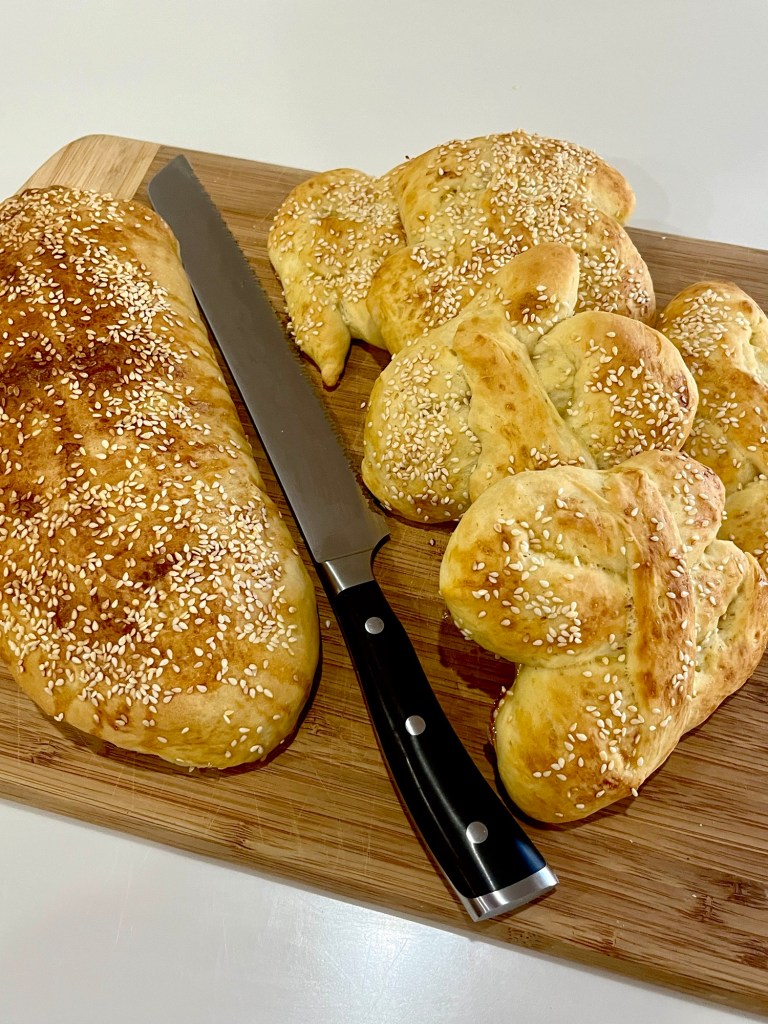
Continuing my European Bread Journey today’s selection s Mafalda, a popular bread in Sicily.

This bread uses semolina flour which is made from ground durum wheat. It’s high protein and fiber and makes a denser texture than bread or AP flour. It is a nice crumb and good firm texture and excellent flavor.

On my first attempt I added more water during the mixing/kneading to help the dough come together. This resulted in a very slack risen dough that was difficult to shape. Next time I will use the amount noted in the recipe, otherwise the plan was executed perfectly .

Mafalda Sicilian Sandwich Bread

INGREDIENTS
• 500 g re-milled durum wheat semolina flour (I use Mulino Caputo)
• 2 ¼ tsp (7 g) dry instant yeast (If baking the next day use 1 ¼ tsp instead of 2 tsp)
• 35 g (30 ml) extra virgin olive oil
• 15 g salt
• 7 g (1 tsp) honey
• 1 ¼ c (300 ml) room temperature water (1st try I used 350 ml and the dough was too slack)
• 1 egg yolk + 1 Tbl milk well mixed for wash
• Sesame seeds

METHOD

  1. Mix oil and honey and set aside
  2. In the bowl of a stand mixer, mix the sifted flour and yeast.
  3. Add the water and mix well, then add oil and honey. Use the paddle in these first steps of mixing.
  4. When it is all combined (3 mins), add salt and mix to incorporate it.
  5. Cover the bowl with a kitchen towel and leave it for 15/20 mins to give the flour the time to hydrate.
  6. Switch to the hook attachment and knead the dough at medium-low speed (Kitchen Aid is speed 2), until smooth, ~5-8 mins. (The dough should weigh ~875 g)
  7. At this point, the Mafalda dough can be refrigerated and baked the next day after. (Be sure the bowl is well oiled and tightly covered.
  8. Put the dough in a well-oiled bowl, flip over to coat the dough with oil and cover tightly, and let the Mafalda bread rise until it doubles (~ 1 hour).
  9. After the first rise, punch down the dough, cut it into 8-9 pieces of 100 g each.
  10. Roll each piece out to Form one piece into a boule to make a small sandwich loaf, or two sandwich buns.
  11. Shape into the classic Mafalda shape (a 2 humped snake and fold the “tail” back on top and pressed into the far side, again like a pretzel.) Place well separated on a parchment paper line baking sheet.
  12. Cover the buns with oiled cling wrap and let rise a second time in a warm place like in the oven turned off with the light on. My kitchen was 76⁰ F and the dough required 60 min to double in size,
  13. Egg wash the rolls and sprinkle with sesame seeds.
  14. Place a pan suitable for steaming on the bottom of the oven then pre-heat the oven to 400⁰F, and when hot, add one cup of boiling water to the steam pan and bake small buns for 15-20 mins, a bigger loaf 30-40 mins.
  15. Halfway through cooking time, rotate the pan, and if your bread is still pale (which may happen with a gas oven), switch to convection mode for the rest of the baking time for a nice golden-brown color. Watch closely; it might color too quickly.

Glasnost, Nyet. Glass Bread

Pan de Cristal is an open structure, high hydration, crispy-crust bread from the Catalonian region (Barcelona) of Spain. The great crust and soft chewy interior make it perfect for dipping in oil and vinegar or coating with some good butter.

For those who are not “breadies,” high hydration bread is not for the faint of heart. The entire bake will require about 6 1/2 hours start to finish. Most of the time is resting the dough, but the day is broken up with bowl and coil folds every 20 minutes.

I like to start 2 timers at the beginning. One for 20 minutes and I restart that after every fold. The other is for 3 hours so I don’t need to keep track of all the subsequent folds, just coil fold every 20 minutes until the second timer rings.

Pan de Cristal

INGREDIENTS
• 500g water (80 F in warm weather, 100F if cold)
• 500g Bread Flour
• 3 g (1 tsp) instant yeast
• 10g salt
• 15g olive oil (for the casserole pan)

METHOD
Below is KAB’s method, slightly modified.

  1. To make the dough: Weigh your flour.
  2. In a medium bowl, mix the water, flour, yeast, and salt until thoroughly combined and homogenous. Note: The dough starts off very slack and wet and resembles pancake batter. It will transform itself through time and folds.
  3. Oil a two-quart rectangular baking dish, or casserole pan, (10” x 7”) with the olive oil. The sides should be greater than 1.5” high.
  4. Pour the dough into the pan. Check the dough’s temperature by inserting a digital thermometer into the center. If it’s less than 72°F, move the pan to a warmer spot, e.g., your oven with the light turned on. The dough MUST ferment at a constant 72-78 F.
  5. Cover the pan and allow the dough to rest for 20 minutes.
  6. Start with a bowl fold: Use your wet hands to grab a section of dough from one side, lift it up, then press it down into the middle. Repeat 8 to 12 times going around the periphery of the baking dish 2 or 3 times.
  7. Cover the dish and allow the dough to rest for 20 minutes.
  8. Next do a coil fold: With wet hands, reach under the dough and stretch the middle upward until the dough releases from the dish. Roll it forward off your hands, allowing it to fold over (or “coil”) on itself. Rotate the dish 90 degrees (a quarter turn) and repeat. Continue performing this folding action until the dough will stretch and elongate easily, usually four to five times initially.
  9. Cover the pan and allow the dough to rest for 20 minutes.
  10. Repeat the coil fold: Note: Do coil folds three more times, covering each time, to build strength and developing the dough. (60 more minutes.)
  11. At this point, the dough should be easier to handle and feel tighter. Repeat the coil fold using only two or three folds this time. Cover the bowl and allow the dough to rest for 20 minutes.
  12. Repeat the coil fold one last time, using only one or two folds if the dough is relatively strong and large bubbles should have formed. Transfer the dough to a larger, oil coated dish, cover the dish and allow the dough to rest for about 80 minutes. It should about triple in size. After this rest 4 hours should have elapsed.
  13. Divide the dough: Coat the top of the dough with flour. Use a bowl scraper to gently release the dough from the sides of the pan.
  14. As gently as possible, turn the dough out onto a heavily floured surface, keeping the rectangle or square shape – be careful not to deflate the delicate dough. Sprinkle a generous amount of flour on top of the dough, leaving no exposed sticky spots.
    a. For four small loaves: Working as gently as possible, use a bench knife or other sharp knife to divide it into four pieces. Gently place two pieces on a piece of parchment, leaving space between them.
    b. For two long loaves: lay two pieces of parchment paper, overlapping 2”. Carefully divide the dough in half lengthwise. Using a bench knife carefully slide some flour under each loaf and shape into regular rectangles. As gently as possible slide the loaves onto separate pieces of parchment paper.
  15. Allow the loaves to rest at room temperature for 2 hours, uncovered until large bubbles appear on the sides and surface. The dough flattened out while proofing for 2 hours. Try a shorter time and watch for bubbles. While the loaves are resting, preheat the oven to 475°F with a baking stone on a lower rack. The loaves are ready for the oven when there are a few large bubbles on the surface of each loaf, and they feel light and airy.
  16. To bake the bread: Carefully slide the two loaves (still resting on the parchment) into the oven onto the preheated stone or steel. If space is tight and the full sheet of parchment won’t fit on the stone or steel, cut the parchment between the two loaves and arrange them as best you can. Allow the other two loaves to continue to rest.
  17. Bake the loaves for 15 minutes, then transfer them, from the stone or steel, directly onto a rack in the upper third of the oven for an additional 13 to 15 minutes. Moving them allows the baking stone or steel to become hot again in preparation for the next two loaves. After a total of 30 minutes of baking, remove the loaves from the oven and allow them to cool on a rack.
  18. Repeat the process with the two remaining loaves or loaf. Cool the bread fully before slicing.
  19. Storage information: Wrap the bread loosely and store it at room temperature for up to several days; freeze for longer storage.

Pumpkin Cake

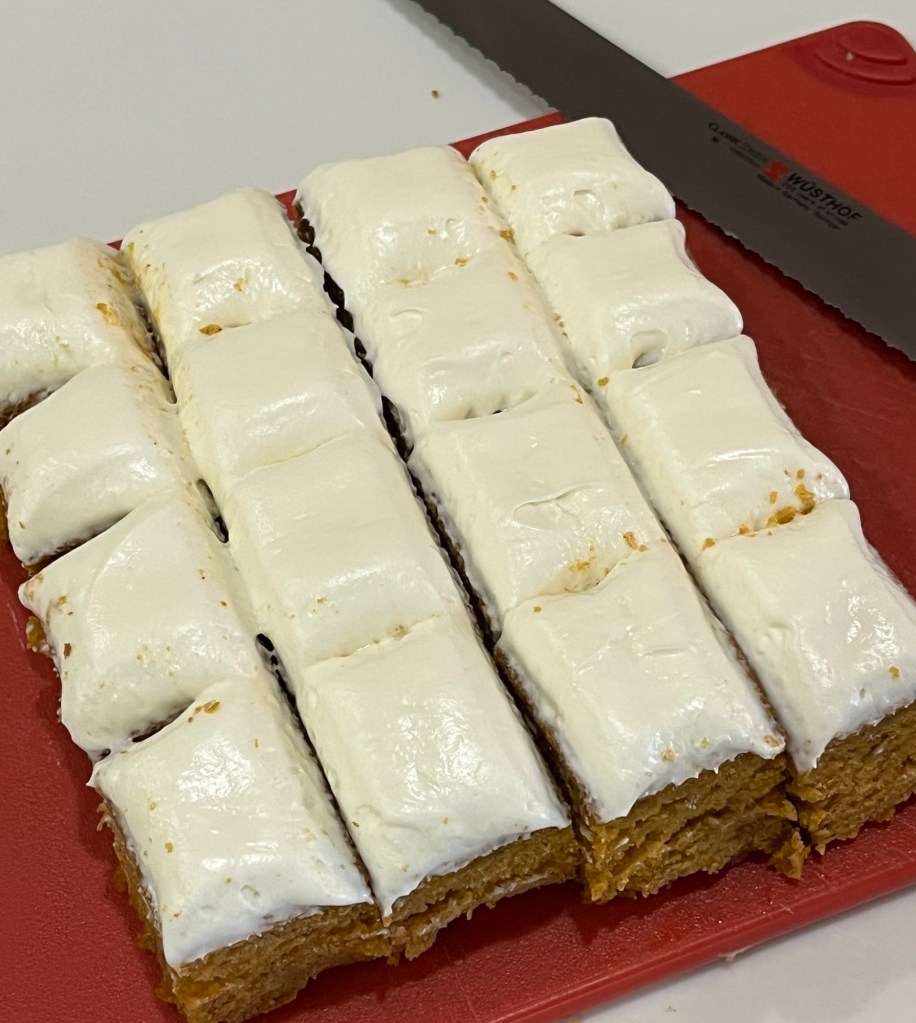
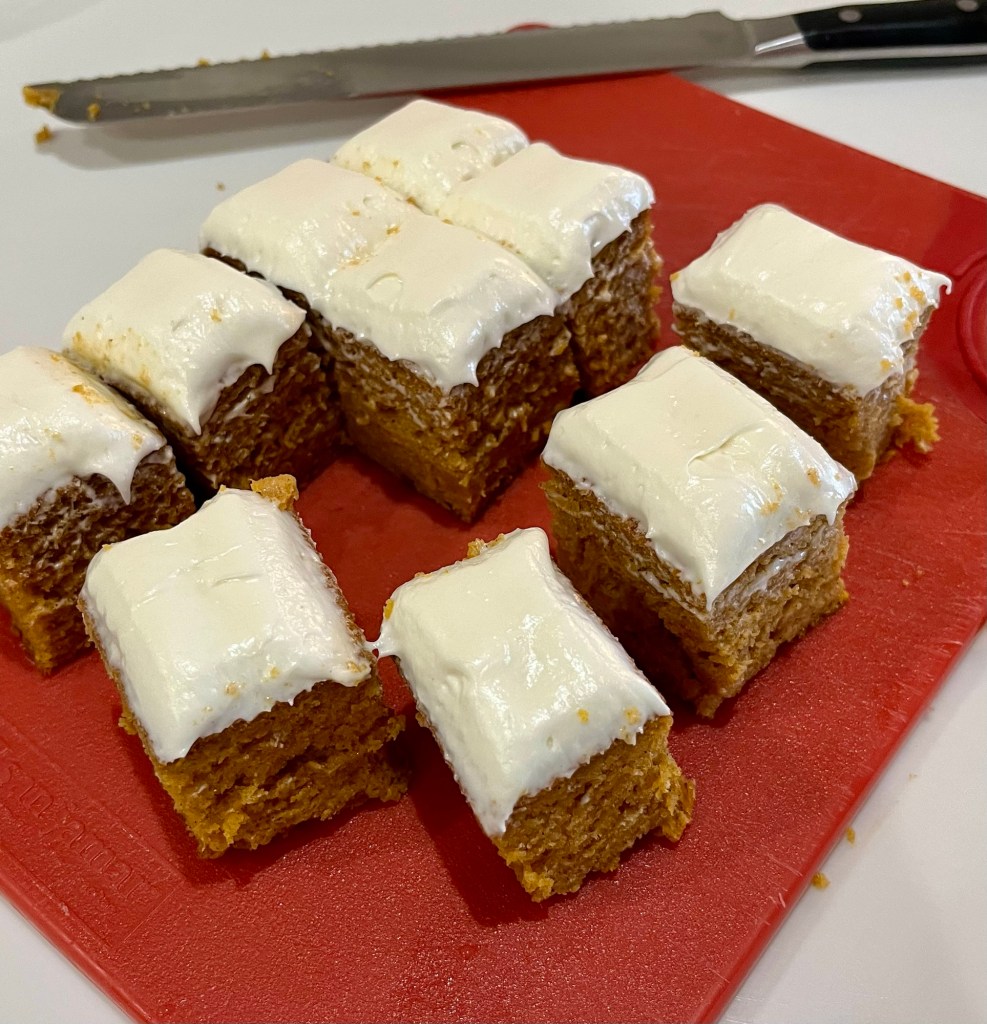
The neighborhood Halloween decorations aren’t even up and I am making Thanksgiving-ish desserts! However, these are exceptional. I used Kim’s gluten free flour so one of our friends could enjoy them.

It is moist, not too pumpkin-pie-ish and not too sweet. Easy, quick and delicious.

Pumpkin Cake

INGREDIENTS
• 14.5 ounces pumpkin puree
• ½ cup plain whole milk yogurt
• ½ cup unsalted butter (melted)
• 2 eggs (lightly beaten)
• 2 teaspoons vanilla extract
• 2 cups all-purpose flour (Optional: use Kim’s gluten free AP flour.)
• ⅔ cup sugar
• 2 teaspoons pumpkin pie spice
• 2 teaspoons baking powder
• 1 teaspoon baking soda
• ½ teaspoon salt
Cream Cheese Frosting
• 226g full-fat brick cream cheese, softened to room temperature
• 113g unsalted butter, softened to room temperature
• 360g confectioners’ sugar, plus an extra 1/4 cup (30g) if needed
• 1 teaspoon pure vanilla extract
• 1/8 teaspoon salt
METHOD

  1. Preheat the oven to 375 F and line an 8×8-inch pan with parchment paper.
  2. Stir together the pumpkin puree, yogurt, melted butter, egg, and vanilla in a large bowl.
  3. Stir in the flour, sugar, pumpkin pie spice, baking powder, baking soda, and salt.
  4. Pour batter into the prepared pan. Bake for 30-34 minutes or until a cake tester inserted into the center comes out clean. If the top of the cake darkens, tent with aluminum foil, reduce the heat to 350F and bake an additional 5 minutes until internal temperature reaches 195-200F.
  5. Let the cake cool in the pan for 5 minutes. Then use the parchment paper to lift the cake out of the pan onto a wire rack to cool completely.

    Cream Cheese Frosting
  6. In a large bowl using a handheld or stand mixer fitted with a paddle or whisk attachment, beat the cream cheese and butter together on high speed until smooth and creamy.
  7. Add confectioners’ sugar, the vanilla, and salt. Beat on low speed for 30 seconds, then switch to high speed and beat for 2 minutes. If you want the frosting a little thicker, add the extra 30g (1/4 c) of confectioners’ sugar (I add it).
  8. Cover and store leftover frosting for up to 5 days in the refrigerator or up to 3 months in the freezer. After freezing, thaw in the refrigerator then beat the frosting for a few seconds so it’s creamy again.
  9. Frost with cream cheese frosting, slice, and serve.

Pain Français et l’Europe

I decided to bake a tour of Europe. Over the past month I made Russian Dark Rye, German Light Rye and Italian bread and today was French Bread

I made them all before but randomly, not with a plan. As with the pretzels having a plan and executing it is very rewarding.

The French bread is good but not exceptional when compared to the two ryes and Italian breads. I don’t find a distinctive flavor, but the texture and crust is very good

French Bread

INGREDIENTS
Starter
• 1 c (227g) cool to lukewarm water (90°F to 100°F)
• ½ teaspoon active dry yeast
• 1 ¼ c (149g) Unbleached Bread Flour
• ¼ c (28g) Premium 100% Whole Wheat Flour
Dough
• all of the starter (above)
• 1 cup (227g) lukewarm water (100°F to 115°F)
• ¾ tsp active dry
• 1 Tbl (14g) sugar
• 3 ¾ to 4 c (450g to 480g) Unbleached Bread Flour
• 1 ½ to 2 ¼ tsp salt, to taste
• Egg wash (1 egg yolk and 1 Tbl milk)

METHOD

  1. To make the starter: Stir all the starter ingredients together to make a thick, pudding-like mixture. Cover with plastic wrap and let it rest for at least 2 hours. For best flavor, let the starter rest longer; overnight (up to 16 hours) is best.
  2. To make the dough: Stir down the starter with a spoon and add the water, yeast, sugar, 3 ¼ cups (390g) of the flour, and the salt. The dough will be a loose, messy mass. Let it rest for 12 to 15 minutes, then stir it again; it should become more cohesive and a bit smoother. Dough handles better once it’s had time for the flour to absorb the water while resting and relaxing. By using this method, you’ll tend to add less flour and have much bigger holes in your finished bread.
  3. Knead the dough, adding up to an additional ¾ cup (90g) flour (as necessary to make a soft dough), 10 to 12 minutes. The dough should weigh ~1100g.
  4. Place the dough in a lightly greased bowl or plastic container, cover with lightly greased plastic wrap, and let it rise until almost doubled (depending on the weather, this could be 1 to 2 hours). If you’re going out, or if you prefer, let the dough rise slowly in the fridge. If your dough was refrigerated, allow it to come to room temperature before shaping; it’ll warm up and rise at the same time. I used my proofing oven with only the light on for warmth. The same for the final proof below.
  5. Deflate the dough gently, but don’t knock out all the air. This will create those “holes” so important to French bread. For one large loaf, form the dough into a round ball; for two loaves, divide the dough in half and shape into two balls. For loaves, form into a batard (~500g) and a longer thin batard about 2” diameter and 4” shorter than bread tray (~600g). Place on semolina floured or parchment paper lined French bread tray to rise.
  6. Place a semolina or cornmeal-dusted piece of parchment paper onto a baking sheet. (Note to self: Don’t go crazy with semolina. It WILL fall off the paper and onto the floor when transferring the loaves from the peel onto the baking stone in the oven.) Gently place the ball(s) of dough on the baking sheet, seam-side down. It is easiest to roll the loaves onto the baking peel.
  7. Cover the bread gently with lightly greased plastic wrap, and let it rise until it’s puffy and about 50% larger, anywhere from 30 to 45 minutes if using the proofing drawer.
  8. Preheat your oven to 475°F.
  9. Dust each loaf with a little flour. Slash or crosshatch it with a sharp knife or lame. Coat with egg wash, then spritz water into the oven with a clean plant mister and place the bread in the oven. Reduce the heat to 425°F and spritz with water every few minutes for the first 15 minutes of baking.
  10. If you are using parchment paper, remove it after the first 15 minutes of baking.
  11. Bake the bread for about 25 to 30 minutes, or until it’s a rich golden brown, and its interior temperature registers at least 190°F on a digital thermometer. The smaller loaves will bake more quickly, so keep your eye on them.
  12. Remove the bread from the oven and cool it on a rack. Store bread, loosely wrapped in paper, for a couple of days at room temperature; wrap it in plastic and freeze for longer storage.

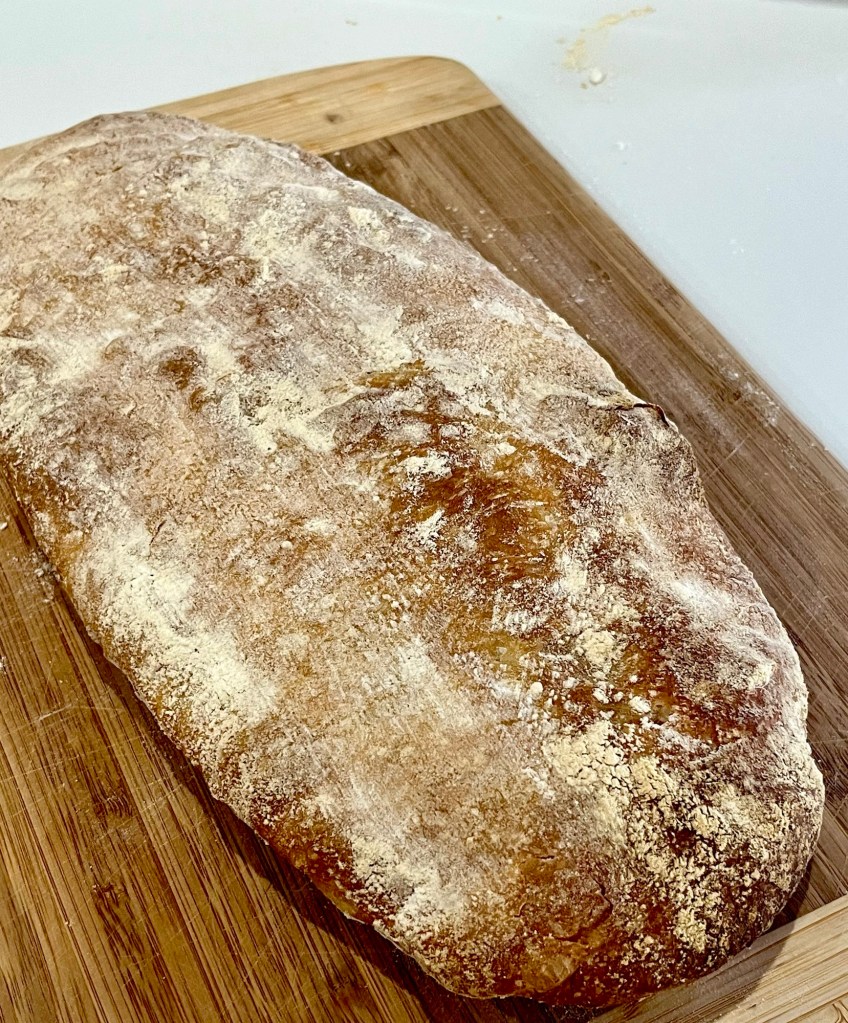
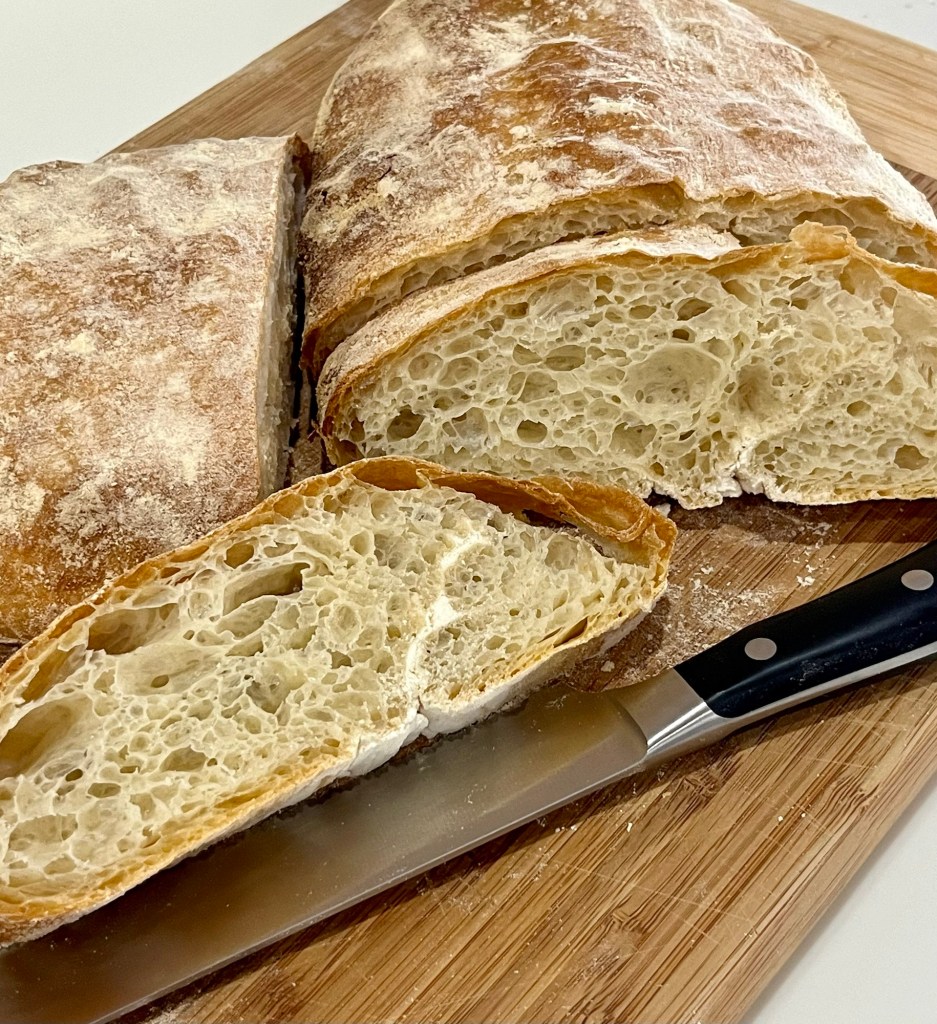
Crusty Italian Bread v2.0

I “kneaded” something simple and not too stressful this morning so I decided on this Italian bread. (Adding steam to the baking makes it crusty.)

I don’t know if it is experience, laziness or trying to be quiet, but I recently tend to hand-knead my doughs rather than use the stand mixer dough hook. I like to feel the dough come together and would rather slightly under-knead than over-knead. (The bakes tend to come out better.)

I almost always use weights rather than volumes to measure ingredients, but there is some controversy regarding how much a cup of AP flour weighs. Opinions vary from 120g/c to 150g/c which is enormous. I fluffed, scooped and leveled the flour and ended up adding about 3 1/2 cups then more as needed to knead. I probably ended up with the 500g or 4c as noted in the recipe.

Also Crusty Italian Bread v2.1 will likely have double the amount of salt. While QC hasn’t tested it yet, Dede feels it could use it. I also switched the whole egg/water egg wash to egg yolk/milk. I liked the shine and color on the pretzels I made earlier this week so I decided to go with it again. Probably the right move. It is beautiful.

Crusty Italian Bread

INGREDIENTS
• 314 g (1⅓ c) warm water
• 7 g (2¼ tsp) yeast
• 16 g (1 Tbl) brown sugar
• 12 g (2 tsp) salt
• 21 g (1½ tsp) olive oil
• 500 g (~4 c) AP flour
• 1 egg yolk for wash
• 1 Tbl sesame seeds (if desired)

METHOD

  1. Combine warm water, yeast, and brown sugar in a stand mixer bowl, stir and let stand ~8-10 minutes until it begins activate
  2. Add olive oil and salt, mix well.
  3. Gradually add the flour and mix with a Danish Dough Whisk until the sides and bottom of the bowl come clean.
  4. Knead knead by had for ~8 minutes until the dough is soft, smooth and not sticky. The dough should weigh ~865g
  5. Cover the dough and let rise until doubled, ~30 minutes.
  6. Punch it down, shape into an oval and book-fold into a boule
  7. Tension by rolling back and forth with a cupped hand. Pinch seams and continue to tension to blend.
  8. Cover the loaf with a damp cloth and let it rise until doubled, ~20 min. Over-proofing will cause the loaves to flatten.
  9. Preheat oven to 375ᵒF degrees.
  10. Brush top of loaf with an egg wash (whisked 1 egg yolk and 1 Tbl milk)
  11. Sprinkle top of loaf with sesame seeds (if desired)
  12. Score with a few, quick, cuts diagonally across the loaf.
  13. Pour 1 cup of hot water in a shallow pan on the rack underneath the bread in the oven.
  14. After 20 minutes put an oven-safe digital thermometer into the loaf.
  15. Continue baking for an additional 5-10 minutes (internal temp reaches 190ᵒF) or until the loaf turn golden brown and produces a hollow sound when tapped.
  16. Remove from the oven and cool on racks.

Time To Move On

Today was the fourth attempt to perfect my large, soft and chewy bagels. Let’s say, 4 times is a charm, It’s gin to move on to other

In the past I altered the type of flour, I changed the rising and proofing times, I developed a new way to poach the pretzel dough, I changed the hydration ratio, but ultimately it was advise from the King Arthur Baking chat line that made the day.

This time I followed the directions below and couldn’t be happier. The texture, taste and appearance are all spot-on to my vision.

Pretzels Higher Hydration and Improved Method

INGREDIENTS
• 1 cup water
• ½ cup 2% milk including 2 Tbl heavy cream
• 4½ tsp. white sugar
• 1½ tsp. salt
• 2¼ tsp active dry yeast
• 575 (5½ c) bread flour
• 50g (3½ Tbl) unsalted butter, melted – cooled slightly
• Vegetable oil or spray
• 12 cups water
• 2 Tbl light malt powder
• 5 Tbl baked baking soda
• 1 large egg yolk
• 1 Tbs. Milk
• Kosher salt
METHOD

  1. Melt the 50g of butter and set aside to cool.
  2. Heat the water in the microwave for 20-30 sec to achieve a temperature of about 120-130 deg then combine with the cold milk in a large measuring cup for a resulting solution temperature of 110 to 115 degrees F.
  3. Add the sugar and salt to the warmed water and milk and stir to combine. Sprinkle in the yeast and mix with a fork. Allow the mixture to sit for about 5 minutes or until it becomes foamy.
  4. Pour the foamy mixture into a large bowl and add the melted, cooled, unsalted butter and flour a cup at a time. Mix by hand with a Dutch style hand mixer until no dry flour remains in the bowl. If necessary, add one or two tablespoons of water the be sure the dough comes together as a smooth ball, Knead by hand for 7 minutes. It’s done kneading when it is smooth and firm to the touch and not sticky. Don’t over-knead.
  5. Remove the dough from the bowl and form into a ball. Wipe out the bowl and grease it with 1-2 tablespoons of oil. Place the dough ball back into the bowl and turn over a couple of times to coat thoroughly with the oil. Cover the bowl with a dish towel or plastic wrap and place in a warm area, free from drafts or cool air for about 1 hour, until the dough has risen and doubled in size.
  6. When the dough is ready, preheat the oven to 450○F and position the oven rack in the upper third of the oven. Line a large (15″ x 20″) baking sheet with parchment paper and spray with Bakers Joy. Set aside.
  7. In a small bowl, whisk together the egg yolk with 1 tablespoon of milk (egg wash). Set aside.
  8. In a large, wide pot (6-8 quarts) add 12 cups of water, baked baking soda and malt powder. Stir to combine and bring to a full boil.
  9. In the meantime, dampen a kitchen towel with water and set aside. Lightly grease a clean work surface with some vegetable oil (spraying with Bakers Joy worked well too). Remove the dough from the bowl and de-gas by punching down the dough. The dough should weigh ~925g. Place it on the work surface and divide into 2, 3 or up to 8 equal pieces. [For large pretzels, divide dough into 2 or 3 pieces.] Cover the pieces that you’re not rolling with plastic wrap or a damp kitchen towel, so they don’t become dry. Using the palms of your hands, roll each piece of dough to a 24-30” [40” for large pretzel] long rope and then shape into a “U”. If the dough will not roll out to the desired length, set aside, under a damp cloth, and let rest for 10-15 minutes, then try rolling again.
  10. Grab the ends of the rope and cross them over each other twice, then bring the ends down to the bottom of the ‘U” and press them down to seal, forming the shape of a pretzel. Lay the pretzel top-side down in the sieve/strainer
  11. Lower the sieve containing the pretzel into the boiling water mixture for about 30 seconds. Either push it down underwater or baste it. The pretzel will puff up while boiling. Flip the pretzel onto the parchment lined, (now top side up) sprayed baking sheet a few inches apart. Repeat for the other pretzels.
  12. Using a pastry brush, brush the top and sides of each pretzel with the egg wash and then sprinkle with coarse salt.
  13. Place the pretzel filled baking sheet on the upper oven rack and bake for about 7 minutes.
  14. Open the oven and quickly rotate the baking sheet so that the pretzels that were facing the front are now facing the rear of the oven. It may seem like a pain, but it’s quick and easy and will ensure even baking.
  15. Continue to bake for another 7 minutes or until pretzels are dark golden brown.
  16. Remove sheet from oven and place pretzels on a wire rack to cool slightly before serving.

Outrageously good if served warm. Mildly spectacular if served later.