
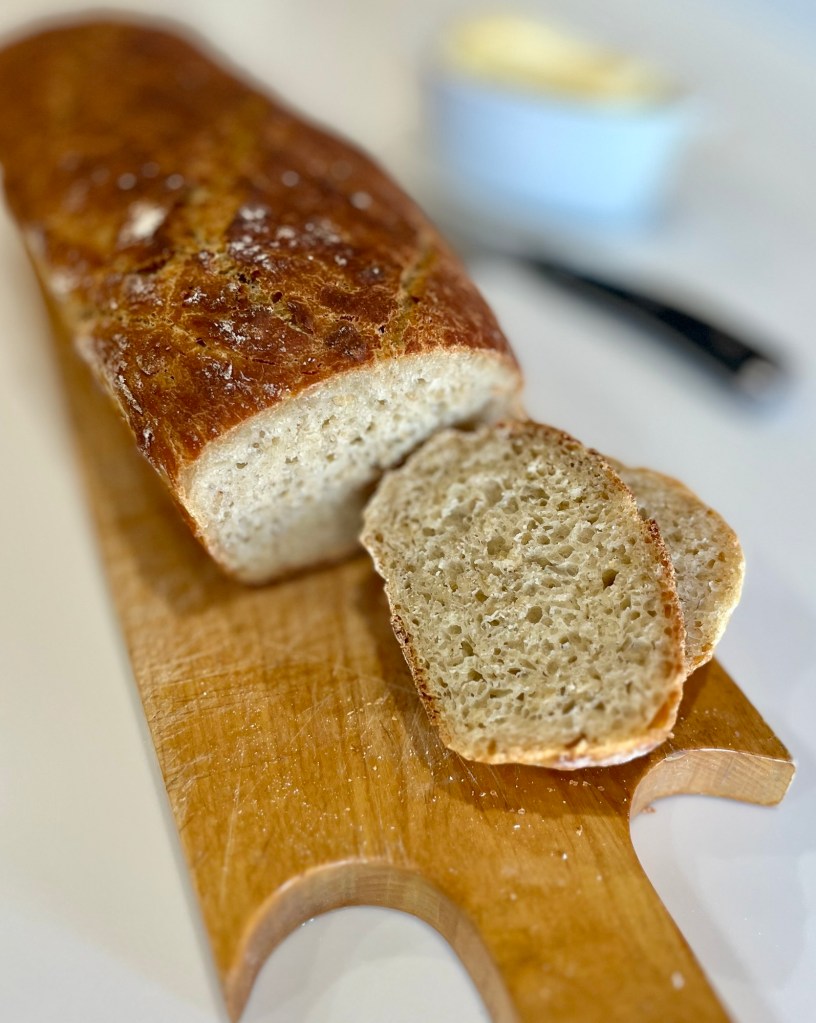
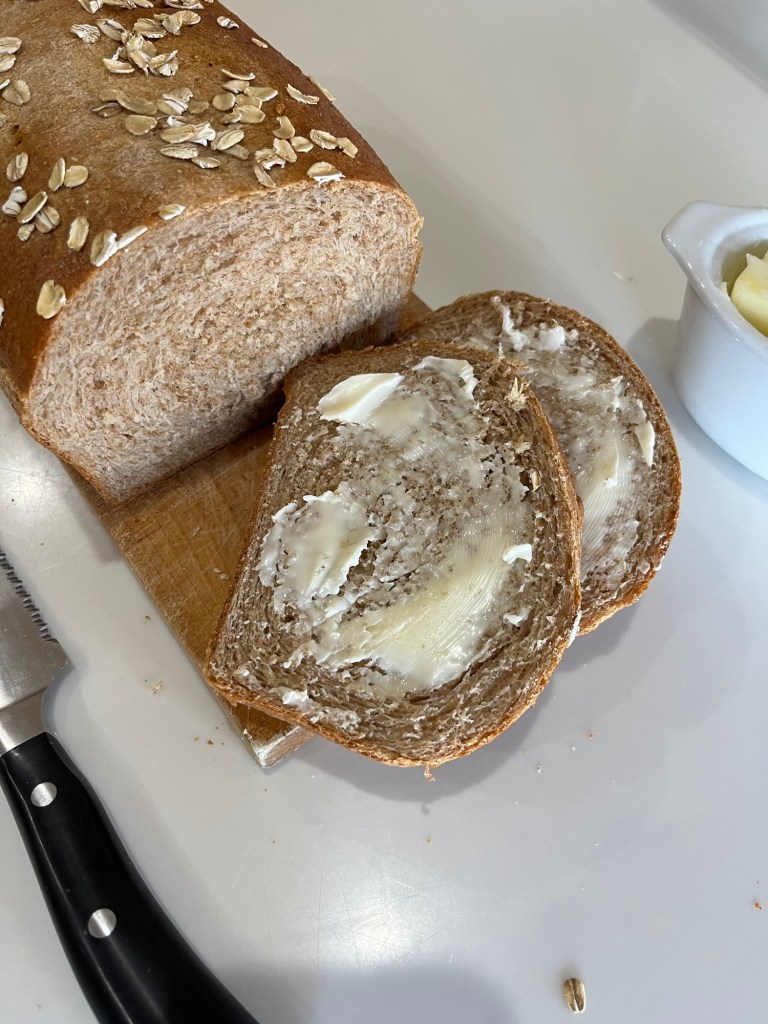
I wasn’t going to mention the artisan bread (as seen in the background) I made this morning, but I added a twist to the recipe. I use the Tangzong technique fairly often, but hadn’t used it on artisan bread. The standard method yields a bread that is 9.5 out of 10, so what is the point?
Tangzong pre-gelatinizes the starch in the flour, allowing it to absorb twice as much water than with cool water. Since there’s less free (unabsorbed) water in the dough, it’s less sticky and easier to knead plus it stays fresh longer, not that that is an issue here, over the past 2 weeks I made the artisan loaf every 2 or 3 days. For variety I did occasionally change from boule to batard.
I also made Scottish Oatcakes this morning. I read an article about them, which is all it ever takes for me. The bake resulted in 16 crisp “biscuits” (as cookies are called in the UK.) They be a nice change from all the cookies (but don’t worry, plenty of cookies coming up. I am doing another fund raiser in March and need to practice, practice, practice.)

Artisan Bread with Tangzong
INGREDIENTS
- 450g (3 ¾ c) bread flour divided (For Italian Bread use AP flour))
- 2 ¼ teaspoons instant yeast
- 10g (1 ¾ tsp) kosher salt
- 360g (1 ½ c) warm water between 120°F and 130°F (360 grams)
METHOD
- In a large mixing bowl, whisk flour, yeast, and salt to combine. Measure water into a small bowl
- Tangzong: Transfer 3 tablespoons of the measured flour and ½ cup of the measured milk or water into a saucepan and set over medium-high heat.
- Cook the mixture, whisking constantly until it thickens into a thick slurry (~1 minute.)
- Transfer the cooked mixture to a bowl until cool to lukewarm, then add remaining flour, milk (or water), and other dough ingredients combine with a dutch dough which until the mixture is very sticky, and no lumps of flour remain.
- Cover and place in a proofing oven until doubled in size, about 1 to 1 ½ hours.
- Preheat the oven to 450°F. Place a large dutch oven with a lid in the oven for at least 30 minutes.
- Using lightly floured hands, reach down one side of the dough to the bottom of the bowl, pull up, and stretch the edge of the dough over the center toward the opposite side. Turn the bowl 90 degrees and repeat the folding and turning, working in a circle around the dough until the dough starts to hold its shape, about 8 to 10 rotations. Pinch any seams together at the center of the dough ball.
- Turn out the dough onto a lightly floured surface, placing it seam side down. Shape into a boule or batard, depending on the intended use. Transfer the dough onto parchment paper lined banneton and sprinkle with flour. Loosely cover with plastic wrap or a tea towel for 10 minutes while the oven heats to 450°F. Place a large dutch oven with a lid in the oven while it preheats.
- Using a sharp knife or bread lame, cut a slit about ¼-inch deep across the top of the dough. Very carefully place the dough with the parchment paper directly into the preheated Dutch oven. Cover with the lid.
- Bake for 20 minutes. Remove the lid and bake until deeply golden brown and the internal temperature is about 195°F (~15 to 17 minutes more.) Carefully remove the bread from the Dutch oven using the parchment paper to help, and place on a wire rack to cool for at least 20 minutes before slicing
Tangzong
Tangzong pre-gelatinizes the starch in the flour, allowing it to absorb twice as much water than with cool water. Since there’s less free (unabsorbed) water in the dough, it’s less sticky and easier to knead
METHOD
- Measure out the total amount of flour and milk specified in the recipe.
- Transfer 3 tablespoons of the measured flour and ½ cup of the measured milk or water into a saucepan and set over medium-high heat.
- Cook the mixture, whisking constantly until it thickens into a thick slurry (~1 minute.)
- Transfer the cooked mixture to a bowl until cool to lukewarm, then add remaining flour, milk (or water), and other dough ingredients and proceed with the original recipe method.
Scottish Oatcakes
INGREDIENTS
• 226g quick-cooking oats (2 ½ c)
• 1 tsp kosher salt
• ¼ tsp baking soda
• 66g (6 Tbl) melted clarified butter
• ¾ c hot water, around 200ºF (93ºC)
METHOD
- In a medium bowl, stir oats, salt, and baking soda to combine. Add melted clarified butter or ghee to oat mixture and, using a flexible spatula, toss to evenly coat oats with fat. Add hot water and stir until mixture begins to thicken, 30 – 60 seconds. Let sit until oat mixture has hydrated and is slightly sticky, about 5 minutes.
- Using a flexible spatula, scrape oat mixture onto a 18×13” piece of parchment. Top with another 18×13” piece of parchment so oat mixture is sandwiched between and, using a rolling pin, roll oat mixture to ¼ “thick. Grab both ends of the parchment, set onto a 18×13” rimmed baking sheet, and freeze until mixture is firm but pliable, about 30 minutes. Line two 18×13” rimmed baking sheet with parchment; set aside.
- While the mixture is chilling adjust oven racks to second-from-top and second-from bottom positions and preheat to 350ºF (175ºC). 350ºF or 325ºF convection
- Set a clean piece of parchment on your kitchen counter. Remove oatcake mixture from freezer. Peel off top layer of parchment, then invert oatcake mixture onto prepared sheet of parchment. Using a 3-inch round cookie cutter, cut out 16 oatcakes. (Scraps can be rerolled, frozen, and punched out into additional oatcakes.) Transfer oatcakes to prepared baking sheets, spacing them about 1 inch apart, and bake until crispy and lightly browned, 30 to 35 minutes. Remove from oven and let cool completely before serving or storing.
Clarified Butter
INGREDIENTS
• 230g (2 sticks) unsalted butter, cubed
METHOD
- In a small saucepan, melt butter over medium-high heat.
- Continue to cook over medium-high heat; an even layer of white milk proteins will float to the surface.
- Bring to a boil; the milk proteins will become foamy.
- Lower heat to medium and continue to gently boil; the milk proteins will break apart.
- As butter gently boils, milk proteins will eventually sink to the bottom of the pot, and the boiling will begin to calm and then cease. Adjust heat as needed to continue boiling off water without scorching milk solids.
- Once boiling has stopped, pour butter through a cheesecloth-lined strainer or through a coffee filter into a heatproof container to remove browned milk solids.
- Let cool, then transfer to a sealed container and refrigerate until ready to use. Clarified butter should keep at least 6 months in the refrigerator.





 aBatteredOldSuitcase