
I never heard of Dutch Crunch Bread before our son, Dan asked me about it. Frances, our D.I.L., brought him a sandwich from San Francisco, made with this bread, one of his favorites.
I checked the internet (of course) and was pleased to see King Arthur Baking had both a recipe and video. I made it the same morning and was overjoyed at the result. A great crunch from the topping and a soft chewy crumb from the basic dough.
I made a nice roast beef sandwich for that day’s lunch and froze 3 rolls to make toast a couple or days later. Let the rolls warm to room temperature, then slice lengthwise I toasted it for breakfast.
Definitely a keeper!


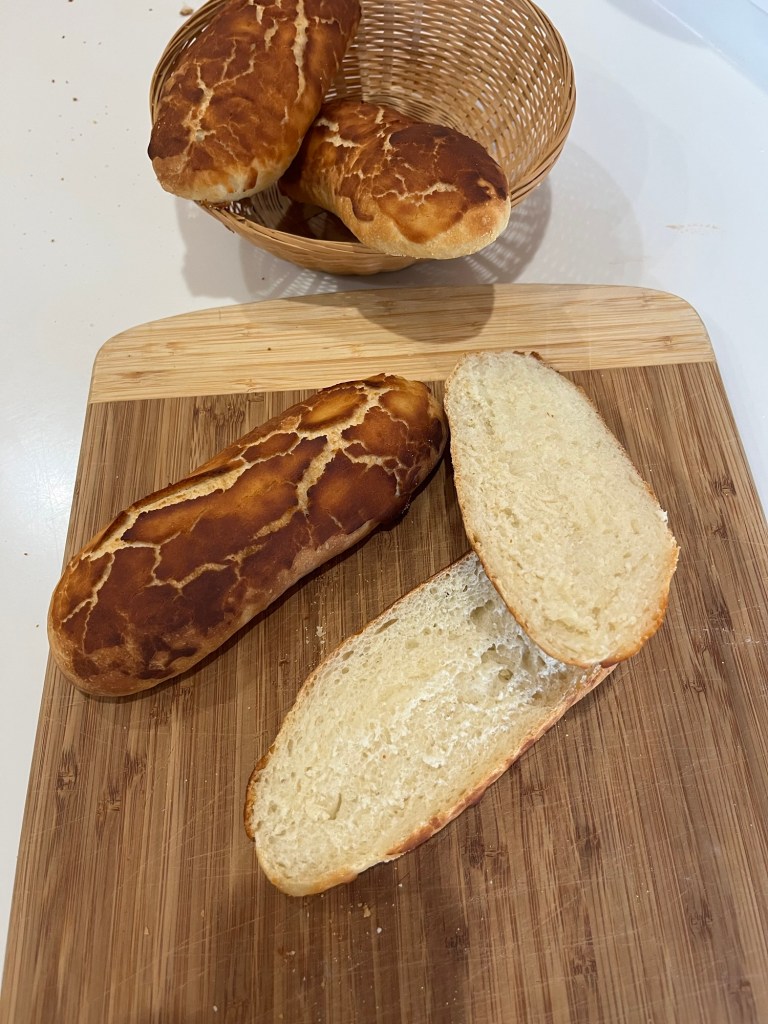
Dutch Crunch Bread
INGREDIENTS
Dough
• 503g (4 c plus 3 Tbl) King Arthur Unbleached Bread Flour
• 331g (1 1/3 c plus 2 Tbl ) water*
• 15g(1 Tbl plus ½ tsp) granulated sugar
• 2 Tbl (28g) butter or 2 Tbl (25g) vegetable oil
• 9g (1 Tbl) instant yeast
• 12g (2 tsp) table salt
*For cooler months (air and flour temperature around 65°F), use 85°F to 95°F water. In warmer months (air and flour temperature around 75°F), use 65°F to 75°F water.
Baking
• yellow cornmeal or King Arthur Semolina Flour, for dusting
Topping
• 113g (1/2 c) water, lukewarm
• 9g (1 Tbl) instant yeast
• 12g (1 Tbl) granulated sugar
• 1 Tbl (12g) vegetable oil
• 6g (1 tsp) table salt
• 107g (3/4 c) white rice flour
METHOD
- To make the dough: Weigh your flour; or measure it by gently spooning it into a cup, then sweeping off any excess. In a large bowl, mix all the dough ingredients together until thoroughly combined and homogeneous. Knead briefly with a wet hand in the bowl, 1 minute or so.
- Scrape down the sides of the bowl, then perform a bowl fold: Use a wet hand to grab a section of dough from one side, lift it up, then press it down into the middle. Give the bowl a quarter-turn (90°) and repeat 3 to 6 times, until you’ve circled the dough and it’s become resistant to stretching. (The dough will be rough at this stage.) Turn the dough seam-side down in the bowl. The dough temperature should be between 74°F and 78°F. Cover the bowl and let it rest at room temperature for 15 minutes.
- Knead the dough in the container or on a work surface to form a cohesive, smooth mass, 2 to 3 minutes. Turn the dough seam-side down in the bowl and allow it to rise at room temperature until it feels marshmallow-y and light, 45 to 90 minutes.
- While the dough is still in the bowl, lightly sprinkle it with flour. Use a bowl scraper to release the sides of the dough so that it can come out of the bowl without pulling or tearing. Invert the dough onto a lightly floured work surface. Lightly flour the top, then divide it into 8 pieces (about 113g each). For larger hoagies, divide the dough into 4 pieces (about 226g each).
- To preshape the dough: Use lightly floured hands to pat each piece of dough into a rough square. Fold the left and right sides in to meet in the middle, then press to gently seal. Starting at the top, fold the rectangle towards yourself in 3 motions, pressing gently after each fold, to create a 5″ cylinder with the seam-side down. The entire time you work, apply flour as needed to make sure the dough is moving easily on the work surface. Cover and repeat with the remaining pieces of dough. Let the preshaped dough rest for 5 to 10 minutes.
- Line 2 baking sheets with parchment and sprinkle lightly with cornmeal or semolina.
- To shape the rolls: Starting with the first piece of dough you preshaped, flip it over so the seam is up. Pat it into a rectangle with the long side facing you. Fold the top long edge into the middle, then fold the bottom edge into the center to meet it. Fold the top of the dough down to the bottom edge and press to seal with the heel of your hand. Roll the log against the surface to make an even tube about 7 1/2″ to 8″ long. Repeat with the remaining dough, placing the shaped rolls on the prepared baking sheets, spacing them evenly.
- Loosely cover the baking sheets and set aside to rise for 30 minutes. While the rolls rise, make the crunch topping.
- To prepare the crunch topping: In a small bowl, stir together the topping ingredients until homogenous. Set aside until the dough completes the 30-minute rise; no need to cover it. Before use, stir to deflate and check the consistency: It should be thick but not tight, somewhere between pudding and ketchup. Adjust with additional water or rice flour as necessary.
- To apply the crunch topping: Portion 1 tablespoon of the crunch topping onto the center of the rolls. (If making the large hoagie-sized rolls, use 2 tablespoons of crunch topping per roll.) Use a small offset spatula or the back of a spoon to gently distribute the crunch topping evenly over the surface and down the sides, stopping just shy of where the roll meets the pan.
- After applying the topping, allow the rolls to rise for an additional 45 to 75 minutes, until jiggly and wobbly. (No need to cover.)
- Towards the end of the rise, preheat the oven to 450°F with racks in the upper and lower thirds.
- Put the rolls in the oven and immediately drop the temperature to 425°F.
- Bake the rolls for 18 to 24 minutes, rotating the baking sheets halfway through, or until the tops are deeply colored and mottled in appearance and the sides are golden. Cool briefly and enjoy.
Storage information: Dutch crunch rolls are best eaten fresh. Store any leftovers in an airtight container at room temperature for 2 days and reheat or toast before using; freeze for longer storage
 aBatteredOldSuitcase