Artisan Italian Bread

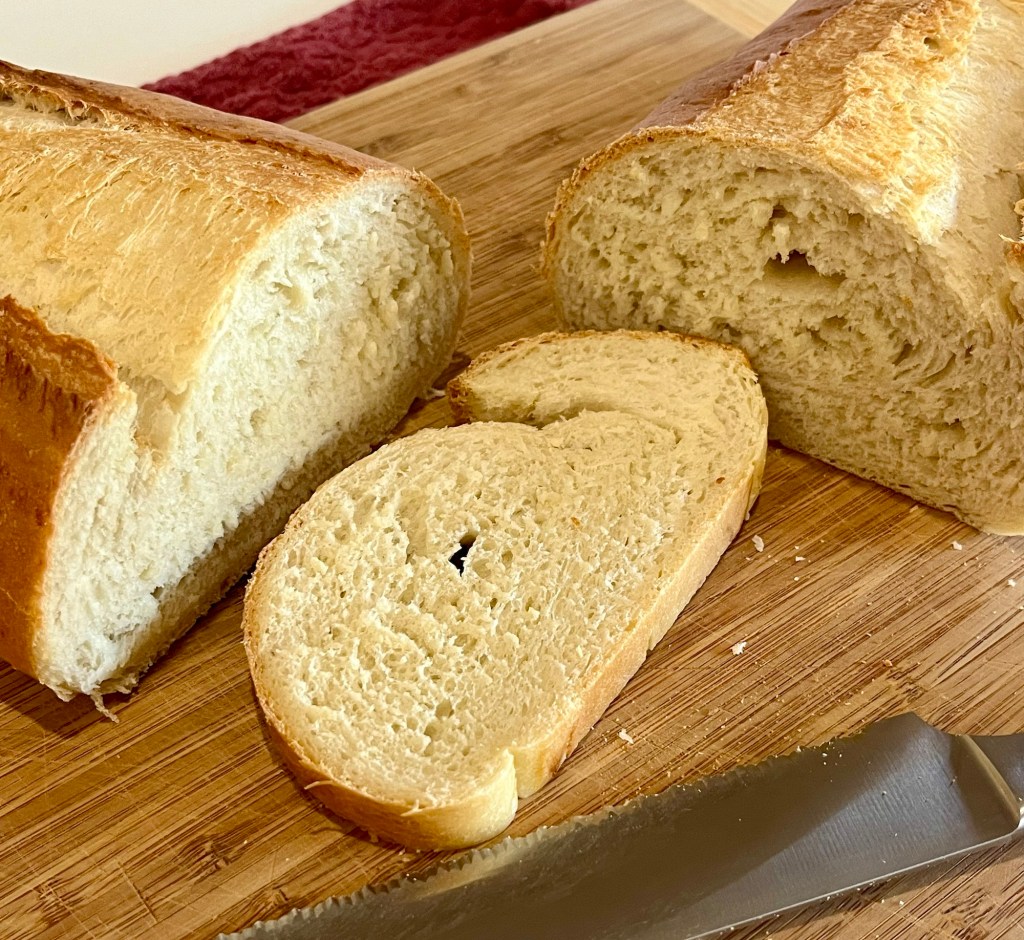
This is my basic Artisan Bread recipe from PreppyKitchen with modifications to make it Italian Bread. This bread substitutes AP flour for the bread flour, reducing the protein and gluten resulting in a softer, finer, more delicate crumb. Rather than using a dutch oven, it is baked on a stone with boiling water added to a pan in the oven to provide steam.

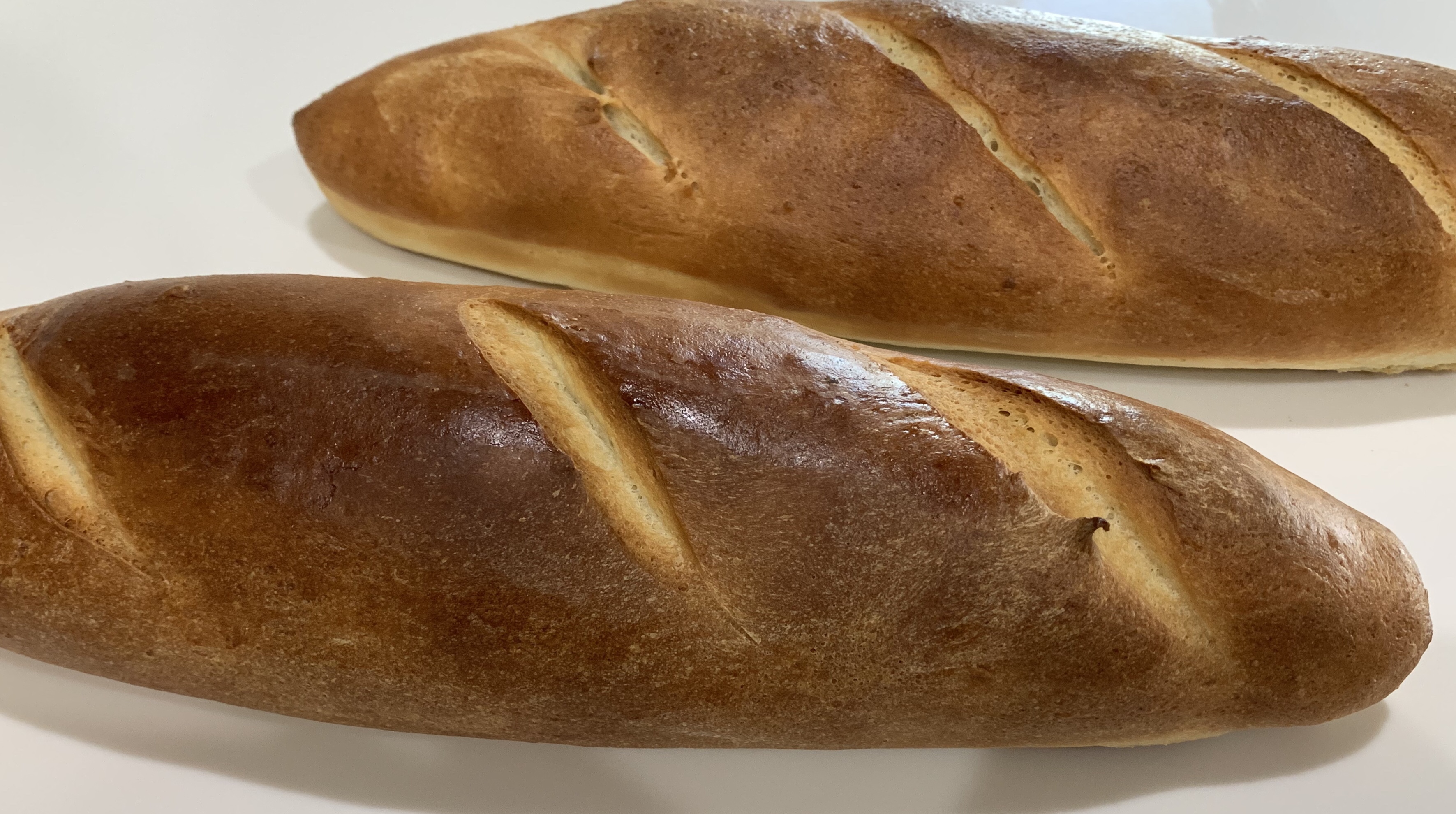
The final product is a soft, flavorful crumb with a nice crackling crust.

Artisan Bread

INGREDIENTS
• 450g (3¾ c) bread flour divided (For Italian Bread use AP flour))
• 2 ¼ teaspoons instant yeast
• 10g (1¾ tsp) kosher salt
• 360g (1½ c) warm water between 120°F and 130°F (360 grams)

As an alternate add 2 tsp sugar, mix the water, yeast and sugar in a bowl and let set 10 minutes. Thoroughly mix in the flour and salt, cover with a towel and let sit for ~1 hour until doubled in size. Bowl fold as in step #4 below. Shape the dough, place into a greased loaf pan, slash the top, and let rise an additional 30 min. Bake 30-35 minutes at 375°F until the top is a golden brown or internal temperature is 190°F.
METHOD

  1. In a large mixing bowl, add flour, yeast, and salt, stirring with a dutch dough whisk to combine. Stir in water until the mixture is very sticky, and no lumps of flour remain.
    a. Cover and place in a warm, draft-free area until doubled in size, about 1½ to 2 hours.
    b. Alternatively, for an overnight rise: After mixing the dough, cover and refrigerate until doubled in size. This will take about 8 hours but will keep in the fridge up to 24 hours total.
  2. Preheat the oven to 450°F. Place a large dutch oven with a lid in the oven for at least 30 minutes.
  3. If refrigerated, remove the dough from the refrigerator and let rest at room temperature for 30 minutes.
  4. Using wet hands, reach down one side of the dough to the bottom of the bowl, pull up, and stretch the edge of the dough over the center toward the opposite side. Turn the bowl 90 degrees and repeat the folding and turning, working in a circle around the dough until the dough starts to hold its shape, about 8 to 10 rotations. Pinch any seams together at the center of the dough ball.
  5. Turn out the dough onto a lightly floured surface, placing it seam side down. Shape into a boule or batard, depending on the intended use. Transfer the dough onto parchment paper lined banneton and sprinkle it with flour. (Alternatively, divide dough in half and form each into a small batard, place in a parchment paper line French bread form) Loosely cover with plastic wrap or a tea towel for 10 minutes while the oven heats to 450°F. Place a large dutch oven with a lid in the oven while it preheats.
  6. Using a sharp knife or bread lame, cut a slit about ¼-inch deep across the top of the dough. Very carefully place the dough with the parchment paper directly into the preheated Dutch oven. Cover with the lid.
  7. Bake for 15 minutes. (If making 2 smaller loaves shaped in french bread forms, slide the loaves from the bread form directly only the baking stone and bake for ~20-25 minutes, on an oven rack positioned in the upper third of the oven then check internal temperature.) Remove the lid and bake until deeply golden brown and the internal temperature is about 195°F (~11 to 12 minutes more.) Carefully remove the bread from the Dutch oven using the parchment paper to help, and place on a wire rack to cool for at least 20 minutes before slicing

Crusty Italian Bread v2.0

I “kneaded” something simple and not too stressful this morning so I decided on this Italian bread. (Adding steam to the baking makes it crusty.)

I don’t know if it is experience, laziness or trying to be quiet, but I recently tend to hand-knead my doughs rather than use the stand mixer dough hook. I like to feel the dough come together and would rather slightly under-knead than over-knead. (The bakes tend to come out better.)

I almost always use weights rather than volumes to measure ingredients, but there is some controversy regarding how much a cup of AP flour weighs. Opinions vary from 120g/c to 150g/c which is enormous. I fluffed, scooped and leveled the flour and ended up adding about 3 1/2 cups then more as needed to knead. I probably ended up with the 500g or 4c as noted in the recipe.

Also Crusty Italian Bread v2.1 will likely have double the amount of salt. While QC hasn’t tested it yet, Dede feels it could use it. I also switched the whole egg/water egg wash to egg yolk/milk. I liked the shine and color on the pretzels I made earlier this week so I decided to go with it again. Probably the right move. It is beautiful.

Crusty Italian Bread

INGREDIENTS
• 314 g (1⅓ c) warm water
• 7 g (2¼ tsp) yeast
• 16 g (1 Tbl) brown sugar
• 12 g (2 tsp) salt
• 21 g (1½ tsp) olive oil
• 500 g (~4 c) AP flour
• 1 egg yolk for wash
• 1 Tbl sesame seeds (if desired)

METHOD

  1. Combine warm water, yeast, and brown sugar in a stand mixer bowl, stir and let stand ~8-10 minutes until it begins activate
  2. Add olive oil and salt, mix well.
  3. Gradually add the flour and mix with a Danish Dough Whisk until the sides and bottom of the bowl come clean.
  4. Knead knead by had for ~8 minutes until the dough is soft, smooth and not sticky. The dough should weigh ~865g
  5. Cover the dough and let rise until doubled, ~30 minutes.
  6. Punch it down, shape into an oval and book-fold into a boule
  7. Tension by rolling back and forth with a cupped hand. Pinch seams and continue to tension to blend.
  8. Cover the loaf with a damp cloth and let it rise until doubled, ~20 min. Over-proofing will cause the loaves to flatten.
  9. Preheat oven to 375ᵒF degrees.
  10. Brush top of loaf with an egg wash (whisked 1 egg yolk and 1 Tbl milk)
  11. Sprinkle top of loaf with sesame seeds (if desired)
  12. Score with a few, quick, cuts diagonally across the loaf.
  13. Pour 1 cup of hot water in a shallow pan on the rack underneath the bread in the oven.
  14. After 20 minutes put an oven-safe digital thermometer into the loaf.
  15. Continue baking for an additional 5-10 minutes (internal temp reaches 190ᵒF) or until the loaf turn golden brown and produces a hollow sound when tapped.
  16. Remove from the oven and cool on racks.

Krusty the Clown or Crusty Italian Bread

I decided to make a white cake this morning, until I saw this recipe for crusty Italian bread in my files. Didn’t need no stinkin’ cake anyway, This bread is very easy to make and doesn’t use any special flour (like bread flour.) If you have yeast in your cupboard (and who doesn’t) and about two hours (15 min hands on) you should be ready to go!

Crusty Italian Bread

INGREDIENTS
• 314 g (1⅓ cups) warm water
• 7 g (2¼ tsp) yeast
• 16 g (1 Tbl) brown sugar
• 12 g (2 tsp) salt
• 21 g (1½ tsp) olive oil
• 500 g (4 c) AP flour
• 1 egg for wash

METHOD

  1. Combine warm water, yeast, and brown sugar in a stand mixer bowl, stir and let stand ~8-10 minutes until it begins activate
  2. Add olive oil and salt, mix well.
  3. Gradually add the flour until the sides and bottom of the bowl come clean.
  4. Knead using the dough hook to knead for 8 minutes.
  5. Cover the dough and let rise until doubled, ~30 minutes. (I use a proofing oven that was warmed to temperature, then turned off.)
  6. Punch it down, form into an oval and shape it into a loaf. Tuck ends under.
  7. Cover the loaf with a damp cloth and let it rise (in the still warm oven) until doubled. ~20 min. Over-proofing will cause the loaves to flatten.
  8. Preheat oven to 375ᵒF degrees.
  9. Brush top of loaf with an egg wash (1 egg and 1 tablespoon water)
  10. Score with a single, quick, long cut down the center.
  11. Pour 1 cup of hot water in a shallow pan on the rack underneath the bread in the oven.
  12. Bake for 25-30 minutes (internal temp reaches 190ᵒF) or until the loaf turn golden brown and produces a hollow sound when tapped.
  13. Remove from the pan and cool on racks.

Pane Italiano For my friend Rita

My friend Rita, and her daughter Sarah, recently returned from an Italian vacation. This bread’s for them!

I woke up this morning and decided to cut the Next Up list in Dede’s Bakery and Confectionary list with Italian bread. This loaf has a nice crumb, open structure, good chewy crust and great taste. “ ‘O sole mio!”

Italian Bread

INGREDIENTS
• 2 ¼ tsp (7g) active dry yeast
• 1 ¾ c (413g) warm water
• 1 tsp (4g) sugar
• 3 ¼ c (455g) bread flour
• 2 tsp (12g) salt
• 1 egg white

METHOD

  1. In the bowl of your stand mixer, mix your yeast, warm water, and sugar. Allow the mixture to sit until the yeast becomes frothy, about 5 minutes.
  2. Once the yeast is ready, add the flour and salt to the bowl. using the dough hook attachment, mix on low speed until the dough comes together, about 3-4 minutes. Increase the speed to medium and mix it for 3-5 minutes to develop the gluten. Add additional flour by the Tbl until the dough barely cleans the sides of the bowl.
  3. Once the dough is done mixing, remove it from the mixer and place it into an oiled bowl. Cover and let the dough rest until it has doubled in size, about 1 hour. Prepare a baking sheet by lining it with parchment paper. It should weigh ~862g.
  4. Dump the dough out onto a floured surface and pound the air out of it, fold it back in on itself into a round and place it back into the bowl, seam side down. Cover and let it rest for another 30-40 minutes.
  5. Once it has rested and risen back up again, dump it out onto a lightly floured surface and degas it again. Cut the dough in half and toll them both up into 10 inch baguette-like loaves. Place the loaves onto your prepared baking sheet, seam side down and cover them. Preheat your oven to 375F.
  6. Whisk egg white and 1 tbl water to use as an egg wash
  7. Proof your loaves until they are nearly double in size about 30-45 minutes. Once the loaves are ready, score your loaves and bake them for 25-30 minutes After the first 15 minutes brush egg wash on the bread, sprinkle with sesame seeds and return to finish baking.
  8. They should have a light golden crust and bake to interior temp of 190F.

Supermarket Italian Bread

For some reason I had a craving for Italian Bread. To the best of my knowledge I never made King Arthur Baking’s Supermarket Italian Bread, so it was time to give it a try.

I followed KAF’s (I know it should now be KAB’s, but old dogs and all that…) recipe and made two loaves almost identical both inside and out to what KAF published on their website.

Very nice flavor, good crumb and great crust!

Italian Supermarket Bread

KAF
INGREDIENTS

Dough
• 4 cups (482g) AP Flour
• 2 tablespoons (21g) potato flour or 1/4 cup (21g) dried potato flakes
• 1/4 cup (35g) nonfat dry milk
• 2 teaspoons salt
• 2 teaspoons sugar
• 2 teaspoons instant yeast
• 1 1/3 cups (301g) lukewarm water
• 3 tablespoons (35g) olive oil (I use spray olive oil)
Topping
• 1 egg white, beaten with 1 tablespoon water, or substitute Quick Shine
• sesame seeds

METHOD

  1. In your stand mixer bowl combine the yeast, sugar and water and allow to rest for 10 minutes
  2. Add half of the flour and all of the rest of the dough ingredients till cohesive. Add the rest of the flour mixing between each addition
  3. Knead the dough for 5 to 8 minutes, until it’s smooth and supple, adding more water or flour as needed.
  4. Cover the dough and allow it to rise for 1 hour, or until it’s doubled in bulk.
  5. Transfer the dough to a lightly greased work surface and divide it into two pieces. Shape each piece into a smooth 16″ log. Place the logs into the two wells of a lightly greased Italian bread pan, cover, and let the loaves rise until very puffy, about 1 hour.
  6. Brush the loaves with the egg wash (or spray them with Quick Shine), then sprinkle heavily with sesame seeds. Slash the loaves diagonally, making 3 slashes in each, and immediately put them in the oven. Bake in a preheated 400°F oven for about 25 minutes, until the loaves are golden brown. For the crispiest crust, turn off the oven, prop the door open, and allow the bread to cool in the oven

Rustic Italian Bread

I ran across a four ingredient, no knead, no stretch and fold, Italian bread. I am on my third bake of this bread, each with minor tweaks.

Version 1 was as presented. Version 2 was as presented but baked in a Dutch oven (my preferred baking method.) Version 3 included Cake and Bread Enhancer (fifth ingredient) and was baked flat on a baking stone.

Version 1 was excellent. Version 2 was excellent. Version 3 was excellent. All three had great, crispy crusts and a soft tender crumb on the inside.

My current favorite is (was) my high hydration honey no-knead bread, but this may be my new go to. It’s even easier than the honey no-knead. Simply mix everything together the let it ferment for 2 hours. Gently pour out, (I do mean pour, it is high hydration, slack and sticky,) minimally shape and bake. All done!

My goal is to create larger holes in the bread. Version 2 (center) and 3 (right) were the best. I overworked the fermented dough a little too much in Version 1. Try, try, and try again!

Rustic Italian Bread

INGREDIENTS
• 380 g AP flour + more for dusting
• 20 g (3 Tbl) Bread Enhancer
• 1 tsp sea salt
• 350 g warm water
• 2 tsp active dry yeast

METHOD

  1. Add the flour, enhancer, salt and yeast to your stand mixer. Use the paddle attachment to mix and combine so no dry patches remain.
  2. Add the warm water and mix until everything is incorporated and a soft, wet dough forms. It will be a slack, sticky dough.
  3. Loosely cover the bowl with plastic and let the dough rise at room temperature (See tip below) for 2 to 3 hours or until doubled in size.
  4. Dust your kitchen counter with flour and scrape the very sticky dough out with a bowl scraper.
  5. With floured hands shape the dough into a ball (or batard,) deflating it as little as possible.
  6. Line a banneton with parchment paper. (See tip below)
  7. Place the ball of dough in the lined banneton smooth side up and let it rest while your oven heats up.
  8. Use a sharp knife or lame to lightly slash an X in the top of the loaf.
  9. Preheat your oven to 450 F with a dutch oven inside for about 45 minutes before baking the bread. Fill an oven proof bowl with 2 inches of water and place it on the bottom rack.
  10. Once hot, carefully transfer the bread loaf into the dutch oven using the parchment paper.
  11. Cover with the lid and bake for 30 minutes. Remove lid and bake another 5 minutes until golden brown on top. The internal temperature should be 205 F
  12. Remove the bread from the dutch oven and transfer to a cooling rack or it won’t stay crispy.

TIPS

  1. Lining a round banneton: Crumple parchment paper starting from the edges. You should end up with a ball which will smooth out to fill the round banneton
  2. Room temperature proofing: I like to put the bowl in an “off” oven with the light on. In the winter my kitchen tends to be cool (62-65 F) My “off” oven with the light on is 78o F.

From King Arthur Baking’s Cake and Bread Enhancer: A “miracle” ingredient for your cakes!

(From KAB) Our bakers have called this the “miracle” ingredient for many reasons: it makes cakes and other baked goods softer, moister, and helps them stay fresher longer. Our blend contains vegetable fats that act as emulsifiers, allowing the fats and liquids in your favorite recipe to combine more easily. The enhancer also acts as a stabilizer and texture enhancer. Cake enhancers are commonly used in professional bakeries to keep breads fresh and soft, and help cakes stay light and fluffy. It’s especially great for making soft sandwich loaves.

Pane Rustico – Rustic Italian Bread

Italian Peasant Bread is a staple in Italy. The recipe changes slightly between locations depending on what grains are available. It has a good hole structure, soft crumb and firm crunchy crust. Unlike most Italian breads this one incorporated no milk or olive oil.

Italian Peasant Bread

This isn’t a difficult recipe and can be made on one morning. I hand kneaded the wet dough but may try the easier stretch and fold method the next time. The results were worth the little extra effort of kneading. The Q.A. Department is in favor of any method that turns out this delicious.

The final Bâtard was 17”x7”x4”.

Biga – (Mix 8 to 10 hours before mixing the final dough)

Measured Grams Ingredients
• 1 cup 227 g. Water (room temperature)
• ¼-tsp. ¼-tsp. Instant Yeast
• ½ cup 72 g. All Purpose Flour (King Arthur, Unbleached, Unbromated)
• ½ cup 81 g. Tipo 00 Whole Wheat Flour
• ¼ cup 41 g. Cornmeal (whole, stone ground)

  1. In a large mixing bowl, combine the water, instant yeast, all-purpose flour, whole wheat flour, and cornmeal.
  2. Mix with a rubber spatula to combine and then beat well. Scrape down the sides of the bowl.
  3. Cover with plastic wrap (cling film) and let ferment at room temperature 68º-74ºF (20º-23ºC) for 8 to 10 hours.

Final Dough
Measured Grams Ingredients
• 2-½ cups 421 g. Biga (fully fermented)
• 1 cup 227 g. Water (room temperature)
• ½-tsp. 3 g. Instant Yeast
• 3-½ cups 490 g. All purpose flour
• 2 tsp. 16 g. Sea Salt (fine)

Mixing, Kneading, and Fermenting the Dough

  1. Uncover the fermented biga and add the water, instant yeast, and half of the all-purpose flour.
  2. Use a rubber spatula to mix the ingredients until thick batter forms. Beat the batter until well combined.
  3. Add the remaining all-purpose flour and sea salt. Fold the ingredient together using the rubber spatula until the mixture becomes a shaggy mass.
  4. Scrape off the rubber spatula with the plastic scrape. Scrape down the bowl and turn the dough onto the work surface.
  5. Knead the ingredients for 1 minute to incorporate the ingredients. The dough will be sticky. “Do not add any flour to the work surface.”
  6. Continue to knead the dough for 6 to 8 minutes or until the dough is strong and elastic. Round the dough into a ball.
  7. Spray a bowl with non-stick spray or oil and place the dough into the bowl. Cover with plastic wrap.
  8. Ferment the dough for 1 hour at room temperature.
  9. After 1 hour. Lightly flour the work surface. Uncover the dough and turn it onto the lightly flour work surface.
  10. Fold the dough
  11. Place the folded dough back into the bowl and cover with plastic wrap.
  12. Ferment the dough 1 hour.
  13. After 1 hour. Lightly flour the work surface. Uncover the dough and turn it onto the lightly flour work surface.
  14. Degas and fold the edges of the dough to the center to start to form the dough into a round shape.
  15. Clear the work surface of the flour.
  16. Turn the dough over and continue to pre-shape the dough into a tight round. The seam will be on the bottom.
  17. Cover the dough with the bowl and let the dough rest for 15 minutes before the final shaping.
  18. Pre-heat the oven and baking stone to 500ºF (260ºC) for at least 1 hour before baking the loaf.

Equipment:

• Baking Couche
• Bakers Lame
• Large Stainless Steel Bowl
• Baking Stone 14″ x 16″
• ¼-Sheet of Parchment Paper
• Baker’s Peel/Pizza Peel

Final Shaping and Proofing the Dough

  1. After the 15-minute rest uncover the dough. Lightly flour the top of the round and turn the dough over onto the work surface with the seam side up.
  2. Degas and shape the dough into an oval.
  3. Shape the dough into “Bâtard” (loaf shape)
  4. Lightly flour the canvas baking cloth.
  5. Place the Bâtard seam side up onto the floured canvas and fold each side to cover the ends of the loaf first. Then fold the remaining canvas to enclose the Bâtard. This will keep the loaf from spreading while it is proofing.
  6. Proof the loaf for 50 minutes to a 1 hour at room temperature. Check to see if the dough is ready by the touch test. Lightly press the dough with your fingertip. The dough should hold the indentation if the dough should pushes back completely let it continue to proof until it holds an indentation from your finger.
  7. Place the parchment paper onto the baking peel.
  8. Uncover the proofed loaf and place it seam side down onto the ¼-sheet of parchment paper.
  9. Use a straight edge razor or sharp knife to cut a long slash from end to end of the loaf.
  10. Slide the loaf onto the 500ºF (260ºC) preheated oven onto the baking stone. Place the large stainless steel bowl over the loaf.
  11. Bake the loaf with the bowl over it for 10 minutes.
  12. After 10 minutes, remove the bowl using tongs and kitchen hot pads.
  13. Reduce the oven temperature to 450ºF (232ºC). Turn the loaf to get even browning and remove the parchment paper.
  14. Continue to bake the loaf for 20 to 25 more minutes or until the exterior of the loaf is a deep golden brown.
  15. Using the peel. Remove the baked Italian Peasant Bread from the oven.
  16. Place the baked Italian Peasant Bread onto a cooling rack and cool completely to room temperature before cutting.

Terza Volta un Incanto

Ever hear the third times a charm? Well, believe it—it’s true. This was my third attempt at this bread. The first two were disasters due to simple, stupid mistakes. In the first one I used 2 Tbl of salt instead of 2 tsp. I proofed the second one too warm. I tossed the first one. Not only did it take forever to rise due to the salt retarding the yeast, the salt taste was overwhelming. Plus I forgot the egg wash so the crust was dull and unappealing. The second was proofed in the proofing oven and rose too fast causing splits along the sides and when scored with the lame it flattened but was still ok to use for garlic bread.

The third and successful bake was proofed at room temperature for 15 minutes shorter than the recipe called for, but still doubling the size of the dough. I also activated the yeast for 10 min prior to adding the rest of the ingredients. (Step 1 below.)

Italian Supermarket Bread KAF

INGREDIENTS
Dough
• 4 cups (482g) AP Flour
• 2 tablespoons (21g) potato flour or 1/4 cup (21g) dried potato flakes
• 1/4 cup (35g) nonfat dry milk
• 2 teaspoons salt
• 2 teaspoons sugar
• 2 teaspoons instant yeast
• 1 1/3 cups (301g) lukewarm water
• 3 tablespoons (35g) olive oil
Topping
• 1 egg white, beaten with 1 tablespoon water, or substitute Quick Shine
• sesame seeds
METHOD

  1. In your stand mixer bowl combine the yeast, sugar and water and allow to rest for 10 minutes
  2. Add half of the flour and all of the rest of the dough ingredients till cohesive. Add the rest of the
    flour mixing between each addition
  3. Knead the dough for 5 to 8 minutes, until it’s smooth and supple, adding more water or flour as
    needed.
  4. Cover the dough and allow it to rise for 1 hour, or until it’s doubled in bulk.
  5. Transfer the dough to a lightly greased work surface and divide it into two pieces. Shape each
    piece into a smooth 16″ log. Place the logs into the two wells of a lightly greased Italian bread
    pan, cover, and let the loaves rise until very puffy, about 1 hour.
  6. Brush the loaves with the egg wash (or spray them with Quick Shine), then sprinkle heavily with
    sesame seeds. Slash the loaves diagonally, making 3 slashes in each, and immediately put them in the oven. Bake in a preheated 400°F oven for about 25 minutes, until the loaves are golden brown. For the crispiest crust, turn off the oven, prop the door open, and allow the bread to cool in the oven