Time To Move On

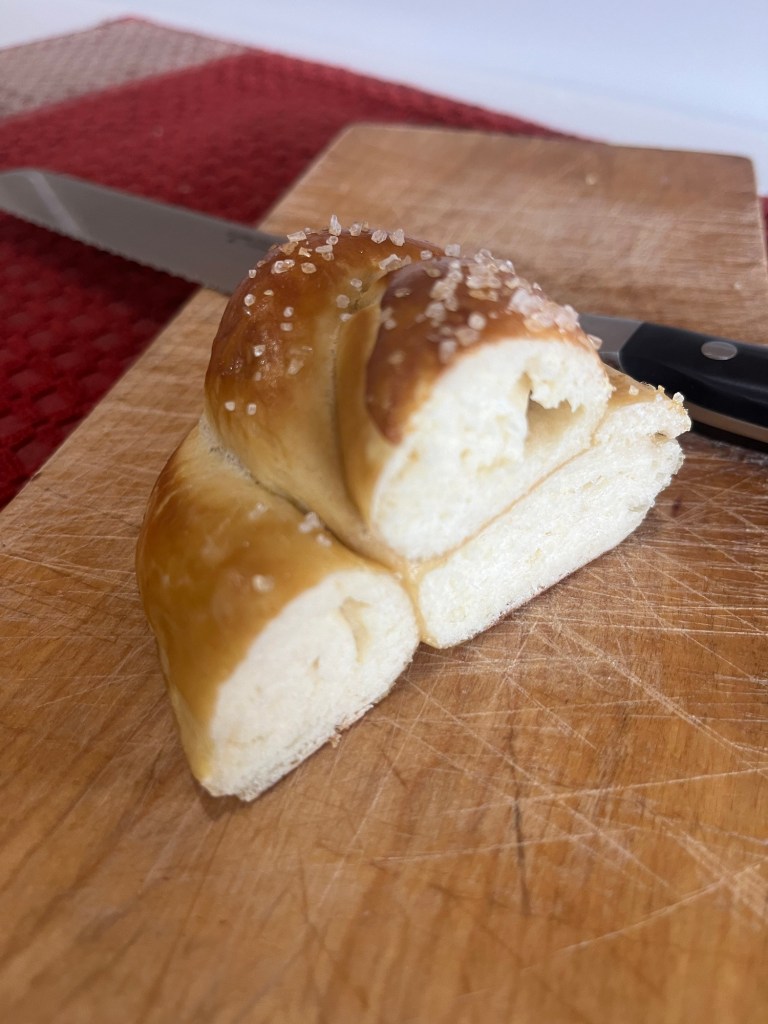
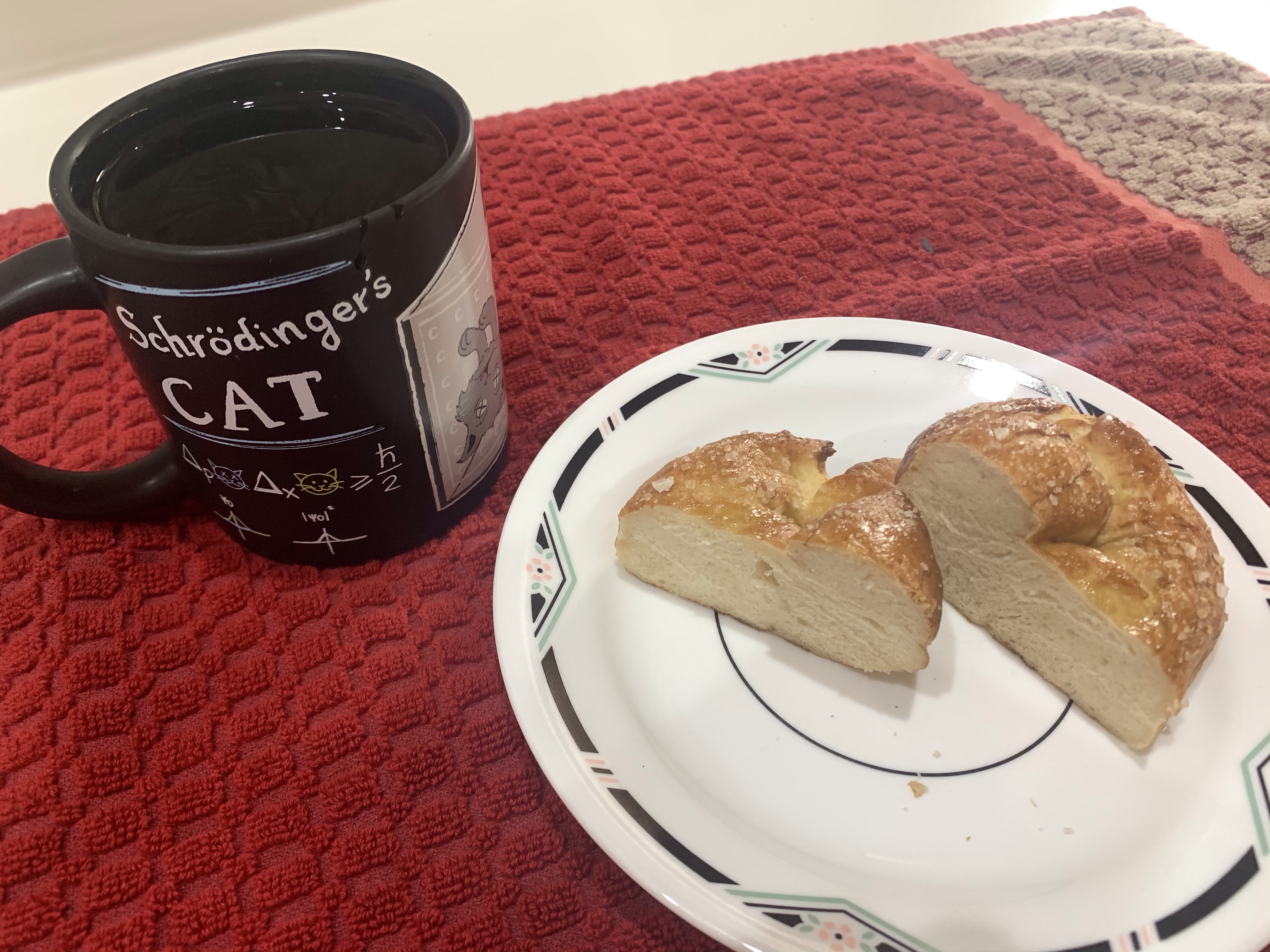
Today was the fourth attempt to perfect my large, soft and chewy bagels. Let’s say, 4 times is a charm, It’s gin to move on to other

In the past I altered the type of flour, I changed the rising and proofing times, I developed a new way to poach the pretzel dough, I changed the hydration ratio, but ultimately it was advise from the King Arthur Baking chat line that made the day.

This time I followed the directions below and couldn’t be happier. The texture, taste and appearance are all spot-on to my vision.

Pretzels Higher Hydration and Improved Method

INGREDIENTS
• 1 cup water
• ½ cup 2% milk including 2 Tbl heavy cream
• 4½ tsp. white sugar
• 1½ tsp. salt
• 2¼ tsp active dry yeast
• 575 (5½ c) bread flour
• 50g (3½ Tbl) unsalted butter, melted – cooled slightly
• Vegetable oil or spray
• 12 cups water
• 2 Tbl light malt powder
• 5 Tbl baked baking soda
• 1 large egg yolk
• 1 Tbs. Milk
• Kosher salt
METHOD

  1. Melt the 50g of butter and set aside to cool.
  2. Heat the water in the microwave for 20-30 sec to achieve a temperature of about 120-130 deg then combine with the cold milk in a large measuring cup for a resulting solution temperature of 110 to 115 degrees F.
  3. Add the sugar and salt to the warmed water and milk and stir to combine. Sprinkle in the yeast and mix with a fork. Allow the mixture to sit for about 5 minutes or until it becomes foamy.
  4. Pour the foamy mixture into a large bowl and add the melted, cooled, unsalted butter and flour a cup at a time. Mix by hand with a Dutch style hand mixer until no dry flour remains in the bowl. If necessary, add one or two tablespoons of water the be sure the dough comes together as a smooth ball, Knead by hand for 7 minutes. It’s done kneading when it is smooth and firm to the touch and not sticky. Don’t over-knead.
  5. Remove the dough from the bowl and form into a ball. Wipe out the bowl and grease it with 1-2 tablespoons of oil. Place the dough ball back into the bowl and turn over a couple of times to coat thoroughly with the oil. Cover the bowl with a dish towel or plastic wrap and place in a warm area, free from drafts or cool air for about 1 hour, until the dough has risen and doubled in size.
  6. When the dough is ready, preheat the oven to 450○F and position the oven rack in the upper third of the oven. Line a large (15″ x 20″) baking sheet with parchment paper and spray with Bakers Joy. Set aside.
  7. In a small bowl, whisk together the egg yolk with 1 tablespoon of milk (egg wash). Set aside.
  8. In a large, wide pot (6-8 quarts) add 12 cups of water, baked baking soda and malt powder. Stir to combine and bring to a full boil.
  9. In the meantime, dampen a kitchen towel with water and set aside. Lightly grease a clean work surface with some vegetable oil (spraying with Bakers Joy worked well too). Remove the dough from the bowl and de-gas by punching down the dough. The dough should weigh ~925g. Place it on the work surface and divide into 2, 3 or up to 8 equal pieces. [For large pretzels, divide dough into 2 or 3 pieces.] Cover the pieces that you’re not rolling with plastic wrap or a damp kitchen towel, so they don’t become dry. Using the palms of your hands, roll each piece of dough to a 24-30” [40” for large pretzel] long rope and then shape into a “U”. If the dough will not roll out to the desired length, set aside, under a damp cloth, and let rest for 10-15 minutes, then try rolling again.
  10. Grab the ends of the rope and cross them over each other twice, then bring the ends down to the bottom of the ‘U” and press them down to seal, forming the shape of a pretzel. Lay the pretzel top-side down in the sieve/strainer
  11. Lower the sieve containing the pretzel into the boiling water mixture for about 30 seconds. Either push it down underwater or baste it. The pretzel will puff up while boiling. Flip the pretzel onto the parchment lined, (now top side up) sprayed baking sheet a few inches apart. Repeat for the other pretzels.
  12. Using a pastry brush, brush the top and sides of each pretzel with the egg wash and then sprinkle with coarse salt.
  13. Place the pretzel filled baking sheet on the upper oven rack and bake for about 7 minutes.
  14. Open the oven and quickly rotate the baking sheet so that the pretzels that were facing the front are now facing the rear of the oven. It may seem like a pain, but it’s quick and easy and will ensure even baking.
  15. Continue to bake for another 7 minutes or until pretzels are dark golden brown.
  16. Remove sheet from oven and place pretzels on a wire rack to cool slightly before serving.

Outrageously good if served warm. Mildly spectacular if served later.

The BIG Pretzel Experiment

Last week we went to dinner at Kathrin’s Biergarten with a friend from Florida. They have amazing big pretzels, so of course I had to try my hand. My “normal” sized pretzels are soft and chewy with great pretzel taste so how hard could BIG pretzels be? (More than you would think.)

My first batch this morning was made using the same recipe as my normal pretzels except instead of cutting the dough into 8 pieces, I only cut it into 2. The problem came with rolling each piece into looooonnnngggg logs. To make a 10” diameter pretzel the log needed to be 31” plus the extra to for the knot. (Remember C= Pi x D?) I thought 42” long would be about right. The problem is I couldn’t roll it out longer than about 32’ resulting in a thick 8” diameter “Hulk” of a pretzel. Great taste, great chew, but thick and not very pretzely.

With the second batch I cut back on the amount of flour (600 g instead of 687g) hoping the dough would be more flexible and elastic. It was better, but still would only roll to about 38” long.

Upon reading how to reduce the amount of gluten which should increase the stretchiness, next time I will double the amount of butter. This is supposed to coat the gluten strands and increase the stretchinenss of the dough. (Two batches of these bad boys was enough for today.)

I made up enough words for today. In any event the pretzels were all delicious. Just sayin’.

Pretzels

Note: the dough was too firm. It needs to be slacker to roll out to the desired length. Try 1¼ cups water OR 5 cups of flour

INGREDIENTS
• 1 cup water
• ½ cup regular milk (not fat-free milk)
• 4 ½ tsp. white sugar – regular table sugar
• 1 ½ tsp. salt
• 2 ¼ tsp active dry yeast
• 687g (5 ½ c) flour – poured & leveled – not scooped flour! (Second Batch – 625g or 5 c)
• 50g (3 ½ Tbl) unsalted butter, melted – cooled slightly
• Vegetable oil or spray
• 8 cups water
• 1 Tbl light malt powder
• 4 Tbl baked baking soda
• 1 large egg yolk
• 1 Tbs. water
• Kosher salt

METHOD

  1. Melt the 50g of butter and set aside to cool.
  2. Heat the water in the microwave for 20-30 sec to achieve a temperature of about 120-130 deg then combine with the cold milk in a large measuring cup for a resulting solution temperature of 110 to 115 degrees F.
  3. Add the sugar and salt to the warmed water and milk and stir to combine. Sprinkle in the yeast and mix with a fork. Allow the mixture to sit for about 5 minutes or until it becomes foamy.
  4. Pour the foamy mixture into the bowl of a stand mixer fitted with a dough hook and add the melted, cooled, unsalted butter and flour. (I add the flour a cup at a time to be sure it mixes well.) Mix on low speed for until combined and no dry flour remains in the bowl. Scrape the bowl as needed. If necessary add one or two tablespoons of water the be sure the dough comes together as a smooth ball, Continue to mix for about another 7 minutes or until the dough pulls away from the sides of the bowl and is smooth. Scrape the dough from the hook if it comes up to far. Note: The dough may begin to pull away from the bowl after only 2 minutes but may look a bit pulled or shaggy and still be sticky. The dough should clean the sides of the mixer bowl. It’s not done kneading until it is smooth and firm to the touch and not sticky.
  5. Remove the dough from the bowl and form into a ball. Wipe out the bowl and grease it with 1-2 tablespoons of oil. Place the dough ball back into the bowl and turn over a couple of times to coat thoroughly with the oil. Cover the bowl with a dish towel or plastic wrap and place in a warm area, free from drafts or cool air for about 1 hour, until the dough has risen and doubled in size.
  6. When the dough is ready, preheat the oven to 450○F and position the oven rack in the upper third of the oven. Line a large (15″ x 20″) baking sheet with parchment paper and spray with Bakers Joy. Set aside. Note: You may need 2 baking sheets to avoid crowding the pretzels. If only one small, puny sheet is available, make one batch of pretzels and keep the remaining dough covered, so it does not become dry. Between batches, allow the baking sheet to cool, before filling with remaining pretzels.
  7. In a large, wide pot (6-8 quarts) add 8 cups of water, baked baking soda and malt powder. Stir to combine and bring to a full boil. Place a plate lined with paper towels nearby, as well as the kitchen spider or slotted spoon.
  8. In the meantime, dampen a kitchen towel with water and set aside. Lightly grease a clean work surface with some vegetable oil (spraying with Bakers Joy worked well too). Remove the dough from the bowl, place it on the work surface and divide into 8 equal pieces. [For large pretzels, divide dough into two pieces.] Cover the pieces that you’re not rolling with plastic wrap or a damp kitchen towel, so they don’t become dry. Using the palms of your hands, roll each piece of dough to a 24-30” [40” for large pretzel.] long rope and then shape into a “U”. Grab the ends of the rope and cross them over each other once or twice and then bring the ends down to the bottom of the ‘U” and press them down to seal, forming the shape of a pretzel. Place the pretzels onto the greased parchment-lined baking sheet and cover with a damp kitchen towel to prevent the dough from drying out, while you continue to roll the remaining dough. You can also cut some of them into 1 ½” logs to make nuggets
  9. In a small bowl, whisk together the egg yolk with 1 tablespoon of water (egg wash). Set aside.
  10. One at a time, lower each pretzel into the boiling water mixture for about 30 seconds. I push them down underwater a few times to assure the top is treated as well. The pretzels will puff up while boiling. Using a kitchen spider or slotted spoon, carefully remove the pretzel from the water, blot slightly on paper towels and then place back onto the parchment lined greased or sprayed baking sheet a few inches apart.
  11. Using a pastry brush, brush the top and sides of each pretzel with the egg wash and then sprinkle with coarse salt.
  12. Place the pretzel filled baking sheet on the upper oven rack and bake for about 7 minutes. (12 minutes for large pretzels.)
  13. Open the oven and quickly rotate the baking sheet so that the pretzels that were facing the front are now facing the rear of the oven. It may seem like a pain, but it’s quick and easy and will ensure even baking.
  14. Continue to bake for another 7 minutes or until pretzels are dark golden brown. (12 minutes for large pretzels.)
  15. Remove sheet from oven and place pretzels on a wire rack to cool slightly before serving.

Outrageously good if served warm. Mildly spectacular if served later.

Pretzel Day

QC asked for some pretzels for her Maj Jongg game tomorrow and after 18 holes of poorly played golf this morning, that was exactly what I needed to do.

The Soft Chewy Pretzels I make are pretty easy and only take a couple of hours.

Forgive my hubris, but these pretzels are wonderful. Definitely worth making more often,

Soft, Chewy Pretzels

We needed a thank you gift for a friend, who happens to love my soft, chewy pretzels and as my golf was cancelled due to rain…

I had trouble rolling the dough into long enough ropes to make good pretzel “knots.” I believe the dough wasn’t wet enough to allow the 24”-30” rope. Today’s was only about 18”.

That aside the flavor and texture was wonderful. QC gave it a big thumbs up.

Not a Gordian Knot

Dan and Frances made these pretzel knots yesterday and sent me the recipe. They are every bit as good as they said. Great texture and perfect soft pretzel taste.

This recipe avoids the nuisance of placing the pretzels in a an alkaline and malt bath but doing that may make the nice pretzel color. Maybe next time. This is much easier and makes clean-up a snap.

Jack’s Garlic Pretzel Knots


• ¾ cup warm water (105°F to 115°F)
• 1 tablespoon maple syrup
• 1 (¼-ounce) package active dry yeast
• 1½ cups all-purpose flour, plus more for kneading
• ½ cup whole wheat flour
• 1 teaspoon sea salt
• 4 tablespoons extra-virgin olive oil, plus more for brushing
• 1 garlic clove, minced
• ¼ teaspoon lemon zest
• Coarse salt, for sprinkling

Prep and Cook

  1. In a small bowl, stir together ¼ cup of the water, maple syrup, and the yeast. Set aside for 5 minutes, until the yeast is foamy
  2. In the bowl of a mixer fitted with a dough hook, place the flours and salt. Add the yeast mixture, 2 tablespoons of the olive oil, and the remaining ½ cup of water. Mix on medium speed until the dough forms a ball around the hook, 5 to 6 minutes.
  3. Turn the dough out onto a lightly floured surface and knead several times, sprinkling with more flour, as needed, and form into a ball. Brush a large bowl with olive oil, and place the dough inside. Cover with plastic wrap and set aside to rise until doubled in size, 40 to 60 minutes.
  4. Preheat the oven to 450°F and line a baking sheet with parchment paper. Uncover the dough, punch it down and transfer to a lightly floured surface. Cut the dough into 8 equal sections, and roll each section into a 9-inch-long rope. Grab the ends of each dough rope, tie into a knot, and tuck in the ends.
  5. In a small bowl, combine the remaining 2 tablespoons olive oil, the garlic, and lemon zest. Set aside.
  6. Bake the pretzel knots for 10 to 12 minutes, or until golden brown. Brush the garlic oil onto the hot pretzel knots and sprinkle each with coarse salt.