Key Lemon Tarts

You may remember from a previous post that a friend gave me a dozen small lemons from her tree and I made Lemon-Honey Madeleine cookies for her in return. That prompted her to give me two dozen more lemons. I made some gluten free tartlet shells for QC’s mahjong group (one of whom is gluten intolerant) and 5” tart shells for the neighbor QC Corps.

I did a search for different meringue/tart piping ideas and liked this one. After torching, I sprinkled some lemon zest on the top and will ultimately add a blueberry to each small tartlet and two or three to each large one.

Key Lemon Pie and Tarts

INGREDIENTS
Filling
• 14 ounces sweetened condensed milk 1 can
• 4 large egg yolks
• 1/2 cup fresh lemon juice (about 3-4 lemons)
• 2 teaspoons fine lemon zest no white
• 1 graham cracker crust gluten-free if desired
• optional whipped cream lemon zest and lemon slice(s) for garnish
Graham Cracker Crust
• 1 ½ cups finely crushed regular or cinnamon graham crackers (24 squares)
• 1/3 cup butter, melted
• 1 beaten egg white
• 3 tablespoons sugar

METHOD
Filling

  1. Zest, then juice lemons, to get 2 teaspoons of zest and 1/2 cup of juice.
  2. Whisk together sweetened condensed milk, egg yolks, zest and lemon juice (add half at a time) until well combined.
  3. Pour filling into prepared crust and bake for 15 minutes at 350 F. Cool pie completely on rack, then chill for a minimum of 1-2 hours (filling will continue to set as it cools). Store covered.
  4. Optionally, before serving, top with whipped cream rosettes, lemon zest and lemon slice(s)

Graham Cracker Crust

  1. Heat oven to 350°F.
  2. In a food processor pulse the crushed graham crackers several times, then add the rest of the ingredients until well mixed.
  3. Reserve 3 tablespoons crumb mixture for garnishing top of pie before serving, if desired. Press remaining mixture firmly and evenly against bottom and side of pie plate.
  4. Bake at 350 F for 10 min. Set aside to cool

OPTIONAL Tartlet Shell
INGREDIENTS

• 50 g cold butter cut into small cubes
• 100 g all-purpose flour
• 30 g icing sugar
• ¼ tsp vanilla
• ⅛ tsp salt
• 1 egg – ½ for the dough and the other ½ reserved for an egg wash

METHOD

  1. Mix butter with sugar
  2. Add salt then vanilla
  3. Add egg and beat until incorporated. It may not be smooth.
  4. Stir in flour. Mix by hand until incorporated
  5. Cover with plastic and refrigerate for 30 min
  6. Butter or spray tartlet pans, or use non-stick pans
  7. Roll dough to ~ ⅛” thick, then lay over tart mold and press into all crevices and roll top to cut off excess. Cover and refrigerate 30 minutes
  8. Prick holes in bottom and sides of formed dough
  9. Fill tarts with pastry weights (I put weights in a cupcake paper for small tartlets and crumpled and form fitted to the larger tart molds.)
  10. Paint edges of the tartlet with the egg wash.
  11. Bake in preheated oven 350 deg F (175 C) for 15 min (Remove wights and papers 5 minutes before the end of the bake.)
  12. Immediately remove from pans and cool on a wire rack

ITALIAN MERINGUE

INGREDIENTS

  • 150g (or ¾ cup) granulated sugar
  • 60ml (or ¼ cup) water
  • 60g (or ¼ cup) egg whites (about 2 large egg whites)

METHOD

  1. In a medium-sized saucepan, combine the sugar and water. Heat over low heat, stirring until the sugar has dissolved. Once the sugar has dissolved, turn the heat to medium-high and allow the syrup to come to a boil.
  2. In the meantime, add the egg whites to a medium-sized, heatproof bowl and mix (with a mixer fitted with the whisk attachment) until foamy and the whites are almost able to hold soft peaks.
  3. Once the syrup is boiling, clip on a candy (or sugar) thermometer.
  4. Cook until the syrup reaches 116°C/240°F, then take the pan off the heat and slowly drizzle the hot syrup into the bowl with the foamy egg whites, mixing continuously to prevent the eggs from scrambling. Don’t pour the syrup onto the whisk, or the syrup may splatter against the sides of the bowl (or into your face!). Instead, aim for a spot close to the whisk.
  5. Once all the syrup has been added, keep mixing until the bottom of the bowl feels cool to the touch and the meringue has cooled down to body temperature.
  6. Use immediately or keep in the fridge (covered) until ready to use. It’s a very stable meringue, so it won’t start weeping, leaking or collapsing.

NOTES

Italian meringue can be made two days in advance and stored in the fridge until needed (covered with plastic wrap).
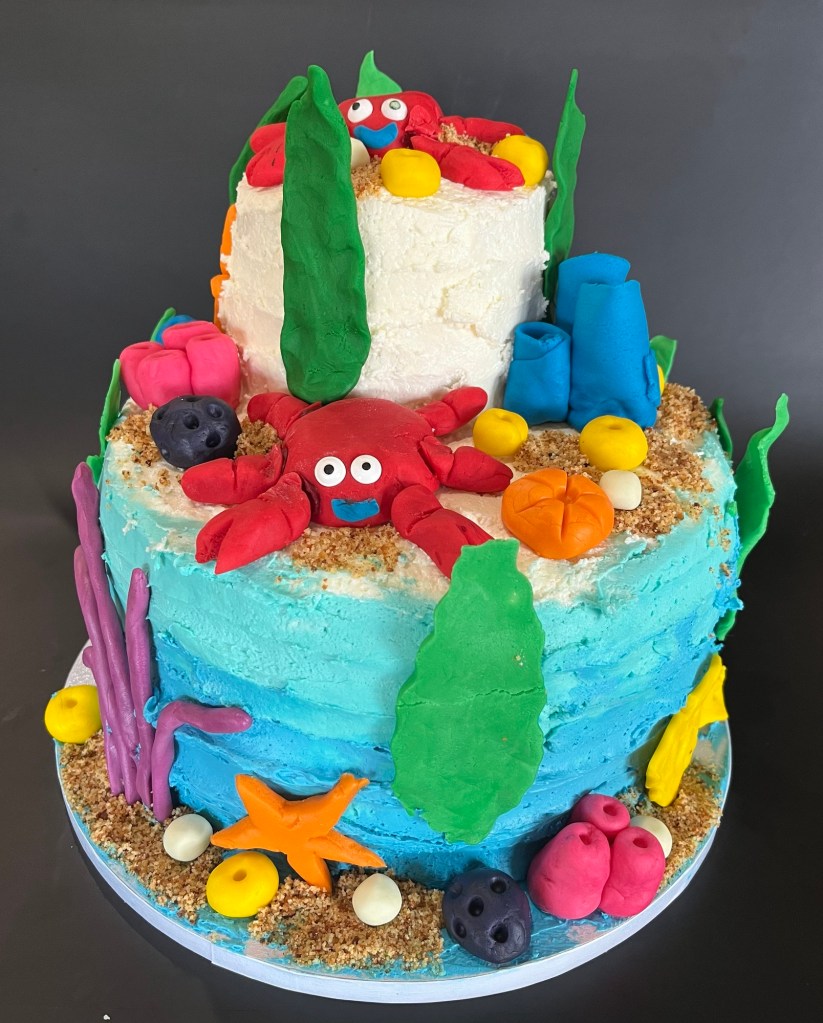
Lucy Van Pelt Was Crabby Too

To make a cake for a “Crab Fest” charity auction, I searched the internet for some crab themed cakes. I designed mine based on several ideas I found..

It’s a three layer Extreme Chocolate Cake and a two layer Vanilla Cake. The decorations are Marshmallow Fondant and the sand is blitzed vanilla cake scraps.

The crumb coat is American Buttercream and the finish frosting is Italian Meringue Buttercream.

Vanilla Layer Cake


INGREDIENTS
VANILLA CAKE

  • 1¼ cups (162g) all-purpose flour
  • 1¼ tsp baking powder
  • ¼ tsp salt
  • 6 Tbl (84g) unsalted butter, room temperature
  • ¾ c (155g) sugar
  • 1 ½ Tbl vegetable oil
  • ½ Tbl vanilla extract
  • 2 large eggs
  • ½ c + 4 Tbl (150ml) milk

    METHOD
    For the Cake:
  1. Prepare two 5-inch cake pans with parchment paper circles in the bottom and baking spray or grease the sides. Preheat oven to 350°F (176°C).
  2. Combine the flour, baking powder and salt in a medium sized bowl and set aside.
  3. Add the butter, sugar, oil and vanilla extract to a large mixer bowl and beat together until light in color and fluffy, about 2-3 minutes. Do not skimp on the creaming time.
  4. Add the eggs one at a time, mixing until mostly combined after each. Scrape down the sides of the bowl as needed to be sure all ingredients are well incorporated.
  5. Add half of the dry ingredients to the batter and mix until mostly combined.
  6. Slowly add the milk and mix until well combined. The batter will look curdled, but that’s ok.
  7. Add the remaining dry ingredients and mix until well combined and smooth. Scrape down the sides of the bowl as needed to be sure all ingredients are well incorporated. Do not over mix the
    batter.
  8. Wrap each pan with wet cake pan strips then divide the batter evenly between the cakes pans (~320g per cake pan.) and bake for ~28 minutes, or until a toothpick comes out with a few
    crumbs. (205°F) If the tops of the cakes brown too much, cover with foil after ~20 minutes.
  9. Remove the cakes from the oven and allow to cool for about 2-3 minutes, then remove to cooling racks to cool completely.

Madeleine Cookies

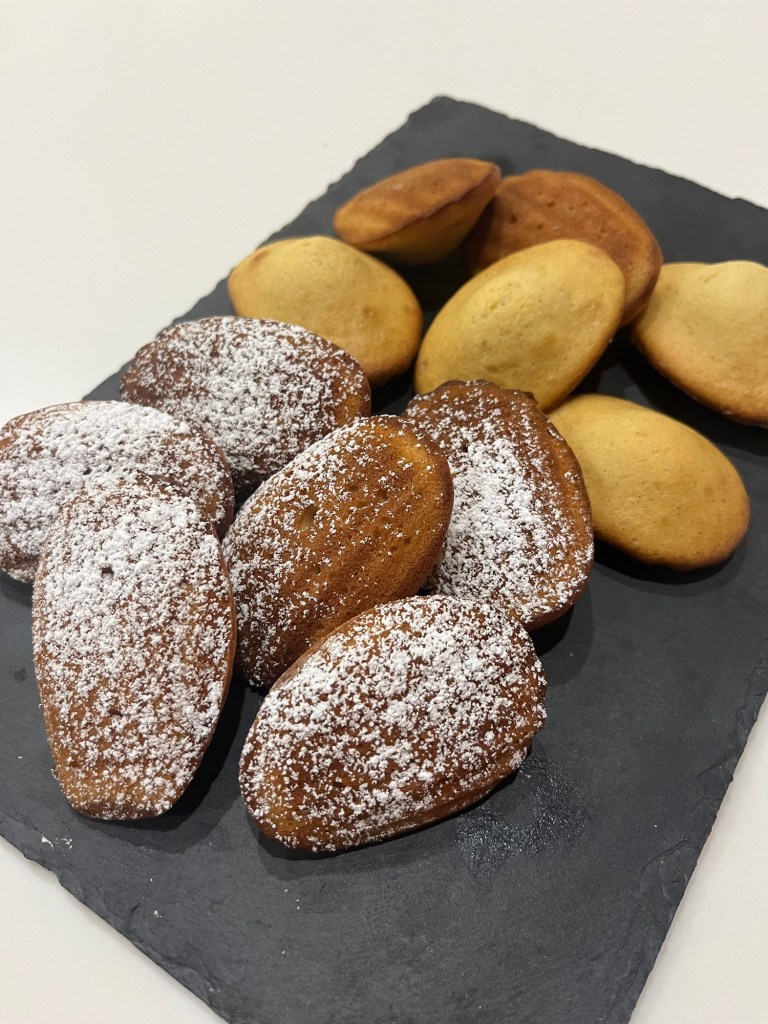
I was given a dozen miniature lemons from a friend. I decided to return them to her after some “processing.” She is also off processed sugar, so I substituted honey for the granulated sugar.

This morning’s batch was good, but slightly over-baked. The tops didn’t look quite brown enough, but after removing them from the pan I discovered they were indeed over-baked. This recipe was adapted from Ricardo Cuisine.

I reduced the baking time by 2 minutes for this evening’s batch (a different recipe from this morning. This recipe was adapted from Baker By Nature.) For the final batch tomorrow I’ll reduce the time by another minute. I would like the fluted side to be a nice golden brown. If you try this recipe I would suggest adding a few tablespoons of lemon juice.

Madeleine– Classic French

INGREDIENTS
• 1 stick (4 ounces) unsalted butter, melted until browned
• 2 tsp vanilla extract
• 3 tsp lemon zest, finely grated.
• 1 c all-purpose flour
• 1 ¼ tsp baking powder
• ¼ tsp salt
• 3 large eggs, at room temperature
• 3/4 c granulated sugar (optional 125 g honey)
• ½ c confectioners sugar, sifted, (optional)

METHOD

  1. Cut the butter in tablespoons and place them in a heavy saucepan over medium heat. Once the butter has melted, reduce the heat to low and continue cooking, until the solids sink to the bottom of the pan and turn golden brown, about 10 minutes. Remove from heat and pour the browned butter into a small bowl. Stir the vanilla and lemon zest into the butter, then set aside to cool.
  2. In a medium mixing bowl, whisk together the flour, baking powder, and salt. Set aside until needed.
  3. In the bowl of a stand mixer fitted with the whisk attachment, beat the eggs at medium speed while gradually adding the sugar. Once all of the sugar has been added, increase the speed to medium-high and continue whipping the mixture until it’s very thick and pale in color, about 3 to 4 minutes. Turn the mixer off and, using a silicon spatula, fold in the flour mixture in three additions, stirring just until combined. Fold in the butter mixture.
  4. Cover the bowl and refrigerate for at least 4 hours, and up to 2 days.
  5. 30 minutes before you’re ready to bake, preheat the oven to 375 degrees (F). Generously brush the molds of your madeleine pan (even if they are non-stick) with butter.
  6. Spoon teaspoons full of the batter into the center of each mold. You don’t need to spread the batter.
  7. Bake for 10-11 minutes, or until the “bellies” have risen and their tops are a very light golden.
  8. Cool madeleines in the pan placed on a cooling rack for a minute or two, then gently loosen them from the molds. If they stick, carefully run a small knife around the edge of the cakes until they release.
  9. Dust with confectioners’ sugar and serve warm, with coffee or tea.

No Knead Crusty White Bread

KAB to the rescue! I made their No Knead Crusty White Bread this morning. Mix ingredients, let sit 2 hours, refrigerate 2 (and more) hours shape, let rise, bake, enjoy.

This is a very easy 75% hydration bread that takes very little hands on time and is exceptional. I made half (630g) on a stone today and will make the other half in a day or two, but use a Dutch Oven.

No Knead Crusty White Bread – KAB

INGREDIENTS
• 7 1/2 cups (900g) AP Flour
• 3 cups (680g) water, lukewarm
• 1 tablespoon (18g) table salt
• 1 1/2 tablespoons (14g) instant yeast

METHOD

  1. Combine all of the ingredients in a large mixing bowl, or a large (6-quart), food-safe plastic bucket. “Lukewarm” means about 105°F.
  2. Mix and stir everything together for a minute in a stand mixer with blade to make a very sticky, rough dough. It will weigh roughly 1225g.
  3. Transfer to a greased plastic proofing bucket and let the dough rise for 2 hours at room temperature.
  4. Then refrigerate it for at least 2 hours, or for up to about 7 days. (If you’re pressed for time, skip the room-temperature rise, and stick it right into the fridge). The longer you keep it in the fridge, the tangier it’ll get; if you chill it for 7 days, it will taste like sourdough. Over the course of the first day or so, it’ll rise, then fall. That’s OK; that’s what it’s supposed to do.
  5. When you’re ready to make bread, sprinkle the top of the dough with flour; this will make it easier to grab a hunk. Grease your hands and pull off about 1/4 to 1/3 of the dough — a 400g to 540g piece, if you have a scale. It’ll be about the size of a softball, or a large grapefruit.
  6. Plop the sticky dough onto a floured work surface, and round it into a ball, or a longer log. Roll around the table to tension the surface.
  7. Place the loaf on a piece of parchment (if you’re going to use a baking stone); or onto a lightly greased or parchment-lined baking sheet. Sift a light coating of flour over the top; this will help keep the bread moist as it rests before baking. Drape the bread with greased plastic wrap or cover it with a reusable cover.
  8. Let the loaf warm to room temperature and rise; this should take about 60 minutes (or longer, up to a couple of hours, if your house is cool). It won’t appear to rise upwards that much; rather, it’ll seem to settle and expand. Preheat your oven to 450°F while the loaf rests. If you’re using a baking stone, position it on a middle rack while the oven preheats. Place a shallow metal or cast iron pan (not glass, Pyrex, or ceramic) on the lowest oven rack, and have 1 cup of hot water ready to go.
  9. When you’re ready to bake, take a sharp knife and slash the bread 2 or 3 times, making a cut about 1/2″ deep. The bread may deflate a bit; that’s OK, it’ll pick right up in the hot oven.
  10. Place the bread in the oven — onto the baking stone, if you’re using one, or simply onto a middle rack, if it’s on a pan — and carefully pour the 1 cup hot water into the shallow pan on the rack beneath. It’ll bubble and steam; close the oven door quickly.
  11. Bake the bread for 25 to 35 minutes, until it’s a deep, golden brown.
  12. Remove the bread from the oven and cool it on a rack.
  13. Store leftover bread in a plastic bag at room temperature

Notes:
• To freeze the dough, divide into 2 parts, deflate, roll into balls, wrap in plastic wrap and label. Store in freezer for up to 2 weeks

Blackberry/Yuzu Meringue Tarts

I am trying to remember how these tarts made it into Dede’s baking schedule. I didn’t have any leftover ingredients from another bake, or some ingredient that was about to expire. Most likely a picture caught my attention, and as I have no will power…

I used my go to short crust pastry for the tart shell and a standard Italian meringue to top the tart. The blackberry/yuzu curd was a new recipe but again, pretty standard. The final result was an outstanding synergy between all the parts. A real keeper.

Blackberry/Yuzu Meringue Tarts

INGREDIENTS
Plain flour, for rolling

Shortcrust pastry
• 100 g cold butter cut into small cubes
• 60 g icing sugar
• ½ tsp vanilla
• ¼ tsp salt
• 2 egg – 1 for the dough and the other 1 reserved for an egg wash
• 200 g all-purpose flour
Meringue
• 150g (or ¾ cup) granulated sugar
• 60ml (or ¼ cup) water
• 60g (or ¼ cup) egg whites (about 2 large egg whites)
Curd
• 450g blackberries
• 2 Tbl yuzu juice
• 4 Tbl corn starch
• 325g caster sugar
• 100g unsalted butter, cubed
• 4 egg yolk
• 1 large egg

METHOD

  1. For the Shortbread Pastry – Cut the butter into the sugar
    a. Add salt then vanilla
    b. Add egg and mix until incorporated
    c. Stir in flour. Mix by hand like you are kneading bread until incorporated
  2. For the pastry case – Roll out the pastry to ¼” thick. Gently push the pastry into the tart case leaving a little overhanging the edges.
    a. Trim the excess pastry but leave a little overhang. Chill for 30 minutes.
    b. Preheat the oven to 400ºF. Line the pastry with baking parchment, fill with baking beads and blind bake for 20 minutes. Remove the paper and beans; bake for a further 5-6 minutes, until golden. Set aside to cool. Reduce the oven temperature to 350ºF.
  3. For the curd – put the berries and yuzu juice in a food processor, blend until smooth. Pass through a sieve into a large bowl (you should have 1 ½ c). Discard the seeds.
    a. In a large, heavy-based pan, mix the corn starch and sugar, then stir in the blackberry mixture. Cook over a medium heat, stirring with a balloon whisk, until thick and smooth.
    b. When it starts to bubble, take it off the heat and whisk in the butter until melted. Leave to cool slightly, then whisk in the egg yolks and the whole egg. Return the mixture to the heat, whisking for 5-8 minutes until it becomes a very thick dropping consistency. Set aside.
  4. For the meringue –
    a. In a medium-sized saucepan, combine the sugar and water. Heat over low heat, stirring until the sugar has dissolved. Once the sugar has dissolved, turn the heat to medium-high and allow the syrup to come to a boil.
    b. In the meantime, add the egg whites to a medium-sized, heatproof bowl and mix (with a mixer fitted with the whisk attachment) until foamy and the whites are almost able to hold soft peaks.
    c. Once the syrup is boiling, clip on a candy (or sugar) thermometer.
    d. Cook until the syrup reaches 116°C/240°F, then take the pan off the heat and slowly drizzle the hot syrup into the bowl with the foamy egg whites, mixing continuously to prevent the eggs from scrambling. Don’t pour the syrup onto the whisk, or the syrup may splatter against the sides of the bowl (or into your face!). Instead, aim for a spot close to the whisk.
    e. Once all the syrup has been added, keep mixing until the bottom of the bowl feels cool to the touch and the meringue has cooled down to body temperature.
    f. Use immediately or keep in the fridge (covered) until ready to use. It’s a very stable meringue, so it won’t start weeping, leaking or collapsing.
  5. Assembly –
    a. Fill the tart case with the warm curd and let cool.
    b. Pipe the meringue as stars covering about half of the top and add a raspberry or other decoration.

Pan de Cristal – Revisited

I first made this bread about two years ago. I was hesitant to make it again as it isn’t the easiest loaf to make. It’s 100% hydration which means equal parts flour and water. This makes a very soft, slack, tricky dough to handle, However, this weekend I saw a great tutorial on YouTube by Martin Philip at King Arthur Baking. He demonstration how to make it much easier, I decided to give it another try. (My no golf weekend is not over.)

Watch his tutorial and give it a try. It still isn’t the easiest, even with his help, but it is well worth the effort. It has a crisp crust and the texture of air inside. A little butter, or some oil and vinegar REALLY sets this bread off.

Pan de Cristal

INGREDIENTS
• 500g water (80 F in warm weather, 100F if cold)
• 500g Bread Flour
• 2.5g (3/4 teaspoon) instant yeast
• 10g salt
• 15g olive oil

METHOD

  1. To make the dough: Weigh your flour; or measure it by gently spooning it into a cup, then sweeping off any excess.
  2. In a medium bowl, mix the water, flour, yeast, and salt until thoroughly combined and homogenous. Note: The dough starts off very slack and wet. That’s OK; it will transform itself through time and folds.
  3. Oil a two-quart rectangular baking dish (10” x 7”) with the olive oil. If you don’t have a 2-quart dish, an 8” or 9” square pan will work. Don’t worry about any pan you use being oven-safe; you won’t be baking the bread in it.
  4. Pour the dough into the pan. Check the dough’s temperature by inserting a digital thermometer into the center. If it’s less than 72°F, move the pan to a warmer spot, e.g., your oven with the light turned on.
  5. Cover the pan and allow the dough to rest for 20 minutes.
  6. Start with a bowl fold: Use your wet hands to grab a section of dough from one side, lift it up, then press it down into the middle. Repeat this around the pan eight to 12 times.
  7. Cover the dish and allow the dough to rest for 20 minutes.
  8. Then do a coil fold: With wet hands, reach under the dough and stretch the middle upward until the dough releases from the dish. Roll it forward off your hands, allowing it to fold over (or “coil”) on itself. This is called a coil fold. Rotate the dish 90 degrees (a quarter turn) and repeat. Continue performing this folding action until the dough feels like it won’t stretch and elongate easily, usually four to five times initially. Note: You’ll be doing this three more times, each time building strength and developing the dough.
  9. Cover the pan and allow the dough to rest for 20 minutes.
  10. Repeat the coil fold. Cover the bowl and allow the dough to rest for 20 minutes.
  11. At this point, the dough should be easier to handle and feel tighter. Repeat the coil fold using only two or three folds this time. Cover the bowl and allow the dough to rest for 20 minutes.
  12. Repeat the coil fold one last time, using only one or two folds if the dough is relatively strong. Cover the bowl and allow the dough to rest for about 80 minutes.
  13. To divide the dough: As gently as possible, turn the dough out onto a heavily floured surface, maintaining the rectangle or square shape – be careful not to deflate the delicate dough. Sprinkle a generous amount of flour on top of the dough, leaving no exposed sticky spots. Then, working as gently as possible, use a bench knife or other sharp knife to divide it into four pieces. Gently place two pieces on a piece of parchment, leaving space between them. Repeat with the remaining two pieces of dough, placing them on another piece of parchment.
  14. Allow the loaves to rest at room temperature for 2 hours, uncovered. While the loaves are resting, preheat the oven to 475°F with a baking stone or steel on a lower rack. Allow the oven to preheat for 1 hour to ensure it’s thoroughly heated. The loaves are ready for the oven when there are a few large bubbles on the surface of each loaf and they feel light and airy.
  15. To bake the bread: Carefully slide the two loaves (still resting on the parchment) into the oven onto the preheated stone or steel. If space is tight and the full sheet of parchment won’t fit on the stone or steel, cut the parchment between the two loaves and arrange them as best you can. Allow the other two loaves to continue to rest.
  16. Bake the loaves for 15 minutes, then transfer them, from the stone or steel, directly onto a rack in the upper third of the oven for an additional 13 to 15 minutes. Moving them allows the baking stone or steel to become hot again in preparation for the next two loaves. After a total of 30 minutes of baking, remove the loaves from the oven and allow them to cool on a rack.
  17. Repeat the process with the two remaining loaves. Cool the bread fully before slicing.
  18. Storage information: Wrap the bread loosely and store it at room temperature for up to several days; freeze for longer storage.

ET Call Home

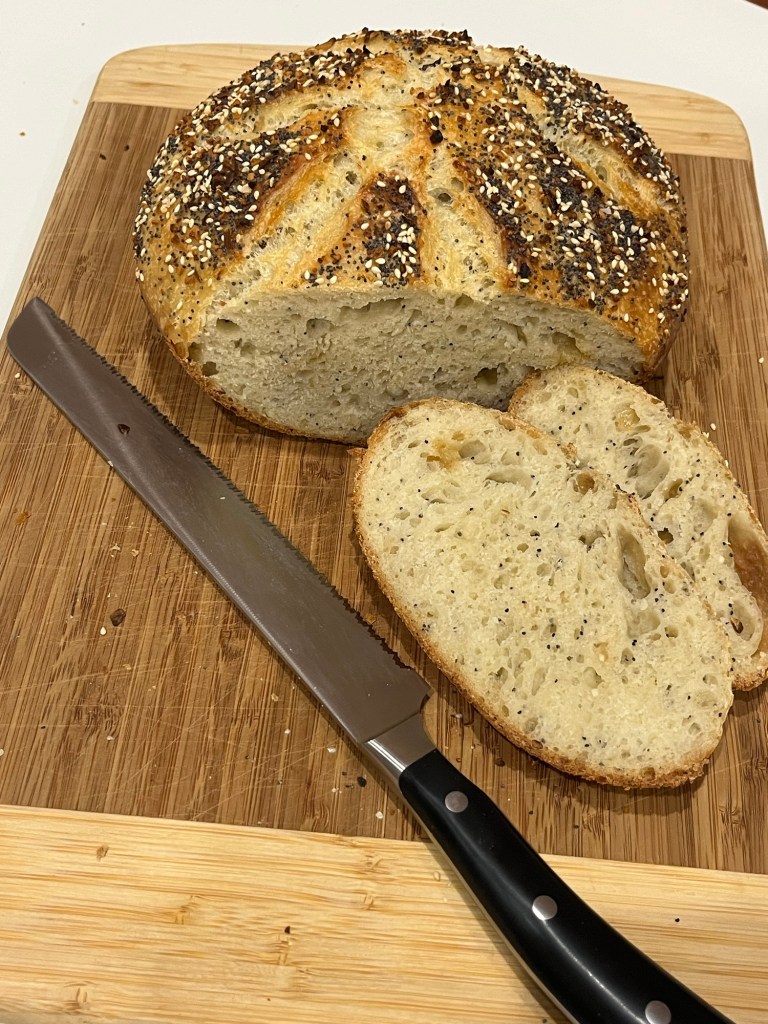
Another winning recipe from King Arthur Baking – Everything No-Knead Bread.

What’s nice about this bread is how easy it is to prepare and bake. It has a fantastic flavor and texture. It took about 30minutes to mix the ingredients (by hand), before it fermented, covered for 8 hours. It’s shaped, popped into a Dutch oven to proof for 1.5 – 2 hours, then baked for about an hour. That it! (Check the proofing by using the poke test. The first loaf was over proofed after 2 hours.)

No Knead Everything Bread – KAB

INGREDIENTS

Dough
• 2 1/4 c (510g) water, cool
• 5 1/2 c (660g) Unbleached Bread Flour
• 1/2 tsp instant yeast
• 2 tsp (12g) table salt
• 2 Tbl (18g) Everything Bagel Topping
• 2 Tbl (25g) olive oil
Topping
• 1 Tbl Everything Bagel Topping

METHOD

  1. Weigh your flour; or measure it by gently spooning it into a cup, then sweeping off any excess. Mix the dough ingredients in a large bowl to make a sticky dough. Or beat in a stand mixer for 3 minutes.
  2. Cover with plastic wrap, and let rest at room temperature overnight, or for at least 8 hours; the dough will become bubbly and rise quite a bit, so make sure it’s in a large bowl.
  3. Lightly grease a 14″ to 15″ long lidded stoneware baker, or 9″ to 10″ round lidded baking crock. Our bread baking crock and bread pot are both great choices.
  4. Turn the dough onto a generously floured surface; the dough will be slack. To shape the loaf, fold the dough over onto itself using a bench knife or well-floured hands. Because the dough is slightly sticky, it’s best to work quickly.
  5. Place the dough in the prepared pan, smooth side up.
  6. Cover and let rise at room temperature for about 2 hours, until a slight indentation remains when you poke it with your finger.
  7. Just before baking, spritz or brush the dough with water and sprinkle with about 1 tablespoon Everything topping over the dough. Using kitchen scissors, make several 1/2″ deep cuts in a decorative pattern on the top of the dough to allow the bread to expand.
  8. Replace the lid on the pot and put it in a cold oven; set the temperature to 450°F.
  9. Bake the bread for 50 minutes (start the timer once the bread goes into the oven), then remove the lid and continue to bake for another 5 to 10 minutes, until it’s deep brown in color, and a digital thermometer inserted into the center registers about 205°F.
  10. Remove the bread from the oven, turn it onto a rack, and cool before slicing.

KAB Recipe of 2024!

I received a personalized email from King Arthur Baking (along with probably a million other customers) proclaiming their selection of the recipe of the year for 2024. How could I resist.?

There were two interesting techniques that I never used in cookies. The first was making brown butter. This adds a rich caramel taste. The other was tangzhong, which is used in many Japanese breads to provide a soft, fluffy texture.

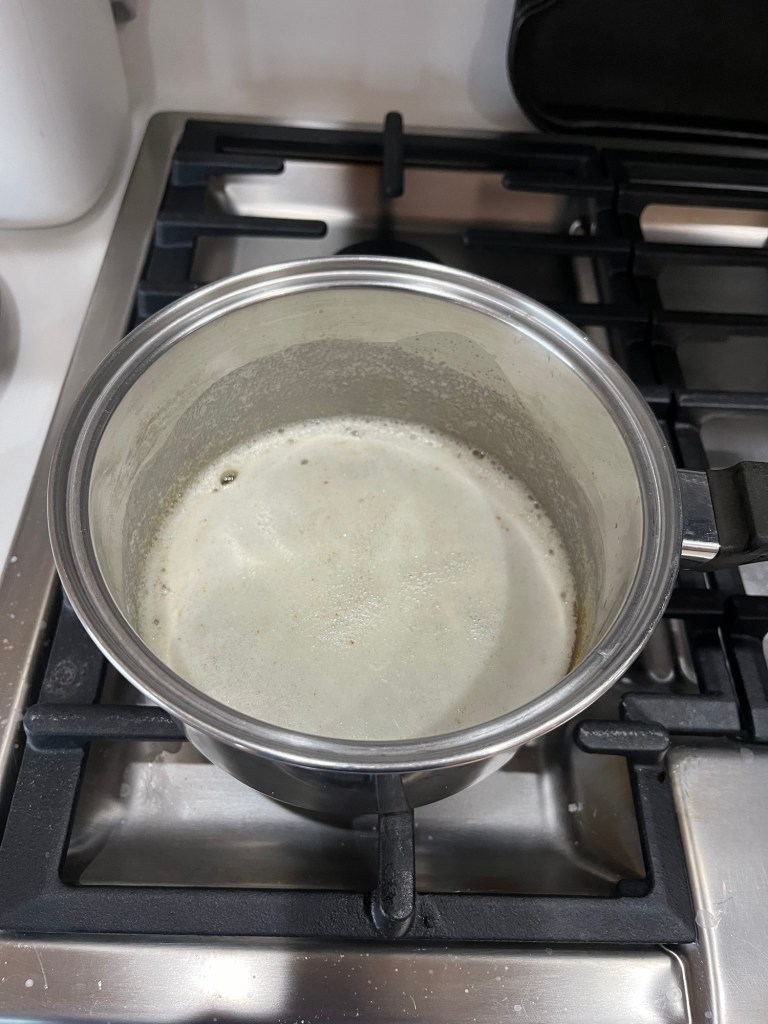
I never made brown butter before (but will again) and was an unsure when it was “done.” The recipe states it will foam near the end, but it also foams near the beginning. The second foam is very fine and if you stir the butter and you can see the browned butter with some bits stuck to the bottom of the pan.

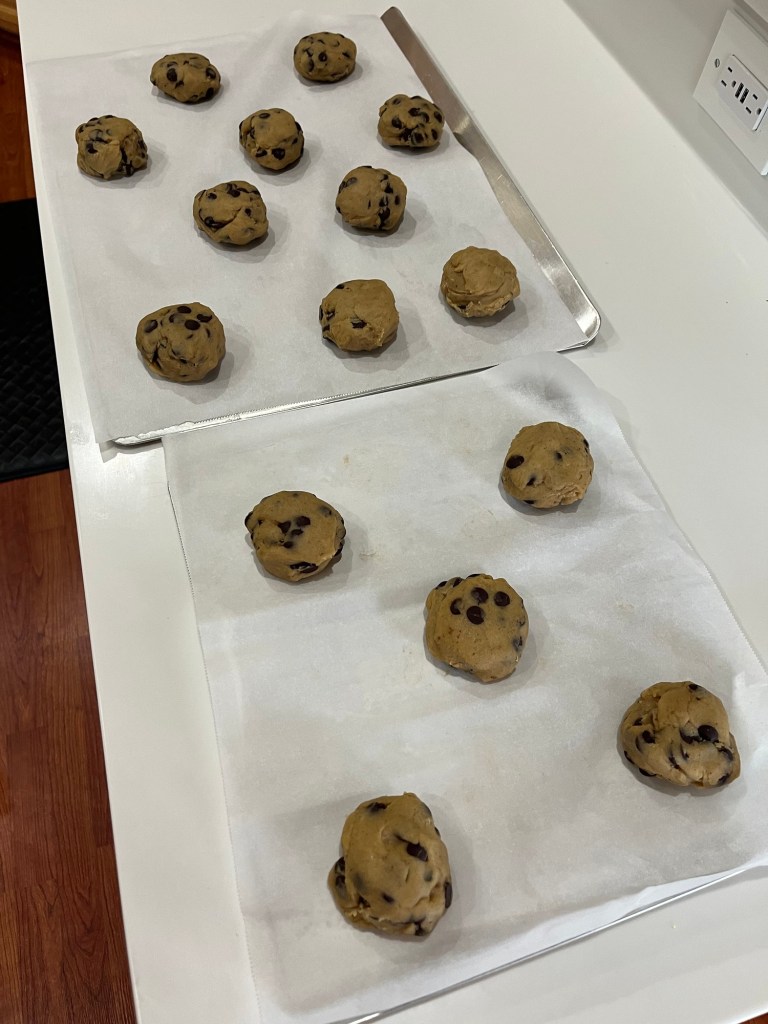
I also formed the dough into balls before refrigerating overnight. It seemed like s sensible step.

Chocolate Chip Cookies – Supersized, Super Soft from KAB

PREP-45 mins: BAKE-15 to 22 mins: TOTAL-1 day 1 hr: YIELD-16 to 17 large (4″) cookies or 28 medium (3″) cookies

INGREDIENTS
• 2 cups (426g) light brown sugar, packed
• 2 teaspoons table salt
• 16 tablespoons (226g) unsalted butter, cut into 1″ pieces
• 1/2 cup (113g) milk, whole preferred
• 2 3/4 cups (330g) King Arthur Unbleached Bread Flour, divided
• 2 large eggs, cold from the refrigerator
• 1 tablespoon King Arthur Pure Vanilla Extract
• 1 3/4 teaspoons baking powder
• 1/4 teaspoon baking soda
• 2 cups (340g) semisweet chocolate, preferably 60% to 65% cocoa content*
*Use chopped wafers or bars for best results; if using chocolate chips, chop them roughly before incorporating. (My chocolate chips were small so I didn’t chop them.)

METHOD

  1. In a large bowl, combine the brown sugar and salt. Set aside.
  2. To brown the butter: In a saucepan over medium-high heat, melt the butter. After several minutes, the butter will sizzle and may spatter. Continue to cook the butter, swirling the pan regularly, for about 5 to 7 minutes, until it’s a dark golden brown color and brown bits start collecting at the bottom of the pan; the butter will have stopped sizzling and may also have a layer of foam on the surface.
  3. Once the butter is browned, immediately pour it over the sugar mixture (be sure to scrape out the brown bits at the bottom) and whisk vigorously to combine; this helps dissolve the sugar slightly and creates the shiny surface of the baked cookies. (The mixture will stay lumpy and won’t become smooth at this point.) Set the empty saucepan aside to cool slightly.
  4. To make the tangzhong: In the same saucepan used to brown the butter, combine the milk with 3 tablespoons (23g) of the bread flour and whisk until no lumps remain.
  5. Place the saucepan over low heat and cook the mixture, stirring regularly with a whisk and then a flexible spatula, until it’s thickened, paste-like, and starts to come together into one mass, about 2 to 3 minutes.
  6. Remove from the heat and transfer directly to the bowl with the butter and sugar. Whisk until mostly smooth; some lumps of the tangzhong mixture are OK.
  7. Add the eggs and vanilla and continue whisking until smooth.
  8. Weigh or measure the remaining 2 1/2 cups plus 1 tablespoon (307g) bread flour by gently spooning it into a cup, then sweeping off any excess. Add the bread flour to the bowl with the butter and sugar, then add the baking powder and baking soda. Using a whisk or flexible spatula, stir until well combined and no dry spots remain.
  9. Place the bowl, uncovered, in the refrigerator and allow it to cool for 10 to 15 minutes.
  10. While the batter is cooling, use a serrated knife to roughly chop the chocolate into coarse pieces. Avoid chopping the chocolate too fine, as small pieces will melt when mixed into the dough.
  11. Remove the dough from the refrigerator and fold in the chopped chocolate. (Dough weighs 1440g. This will make sixteen 90g cookies before baking.)
  12. Return the dough to the refrigerator for 1 – 2 hours.
  13. Remove the dough from the refrigerator and form the dough into 85g to 90g balls, (50g for small cookies,) flatten slightly with the palm of your hand to about 3” diameter circles, cover and return to the refrigerator for 24 to 72 hours to allow the flavors to intensify.
  14. To bake the cookies: When you’re ready to bake, remove the chilled cookie dough from the refrigerator and let it rest at room temperature for about 10 to 15 minutes to allow it to warm up slightly. Meanwhile, preheat the oven to 350°F with a rack in the center.
  15. Arrange the cookie dough balls on parchment-lined baking sheets, them 3″ to 4″ apart. (Five dough balls fit perfectly on a half-sheet pan. The 90g cookies can be arranged in a 2-1-2 pattern; the 50g cookies can be arranged in a slightly staggered 4 x 2 pattern.) For consistently shaped cookies, roll each piece of dough into a smooth ball before baking.
  16. Bake the large (90g) chocolate chip cookies for 18 to 22 minutes or the smaller (50g) cookies for 15 to 18 minutes, until the edges are set and the cookies are browned, rotating the pan halfway through baking to ensure even browning. (For best results, bake one pan of cookies at a time.) Remove the cookies from the oven and let them rest on the baking sheets until cool enough to handle, at least 15 minutes.

Storage information: Store leftover chocolate chip cookies, covered, for up to 5 days; their slightly crispy edges will soften and the cookies will maintain a soft texture. Freeze baked cookies for longer storage.

Blueberry/Lemon Drizzle Cake

Always a fan of Chef Jacques Pepin who scores a home run again with this cake. It’s easy to make, the directions are spot on and it’s delicious to boot!

My only change was to substitute 1/2 cup of yogurt for 1/2 cup of sour cream. Who knew a container of yogurt was only 1/2 cup?

Blueberry Cake —Cake Chef Jacques Pepin

Active time: 15min Total Time: 2 hours

INGREDIENTS

  • 1 ½ c plus 1 Tbl AP flour divided.
  • 2 tsp baking powder
  • 3 large eggs
  • 1 c granulated sugar
  • ½ c plain yogurt (or 1 c yogurt and no sour cream)
  • ½ c sour cream (or 1 c sour cream and no yogurt)
  • ½ tsp salt
  • ½ tsp vanilla
  • ½ c vegetable oil
  • 2 tsp lemon zest
  • 1 ½ c fresh or frozen blueberries
    Lemon Glaze/Syrup
  • 3 Tbl lemon juice
  • 1 c sifted confectioner’s sugar

    METHOD
  1. Preheat the oven to 350F
  2. Grease the sides and bottom of a loaf pan
  3. Sift together all dry ingredients for the bread
  4. In a large bowl, mix together all the moist ingredients
  5. Slowly add in the dry ingredients
  6. In a separate bowl, add the Tbl of flour to the blueberries and toss to coat the fruit.
  7. Fold gently into the batter
  8. Pour the batter into the prepared pan
  9. Bake for 50 to 55 minutes. If a toothpick comes out clean the bread is done
  10. Remove from the oven and let cool for 10 minutes
  11. Remove loaf from pan and allow to cool on a cooling rack
  12. In a small saucepan on low heat, add the powdered sugar to the lemon juice and let it dissolve.
    Simmer for 3 minutes
  13. Using a toothpick, poke holes all over the loaf, top and sides
  14. Use a pastry brush to brush the lemon syrup on the top and the sides.

Fudge – Not Like What Mom Made

I made a recipe for chocolate fudge that was totally different from my Mom’s. (To be fair it did use chocolate.)

It wasn’t bad, but it wasn’t Mom’s either. This new recipe was smooth, silky, and not too sweet, like what you buy in a good chocolate shop.

Mom’s, or to be more accurate, Better Housekeeping’s, is sweet, a bit grainy and significantly more work. (Beating at the end to achieve the correct viscosity for it to still pour, but harden properly is always a challenge.)

It was a good exercise and it’s always a fun to try new recipes, but Mom always liked her’s best, (an homage to Tommy Smothers) and so do QC and me.

Chocolate Fudge –
with Sweetened Condensed Milk

INGREDIENTS
• 350 g (12 oz) 54% dark chocolate chips
• 397 g (14 oz) sweetened condensed milk
• 20 g (1 tbsp) unsalted butter
• ½ tsp vanilla extract
• 1 pinch of sea salt

METHOD

  1. Line an 8” square cake pan with parchment paper.
  2. Place all the ingredients in a saucepan chopped chocolate, sweetened condensed milk, softened butter, vanilla extract, and sea salt.
  3. On low heat, let the preparation melt completely while stirring from time to time with a spatula.
  4. Immediately pour the preparation into the prepared pan.
  5. Cover with plastic wrap and let cool completely in the refrigerator for at least 2-3 hours.
  6. When the chocolate fudge has completely cooled, remove it from the cake pan and cut into 1” squares.

Chocolate Fudge –
Good Housekeeping’s and Mom’s

INGREDIENTS

• 4 c sugar
• 1 1/3 c milk
• ¼ c corn syrup
• ¼ tsp salt
• 4 oz unsweetened baking chocolate
• ¼ c butter
• 2 tsp vanilla

METHOD

  1. Grease bottom and sides of 8-inch square pan with butter.
  2. In 3-quart saucepan, cook sugar, milk, corn syrup, salt and chocolate over medium heat, stirring constantly, until chocolate is melted and sugar is dissolved. Cook, stirring occasionally, to 234°F on candy thermometer or until small amount of mixture dropped into cup of very cold water forms a soft ball that flattens when removed from water; remove from heat. Stir in butter.
  3. Cool mixture without stirring to 120°F, about 1 hour. (Bottom of saucepan will be lukewarm.) Add vanilla. Beat vigorously and continuously 5 to 10 minutes, using wooden spoon, until mixture is thick and no longer glossy. (Mixture will hold its shape when dropped from a spoon.)
  4. Spread in pan. Let stand about 1 hour or until firm. Cut into 1-inch squares.