Olive Breadsticks, Revisited

I made a batch of these breadsticks a few months ago and yesterday I realized I was ready for a few more. These are great plain as snacks or with a nice marinara sauce for dipping or as a side with pasta. The slight tartness of the olives adds a nice balance to the sweetness of the bread. My problem is I eat too many.

These breadsticks are easy to make. The only tricky part is cutting, handling and shaping the slack dough. After rising, the dough is soft, sticky and wet. Use a LOT of flour Breadsticks2on your work table and generously dust the top of the dough before you gently form it into a rough rectangle about 16″ x 14″. Cut the rectangle in half (two 7″ smaller rectangles) then cut each of those into about 1″ strips, avoiding dissecting any olives. Use your bench knife and separate the first strip by flicking it onto the flour next to the dough rectangle. Pick it up with flour dusted fingers, place on the parchment-lined baking sheet and stretch it to about 10″ and try to straighten. I was not totally successful in straightening the breadsticks, but it doesn’t hurt the flavor.

Wascally Easter Wabbit

It’s always fun when Easter and Passover coincide. This doesn’t happen as often as you might imagine, and this non-coincidelitization is not by accident. In 325 CE the Council of Nicaea established that Easter would be held on the first Sunday after the first full moon occurring on or after first day of spring unless the full moon is on Sunday when Easter is delayed by 1 week. Passover commences on the 15th of the Hebrew month of Nisan and lasts for either seven or eight days depending on the Jewish tradition being observed. The Jewish month is lunar based and varies substantially from the Gregorian calendar. I know, TMI. Anyway, this decreases the chances of Easter falling on the same day as Passover, but doesn’t eliminate it, as in this year. Following the Jewish Passover dietary restrictions for the 8 days of Pesach (which I don’t; The first two days are enough for me) while preparing desserts for Easter is… interesting.

Several years ago I purchased a Wilton Egg Mold to make an M&M cake for Robin’s birthday and a football for another party, and now an Easter egg cake. This mold creates perfect egg shaped cakes, but has some challenges. The mold measures 9″x6″x6″ which means you need to time the bake for a 6″ deep cake, but the ends are thinner so don’t over bake and burn the ends. I found doubling the baking time is about right, i.e. 60 minutes for a recipe for a standard 2″ deep pan calling for 30 min.

Another problem is sealing the two halves during the bake. The chocolate cake recipe I prefer adds a cup of boiling water just prior to pouring. This makes a very low viscosity batter which is easy to spill, hence you don’t want to move the mold after it is filled. Mold with stringTying the two mold halves together without sloshing batter is a challenge. I place the string across the oval stand prior to placing the empty mold on it. The mold should be filled to the top rim with batter. Thus far, doing this assured the top half is filled with cake. I Egg Mold with Clipsthen place the top half on and tie the string around both. This time I also added 5 paper binder clips positioned around the edge of theEgg Mold two molds. (I would use 7-10 clips, if I had them.) Do place the mold on a cookie sheet to catch spills and choose one that does not warp in the heat.

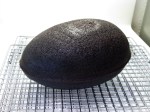
If there is little leakage, and the bake is properly timed, and you coated the molds with release spray you should end up with a beautiful Peanut M&M – Football – Easter Egg – shaped cake. A couple of other hints with this mold: remove the top half 5 minutes after removing the cake from the oven, Chocolate Cakethen remove the cake from the bottom mold 5 minutes later. You may have to shake the pan slightly for the cake to release. Cool on a rack.

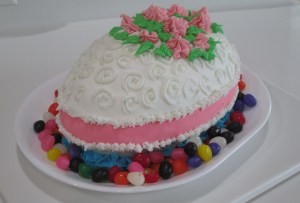
For Grace’s 1st birthday I am making a cake for  about 100 people. I want this to be a smooth surface (i.e. fondant) but dislike store bought fondant. This weekend I made a Fondant Covered Chocolate cakebatch of marshmallow frosting to try it on the Easter egg cake. It was easy to make, roll and drape. While intensely sweet (read: marshmallow and confectioners sugar) it tasted much better than store bought, plus it cuts easily to make decorations. This fondant may be flavored, but will be very sweet no matter what flavor. This fondant is smooth and soft, IMG_0025easy to drape and form. The pink band around the cake is a band of colored fondant, wetted and wrapped around the cake.

I wanted the second cake to be a chocolate covered egg with lots of colored royal icing decoration. I envisioned a chocolate egg, like the hollow chocolate eggs you buy in the market for Easter. Alas, my tempered chocolate set to quickly and would not pour over the crumb coated cake. I had to spread it as quickly as possible, but was not quick enough. It was too thick and lumpy.  If anyone has suggestions to remedy this I would appreciate your input. The Finished Tempured Chocolate Yellow Cakepiping is all buttercream, both white and colored. I was going to make buttercream roses for the toppers, but by the time I finished the rest, my hand was cramping and decided simple dropped flowers (Wilton #193 tip) would suffice. I added the jelly beans for some additional color, they probably weren’t needed but we like jelly beans.

At the end of the meal there was 1/3rd of the white frosted cake left, a 1/4 of the chocolate and almost none of the outstanding carrot cake Fran made. Both 9″ tarts (one creme patisserie/fruit and one chocolate/orange) were left. Not a bad effort for 20 adults.

INGREDIENTS

Chocolate Cake

  • 2 cups white sugar
  • 1 3/4 cups all-purpose flour
  • 3/4 cup unsweetened cocoa powder
  • 1 1/2 teaspoons baking soda
  • 1 1/2 teaspoons baking powder
  • 1 teaspoon salt
  • 2 eggs
  • 1 cup milk
  • 1/2 cup vegetable oil
  • 2 teaspoons vanilla extract
  • 1 cup boiling water

Yellow Cake

  • 4 1/2 cups (570g) all-purpose flour
  • 2 teaspoon baking soda
  • 1 teaspoon salt
  • 2 cup (460g) unsalted butter, softened
  • 3 3/4 cups (700g) granulated sugar
  • 4 large eggs, at room temperature
  • 4 teaspoons pure vanilla extract
  • 1 cup (240g) sour cream, at room temperature
  • 2 cup (480ml) whole milk, at room temperature

Buttercream

  • 4 cups of powdered sugar (or 1 box)
  • 1 Cup (2 sticks) of softened butter
  • 1/4 cup meringue powder to make a crusting frosting
  • 2-3 teaspoons of vanilla
  • 1-2 tablespoons of milk
  • Violet food coloring (a little of this will make the frosting white, not yellow from the butter coloring. Just a little on the end of a tooth pick is enough)

Marshmallow Fondant

  • 500 g marshmallows
  • 1000 g confectioners sugar
  • 1 tsp white vanilla
  • 2-3 Tbl water

Tempered Chocolate

  • Scharffen Berger Semi-Sweet Dark Chocolate (I like this brand but any would do)

METHOD

Chocolate Cake

  1. Preheat oven to 350 degrees F (175 degrees C). Spray both halves of the egg mold.
  2. Use the first set of ingredients to make the cake. In a medium bowl, stir together the sugar, flour, cocoa, baking soda, baking powder and salt. Add the eggs, milk, oil and vanilla, mix for 3 minutes with an electric mixer. Stir in the boiling water by hand. Pour to fill the bottom mold to the brim.
  3. Bake for 60 minutes in the preheated oven. (Bake time make take some experimentation)  Cool for 5 minutes before removing the top half and another 5 minutes before rolling the cake on a rack to cool completely.

Yellow Cake

  1. Preheat oven to 350°F (175°C). Spray both halves of the egg mold.
  2. Whisk the flour, baking soda, and salt together in a large bowl. Set aside. Using a handheld or stand mixer fitted with a paddle attachment, beat the butter on high speed until smooth and creamy – about 1 minute. Add the sugar and beat on high speed for 3 full minutes until creamed together. The mixture should be a light yellow color. Scrape down the sides and up the bottom of the bowl with a rubber spatula as needed. On medium-high speed, add 1 egg at a time, beating well after each addition until both are mixed in. On high speed, beat in the vanilla extract and sour cream. Scrape down the sides and up the bottom of the bowl with a rubber spatula as needed.
  3. With the mixer running on low speed, add the dry ingredients to the wet ingredients alternating with the milk. Start and end with the dry ingredients. Mix each addition just until incorporated. Do not overmix this batter. The batter will be smooth, velvety, and slightly thick.
  4. Pour the cake batter into the prepared pan. Smooth it out into an even layer.
  5. Bake for 60 minutes in the preheated oven. (Bake time make take some experimentation)  Cool for 5 minutes before removing the top half and another 5 minutes before rolling the cake on a rack to cool completely.

Buttercream

  1. Add powdered sugar and meringue powder to mixing bowl.
  2. Add softened sticks of butter
  3. Add vanilla. If you want white buttercream use clear imitation vanilla.
  4. Add 1 tbsp of milk.
  5. Beat on low until powdered sugar is incorporated. Then move mixer up to medium-high speed. Scrape sides and bottom of bowl often. When completely mixed the frosting may appear dry.
  6. Add more milk, a little bit at a time until frosting is the proper consistency.
  7. Again, for white frosting now add a little violet food coloring. I use the end of a toothpick and add just a little at a time. Mix thoroughly.

Marshmallow Fondant

  1. Grease (well with Crisco or equivalent) a heat proof microwavable bowl
  2. Place marshmallow in the bowl and sprinkle 2-3 Tbl water over the marshmallows
  3. Heat in a microwave in 30 second increments until the marshmallow is melted and smooth. Don’t overcook and burn.
  4. Grease (well) dough hook and stand mixer bowl and add melted marshmallow.
  5. Add confectioners sugar a cup at a time and stir on medium until incorporated.
  6. Add the vanilla during one of the sugar additions.
  7. Reserve about a cup of sugar to use during hand kneading
  8. Grease (well) your workspace and hands and turn the fondant out.
  9. Cover with sugar and begin kneading, adding more sugar as necessary until the fondant is smooth and not sticky.
  10. Use a greased rolling pin and roll the fondant out to required size. For this cake I rolled it out to about 18″ x 14″. It was easy to pick up and drape over the cake.

Tempered Chocolate

  1. Cut 1 lb of chocolate into small pieces (or pulse in a food processor)
  2. Place chocolate in a heat proof bowl over simmering water (the bowl should not touch the water.)
  3. Heat the chocolate while stirring until melted, continue heating to 120 deg
  4. Remove the bowl from the heat (dry the bottom of the bowl. Any water will cause the chocolate to seize.)
  5. When the chocolate cools to 82 deg, place back on the heat and heat to 90 deg.
  6. Pour the liquid chocolate over the cake. This will cool the chocolate and make it set into a thin crust. My problem was I let the chocolate cool too much before trying to pour. Next time I will leave the bowl on the hot water and remove both from the heat. Hopefully this will keep the chocolate thin enough to pour. If anyone has suggestions I would appreciate them.

Tart vs. Prostitute

I decided to make a new dessert for Passover this year. Of course, leavening agents, such as flour, yeast etc are prohibited from Passover foods, so the chocolate/orange tart I was considering was out… or was it?

My research into Passover prohibitions and tarts logically led me to a discussion of the difference between tarts and prostitutes. Using the Wiki dictionary (the source of all truths) I find the word prostitute, as a verb, is to use one’s talents in return for money, or fame, or perhaps a few nights lodging, whereas a tart, as a noun, is a small open pie, or piece of pastry. Dictionaries are like statistics: what do you want them to say?

This research actually stemmed from looking at the story of Solomon deciding which woman was the real mother by offering to split the child with his sword and giving half to each woman. The women were actually prostitutes, but their profession was either superfluous to the story, and Solomon’s decision, or not, depending on the interpretation. And, of course, as usual in midrash, there are many more opinions than “opinioners.”

I find it interesting that a judge can rule on a case 3000 years ago by purely considering the facts of the case and not the legal standing of the two women. Some say wisdom began flowing from his mouth when he threatened to cut the child in half. Today so many people with questionable legal standing are unable to appeal to the legal establishment for fear of reprisal due not to the injury they may have sustained but rather for the superfluous state of their resident status. And therefore, so often judgement is rendered without any wisdom present.Almond Flour Tart Shell

Anyway, I decided an almond flour tart shell with chocolate mousse and orange zest swirl is appropriate and fitting for our Passover this year. I made a shell to be confident it would have the taste and texture required, and it did. It doesn’t roll our like a standard AP flour
dough, but can be formed into the tart shell by hand and pastry weights should keep the shape well enough to form the final tart. Because there is less binding agent in almond flour, I doubled the amount of egg.  I will probably increase the almond flour content by 25-50% to make the dough easier to handle and hopefully a little more pastry-like. The chocolate and orange ingredients are allowed anyway, substituting almond flour for AP flour where appropriate.

Please pass over me when the gefilte fish is served!

INGREDIENTS

For the Tart Shell

  • 100 g cold butter cut into small cubes
  • 200 g almond flour (I may increase this by 50g, not sure yet)
  • 60 g icing sugar
  • ½ tsp vanilla
  • ¼ tsp salt
  • 2 eggs (100g)

For the Chocolate Filling

  • 75g butter
  • 115g dark chocolate (no more than 60% cocoa solids), finely chopped
  • 115g caster sugar
  • 55g almond flour
  • 4 medium eggs

For the Orange Filling

  • 25g butter
  • 50g white chocolate
  • 1 orange, finely grated zest only
  • 35g caster sugar
  • 25g almond flour
  • 2 medium egg yolks

METHOD

Tart Shell

  1. Mix butter with sugar (I break up the chunks of butter by rubbing them into the sugar with my hands)
  2. Add salt then vanilla
  3. Add egg and mix well
  4. Stir in flour. Mix by hand until incorporated. I did this in 3 parts mixing well between each.
  5. Cover with plastic and refrigerate for 30 min until it firms up a bit.
  6. Butter (spray) tartlet pan
  7. Coat hands with flour and press the sticky dough into tart mold
  8. Prick holes in bottom and sides of formed dough
  9. Add pastry weights to the pan
  10. Bake in preheated oven 350o F (175o C) for 17 – 20 min
    1. Remove pastry weights with 5 min left in the bake
    2. Remove pastry shells from pans and let cool on wire rack

Chocolate Filling

  1. Melt the butter and chocolate in a heatproof bowl set over a pan of gently simmering water until melted and smooth.
  2. Remove from the heat and stir in the sugar and flour.
  3. Beat in the eggs, one at a time, and leave to stand.

Orange Filling

  1. Melt the butter and white chocolate in a heatproof bowl set over a pan of gently simmering water until melted and smooth.
  2. Remove from the heat and stir in the orange zest, sugar and flour.
  3. Beat in the egg yolks, one at a time and pour the mixture into a bowl.

Assemble and Bake the Tart

  1. Place the tart shell on a baking tray.
  2. Pour the chocolate mixture into the shell.
  3. Drizzle or pipe the orange filling over the chocolate filling to create a swirl effect.
  4. Draw a tooth stick through the filling to create a marbled effect.
  5. Bake for 10-12 minutes, or until just set around the edges, but still slightly wobbly in the centre.
  6. Remove from the oven and allow to cool slightly, until warm but not piping hot, then serve. It is actually very good cold also.

WTF! (What The Fig!)

For Purim this year I made and donated 4 dozen hamantaschen to our California temple for their bake sale. I really, Really, REALLY liked the fig variety and knew there must be another place to use that fig purée.  I was considering homemade Fig Newtons®, but those cookies are available in those so-convenient two serving packages I thought, why try to copy perfection? I mean, artists copy Renoirs to hone their artistic skills, but only as an exercise… for practice… right? How could I chance trying to improve my baking skills and thereby perhaps plagiarize perfection?

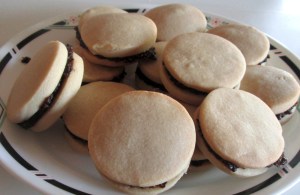
I thought a fig-filled/short-bread cookie might Fig Shortbread Cookie 3be a good combination. The slight snap of this buttery cookie and the sweet/tartness of the fig pureé should pair well.  

I was right, but the first batch had a minor problem.  I tried to roll the shortbread dough thinner than usual for cookies, but it still ended up too thick. I rolled them directly on the parchment paper covered cookie sheet thinking they would be too fragile to move after cutting. I chickened out and still left them about 2x too thick, much like leaving your birdie putt short. (NEVER leave your birdie putt short!) By making the cookie thick, the buttery flavor of the cookie overpowered the fig flavor, so I added additional fig filling for each cookie. (What a shame.) When biting the cookie, the filling squeezes out the sides of the cookie and has to be licked off. (What a shame.)

Shortbread Cookie

INGREDIENTS

  • 1 cup butter or margarine, softened
  • ¾ cup powdered sugar
  • 1 teaspoon vanilla
  • 2 ½ cups Gold Medal™ all-purpose flour

METHOD

  1. Heat oven to 350°F. In large bowl, beat butter, powdered sugar and vanilla with spoon. Stir in flour. (If dough is crumbly, mix in 1 to 2 tablespoons butter or margarine, softened.)
  2. Roll dough ¼” (or less if you can) thick on a parchment paper lined cookie sheet. Cut into small shapes and remove the excess, combine and roll out again, and again.
  3. Bake 10 to 16 minutes (depending on thickness of the cookie) or until set and bottoms are light golden brown. Immediately remove from cookie sheet to wire rack. Cool completely, about 30 minutes. I like to slide the parchment paper off the cookie sheet with all the cookies still attached, let cool until cookies release from the paper and leave on the wire rack until cool.

Fig Filling

INGREDIENTS

  • 1 ½ scant cups chopped, stemmed, dried black figs (about 9 ounces)
  • 3/4 cup (177 ml) pomegranate juice
  • ⅓ cup (66 grams) sugar
  • Finely grated zest of 1 orange
  • 1 star anise, or ¼ tsp crushed fennel seeds
  • 1 cup water

METHOD

  1. In a saucepan, combine the figs, juice, sugar, zest, star anise (or fennel), and 1 cup of water and bring to a boil.
  2. Simmer over low heat until the figs are softened and the liquid is syrupy and is reduced to about ½ cup.
  3. Let the figs cool in their syrup, then puree in a food processor until smooth. [If you dislike the taste of star anise, you should remove it before pureeing, but if you do, leave it in.

He Said With a Rye Smile

When I retired, I realized I needed a new hobby, beyond brewing beer, (I have a batch of English Bitter about to be bottled) so I decided to start baking seriously, expanding my skills and experimenting with new recipes and techniques.  Now,  having nearly mastered the concept of retirement, I bake a lot of bread. I also bake a lot of pastries, cakes, cookies, biscuits, crackers, pizza, bagels and pretzels. (I’ve gotta get another hobby!)Hubble Deep Field Image

One of the holy grails of baking is to produce a good New York Jewish Rye Bread. This bread has a tangy rye flavor, chewy crumb and glazed, blistered crust. There are as many recipes and techniques to make this bread as there are galaxies in Hubble’s Deep Field image.

The recipe/method I chose was from Chef John V., A Good Cooking Recipe! This is not the easiest recipe, nor does it use the most common ingredients, however, his historical introduction rang with an authenticity that hooked me. His grandfather owned a dairy farm, as did mine. He was from Hudson NY, whereas mine was from Salisbury Vermont. He sold the farm and became a baker, whereas mine was a farmer to the end of his life. His other grandfather would work at the bakery whenever they needed help, whereas mine, did not. I didn’t say we had parallel experience, just that his sounded authentic.

Chef John V. uses some unusual, or at least uncommon (to me) ingredients that I found intriguing. Potato water: I have recipes that use small amounts of potato flour, but never potato “water”. First Clear Flour: milled from spring wheat and has a very high gluten and protein content which gives this rye its chewiness. White Rye Flour: milled from whole rye berries after the bran and germ are removed. I made the potato water and purchased the unusual flours from King Arthur (another Vermont connection.) He also uses a sour starter which requires 3 days of room temperature fermentation. When ready, the starter has a very yeasty, sour aroma – delicious.

The result of this first try was three small loaves of flavorful, aromatic, chewy crust and crumb rye bread, well worth the effort and will certainly be repeated. It might be fun to try an “easy” rye bread recipe to contrast the effort/reward of the two techniques. I think two medium sized loaves (think bigger sandwiches) would be appropropriate for this recipe.

New York Style Jewish Rye

Recipe by: Chef John V., A Good Cooking Recipe!

This recipe is as close to the original as can be. The only difference is they baked it in ovens that could inject steam during the first 10 minutes, which gave the crust its blistered look and chewy texture.

Note: This is a must have proper ingredient recipe! You can’t substitute medium rye flour without a change in texture. Light Rye or White Rye flour is a must is as 1st Clear Flour. Also note that flour has a different moisture content during the winter as in the summer, so in the winter you may need to add a bit more water and in the summer a little less. No more than a few tablespoons should do—this is a stiff dough! For your success please remember to measure exactly as baking is a science.

Serving size: 3 – 1½ pound oblong rye loaves (Note: next time 2 medium sized loaves)

Preparation time: Start to finish is 3 days including a sour starter

 INGREDIENTS:

  • Sour Starter—
    • 1 cup warm potato water*
    • 1 cup light rye flour—see footnote
    • 1 Tbsp. yeast, dry active or 1 fresh yeast cake
    • Stir to blend well, then cover with plastic wrap and let sit for 3 days at room temperature 65-70o F

* Potato water—Peel and quarter 2 pounds of regular potatoes, cover with water and season with salt. Cook like you would for boiled or mashed potatoes, drain—saving the water the potatoes were cooked in. This is potato water, it gives bread a moist and compact texture. Save or eat the potatoes as you like.

  • Dough for the bread—
    • 2 cups warm water, about 120o
    • 1 Tbsp. sugar
    • 1 Tbsp. yeast
    • Add—starter from above
    • 2 cups light rye flour
    • 2 Tbsp. kosher salt
    • 2 Tbsp. caraway seeds
    • 4 ¾ cups first clear flour—see footnote
  • Glaze—1 cup water
    • 3 Tbsp. cornstarch mixed with ¼ cup cold water—no lumps

 METHOD:

  1. In a mixer or by hand combine 2 cups warm water with sugar and yeast, mix and let sit for 10 minutes.
  2. Add the sour starter and the remaining ingredients. Mix on low speed for 2-3 minutes with a dough hook, then increase to medium speed and mix 6 minutes longer, be sure all the flour is absorbed into the dough by raising and lowering the bowl from time to time.
  3. Remove from the machine and cover with plastic wrap. Let rise 2 hours @ 70o or until doubled in size.
  4. Portion into 3 – 1½ pound pieces of dough and shape into oblong loaves, place on baking pans that have been sprinkled with semolina flour or fine cornmeal. Cover with a damp but not wet cloth and let rise for 40 minutes at @ 75-80o (on top of the stove is fine).
  5. Carefully remove the damp cloth, then slash the dough 3 times across the top with a very sharp knife or razor blade about ¾ of an inch deep. Immediately place in a pre-heated 375o oven, and place a pan of boiling water on the oven’s bottom. Remove the pan after 10 minutes, this will create steam and help with crust development. Continue to bake for 30 minutes or until center is 180 degrees F.
  6. For the glaze: boil 1 cup of water, mix the cornstarch with ¼ cup cold water, then combine with boiled water and stir continually until thickened. Cover with plastic wrap.
  7. Remove the bread and with a pastry brush, brush with the cooked cornstarch. A small amount of this glaze is enough, it’s used to create a shiny surface. Cool the bread on wire racks for at least 1 hour before slicing.

Footnote:

White Rye Flour is milled from whole rye berries which has the bran and germ removed and is unbleached. Medium rye is the next grade with is darker in color and if it were to be used in this bread it would make a darker loaf but not as dark as pumpernickel.

First Clear Flour is milled from spring wheat and has a very high gluten and protein content which gives this rye its chewiness.

Retirement is Loafing… NOT!

I admit it. I have a bread machine. I was consistently underwhelmed by the results from Whitebread1this device. Currently, it is in storage in the garage. I also have a KitchenAide mixer with a dough hook and am very pleased with the consistently good results from this device. It both mixes the ingredients and does 90% of the kneading. It would probably do all the kneading but there is something satisfying about having your hand on, and in the dough, feeling it develop the gluten into a soft, resilient ball.
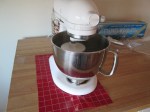
Here is a tip: if, while using your stand mixer to IMG_0029knead bread, it walks across the table, put a silicone baking liner under the mixer. I buy a Cooks Essentials 24″ x 72″ roll every year or so.

After a long search (and many test bakes) for a “go to” white sandwich bread recipe I found one on, of all places, the back of a bag of  Gold Medal flour, duh! I have changed the Method a little, but held pretty close to the Ingredients. I did try substituting butter for the shortening, no big difference, but don’t leave it out. I tried both bread and AP flour, and prefer bread. (I am making bread… why would I not use bread flour?)


INGREDIENTS

  • 6 to 7 cups Gold Medal™ all-purpose flour* or Better for Bread® bread flour
  • 3 Tbl sugar
  • 1 Tbl salt
  • 2 Tbl shortening – NOTE: 1 Tbl shortening weighs 13g, easier to weigh than spoon
  • 4 1/2 tsp quick active dry yeast (2 packages regular)
  • 2 ¼ cups very warm water (120° to 130°F)
  • 2 Tbl butter or margarine, melted, if desired

METHOD

  1. In large bowl, with the dough hook, stir 3 1/2 cups of the flour, the sugar, salt, shortening and yeast until well mixed. Add warm water. Beat  on low speed 1 minute, scraping bowl frequently. Beat on medium speed 1 minute, scraping bowl frequently. Stir in enough remaining flour, 1/2 cup at a time, to make dough easy to handle, not very sticky.
  2. Increase the speed to medium, KitchenAide (4 or 5) and knead for 7 minutes.
  3. Place dough on lightly floured surface. Knead until dough is smooth and springy.
  4. Spray large bowl (I use a dough rising bucket with snap on top) with canola, or other sprayable oil. Place dough in bowl, turning dough to grease all sides. Cover bowl loosely with plastic wrap (if using the bucket, spray the lid also) and let rise in warm place 40 to 60 minutes or until dough has doubled in size. (I use the proofing setting on my oven. This is a little higher temperature than recommended but the results justify the process.) Dough is ready if indentation remains when touched.
  5. Spray the bottoms and sides of two 8×4-inch or 9×5-inch loaf pans with cooking spray.
  6. Gently push fist into dough to deflate. Divide dough in half. (I find I end up with two 750g dough. Gently flatten each half with shaping into a 18×9-inch rectangle on lightly floured surface. (I used to use a rolling pin, but I prefer the texture by treating the dough more gently and not deflating too much.) Roll dough up, beginning at 9-inch side. Press with thumbs to seal after each turn. Pinch edge of dough into roll to seal and form a tight seal. Pinch each end of roll to seal. Fold ends under loaf. Place seam side down in pan. Here is another point of option. You can either brush loaves lightly with butter a this point, or for a crustier crust, don’t. Cover loosely with plastic wrap and let rise in warm place 35 to 50 minutes or until dough has doubled in size.
  7. Move oven rack to low position so that tops of pans will be in center of oven. Heat oven to 425°F.
  8. Bake 25 to 30 minutes or until loaves are deep golden brown and sound hollow when tapped. For the crusty crust, add a baking pan below the bread and pour a cup of water into the hot pan when you put the bread in to bake. Remove the pan and water after 10 minutes and let the bread continue to bake.
  9. Remove from pans to wire rack. For a softer, but still chewy crust brush loaves with butter, otherwise leave them dry; cool.


Somewhere, Under the Rainbow

Frances sent me a picture of these cupcakes thinking I might like the design and might make them. She was right, I did and I did. Sadly, she is not eating any added sugar at the moment… sigh. I also had a new white cake recipe I wanted to try and the confluence of these two irresistible forces resulted in an almost perfect cupcake. However, my unpaid, full time, in-house taste tester felt the cupcake was sweet and adding the buttercream frosting just put her over the edge. You know, the typical shakes, cold sweats and hyperactivity of a pure sugar high. The white cake recipe is a keeper though. Maybe a cream cheese frosting…

Land o’Lakes published the rainbow piping concept. I read it but then I did it my way

Yes, there were times, I’m sure you knew
When I bit off more than I could chew (get it?)
But through it all, when there was doubt
I ate it up and spit it out (never!)
I faced it all and I stood tall
And did it my way

Buttercream Frosting

Previously if I wanted multi-colored piping I will fill small piping bags with different colored frosting, snip the ends off and cram them into a large bag. This worked fair at best. This technique is far superior, and maybe even easier. I use Wiltons Icing Colors. They are concentrated and you don’t need much for very vibrant colors.

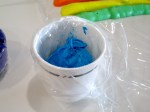
Once the colored frosting is piped into rows on a piece of food wrap, roll the wrap up and snip off the end. Put the rolled frosting into a large piping bag with a large star end.

Run a little of the frosting out until the mixture comes out evenly distributed, then pipe the rainbows, surrounding the marshmallow clouds.

Thank you Land o’Lakes, this was a great technique.

THE BEST BUTTERCREAM FROSTING

INGREDIENTS

  • 4 cups of powdered sugar (or 1 box)
  • 1 Cup (2 sticks) of softened butter
  • 2-3 teaspoons of vanilla
  • 1-2 tablespoons of milk
  • Violet food coloring

METHOD

  1. Add powdered sugar to mixing bowl.
  2. Add softened sticks of butter
  3. Add vanilla. If you want white buttercream use clear imitation vanilla. Also, adding a little violet food coloring (like the end of a toothpicks worth) will help lighten the yellowish color due to the butter.
  4. Add 1 tbsp of milk.
  5. Beat on low until powdered sugar is incorporated. Then move mixer up to medium-high speed. Scrape sides and bottom of bowl often. When completely mixed the frosting may appear dry.
  6. Add more milk, a little bit at a time until frosting is the proper consistency.

White Cup Cakes –

I don’t remember where I saw this recipe but it is a basic white cake with whipped egg whites (meringue) gently folded into the batter. I made a half recipe just to try it. This made 15 medium sized cupcakes. Either follow the instructions and make cakes, or do what I did, or both, and make a lot of cupcakes!

INGREDIENTS

  • 1 cup milk
  • 1 ½ teaspoons vanilla extract
  • 1 cup butter, softened
  • 2 cups sugar
  • 3 cups cake flour
  • 1 tablespoon baking powder
  • 5 egg whites

METHOD

  1. Preheat oven to 350°. Grease 3 (8-inch) round cake pans; line bottoms with parchment paper, and grease and flour paper.
  2. Stir together milk and vanilla.
  3. Beat butter at medium speed with a heavy-duty electric stand mixer until creamy; gradually add sugar, beating until light and fluffy. Sift together flour and baking powder; add to butter mixture alternately with milk mixture, beginning and ending with flour mixture. Beat at low speed just until blended after each addition.
  4. Beat egg whites at medium speed until stiff peaks form; gently fold into batter. Pour batter into prepared pans.
  5. Bake at 350° for 20 to 23 minutes or until a wooden pick inserted in center comes out clean. Cool in pans on wire racks 10 minutes. Remove from pans to wire racks; discard parchment paper. Cool completely (about 40 minutes).
  6. Spread Vanilla Buttercream Frosting between layers (about 1 cup per layer) and on top and sides of cake.

Sorry, a Bit Groggy This Morning

Purim is almost here. This story is from the Book of Esther and is yet another tale of “they tried to kill us, they failed, let’s eat” and in this case, “let’s drink.” This batch of hamantaschen was practice for the 4 dozen I am making next weekend for Temple Or Rishon’s Purim celebration.  When the story is read aloud, every time Haman’s name is spoken a grager (pronounced grogger, hence the poor headline pun) is sounded.

Thanks to Tori Avery for an excellent recipe and instructions. I made a few additions, but it is hamentaschen99.9% pure Tori. I added another filling to Tori’s fig and caramel apple, when Fran found a cannoli-chocolate chip filling. Talk about a cultural melting pot!

HAMANTASCHEN

INGREDIENTS

  • 170g (¾ cup) unsalted butter, room temperature
  • 150g (⅔ cup) sugar
  • 55g (1 egg,) room temperature
  • 1 tsp vanilla
  • 4g (1 tsp) grated orange zest
  • 200g (2¼) cups flour
  • ¼ tsp salt
  • 1-5 tsp water (if needed)

METHOD

  1. Slice room temperature butter into small chunks and place in a large mixing bowl.
  2. Add sugar to the bowl. Use an electric mixer to cream the butter and sugar together for a few minutes till light and fluffy.
  3. Add the egg, vanilla, and orange zest to the bowl. Beat again till creamy and well mixed.
  4. Mix with the electric mixer on low speed till a crumbly dough forms.
  5. Begin to knead dough with hands till a smooth dough ball forms. Try not to overwork the dough, only knead till the dough is the right consistency. If the crumbles are too dry to form a smooth dough, add water slowly, 1 teaspoon at a time, using your hands to knead the liquid into the dough. Knead and add liquid until the dough is smooth and slightly tacky to the touch (not sticky), with a consistency that is right for rolling out. It can easily go from the right consistency to too wet/sticky, so add water very slowly. If the dough seems too wet, knead in a little flour till it reaches the right texture.
  6. Form the dough into a flat disk about 1” thick and wrap in plastic wrap. Place in the refrigerator to chill for 3 hours to overnight.
  7. Before you begin to assemble the hamantaschen, choose and make your filling and have it on hand to work with. Preheat oven to 350 degrees F. Lightly flour a smooth, clean surface. Unwrap the dough disk and place it on the floured surface. The dough will be very firm after chilling.
  8. Use a rolling pin to roll the dough out to ¼ inch thick. At the beginning, it will be tough to roll out– you may need to pound it a bit. A heavy rolling pin works best. As you roll, cracks may form on the edges of the dough. Repair any large cracks with your fingers and continue rolling.
  9. When the dough reaches ¼ inch thickness, scrape the dough up with a pastry scraper, lightly reflour the surface, and flip the dough over. Continue rolling the dough out very thin (less than 1/8 of an inch thick). The thinner you roll the dough, the more delicate and crisp the cookies will turn out– just make sure that the dough is still thick enough to hold the filling and its shape! If you prefer a thicker, more doughy texture to your cookies (less delicate), keep the dough closer to ¼ inch thick. Lightly flour the rolling pin occasionally to prevent sticking.
  10. Use a 3-inch cookie cutter (not smaller) or the 3-inch rim of a glass to cut circles out of the dough, cutting as many as you can from the dough.
  11. Gather the scraps and roll them out again. Cut circles. Repeat process again if needed until you’ve cut as many circles as you can from the dough. You should end up with around 35 circles (unless you’ve kept your dough on the thicker side, which will result in less cookies). (I ended up with 25 circles, less than ¼ of an inch thick.)
  12. Place a teaspoon of filling (whichever filling you choose) into the center of each circle. Do not use more than a teaspoon of filling, or you run the risk of your hamantaschen opening and filling spilling out during baking. Cover unused circles with a lightly damp towel to prevent them from drying out while you are filling.
  13. Assemble the hamantaschen in three steps. First, grasp the left side of the circle and fold it towards the center to make a flap that covers the left third of the circle.
  14. Grasp the right side of the circle and fold it towards the center, overlapping the upper part of the left side flap to create a triangular tip at the top of the circle. A small triangle of filling should still be visible in the center.
  15. Grasp the bottom part of the circle and fold it upward to create a third flap and complete the triangle. When you fold this flap up, be sure to tuck the left side of this new flap underneath the left side of the triangle, while letting the right side of this new flap overlap the right side of the triangle. This way, each side of your triangle has a corner that folds over and a corner that folds under– it creates a “pinwheel” effect. This method if folding is not only pretty– it will help to keep the cookies from opening while they bake.
  16. Pinch each corner of the triangle gently but firmly to secure the shape. If any cracks have formed at the places where the dough is creased, use the warmth of your fingers to smooth them out.
  17. Repeat this process for the remaining circles.
  18. After your hamantaschen are all filled, place them on a lightly greased baking sheet, evenly spaced.
  19. Place them in the oven and let them bake at 350 degrees for 20-25 minutes, till the cookies are cooked through and lightly golden.
  20. Cool the cookies on a wire rack. Store them in a tightly sealed plastic bag or Tupperware.

CARAMEL APPLE HAMANTASCHEN FILLING

INGREDIENTS

  • 1½ lbs. Granny Smith apples (about 4 medium apples)
  • 170g (¾ cup) sugar
  • ⅓ cup dulce de leche
  • Salt to taste

Dulce De Leche (makes 1¼ cups)

  • 1 can (14 oz.) sweetened condensed milk (not evaporated milk)
  • 1/8 tsp salt (or more to taste)

METHOD

  1. Preheat oven to 425 degrees F. Pour can of sweetened condensed milk into a ceramic pie plate or dish. Sprinkle the milk lightly with about 1/8 tsp of salt (for a more salted caramel flavor, use 1/4 tsp salt).
  2. Cover tightly with foil. Place the filled pie plate into a large roasting pan and fill the roasting pan with water till it reaches about halfway up the sides of the pie plate.
  3. Place the roasting pan into the oven. Let the mixture cook slowly for 75-90 minutes, check the water level every half hour to make sure it hasn’t dried out too much. Add water as needed.
  4. At 75 minutes, begin checking the color of the dulce de leche. When it reaches a rich light brown caramel color, you’ll know it’s ready. The longer you let it cook, the thicker and darker it will become.
  5. Take the pie plate and roasting pan out of the oven. Carefully remove the pie plate from the hot roasting pan. Take off the foil.
  6. Whisk the dulce de leche mixture. Use warm, or allow to cool to room temperature depending on your intended use.
  7. Store in the refrigerator. The sauce will keep for up to 4 weeks when refrigerated.
  8. Peel and core the apples. Shred them into fine shreds using a hand grater or food processor shredding attachment.
  9. In a medium saucepan, combine the sugar and 3/4 cup of water. Bring to a boil.
  10. Add the shredded apples to the boiling water and return to a boil.
  11. Reduce heat to medium and let the mixture simmer for 25-35 minutes, stirring occasionally, till most of the liquid evaporates and the mixture resembles a very thick applesauce. When the mixture is ready, it will start to sizzle lightly in the pan and clump together when you stir it. Don’t let the mixture burn, but do let it get quite thick.
  12. Stir in the dulce de leche; add salt to taste. The salt adds depth and gives the flavor of a salted caramel. It also offsets the sweetness a bit.
  13. Note that the filling is quite sweet on its own (it may initially taste “too sweet”), but it bakes to perfection when used for filling hamantaschen. Let the mixture cool.
  14. Refrigerate mixture for at least 1 hour before using it to fill hamantaschen; this will thicken it and make it easier to manage when filling.
  15. Use about 1 tsp of filling per cookie.

FIG HAMANTASCHEN FILLING

INGREDIENTS

  • 1 ½ scant cups chopped, stemmed, dried black figs (about 9 ounces)
  • 3/4 cup (177 ml) pomegranate juice
  • ⅓ cup (66 grams) sugar
  • Finely grated zest of 1 orange
  • 1 star anise, or ¼ tsp crushed fennel seeds
  • 1 cup water

METHOD

  1. In a saucepan, combine the figs, juice, sugar, zest, star anise (or fennel), and 1 cup of water and bring to a boil.
  2. Simmer over low heat until the figs are softened and the liquid is syrupy and is reduced to about 1/2 cup.
  3. Let the figs cool in their syrup, then puree in a food processor until smooth. [If you dislike the taste of star anise, you should remove it before pureeing, but if you do, leave it in.

CANNOLI FILLING:

  • ¼ cup ricotta cheese
  • 4 oz. cream cheese, softened
  • 1/4 cup confectioners’ sugar
  • ½ tsp cinnamon
  • ½ cup mini chocolate chips

METHOD

  1. Make the cannoli filling: In the bowl of a mixer, beat all ingredients except the chocolate chips till light and fluffy.
  2. Fold in the chocolate chips and refrigerate, covered, till needed.

It’s Good To Be King Cake,

If Just For A While.

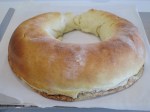
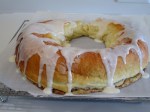
For the end of Mardi Gras I thought it appropriate to make a more or less “traditional King Cake.” I say more or less as I have never had a King Cake and am unsure of the “traditional” texture and flavor. When cut, this cake resembled a cinnamon roll, which is no surprise as it is a yeast dough, twice risen and rolled with cinnamon and sugar. It actually tasted more like a cinnamon roll than a “cake”. Next year, I may try a more cakey recipe.

I thought the glaze was a little too acidic. Maybe I should have used a cream cheese based glaze, or just cut the citrus juice in half. To help the colored sugar adhere I would also give a very light spray of water over the glazed cake prior to dusting. Too much water may melt the colored sugar.

INGREDIENTS

  • 8 oz sour cream
  • 2½ Tbsp sugar
  • 2 Tbsp butter
  • ½ tsp salt
  • 2 tsp active dry yeast
  • ¼ cup warm water (100 – 110 F)
  • ½ Tbsp sugar
  • 1 large egg, slightly beaten
  • 3 to 3½ cups bread flour
  • Purple, green and gold tinted sparkling sugar sprinkles

 CINNAMON FILLING

  • 2½ Tbsp butter, softened
  • ¼ cup sugar
  • 1 tsp ground cinnamon

CREAMY GLAZE

  • 1 ½ Tbsp butter, melted
  • 1 Tbsp fresh lemon juice
  • ¼ tsp vanilla extract
  • 1 to 2 Tbsp milk
  • ¼ cup warm water (100 – 110 F)
  • ½ Tbsp sugar

METHOD

  1. Cook first 4 ingredients in a medium saucepan over low heat, stirring often, until butter melts. Set aside and cool mixture to 100 to 110 F
  2. Stir together yeast, ¼ cup warm water, and ½ Tblsp sugar in a 1 cup glass measuring cup; let stand 5 minutes
  3. Beat sour cream mixture, yeast mixture, eggs and 1 cup flour at medium speed until smooth.
  4. Reduce speed to low, changed to dough hook and gradually add enough remaining flour 2 – 2 ½ cups until a smooth dough forms
  5. Knead with dough hook until smooth and elastic (about 12 min)
  6. Place in an oiled bowl and flip to grease top
  7. Cover and let rise in a warm place for 1 hour or until doubled
  8. Punch down dough, divide in half
  9. Roll into a 22”x12” rectangle
  10. Spread 2 Tbsp softened butter evenly on each rectangle, leaving a 1” border.
  11. Stir together ¼ cup sugar and cinnamon, and sprinkle evenly on each rectangle
  12. Roll up each rectangle, jelly roll style, starting with the long edge.
  13. Place seam side down on lightly greased baking sheet.
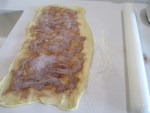
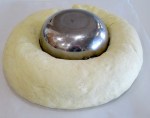
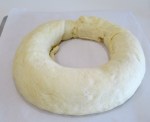
  14. Bring ends together to form an oval ring moistening and pinching edges together to seal

METHOD – GLAZE

  1. Stir together first 4 ingredients
  2. Stir in 2 Tbsp milk, adding additional milk 1 tsp at a time until spreading consistency

PREPARATION AND ASSEMBLE

  1. Cover and let rise in a warm place 20 – 30 min until doubled
  2. Bake at 375 F for 14 – 16 min or until golden
  3. Slightly cool cake in pan on wire rack (about 10 min.)
  4. Drizzle creamy glaze evenly over warm cake, sprinkle with colored sugar, alternating colors
finished-cake

Finished King Cake

OPTION: Cream Cheese-filled King Cake

  1. Prepare 22×12” dough rectangle as directed
  2. Omit 2 Tblsp butter and cinnamon. Increase ¼ cup sugar to ⅓ cup
  3. Beat 1/3 cup sugar with 8 oz softened cream cheese, ½ large egg and 2 tsp vanilla extract at medium
  4. Spread mixture evenly on dough rectangle, leaving 1 inch border

Yeah I’ll be king when dogs get wings
Can I help it if I still dream time to time

What the Focaccia Are You Talking About?

Or, you say tomato and I say potato.

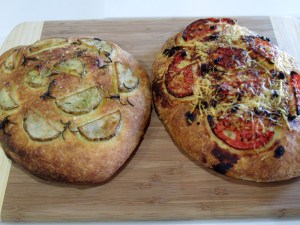
I was flipping through Paul Hollywood’s bread book and saw his focaccia bread, both the Focaccia Pugliese with Tomatoes and Garlic and Potato Focaccia Pugliese. I never made focaccia before and felt these two might be a good beginning. Plus, I craftily asked Fran to put an extra potato in the shopping cart yesterday.

Pugliese is very similar to ciabatta with large holes in the crumb and a very chewy texture. It was interesting that some recipes called for no, or at least minimal kneading, others require typical 7-10 minutes of kneading and still others want extensive kneading, even during the rise to develop even more gluten for a chewier texture.  I chose minimal and it developed an excellent, chewy loaf with a good crunchy crust. The stand mixer really does not care how long you knead.focaccia

My strategy was to make one recipe of bread dough, divide it in half and use one for the tomato and the other for the potato.

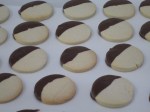
img_0023I also made 2 dozen chocolate dipped short bread cookies, but they were not part of this post. Just a picture for proof.

BREAD INGREDIENTS

  • 4 cups bread flour
  • 1 tbl salt
  • 2 tsp fast acting yeast
  • 1 1/4 cup water

TOMATO TOPPING INGREDIENTS

  • Thin slices of tomato (I used about 1/2 tomato)
  • 1 tsp crushed garlic
  • Sea Salt – as needed
  • Parmesan Cheese – as needed
  • Olive oil – as needed

POTATO TOPPING

  • Thin slices of potato (I used about 1/3 a potato, new potatoes would be better if you had them.)
  • 3-4 sprigs of rosemary from your backyard garden, which you still have to cover every
    night to protect from the frost.
  • Sea Salt – as needed
  • Olive oil – as needed

METHOD

  1. Add all the bread ingredients to a stand mixer equipped with the bread hook. Mix to form a good dough. If you were going to knead the dough keep the mixer running at speed 4 for 7-8 minutes until the dough becomes smooth and elastic.
  2. Cover the mixer bowl and place in the proofing drawer of your beautiful double wall oven. It’s nice having two ovens. I used the top oven to bake the 3 baguettes I made first while proofing the focaccia, (focaccias, focaccii?) the lower.
  3. After and hour of proofing and the dough has at least doubled in size, remove from
    the oven and gently tip onto a lightly floured surface.
  4. Cut the dough in half and place each half on a parchment paper covered large baking sheet, or two smaller sheets.
  5. Gently, using your fingers form each piece of dough into a rough circle about 1/2″ thick.
  6. Punch your fingers into the dough making a rough wavy surface.
  7. Arrange the potato slices, rosemary and sea salt on one and sprinkle and rub
    with olive oil.
  8. Arrange the tomato slices on the other piece of dough and sprinkle with sea salt, garlic, olive oil and cheese.
  9. Push the tomato and potato sliced down inside the dough as much as possible so the dough will rise up around, engulfing the slices.
  10. Place the doughs back in the proofing oven for another hour, or until at least doubled.
  11. Preheat the oven to 425 F convection and bake for 20-25 min until golden brown.
  12. Best eaten warm, but damn, not bad after it has cooled either.