I saw a recipe and “how to” video on making cream puffs. I usually make my choux into eclairs or profiteroles, but thought some sweet whipped cream filling would be a nice change.
Natasha Kravchuk used 1/2 cup water and 1/2 cup milk instead of just a cup of water. Unlike Natasha, I used an egg wash to darken the tops and give the choux a nice sheen. Other than that, it was the same recipe I normally use. Same with the whipped cream except she used 2x the amount of sugar and vanilla. She also piped the whipped cream leaving the center empty. She (and I ) added a fresh raspberry inside before covering with the cut off top.
Also, I saw a hint to wet the parchment paper before piping the choux. I am not sure if it made a difference but the choux rose nicely and didn’t collapse. A few did have bottoms that bowed in. They were sent to QC for evaluation. We were so concerned we sent a larger number of samples than usual.
Actually, say mozzarella! No baking this past weekend, but I did make home-made mozzarella cheese. I read it is the easiest cheese to make and as I needed to run to the store for some for a pan pizza, I thought I would learn how to make it. For emergencies you understand.
It was reasonably easy, but I think I made a few minor errors this first time. I don’t think the curd set completely. On advice from cheese makers blogs I let it set much longer than the recipe specified, but it was still pretty liquid. I may need more rennet and/or let it set at a warmer temperature.
Set Curd
Cut Curd Into Pieces
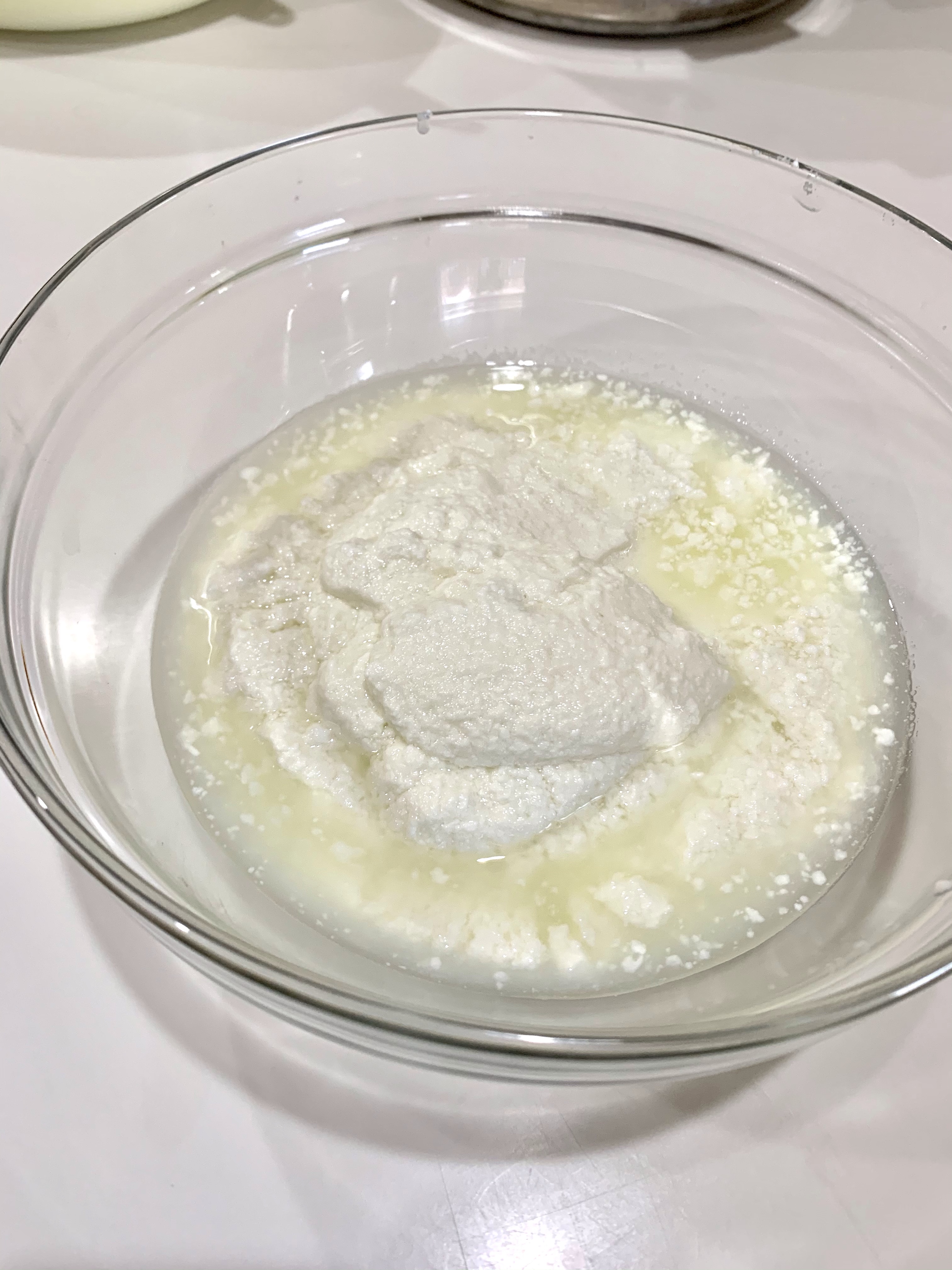
Draining Curd
Drained Curd – Decanted Residual Whey and Begin to Stretch
Once I finished cooking the curd and started to knead and stretch it, I began to see the ‘cottage cheese’ texture, but it never came together to form a glossy mass.
Knead Curd
Form Stretched Cheese
Packaged Cheese in Whey
I packed two small balls of cheese in airtight containers with a little left over whey to let it set and continue curing overnight.
Much to my surprise, the final cheese had a good texture and excellent taste. In summary, it is very easy to make, just a little harder than driving the two miles to the market and buying it.
Measure out 1 cup of water. Stir in the citric acid until dissolved. Measure out ¼ cup of water in a separate bowl. Stir in the rennet until dissolved.
Pour the milk into the pot. Stir in the citric acid solution. Set the pot over medium-high heat and warm to 90°F, stirring gently.
Remove the pot from heat and gently stir in the rennet solution. Count to 30. Stop stirring, cover the pot, and let it sit undisturbed for 5 minutes.
After five minutes, the milk should have set, and it should look and feel like soft silken tofu. If it is still liquidy, re-cover the pot and let it sit for another five minutes. Once the milk has set, cut it into uniform curds: make several parallel cuts vertically through the curds and then several parallel cuts horizontally, creating a grid-like pattern. Make sure your knife reaches all the way to the bottom of the pan.
Place the pot back on the stove over medium heat and warm the curds to 105°F. Stir slowly as the curds warm, but try not to break them up too much. The curds will eventually clump together and separate more completely from the yellow whey.
Remove the pan from the heat and continue stirring gently for another 5 minutes.
Ladle the curds into a microwave-safe bowl with the slotted spoon.
Microwave the curds for one minute. Drain off the whey. Put on your rubber gloves and fold the curds over on themselves a few times. At this point, the curds will still be very loose and cottage-cheese-like.
Microwave the curds for another 30 seconds and check their internal temperature. If the temperature has reached 135°F, continue with stretching the curds. If not, continue microwaving in 30-second bursts until they reach temperature. The curds need to reach this temperature in order to stretch properly.
Sprinkle the salt over the cheese and squish it with your fingers to incorporate. Using both hands, stretch and fold the curds repeatedly. It will start to tighten, become firm, and take on a glossy sheen. When this happens, you are ready to shape the mozzarella. Make one large ball, two smaller balls, or several bite-sized bocconcini. Try not to over-work the mozzarella.
Using and Storing Your Mozzarella:
The mozzarella can be used immediately or kept refrigerated for a week. To refrigerate, place the mozzarella in a small container. Mix a teaspoon of salt with a cup of cool whey and pour this over the mozzarella. Cover and refrigerate. RECIPE NOTES
Adapted from New England Cheesemaking Supply Company











 aBatteredOldSuitcase