Happy Confection Valentines Day!

I have been remiss in posting bakes recently. There are TMI reasons, but I am back now.

I haven’t made filled chocolate confections in a while and Valentines Day is one of my reasons for making them again.

These are all 54% dark chocolate and clockwise from top we have, raspberry jelly, orange jelly, orange creme and caramel creme confections. Not shown are dipped caramel cubes.

The oranges were poached (with permission) from our neighbors trees. It took a few attempts to achieve the correct tartness and consistency of the jelly and creme, but they have LOTS of oranges. Basically, the same with the raspberry, but this time of year I bought them.
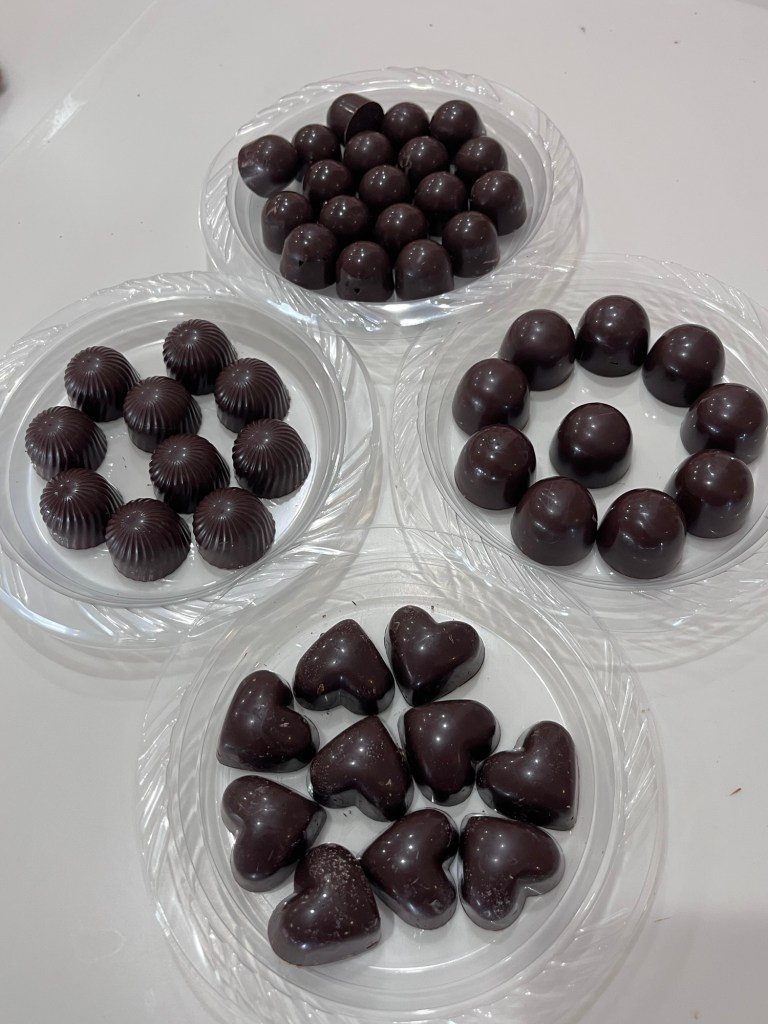
It was fun going back and making these, most rewarding was when tapped upside down 100% released from the mold with a beautiful tempered chocolate shine.

Orange Jelly

Makes ~ 1 ½ cup of jelly

INGREDIENTS
• 2 c orange juice (3-4 oranges)
• 1 ½ Tbl pectin
• ½ tsp butter or margarine
• 300g (1 ½ c) sugar
• 2 Tbl lemon juice

METHOD

  1. Add the juice to a clean pot. Stir in the lemon juice, butter and pectin.
  2. Bring the mixture to a full rolling boil (a boil that doesn’t stop bubbling when stirred) over high heat.
  3. Stir in the sugar (175g) all at once. Return the mixture to a full rolling boil and boil hard for exactly 1 minute, stirring constantly.
  4. Remove from heat and skim off any foam. Ladle the hot jelly into sterilized jars, leaving ¼ inch of headspace.
  5. Wipe the rims, apply lids, and process in a boiling water bath for 10 minutes. Let sit undisturbed for 24 hours to set

Notes:

  1. Optionally add zest from one orange to the orange juice
  2. To soften firm jelly: Heat small amount of water in a bowl, then place a portion of jelly in a smaller bowl such that the water from the larger does not flood the jelly. Stir for about a minute until the jelly softens and becomes pipeable.

Raspberry Creme

INGREDIENTS

• 265g (2 ½ c) frozen raspberries
• zest of 2 lemons
• 60g (¼ c) freshly squeezed lemon juice
• 190g ( ¾ c plus 2 Tbl) granulated sugar
• 3 large eggs
• 85g (6 Tbl) softened butter
• 1 tablespoon cornstarch for a thicker curd (use when baking into a pie or bars)

METHOD

  1. Set out two bowls, one with the butter in it and one with a fine mesh sieve over it.
  2. Place the frozen raspberries, the zest and the lemon juice in a small pot. Cook on medium to low heat until the raspberries soften and burst and it’s mostly liquid.
  3. Press the raspberry mix through the fine mesh sieve to remove the seeds and zest, scraping the bottom of the sieve. You should have ¾ cup raspberry lemon juice. Discard the seeds and rinse the sieve and pat dry, and set it over the bowl with the butter in it.
  4. Return the raspberry juice to the pot and add the sugar and stir. The mix should have cooled quite a bit by now, if it’s hot, wait a bit. Whisk in the eggs (and starch if using) then return the pot to the stove, cooking at medium heat and whisking until the curd is thick at the bottom and covers the back of a wooden spoon or rubber spatula.
  5. Pour the curd through the sieve and press to get as much curd out as possible, scraping the bottom of the sieve. Stir the curd and the butter until the butter is fully melted and you have a shiny, smooth curd. Transfer to a mason jar and chill, then store in the fridge. The curd will become more tart-tasting and stronger in flavor as it chills.

Orange Creme

INGREDIENTS
• 65g (⅓ c) granulated sugar
• Zest of 2 large oranges
• 3 large eggs
• 120g (½ c) freshly squeezed orange juice
• 2 Tbl freshly squeezed lemon juice
• 58g (4 Tbl) butter cold and sliced
• Pinch fine sea salt
• 1 Tbl cornstarch

METHOD

  1. Slice the butter and place it into a bowl and set a fine mesh sieve over it. Set aside.
  2. Pour the sugar in a pot, and zest the oranges over the sugar. Use your fingers to rub the zest into the sugar until you feel it begin to release its oils and become like wet sand. Add the orange juice and lemon juice.
  3. Add the eggs and starch to the pot and whisk well to combine. Do your best to break up the egg bits. Set over medium low heat and begin cooking.
  4. Use a rubber spatula or wooden spoon to stir the creme as it cooks. You’ll keep stirring as it warms and thickens. It will thicken on the bottom first, keep stirring until it reaches about 165⁰ F (it should cover the back of a spoon).
  5. Pour the thickened creme into the bowl through the sieve. Scrape it to get as much curd out as possible, and scrape the bottom of the sieve too.
  6. Stir until the butter fully melts and you have a runny, silky creme. Transfer to a heatproof jar and let come to room temperature. Then set it in the fridge to store.
  7. Creme will keep for about 2 weeks in the fridge.

Dede’s Bakery and Confectionery- Estd 2016

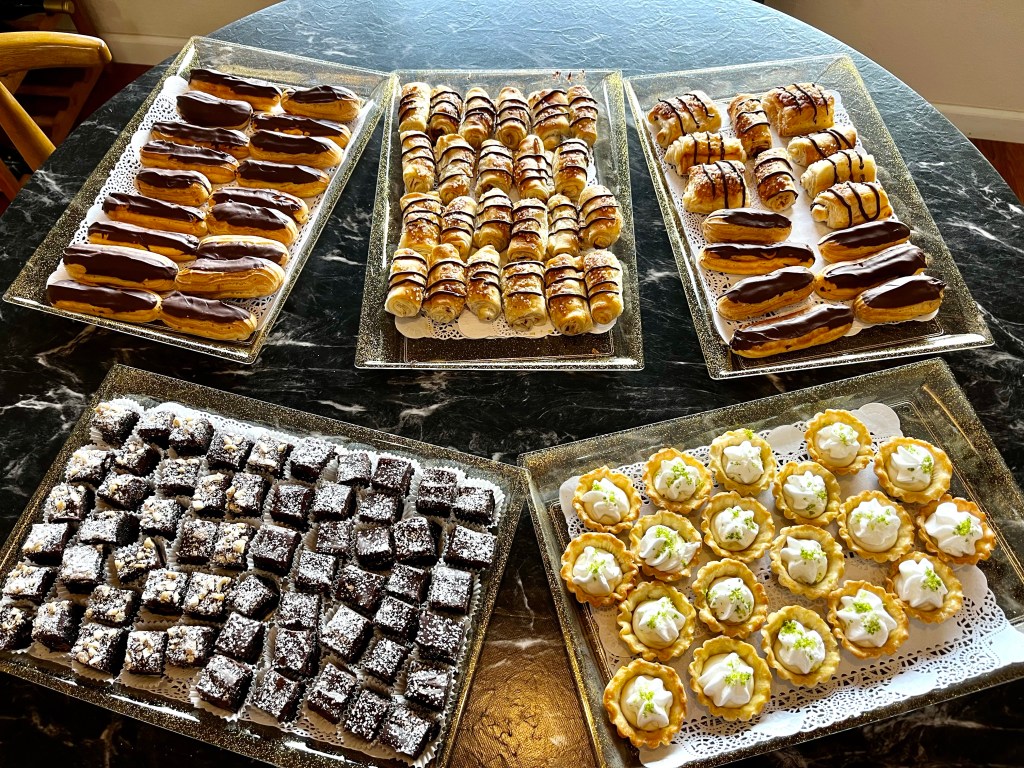
Our synagogue’s fundraiser is tonight and the administrator asked me to provide some of the deserts and something for the auction. To identify my goods I asked Dan to create a logo for me. For those who do not know, DeDe is my granddaughters name for me because they couldn’t pronounce Zayde (Yiddish for grandfather) when they were younger and it just stuck.

Over the last week or so I made and froze choux pastry for the eclairs and shells for the tarts. I made all the fillings yesterday and assembled everything this morning except the pain au chocolat which I made in its entirety this morning. (They don’t take very long.)

I made the chocolate covered caramels a few days ago, wrapped them and set them aside, (after sampling several.)

Happy Valentine’s Day 2023

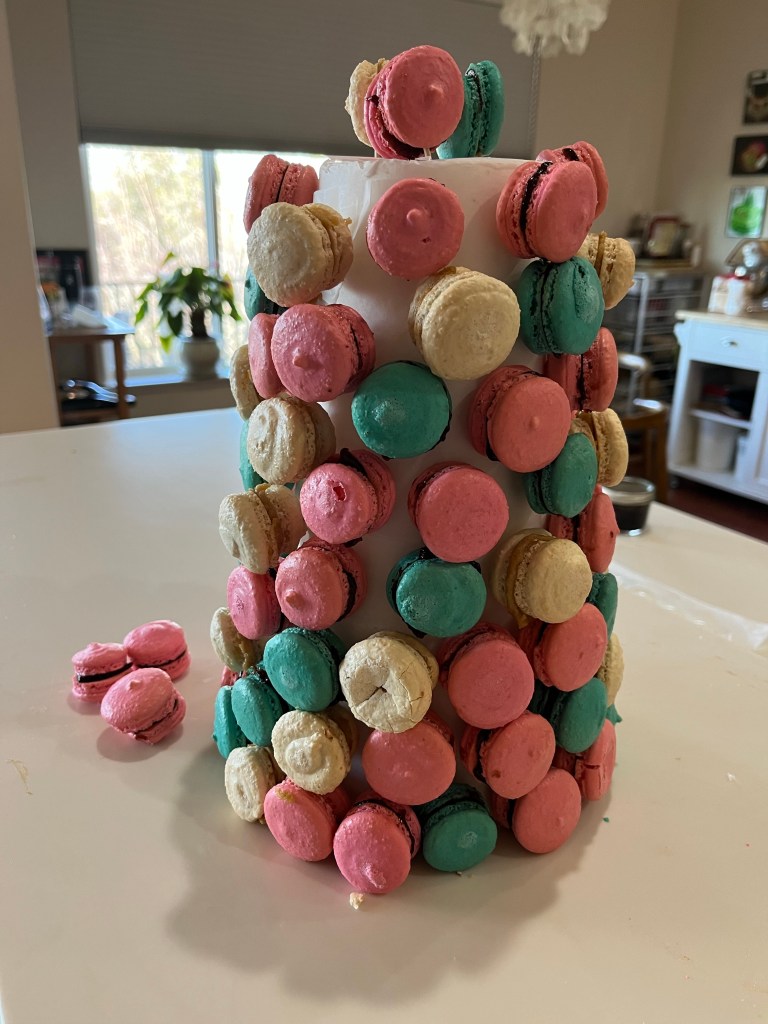
For your (meaning our) indulgence I prepared filled chocolates and a tri-colored macaron tower for this years Valentine’s Day.

Macaron Tower

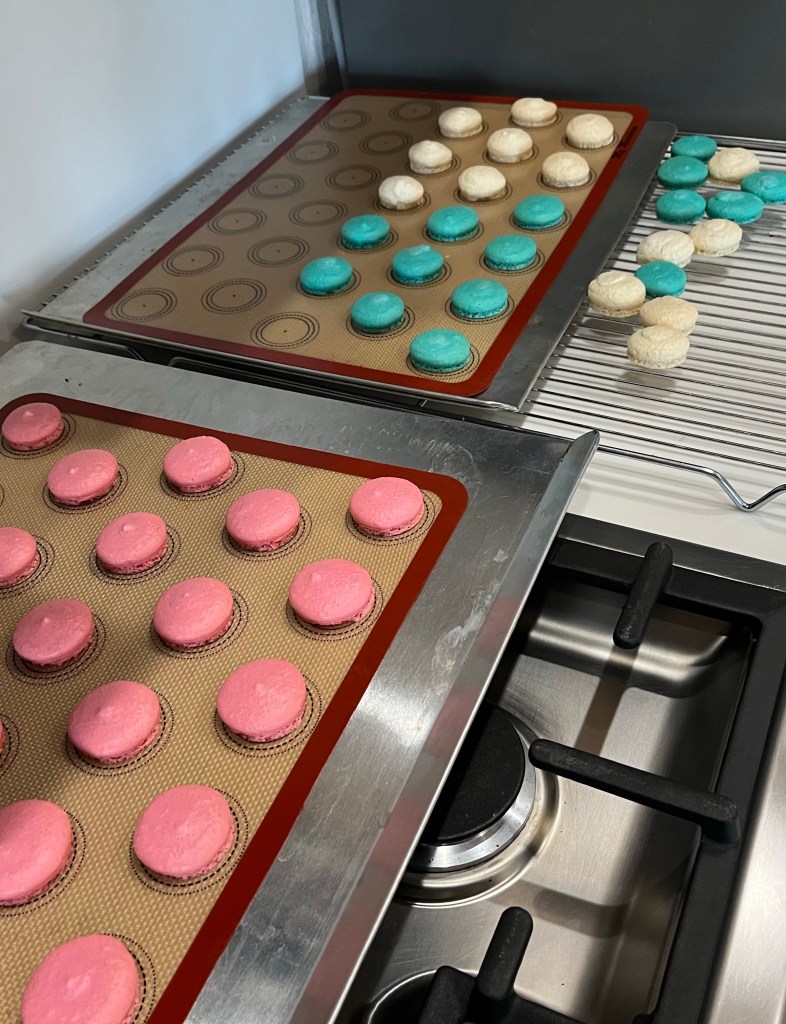
I had problems with the macaron tower. Being frugal, I used left over almond flour. Mistake! The flour was too coarse, even after running through a fine mesh sieve. The resultant batter was grainy and too thick to pipe properly. However, the taste was fine and they were crisp on the outside, had good legs, and were chewy on the inside.

I thought building the tower on my parchment-lined-styrofoam-cone would be easy if I started with a nice even base, then add macarons in a logical sequence row by row. Let’s just say it failed, not due to any ineptitude on my part but rather from geometrical issues with the cone. (It becomes smaller as you go up. Who knew?) I deconstructed the tower (breaking several macarons in the process) and re-built it by placing a single color in a spiral from bottom to top. (The nice teal one.) This method was better, but next time (and there will be a next time) I need to compensate the spiral with basic Euclidean geometric principles.

The teal macarons are filled with homemade plum jam, the pink with plum/raspberry jam and the white with hazelnut butter. They all taste good, but the hazelnut butter didn’t adhere well and the cookies tended to separate. QC suggests using a tart filling like lime or lemon curd to balance the sweetness of the macaron.

Filled Chocolates

I made three trays of chocolates, each with a different shape. To make them a bit special I piped lines of tempered white chocolate in two of the molds and let it cool before filling with tempered 64% chocolate. For the third, I piped some white chocolate into the bottom of each well and used a toothpick to made a star pattern. It worked reasonably well but led to my major mistake with this treat.

I attended a seminar on working with chocolate in Hawaii last year. The most important takeaway was the use of Mycryo to temper chocolate. I changed how to heat the chocolate and now use the microwave. 200g of dark chocolate requires 90 – 120 seconds with a 1000w microwave. After 60 seconds use small bursts and check the temperature between each one. If the temperature exceeds 104F it’s ok, just don’t go too high.

I failed to allow enough time between my golf round in the morning and our traditional happy hour dinner/drinks at our favorite pizza/bar. I tried to un-mold the chocolates too soon and broke many. In fact only six of the orange jelly confections survived. I should have allowed time to put the in the freezer for a few minutes to help them release. Oh well.

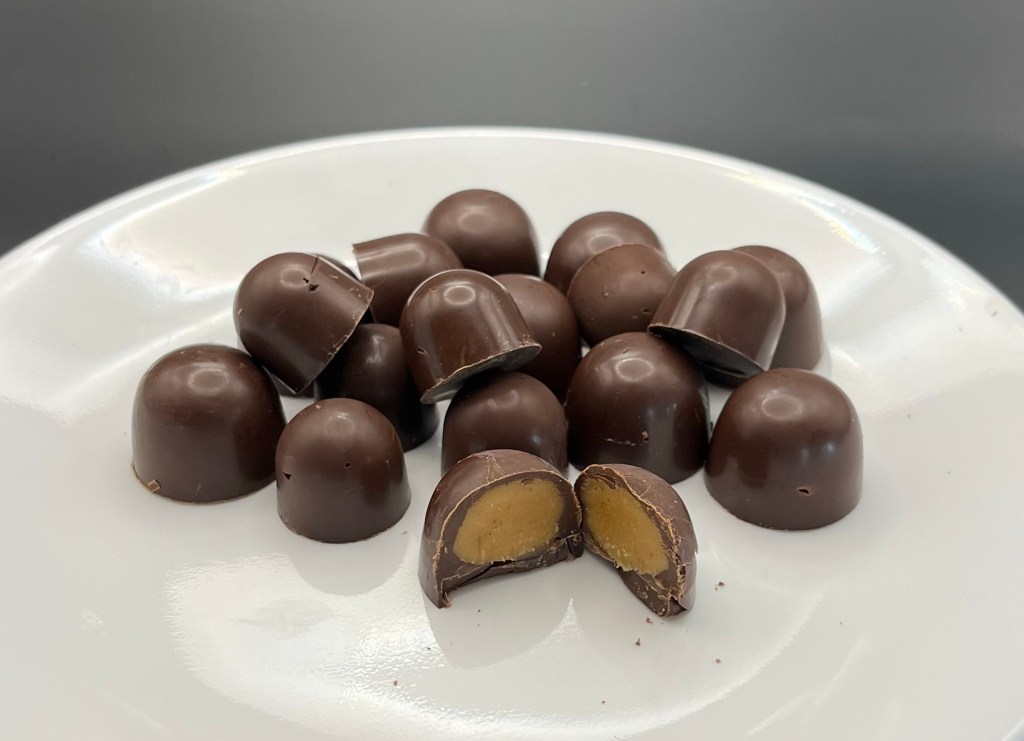
Notice the lack of shine on the macarons, and the points. Plus they were too thick, but had good feet. You can see a chip in the chocolate in the center candy, but also see how the white chocolate lines came out.

The confection with the faint stripes (left) are filled with fresh orange juice jelly, the hearts with soft caramel and the dome shaped ones (right) with coconut cream (think the inside of a Mounds bar. )

Overall, everything tasted good and that’s the most important!

True Lies and False Confections

This morning some radio commentator mentioned St. Valentines Day is Monday. After reviewing my calendar I said to myself, myself I said, “Yikes! Time is running out to make my chocolate candies for friends and family.”

Last year I began using my sous vide to temper chocolate. It is easier to control the temperature of the chocolate than in a double boiler.

Sous Vide Chocolate Tempering Set-up

Here is the setup I use. A pot of water chosen to fit both the sous vide and small pan holding the chocolate. The pan with the chocolate fits snugly so it wouldn’t fall into the water. The dishcloth is used to wipe and water from the bottom of the pan, if necessary, like when removing hot water from the water bath and adding ice to cool the water. There are two acrylic molds in the background to make the candies and the blue silicone mold to hold any excess chocolate. The excess made some nice solid chocolate hearts. Barely visible at the top of the photo is my morning coffee, an essential part of any kitchen adventure.

TEMPERING CHOCOLATE

Weigh desired amount of chocolate remembering it is easier to control the temperature of larger amounts of chocolate.

  1. For dark chocolate, set the sous vide to 126 deg and let the chocolate heat to 122 deg F and hold until it is all at temperature. That’s the beauty of using the sous vide to temper. It will hold indefinitely at any temperature you select.
  2. Remove the sauce pan containing the melted chocolate, wipe the pan dry and set it aside
  3. Replace 6-8 cups of water with 8-10 cups of ice. (Ice takes up more room than water. Add more cold water to the water bath if required.)
  4. Set the sous vide to 75 deg.
  5. When the chocolate cools to 82 deg, set the temperature to 95 to hold the chocolate in temper at 90 deg for over an hour.

NOTE FOR ACRYLIC MOLDS

  1. Paint the inside of each mold with a silicone brush allowing the chocolate to dry before repainting. Leave the brush in the tempered chocolate
  2. Paint three coats of chocolate being sure to examine the sides and corners closely to assure the entire inside of each mold is covered. Hold the coated mold up to the light and see if there are any holes in the coating.

I used different molds, the heart shaped one for the caramel filling and the domed one for the marshmallow. It required about 100 g of caramel to fill the 18 cells of hearts and 50 g of marshmallow to fill each of the domes.

FILLING CHOCOLATES

I warmed the caramel to piping consistency, filled a piping bag with the slightly warm caramel. When filling the chocolate shells be sure to leave adequate room to seal the bottoms of the chocolates. Repeat with about the marshmallow.

Cutting the chocolates for photos is always difficult. The tempering makes them hard and brittle. I used a very thin serrated knife.
Any suggestions would be welcome.

Pour enough chocolate across the filled molds and spread to assure each cell is covered with chocolate. (NOTE: the chocolate was kept at 90 deg and remained tempered throughout all the steps. Yay sous vide!)

Once the bottom coat of chocolate is fairly cool scrape off the excess with a bench knife. Save the excess for you next adventure.

Holiday Sweets

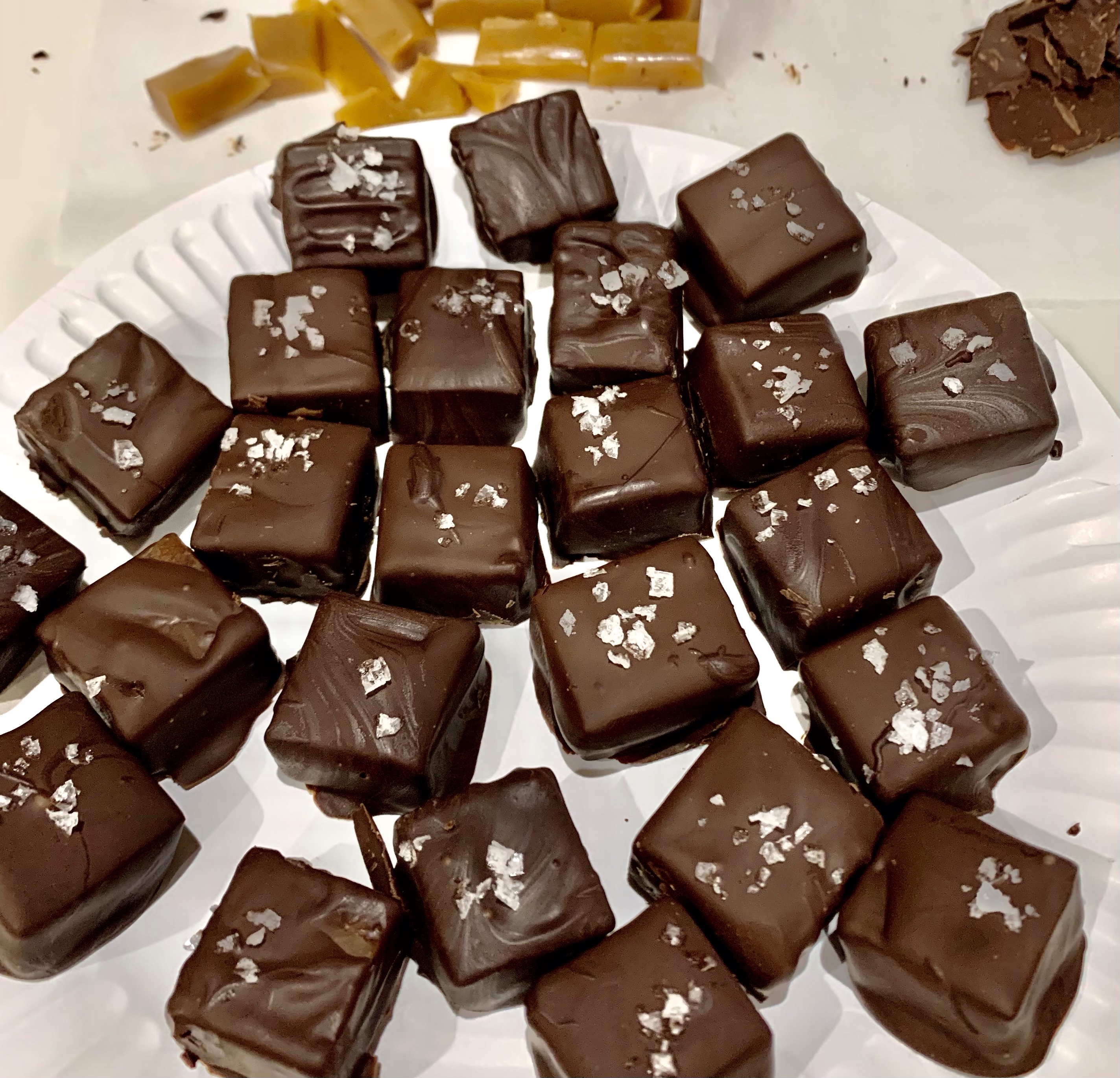
As the holidays approach, the baker often changes his spots from baker to chocolatier. Everyone seems to like my chocolate coated soft caramels dusted with some Maldon Sea Salt Flakes.

I ran out of my favorite Barry 64% cacao chocolate. This chocolate is both delicious and has a 4 out of 5 liquidity which makes a nice thin coating. I found some re-packaged bulk Barry Callebaut 70% dark chocolate which did not have a liquidity rating. After using it I would guess it is in the 2-3 range of 5. By not flowing as well yhis resulted in a thicker coating, but it was all that was available. Hopefully, my “go to” 64% will be back in stock soon!

Paying attention to the temperatures while tempering the chocolate really pays off. The chocolates don’t melt in your fingers and have an attractive, shiny appearance.

I hit the maximum temperature of the caramel perfectly. (238 deg) To cut it I put in in the refrigerator for about 30 minutes, then cut into about 1” squared. I still had to coat the knife with some baking spray to make cleanish cuts.

Caramel on the Bay, Revisited

Do you like soft, chewy caramels, especially when coated with dark chocolate and sprinkled with a bit of Malden Sea Flake Salt? Well, I do!

If you read the past few posts you know I bought 11 pounds of very nice chocolate and am looking for places to use it. Today I discovered it took about 360g, or 12 oz of chocolate to cover 72 one inch cubes of caramel. Now I know..

These are really easy to make, and worth the modest effort. I experimented with coating with simple melted chocolate or using tempered chocolate. Tempering is worth the extra step. The chocolate won’t melt in your hands, but will in your mouth.