Dave Oney was born mid last century in Middlebury, Vermont. He received his BS in Chemistry and worked as a polymer chemist in Massachusetts and New Jersey. He became a microscopist (someone who studies little bitty things using a microscope) and photomicrographer (someone who photographs little bitty things) before settling into a 35-year career in technical sales of scientific imaging equipment (the science of digitally recording itty bitty things, sending the image to a computer for analysis.) He designed and created a number of products contributing to this field. He is (was) proficient in several computer languages and is currently working on mastering English.
After making a few more paradigm shift career changes Dave and his wife, Fran, retired and moved closer to their children and granddaughters and now live in the foothills of the Sierra Nevadas.
I am a big berry buff and when I saw this recipe I knew I would make these.
I followed the recipe exactly on my first bake, but made changes the second time around. Mainly, I swapped the blackberry buttercream for a blackberry meringue frosting. I used some purple food coloring and added some freeze dried blackberry powder. Blackberry is not an overpowering flavor but this added just enough to complement the dark chocolate cupcake.
Dark Chocolate Blackberry Cupcakes
Makes 18 cupcakes
INGREDIENTS For the cupcakes: • 1 c AP flour • ½ c unsweetened cocoa powder • 1 tsp baking soda • ½ tsp salt • ½ c unsalted butter, melted • ¾ c brown sugar • 2 large RT eggs • 1 tsp vanilla extract • ½ c buttermilk (milk with ½ Tbl lemon juice) • ½ c hot water • ½ c mashed, fresh blackberries Blackberry Italian Meringue • 3 egg whites room temperature • 2/3 cup caster sugar • 1/4 cup water • 1/4 teaspoon cream of tartar • 1 Tbl freeze dried blackberry powder
METHOD
Wash 2 c fresh blackberries in cold water
Blend cleaned blackberries until totally broken down.
Add 1 Tbl sugar and blend again.
Separate into ¼ c and ½ c portions. Set both portions aside. (Use any leftover on ice cream or in a margarita, etc.)
Preheat oven to 350°F (175°C). Line a cupcake pan with liners.
In a bowl, whisk flour, cocoa powder, baking soda, and salt.
In another bowl, mix melted butter and brown sugar until smooth. Add eggs and vanilla, then stir in ½ c mashed blackberries.
Alternately add dry ingredients and buttermilk, mixing gently. Stir in hot water until just combined.
Fill cupcake liners ¾ full and bake for 18-20 minutes or until a toothpick comes out clean. Let cool completely.
For the frosting, beat butter until creamy. Add powdered sugar, ¼ c blackberry puree, and vanilla. Beat until fluffy, adding cream if needed. Be sure the frosting is thick enough to hold its shape after piping.
Pipe frosting onto cooled cupcakes and enjoy!
Italian Meringue Method
Wipe down all tools with white vinegar.
Place sugar and water mixture over medium heat for 5 minutes. Do not stir it at all during this time. The mixture will look cloudy.
Gently stir the mixture for 1 minute. There should be little to no granules of sugar left at this point.
Once the mixture begins to bubble from the bottom, 3 to 5 minutes, place the digital thermometer in the pot and increase to medium-high heat. Do not stir it at all after this.
In the bowl of an electric mixer, whip the eggs whites on low speed until foamy. Add the cream of tartar, increase the speed to medium, and beat until soft peaks form.
Allow the sugar mixture to come to a boil and watch carefully. Once it reaches 230 °F turn stand mixer on highest speed to whip egg whites to peaks.
7. Once the sugar syrup reaches 240 °F, remove from heat and remove the probe. This takes about 4- 6 minutes.
Allow the boiling to come to a slow bubble before moving on.
Slowly pour sugar syrup (steady stream) into whisked egg whites. Avoid the whisk attachment or it will fling your mixture all over the bowl.
FB posted this Rustic No Knead Rosemary Garlic Bread by Jacques Pepin. I made a few changes to the method (as if I know more than M. Pepin.)
I followed the ingredients as published and the bread was fantastic, but next time I will increase the amount of garlic. All changes have been incorporated in the recipe below.
I did a stretch and fold before shaping the loaf, This is a 100% hydration bread and has little structure before baking, i.e it is very soft, wet, and hard to handle.. There was no reference to scoring the bread, but on reviewing the published photo realized it was scored with large cross cuts. (Next time, which will be very soon.)
My baking time was also much longer (nearly double) what was published. My modifications are incorporated below.)
Rustic No Knead Rosemary Garlic Bread – Jacques Pepin
INGREDIENTS • 360g (3 c) AP flour • 1 tsp salt • 1 tsp active dry yeast • 355g(1 ½ c) warm water (about 105-115⁰ F) • 5 cloves garlic, minced • 2 Tbl olive oil • 1 Tbl chopped fresh rosemary • ¼ c grated Parmesan cheese
METHOD
In a large bowl, whisk together the flour, salt, and yeast.
Add the warm water, minced garlic, and olive oil to the flour mixture. Stir with a wooden spoon until a shaggy dough forms.
Cover the bowl with plastic wrap and let the dough rest at room temperature for 12-18 hours.
Preheat oven and prepare dough: Preheat oven to 450⁰ F .
Sprinkle a light coating of flour around the edge of the bread and use your fingers to lightly tuck the flour into the edge of the dough. With floured fingers (you may need to re-flour your fingers after each time you touch the bread) stretch and fold the bread, turning 90⁰ and repeat a total of 10-12 stretch and folds to make the dough firmer and easier to handle. Turn the dough out onto a lightly floured surface and gently shape it into a loaf.
Lightly oil a 10-inch cast iron skillet or coat with nonstick spray, sprinkle with cornmeal. Score a large cross in the bread with a lame or sharp knife.
Place the loaf in the skillet for 30-40 minutes, checking the internal temperature every 5 minutes after the first 20, or until golden brown and cooked through.
While the bread is still warm, brush with melted butter and sprinkle with chopped rosemary and Parmesan cheese.
Let the bread cool slightly before slicing and serving. Try this with an oil and vinegar dip.
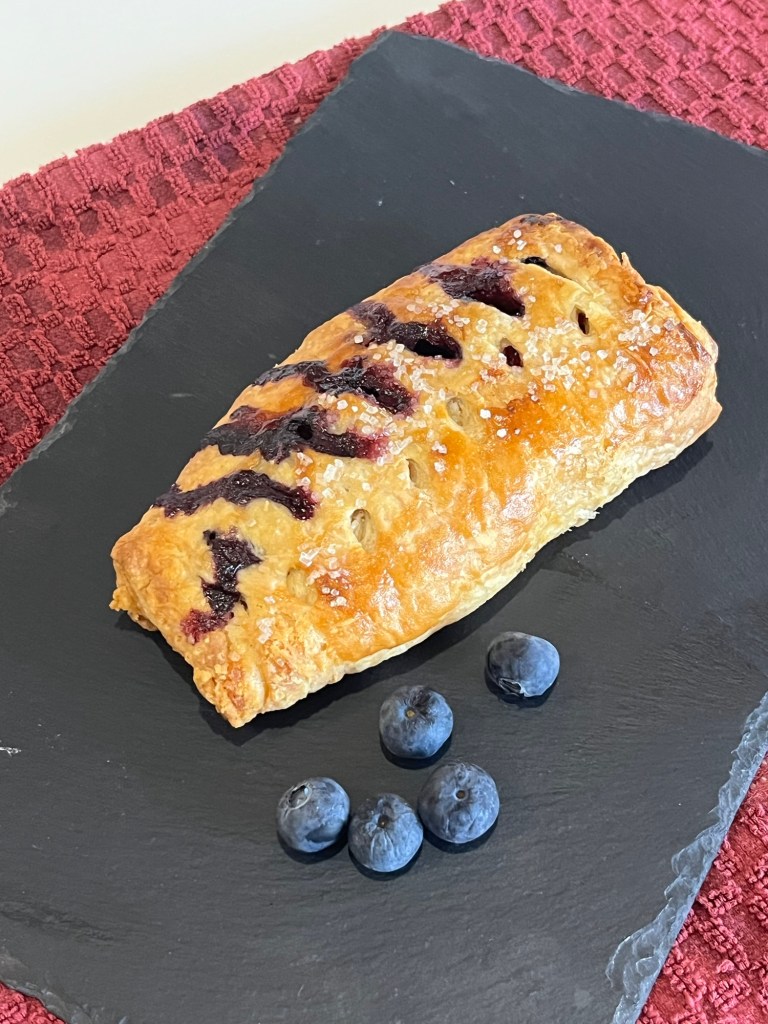
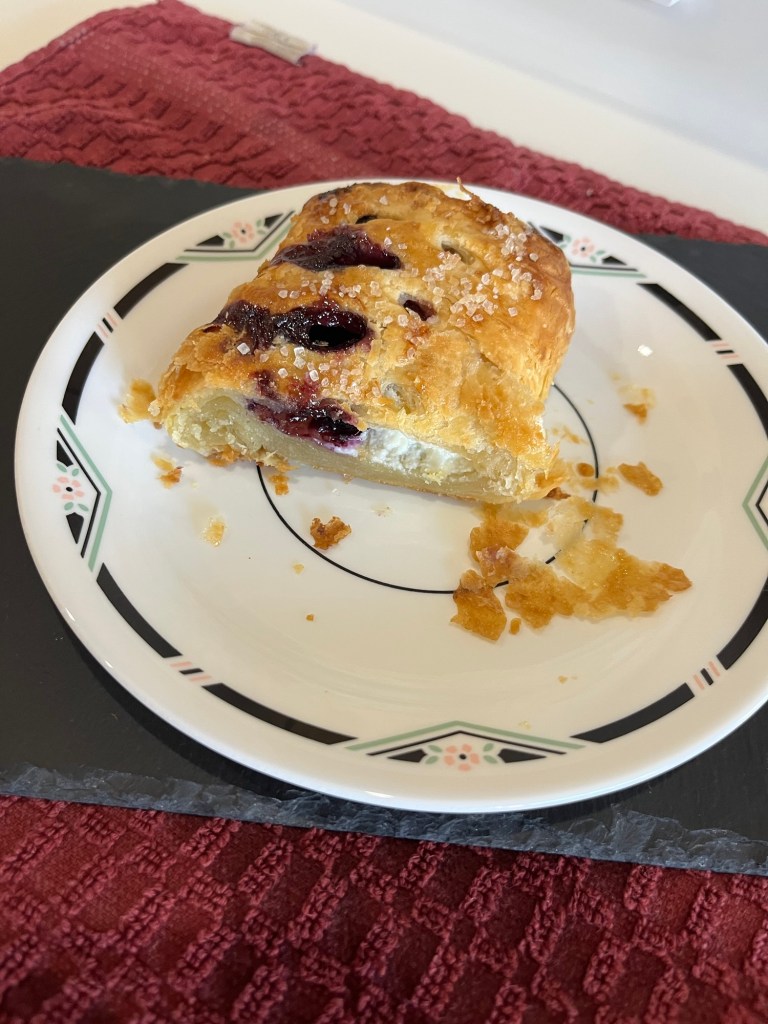
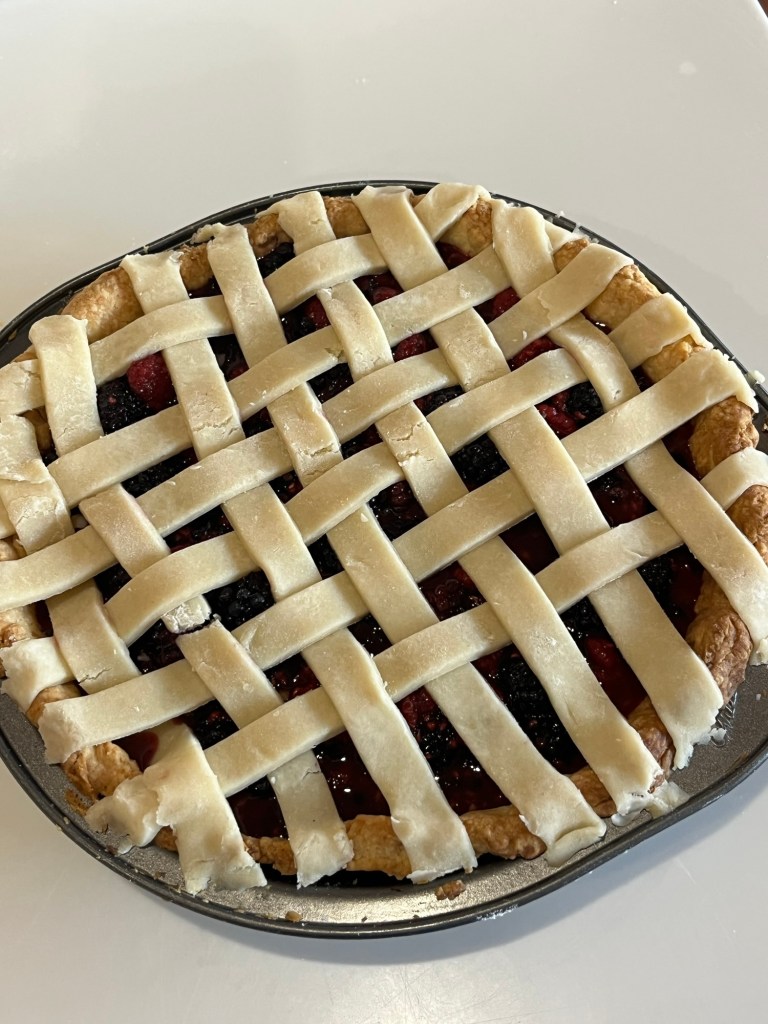
Traditionally we have pizza on Pi Day, but other, more important obligations interfered with tradition. Instead, I made Berry Hand Pies (Blueberry and Raspberry) and while not pizza, they didn’t disappoint.
Berry hand pies are a piece of cake. (Sorry, I couldn’t resist.)
I saw this recipe on FB and was, of course, compelled to make a loaf.
It’s a pretty easy bake and results in a very nice tasting bread with a good whole wheat crumb and texture. Next time will double the amount of maple syrup (costly, but worth it) or add the maple sugar to the top (I didn’t have any.)
Vermont Maple Oatmeal Bread
INGREDIENTS • 1 ¼ cups boiling water • 1 cup rolled oats • ¼ cup (78g) maple syrup or ½ cup maple sugar • 1 tablespoon unsalted butter • 1 ½ teaspoons salt • ½ teaspoon cinnamon • ½ teaspoon maple flavor optional • 2 teaspoons instant yeast • 1 cup whole wheat flour • 2 cups all-purpose flour METHOD
In a large mixing bowl, combine boiling water, oats, maple syrup (or maple sugar), butter, salt, cinnamon, and maple flavor if using. Stir and let cool to lukewarm.
Once cooled, add yeast, whole wheat flour, and all-purpose flour. Stir until a rough dough forms.
Knead the dough until smooth and elastic, about 10 minutes by hand or 7 minutes with a machine.
Transfer to a lightly greased bowl, cover, and let rise for 60 to 90 minutes until puffy and nearly doubled in size.
Gently deflate the dough and shape it into an 8-inch log. Place in a lightly greased 8 ½” x 4 ½” loaf pan.
Cover and let the loaf rise until it crowns about 1 inch over the rim of the pan, about 60 to 90 minutes.
Preheat the oven to 350°F (175°C).
If desired, brush the top with water and sprinkle with maple sugar. Bake for 35 to 40 minutes, tenting with foil after 15 minutes to prevent over-browning. The interior should reach 190°F (88°C).
Remove from the oven, let cool in the pan for 5 minutes, then transfer to a wire rack to cool completely before slicing. NOTES
For a more pronounced maple flavor, increase the maple syrup slightly and reduce the water accordingly.
This bread is excellent toasted with butter or cream cheese. – Store in an airtight container at room temperature for up to three days or freeze for longer storage.
Not often, but on rare occasion I have a baking disaster. Yesterday I wanted blueberry muffins and unfortunately used an old recipe. Apparently, there was a major error in the recipe as after two attempts I binned the results (along with the recipe) and headed to my go-to baker, Sally McKenny. (“Binned” is a term from GBBO where whatever didn’t work is tossed in the trash.)
I wisely turned to Sally’s blueberry muffin recipe and they were overwhelmingly endorsed by the QC Cadre. (For any who do not know, the QC Cadre is composed of a number of my neighbors who volunteered to sample and review my bakes.)
Today is the 80th birthday of one of our good friends, and golf buddy. She asked me to make cupcakes for the 15 guests coming to her bowling/birthday party. I decided to make cupcakes using my Extreme Chocolate Cake recipe with Italian Meringue frosting, because that combination is my fav. I did ask her what her favorite color is, and pink was among her answer, so I made a bi-color frosting.
My notes in my recipe said the recipe would make 36 cupcakes, but of the 3 different sizes of cakes in the recipe, it didn’t say which one made the 36. I decided to go with the medium size cake (10” round.) Well long story shorter, that made 54 cupcakes. I have since modified the recipe.
The cupcakes are soft and delicious and the meringue isn’t too sweet and pairs nicely.
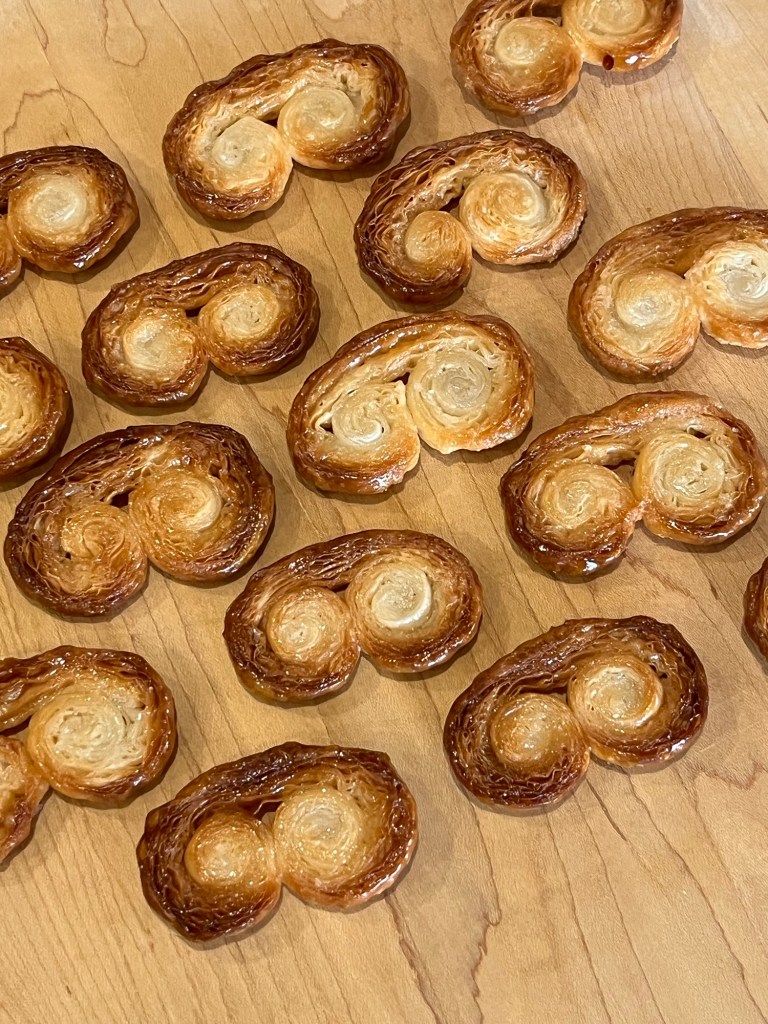
I really think every pastry baker needs to know how to make puff pastry. The easiest version is rough puff, which I made a couple of days ago. It is as easy, delicious, flakey and buttery as the Daring Gourmet claims ( find her recipe here: daringgourmet.com).
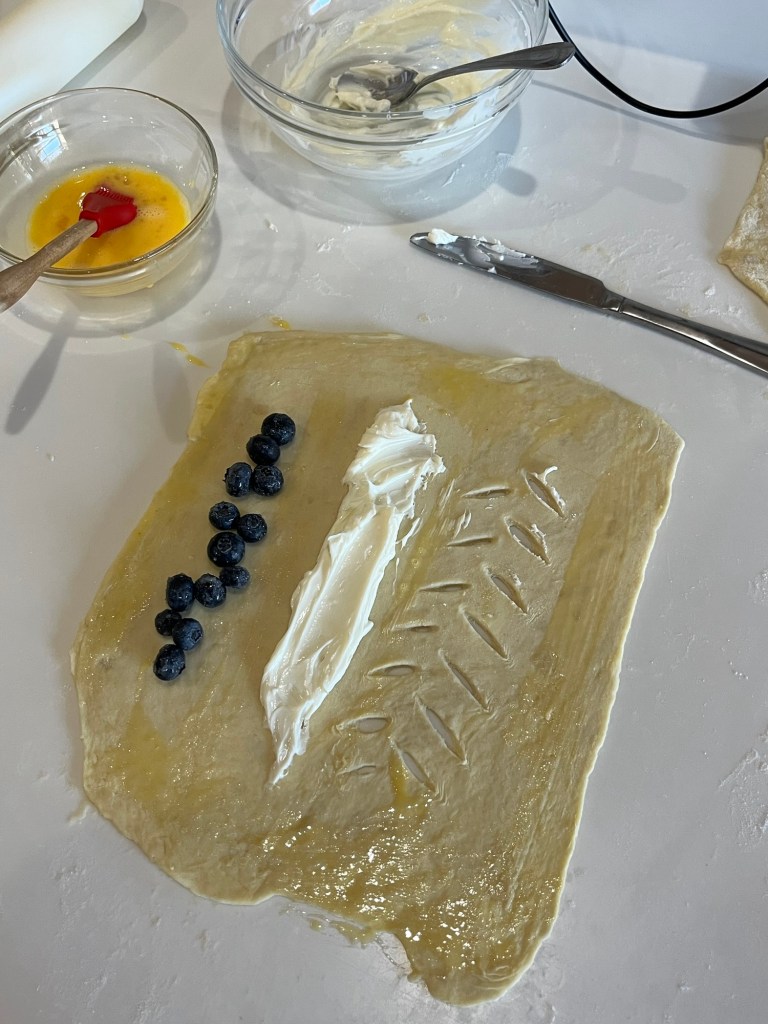
I had some issues turning and rolling to develop a smooth pastry, but after 8 turns it looked pretty good. Kept in the fridge for a couple of days and rolled out to about 1/8th inch thick this morning it looked great. I cut 3” circles, filled them with a cream cheese, sugar, white chocolate chip mixture and topped with a small raspberry. The edges were egg washed, folded and crimped with a fork before coating the top with more egg wash and sparkling sugar.
Actually, I both over-filled and under-sealed them so they are a mess. (See step #5 regarding my disregard of my own advice.) That in no way affects their taste. Using a 4” cutter might help. As advertised the puff pastry was excellent, the filling (my recipe) was likewise excellent, but then, the combination of chocolate and raspberries is hard to beat.
Ignore the artisan bread in the background. I had to heat up the oven anyway so why not?
Berry Hand Pie
INGREDIENTS • 1 egg • 1 tablespoon water • 2 tablespoons all-purpose flour • 1 sheet puff pastry, thawed but cool. • 2 ounces cream cheese, softened • 1 tablespoons granulated sugar or decorating sugar • ¼ cup white chocolate chips • 3 ounces berries • 2 tablespoons coarse white sugar or decorating sugar METHOD
Heat the oven to 400°F. Beat the egg and water in a small bowl with a fork.
Stir the cream cheese and granulated sugar in a medium bowl until the mixture is smooth. Stir in the white chocolate chips.
Cut large berries in half.
Sprinkle the flour on the work surface. Unfold the pastry sheet on the work surface. Roll the pastry sheet into a ~12-inch square. Using a round cutter, cut into as many 3 -inch circles as you can. (Try a 4” cutter and settle for fewer, better looking pastries.)
Brush the edges of the pastry circles with the egg mixture. Place about ½ tablespoon cream cheese mixture in the center of each. (Don’t overfill.) Top each with about one small or two halves of a large berry. Fold the circles in half, pinching the edges together. Crimp both edges with a fork. If you don’t seal them adequately or have to much filling it will leak out of the sides of the finished pastry.
Brush the pastries with the egg mixture and sprinkle with the coarse sugar. Using a sharp knife cut small slits in the tops of the filled pastries. Place the pastries onto a silicone or parchment paper lined baking sheet.
Bake for 20 minutes or until the pastries are golden brown. Remove the pastries from the baking sheets and let cool on wire racks for 10 minutes.
Often I bake for an event or occasion. Sometimes I see a recipe online and want to duplicate it. Sometimes I like to immerse myself in a bake to occupy my mind so I don’t think about anything else. Today was one of those days.
This recipe, upside down key lime pie, is from Sally of Sallys Baking Addiction.. It is delicious and my opinion is shared by the QC Cadre (i.e. neighbors.)
The graham cracker crumble is the perfect crunch for the pie filling just as the sweet meringue balances the tartness off the key lime.
I am sorry, but I cannot write my normal, snarky, quirky pander today. Perhaps I will return to it one day, but not today.
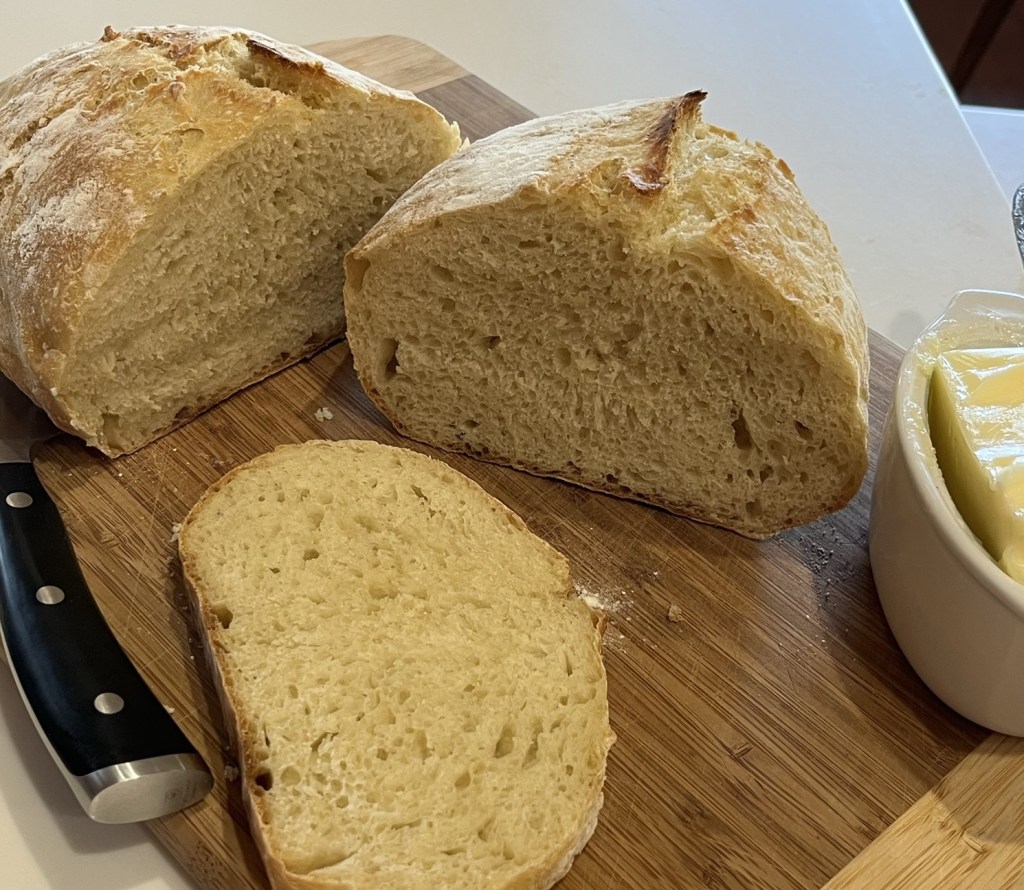
I wasn’t going to mention the artisan bread (as seen in the background) I made this morning, but I added a twist to the recipe. I use the Tangzong technique fairly often, but hadn’t used it on artisan bread. The standard method yields a bread that is 9.5 out of 10, so what is the point?
Tangzong pre-gelatinizes the starch in the flour, allowing it to absorb twice as much water than with cool water. Since there’s less free (unabsorbed) water in the dough, it’s less sticky and easier to knead plus it stays fresh longer, not that that is an issue here, over the past 2 weeks I made the artisan loaf every 2 or 3 days. For variety I did occasionally change from boule to batard.
I also made Scottish Oatcakes this morning. I read an article about them, which is all it ever takes for me. The bake resulted in 16 crisp “biscuits” (as cookies are called in the UK.) They be a nice change from all the cookies (but don’t worry, plenty of cookies coming up. I am doing another fund raiser in March and need to practice, practice, practice.)
Artisan Bread with Tangzong
INGREDIENTS
450g (3 ¾ c) bread flour divided (For Italian Bread use AP flour))
2 ¼ teaspoons instant yeast
10g (1 ¾ tsp) kosher salt
360g (1 ½ c) warm water between 120°F and 130°F (360 grams)
METHOD
In a large mixing bowl, whisk flour, yeast, and salt to combine. Measure water into a small bowl
Tangzong: Transfer 3 tablespoons of the measured flour and ½ cup of the measured milk or water into a saucepan and set over medium-high heat.
Cook the mixture, whisking constantly until it thickens into a thick slurry (~1 minute.)
Transfer the cooked mixture to a bowl until cool to lukewarm, then add remaining flour, milk (or water), and other dough ingredients combine with a dutch dough which until the mixture is very sticky, and no lumps of flour remain.
Cover and place in a proofing oven until doubled in size, about 1 to 1 ½ hours.
Preheat the oven to 450°F. Place a large dutch oven with a lid in the oven for at least 30 minutes.
Using lightly floured hands, reach down one side of the dough to the bottom of the bowl, pull up, and stretch the edge of the dough over the center toward the opposite side. Turn the bowl 90 degrees and repeat the folding and turning, working in a circle around the dough until the dough starts to hold its shape, about 8 to 10 rotations. Pinch any seams together at the center of the dough ball.
Turn out the dough onto a lightly floured surface, placing it seam side down. Shape into a boule or batard, depending on the intended use. Transfer the dough onto parchment paper lined banneton and sprinkle with flour. Loosely cover with plastic wrap or a tea towel for 10 minutes while the oven heats to 450°F. Place a large dutch oven with a lid in the oven while it preheats.
Using a sharp knife or bread lame, cut a slit about ¼-inch deep across the top of the dough. Very carefully place the dough with the parchment paper directly into the preheated Dutch oven. Cover with the lid.
Bake for 20 minutes. Remove the lid and bake until deeply golden brown and the internal temperature is about 195°F (~15 to 17 minutes more.) Carefully remove the bread from the Dutch oven using the parchment paper to help, and place on a wire rack to cool for at least 20 minutes before slicing
Tangzong
Tangzong pre-gelatinizes the starch in the flour, allowing it to absorb twice as much water than with cool water. Since there’s less free (unabsorbed) water in the dough, it’s less sticky and easier to knead
METHOD
Measure out the total amount of flour and milk specified in the recipe.
Transfer 3 tablespoons of the measured flour and ½ cup of the measured milk or water into a saucepan and set over medium-high heat.
Cook the mixture, whisking constantly until it thickens into a thick slurry (~1 minute.)
Transfer the cooked mixture to a bowl until cool to lukewarm, then add remaining flour, milk (or water), and other dough ingredients and proceed with the original recipe method.
Scottish Oatcakes
INGREDIENTS • 226g quick-cooking oats (2 ½ c) • 1 tsp kosher salt • ¼ tsp baking soda • 66g (6 Tbl) melted clarified butter • ¾ c hot water, around 200ºF (93ºC)
METHOD
In a medium bowl, stir oats, salt, and baking soda to combine. Add melted clarified butter or ghee to oat mixture and, using a flexible spatula, toss to evenly coat oats with fat. Add hot water and stir until mixture begins to thicken, 30 – 60 seconds. Let sit until oat mixture has hydrated and is slightly sticky, about 5 minutes.
Using a flexible spatula, scrape oat mixture onto a 18×13” piece of parchment. Top with another 18×13” piece of parchment so oat mixture is sandwiched between and, using a rolling pin, roll oat mixture to ¼ “thick. Grab both ends of the parchment, set onto a 18×13” rimmed baking sheet, and freeze until mixture is firm but pliable, about 30 minutes. Line two 18×13” rimmed baking sheet with parchment; set aside.
While the mixture is chilling adjust oven racks to second-from-top and second-from bottom positions and preheat to 350ºF (175ºC). 350ºF or 325ºF convection
Set a clean piece of parchment on your kitchen counter. Remove oatcake mixture from freezer. Peel off top layer of parchment, then invert oatcake mixture onto prepared sheet of parchment. Using a 3-inch round cookie cutter, cut out 16 oatcakes. (Scraps can be rerolled, frozen, and punched out into additional oatcakes.) Transfer oatcakes to prepared baking sheets, spacing them about 1 inch apart, and bake until crispy and lightly browned, 30 to 35 minutes. Remove from oven and let cool completely before serving or storing.
In a small saucepan, melt butter over medium-high heat.
Continue to cook over medium-high heat; an even layer of white milk proteins will float to the surface.
Bring to a boil; the milk proteins will become foamy.
Lower heat to medium and continue to gently boil; the milk proteins will break apart.
As butter gently boils, milk proteins will eventually sink to the bottom of the pot, and the boiling will begin to calm and then cease. Adjust heat as needed to continue boiling off water without scorching milk solids.
Once boiling has stopped, pour butter through a cheesecloth-lined strainer or through a coffee filter into a heatproof container to remove browned milk solids.
Let cool, then transfer to a sealed container and refrigerate until ready to use. Clarified butter should keep at least 6 months in the refrigerator.
On Wednesday this week I spent the morning replenishing our artisan bread supply and making some nibbling cookies. This bread may be the best I make, and QC said the pistachio/cranberry shortbread cookies may be the best of anything I bake.
To mix things up a little this time I shaped the bread as a boule while the previous bread was a batard. The shortbread cookies were the same as the past bake.