Sandwich Bread

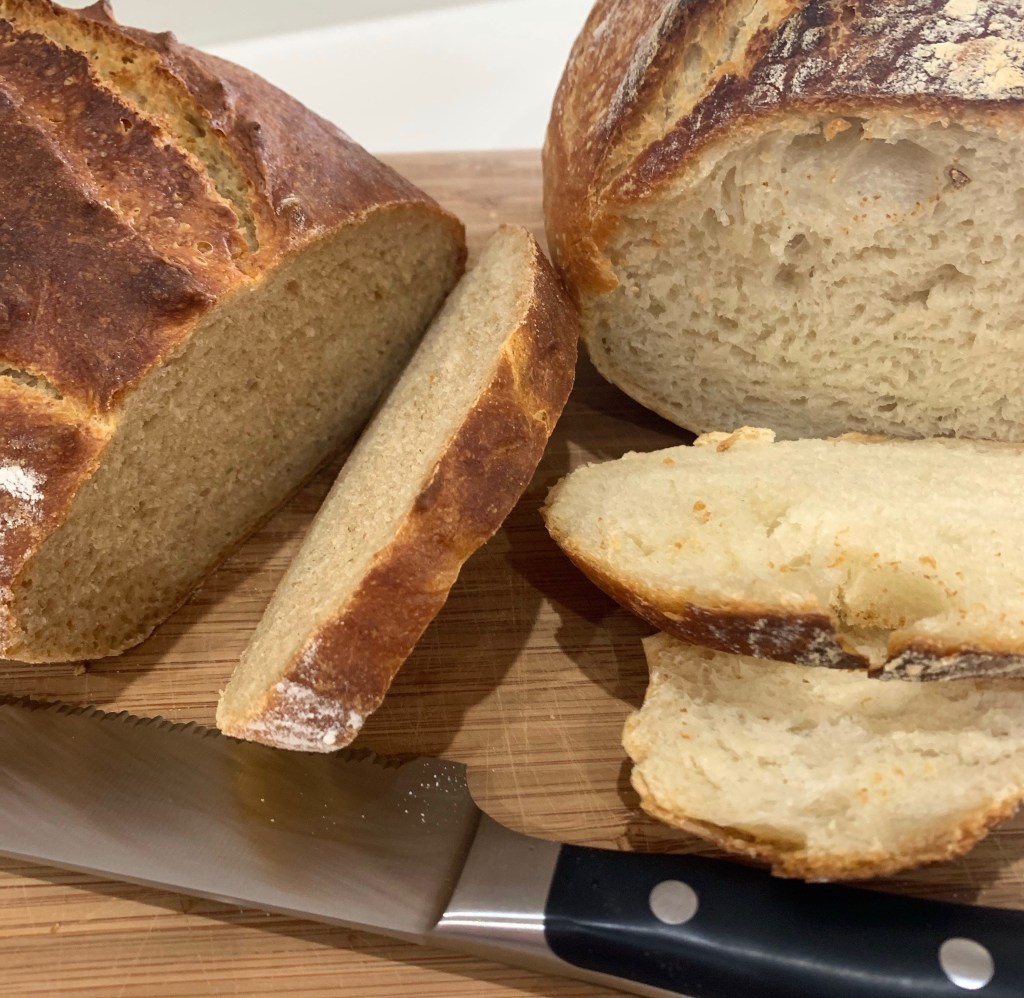
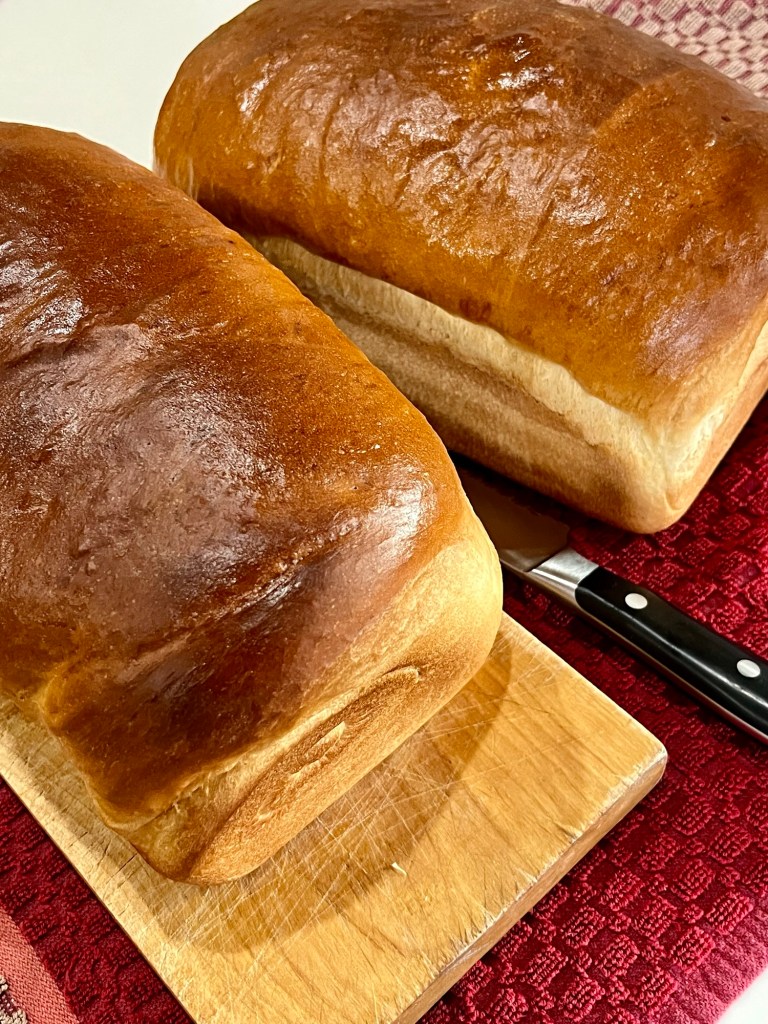
After reading a new recipe for sandwich bread I realized it was very similar to my “go to” artisan bread. The differences are two tablespoons of sugar are added to the water and yeast and allowed to rest for 10 minutes before adding the bread flour and salt, and the bread is baked in a greased loaf pan instead of a Dutch oven

The result is a very soft loaf with a softer crust than the artisan bread and perfect sandwich crumb. It’s amazing what such a small change can make in character of a bread. There is a time and place for everything.

Artisan Bread

INGREDIENTS
• 450g (3 ¾ c) bread flour divided (For Italian Bread use AP flour))
• 2 ¼ teaspoons instant yeast
• 10g (1 ¾ tsp) kosher salt
• 360g (1 ½ c) warm water between 120°F and 130°F (360 grams)

As an alternate add 2 tsp sugar, mix the water, yeast and sugar in a bowl and let set 10 minutes. Thoroughly mix in the flour and salt, cover with a towel and let sit for ~1 hour until doubled in size. Bowl fold as in step #4 below. Shape the dough, place into a greased loaf pan, slash the top, and let rise an additional 30 min. Bake 30-35 minutes at 375°F until the top is a golden brown or internal temperature is 190°F.


METHOD

  1. In a large mixing bowl, add flour, yeast, and salt, stirring with a dutch dough whisk to combine. Stir in water until the mixture is very sticky, and no lumps of flour remain.
    a. Cover and place in a warm, draft-free area until doubled in size, about 1 ½ to 2 hours.
    b. Alternatively, for an overnight rise: After mixing the dough, cover and refrigerate until doubled in size. This will take about 8 hours but will keep in the fridge up to 24 hours total.
  2. Preheat the oven to 450°F. Place a large dutch oven with a lid in the oven for at least 30 minutes.
  3. If refrigerated, remove the dough from the refrigerator and let rest at room temperature for 15 minutes.
  4. Using lightly floured hands, reach down one side of the dough to the bottom of the bowl, pull up, and stretch the edge of the dough over the center toward the opposite side. Turn the bowl 90 degrees and repeat the folding and turning, working in a circle around the dough until the dough starts to hold its shape, about 8 to 10 rotations. Pinch any seams together at the center of the dough ball.
  5. Turn out the dough onto a lightly floured surface, placing it seam side down. Shape into a boule or batard, depending on the intended use. Transfer the dough onto parchment paper lined banneton and sprinkle it with flour. (Alternatively, divide dough in half and form each into a small batard, place in a parchment paper line French bread form) Loosely cover with plastic wrap or a tea towel for 10 minutes while the oven heats to 450°F. Place a large dutch oven with a lid in the oven while it preheats.
  6. Using a sharp knife or bread lame, cut a slit about ¼-inch deep across the top of the dough. Very carefully place the dough with the parchment paper directly into the preheated Dutch oven. Cover with the lid.
  7. Bake for 15 minutes. (If making 2 smaller loaves shaped in french bread forms, bake for 12 minutes, on an oven rack positioned in the upper third of the oven then check internal temperature.) Remove the lid and bake until deeply golden brown and the internal temperature is about 195°F (~11 to 12 minutes more.) Carefully remove the bread from the Dutch oven using the parchment paper to help, and place on a wire rack to cool for at least 20 minutes before slicing

White Sandwich Bread

It’s been a while since I made any basic, traditional sandwich bread, but that ended this afternoon.

At 3:30 we decided to have BLT’s for dinner, except we didn’t have any bread. In her infinite wisdom QC said, “It’s only 3:30. Can’t you make bread before dinner?” Usually I start baking around 6am, but in a crisis I can be flexible.

We bought some “B” at the market this noon, and had one “T” left over from our favorite roast beef wraps. (Flour tortillas, mayo, lettuce, tomato, roast beef and in QC’s case, cheese and in mine pickled jalapeños.) My garden lettuce is starting to bolt and grew very tall over the last week, so it needs to be eaten right away, hence the “L” in our sandwich. (I gave “stalks” of lettuce to the QC Cadre.) The head lettuce has another week or two.

I used to make this bread as my standard, until I found the artisan breads that have nicer crust and crumb.

Bread – White Gold Medal Recipe

INGREDIENTS
2 Loaves
Bread flour • 6 to 7 cups
Sugar • 3 Tbl
Salt • 1 Tbl
Shortening • 2 Tbl
Yeast • 4 ½ Tsp
Warm water • 2 ¼ cups (120° to 130°F)

METHOD

  1. In large bowl, stir ½ of the flour, the sugar, salt, shortening and yeast until well mixed. Add warm water. Beat with electric mixer on low speed 1 minute, scraping bowl frequently. Beat on medium speed 1 minute, scraping bowl frequently. Stir in enough remaining flour, 1 cup at a time, to make dough easy to handle.
  2. Place dough on lightly floured surface. Knead about 10 minutes or until dough is smooth and springy. Grease large bowl with shortening. Place dough in bowl, turning dough to grease all sides. Cover bowl loosely with plastic wrap and let rise in warm place 30 to 40 minutes or until dough has doubled in size. Dough is ready if indentation remains when touched.
  3. Grease bottoms and sides of 8×4-inch or 9×5-inch loaf pans with shortening or spray with cooking spray.
  4. Gently push fist into dough to deflate. Divide dough in half. Flatten each half with hands or rolling pin into 18×9-inch rectangle on lightly floured surface.
  5. Roll dough up tightly, beginning at 9-inch side. Press with thumbs to seal after each turn. Pinch edge of dough into roll to seal. Pinch each end of roll to seal. Fold ends under loaf.
  6. Place seam side down in pan. Brush loaves lightly with butter. Cover loosely with plastic wrap and let rise in warm place 20 to 30 minutes or until dough has doubled in size.
  7. Move oven rack to low position so that tops of pans will be in center of oven. Heat oven to 425°F.
  8. Bake 20 to 30 minutes or until loaves are deep golden brown and sound hollow when tapped and internal temperature is 195 deg. (Tent the bread with aluminum foil if the brown too soon.) Remove from pans to wire rack. Brush loaves with butter; cool.

Blueberry Crumble Dream Cookies

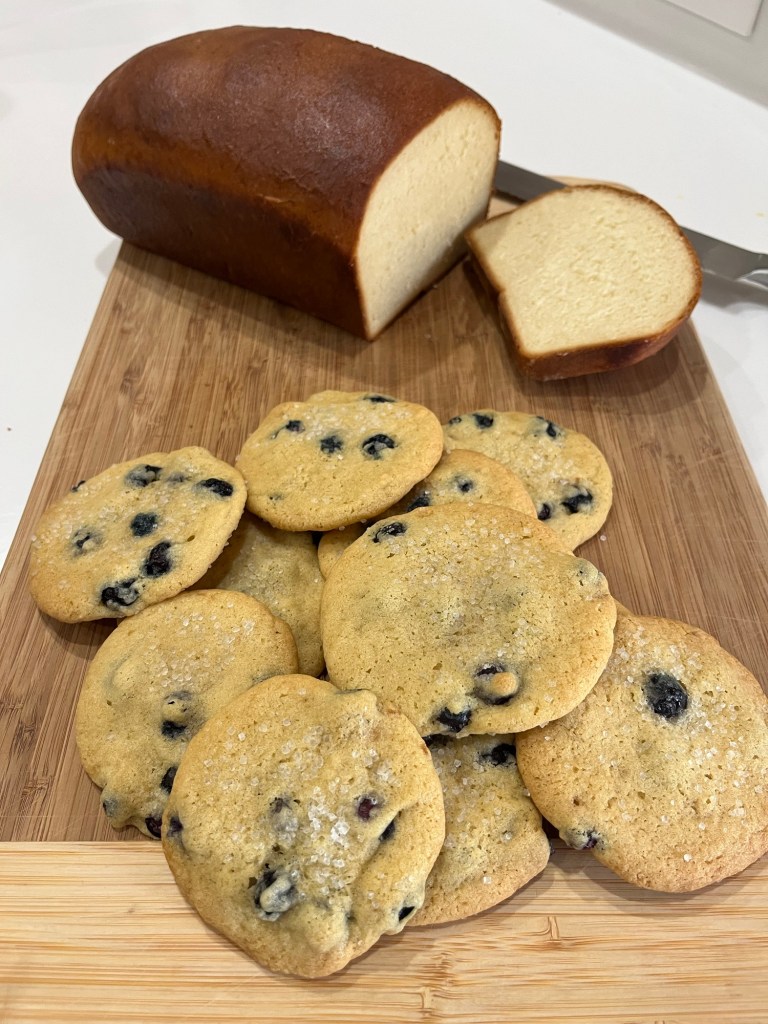
I had high hopes for this cookies, but there are barely a step above “meh.”

They are basically a chocolate chip cookies substituting blueberries for chocolate chip and really, who would want to do that?

They taste fine and have a good texture. Next time, I am making chocolate chip cookies.

Oh yeah. As long as the oven was going to be on I made a loaf of sandwich bread too. It’s a much tighter crumb than my favorite bread (High Hydration No-knead Honey Bread) but this loaf is great for PB&J sandwiches.

Blueberry Crumble Dream Cookies


Prep Time: 15 minutes | Cooking Time: 15 minutes | Total Time: 30 minutes

INGREDIENTS
• 1 cup unsalted butter, softened
• 1 cup granulated sugar
• 1/2 cup brown sugar
• 2 large eggs
• 1 teaspoon vanilla extract
• 2 1/2 cups all-purpose flour
• 1 teaspoon baking soda
• 1/2 teaspoon salt
• 1 1/2 cups fresh blueberries
• 1/2 cup coarse sugar for sprinkling

METHOD

  1. Preheat oven to 350°F (175°C). Line a baking sheet with parchment paper.
  2. In a large bowl, cream together the butter, granulated sugar, and brown sugar until light and fluffy.
  3. Beat in the eggs one at a time, then stir in the vanilla extract.
  4. In a separate bowl, whisk together the flour, baking soda, and salt.
  5. Gradually add the dry ingredients to the wet ingredients, mixing until just combined.
  6. Gently fold in the blueberries.
  7. Drop rounded tablespoons of dough onto the prepared baking sheet.
  8. Sprinkle each cookie with coarse sugar.
  9. Bake for 12-15 minutes, or until the edges are golden brown.
  10. Allow cookies to cool on the baking sheet for 5 minutes before transferring to a wire rack to cool completely.

Idle Hands Make…

This afternoon’s ‘to do’ list contained nothing pressing. Tuesday I hard boiled eggs to include in our dinner salad and to make egg salad Wednesday. Today I baked a loaf of sandwich bread because I love egg salad on fresh baked bread. And as long as I was making bread I decided to replace the hamburger rolls I froze a few weeks ago. (I wasn’t happy with the rise of those whole wheat buns.) Today I mixed a double recipe of bread dough and shaped half into a loaf to bake at 425 deg and the rest into hamburger rolls to be baked at 375 deg.

To make a softer crust I coated the top of the loaf with melted butter before baking (hence the darker crust) and once again after it was baked, but still hot.

I also had a cup of heavy cream to use before it expired, and as long as the oven was on, I dropped the temperature and made some multi berry scones, baked at 400 deg.

Remember the hamburger rolls that baked at 375 deg? Well, as long as the oven was going to be dropped to 375 deg and as long as I had some frozen chocolate chip cookie dough that also bakes at 375 deg, I figured, what the heck.?

I have to find more chores to add to the ‘to do’ list. Today was exhausting.

The best part of the day was participating in the Grandparents Drive-Thru Car Parade at Grace’s school! (Unicorn car. You can’t see the fuzzy pink tail.)

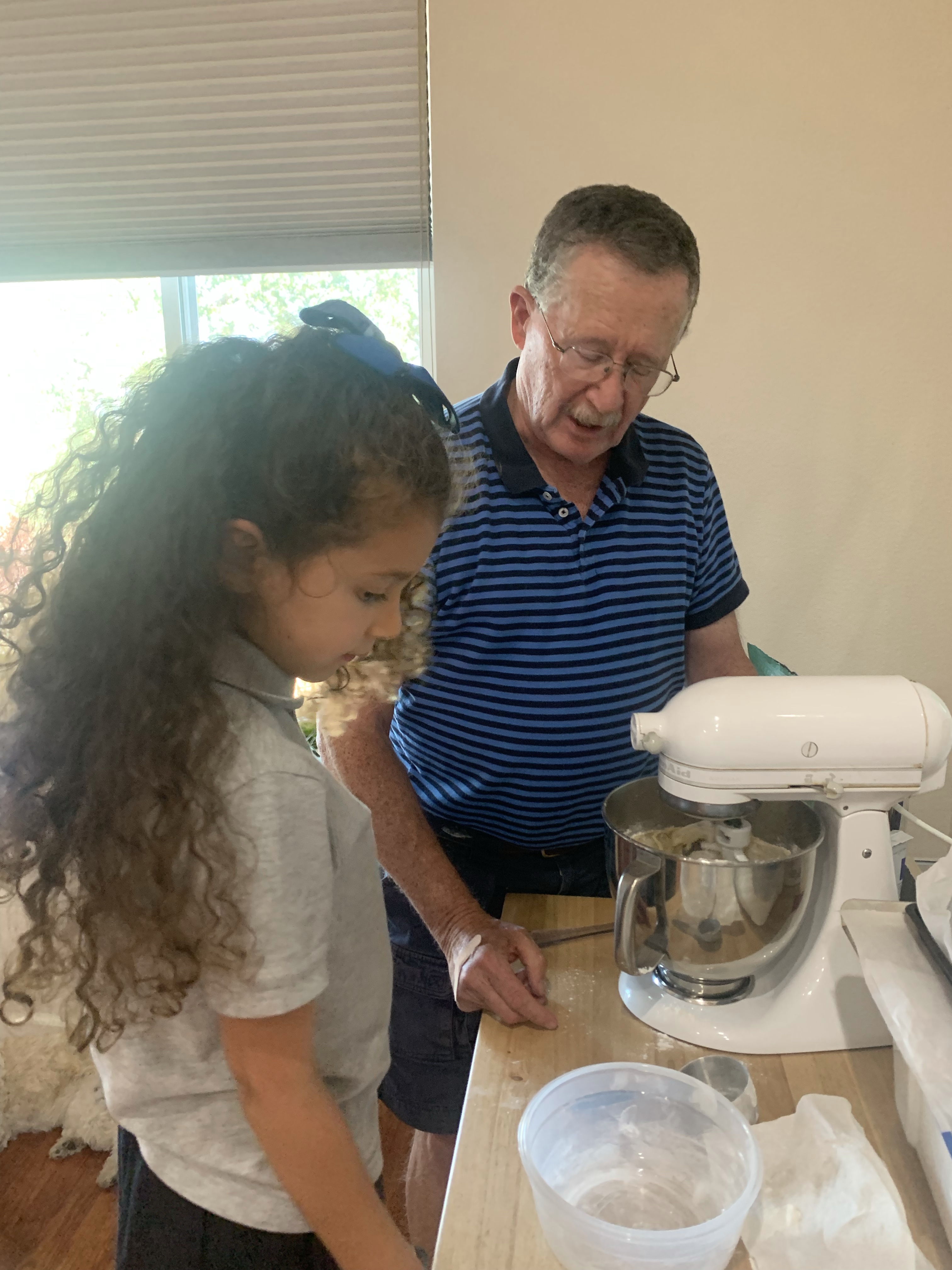
Speaking of Grace, here we are making the aforesaid chocolate chip cookies.

Becoming the Scarlet Pumpernickel

Last week I made a light right sandwich rye. Good crumb, great taste, nice crust. Today I kicked up the percent pumpernickel flour and reduced the light rye flour. I added an egg wash to increase the color of the crust. Better taste, similar crumb and great crust!

Along with the rye experiment, I made another loaf of Honey White bread which has become our staple. I also made some raspberry scones and blackberry hand pies. Busy morning!

Light Rye Bread – KAF (with additional Pumpernickel)


INGREDIENTS
• 1 ½ cups (340g) lukewarm water
• 2 1/3 cups (280g) Bread Flour
• 1 cups (108g) light rye flour
• ½ cups (54g) pumpernickel flour
• 1/4 cup (28g) nonfat dry milk
• 1 ½ teaspoons table salt
• 1 ½ teaspoons instant yeast
• 1 ½ teaspoons Deli Rye Flavor, optional
• 2 tablespoons (25g) vegetable oil
METHOD

  1. Place the water in a large mixing bowl.
  2. Combine the flours with the remaining ingredients in a large mixing bowl, or the bowl of your stand mixer. Mix until there are no dry spots. Using a stand mixer, mix at low speed until all of
    the flour is moistened. The texture of the dough will be soft and sticky due to the pumpernickel flour.
  3. Cover the bowl and let the dough rise at room temperature for 2 hours. Then refrigerate overnight, or for up to 48 hours.
  4. To bake bread: Grease your hands, and scoop the dough out onto a lightly greased or floured work surface. Shape it into a ball and place it, smooth side down, in a floured brotform; or in a bowl lined with a floured smooth cotton dish towel. Let the dough rise, covered, for 2 to 3 hours.
  5. About 45 minutes before the end of the rising time, start preheating the oven to 450°F with a 4 to 4 ½ -quart baking pot or casserole with a lid inside.
  6. When the loaf is fully risen, remove the hot casserole from the oven, carefully grease it, and tip the risen ball of dough into it. Make several slashes in the dough. Cover the pot with the lid, and place it on a middle rack in the oven.
  7. Bake the bread for 25 minutes. Remove the lid and bake for an additional 5 to 10 minutes; the loaf should be lightly browned, and the interior should register at least 195°F on a digital thermometer.
  8. Remove the bread from the oven and turn it out of the crock onto a rack. Cool for several hours before slicing

Where We Stop, Nobody…

I saw this video on FB last week. A baker from Turkey demonstrated making these small, round, enriched bread loaves. The method was so simple and the final product so beautiful I couldn’t resist trying my hand.

The video was in the baker’s language, but it was captioned either with automatically created captions (I hope) or by someone who was very obviously neither a baker or a native English speaker. In honesty, the computer’s, or human translator’s, mastery of English is far better than my translation to any language other than igpay -atinlay.

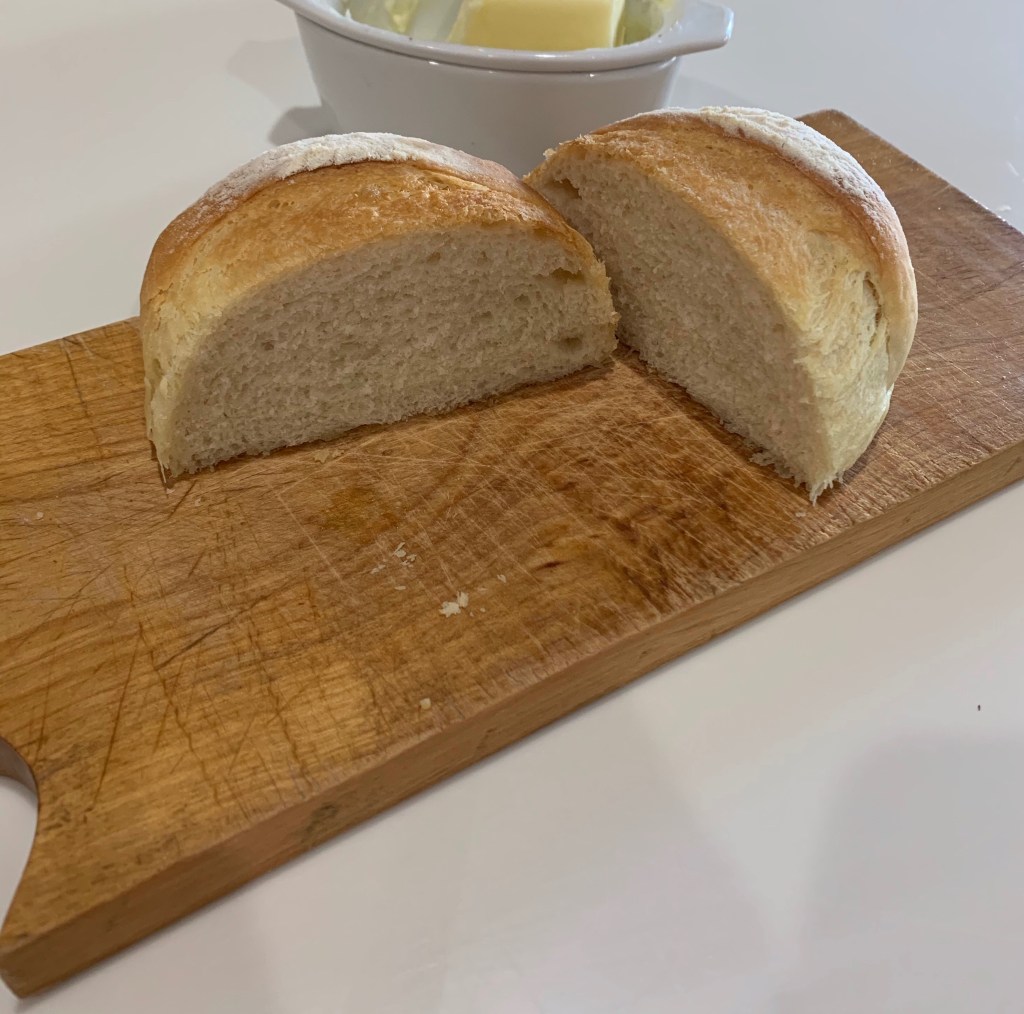
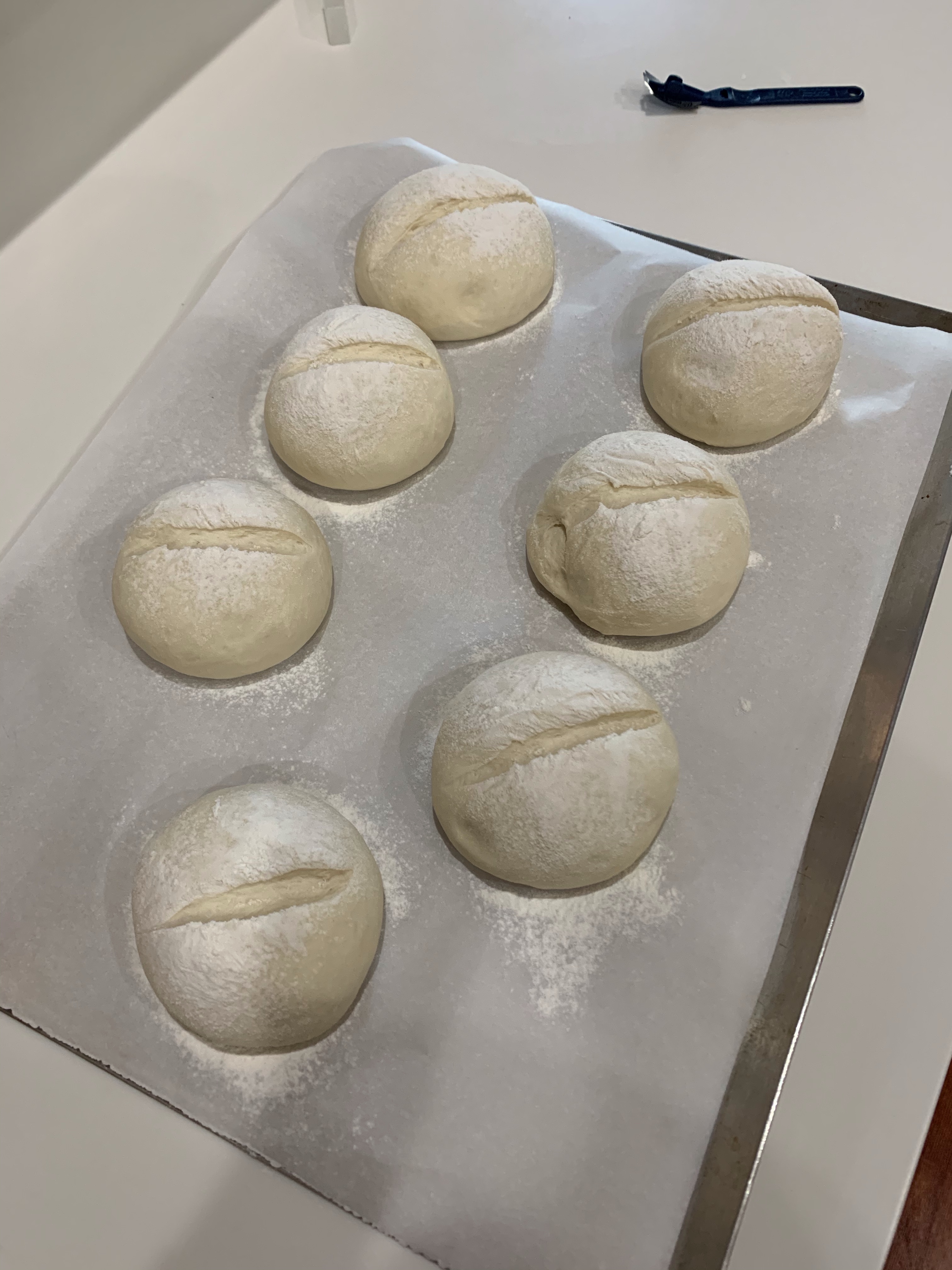
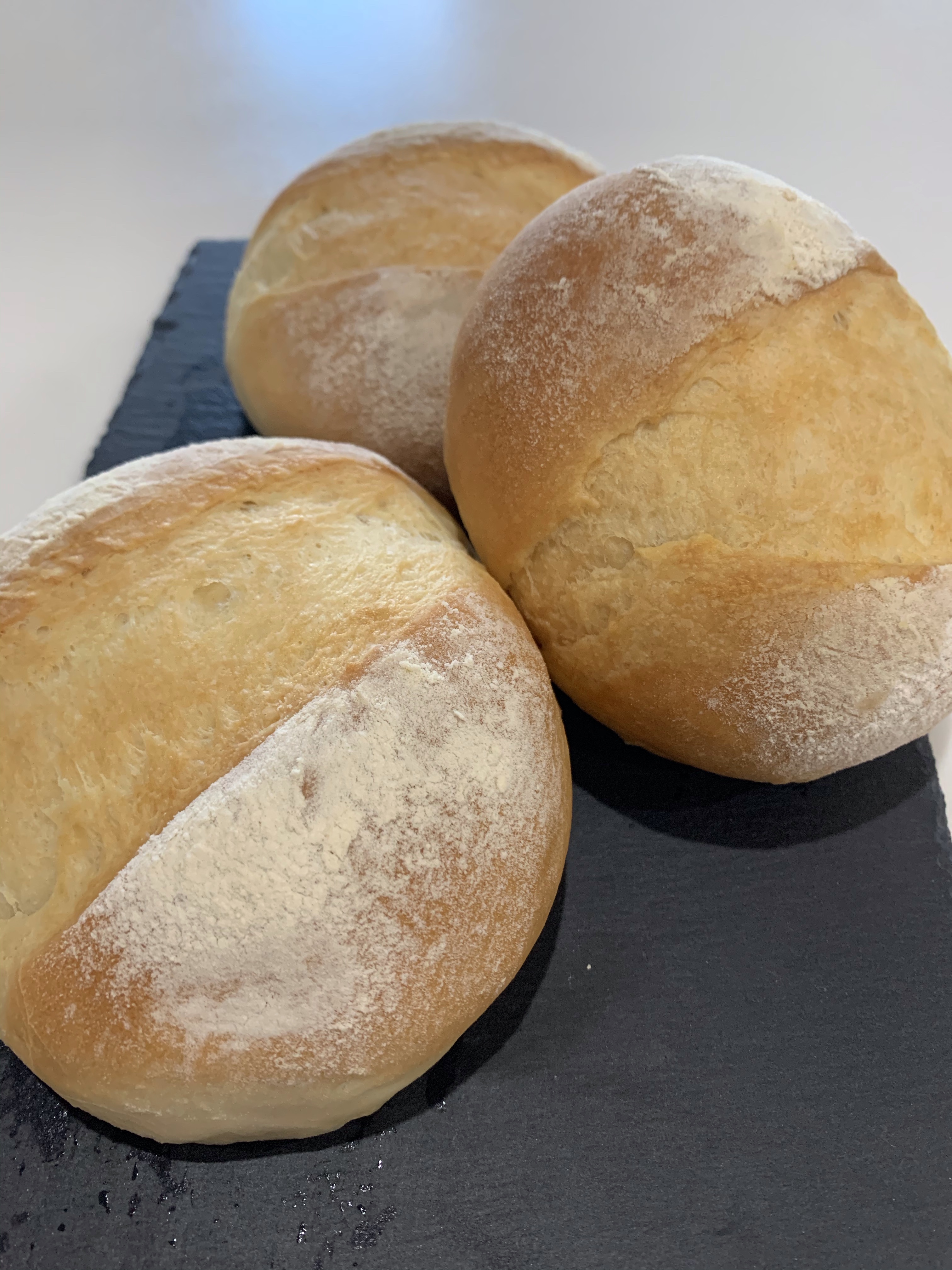
Luckily, and oddly, the recipe ingredients were listed below the video. Oddly in that they were listed in US and Metric units. The method was pretty standard and required little adjustment. I made a few modifications to the original recipe. I mixed and kneaded the down in my stand mixer, rather than my hand. I divided the dough into 7 pieces of 150g each. Next time, I will make each 175g and make 6 loaves as reflected below. This batch of loaves were 5” diameter and 2/5” high. I would like them a little bigger, maybe 6×3”.

The cutting board in this photo was made by my father, or me, I cannot remember, but it is still our day to day cutting board ‘lo these 40+ years.

Enriched Bread – Small Round Loaves

INGREDIENTS
• 200 ml warm milk
• 200 ml warm water
• 10 g (1 Tbl) sugar
• 10g (1 Tbl) instant yeast
• 30 g (2 Tbl) melted butter
• 600g (5 cups) flour
• 8 g (1 tsp) salt
• 25g butter cut in strips to lay on cut rolls before baking

METHOD

  1. Add milk, water, sugar and yeast to the bowl of a stand mixer and mix until combined
  2. Add 300 g flour,butter, salt and mix
  3. Add remaining 300 g of flour and knead until a smooth dough forms, about 8 minutes.
  4. Form the dough into a ball and place in an oiled bowl. (I spray olive oil into the stand mixer bowl.)
  5. Cover and let rise for 45 min
  6. Gently deflate the dough and divide into six 175g pieces
  7. Roll each piece into a ball, tensioning the surface by rolling with a cupped hand on a clean surface. Each ball should be approx 3” diameter
  8. Pat each ball down to flatten and place, well spaced, on a parchment paper lined baking tray. Oven spring will double the size of the loaves
  9. Cover and let rise for 15 – 20 minutes until it passes the poke test
  10. Dust lightly with four, cut a deep slash all the way across the ball with a lame or razor blade or very sharp knife.
  11. Lay a strip of butter, about 0.5”x0.5”x3” long in each slash. (Cut a stick of butter lengthwise into ninths.
  12. Bake in a preheated over at 400F for 25 min.

The Rye Experiment- Part 2a

Oops! I used the pumpernickel flour but forgot to use First Clear instead of AP flour. The plan was to use the best combination of ingredients to make the best loaf of rye bread.

I made two small free form boules. They held their shape really well.

Maybe tomorrow I will read my own instructions all the way through before baking. The results were pretty darn good today, though!

The Rye Experiment, Part 1

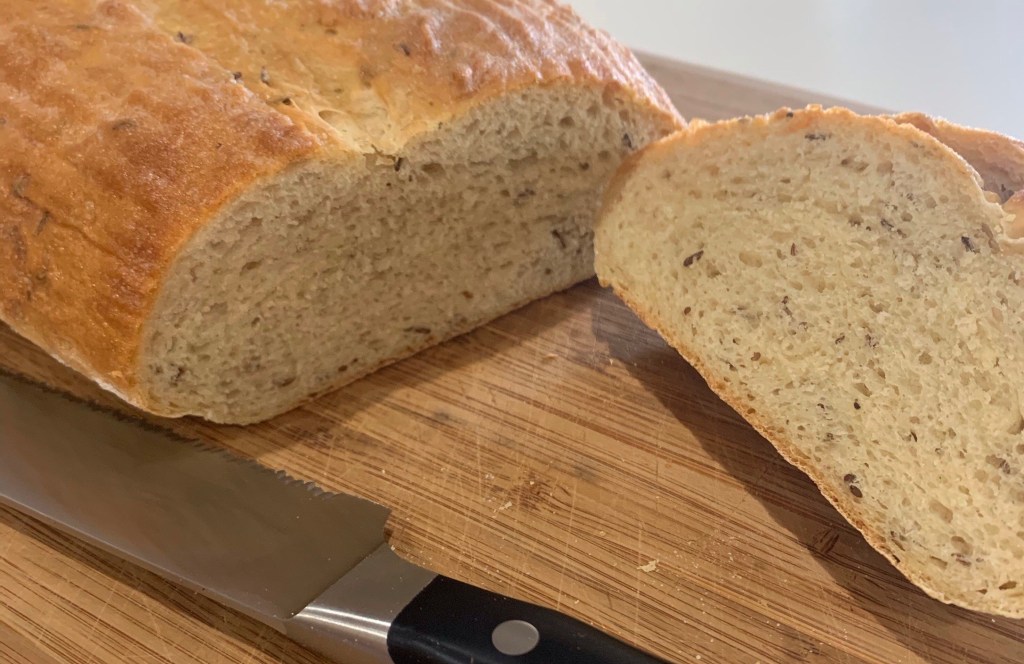
Fran and I are self quarantining so we can join Daniel and Frances’s “pod” for Christmas and New Years. To pass the days I decided to experiment with variations of rye bread recipes. KAB has a good, basic caraway seed rye bread recipe, which I used as a starting place. (Recipe below.)

Following the recipe as written resulted in a well risen, soft rye bread with a good crumb. Today’s roast beef sandwich with lettuce, jalapeños and lettuce was excellent.

The first variation is to replace the white rye flour with first clear flour. In case you were wondering first clear flour is what remains after milling patent flour. It compensates for the low gluten content of rye flour. It is the traditional flour used in Jewish bakeries and adds loftier rise and better chew. This variation will be in the next post, The Rye Experiment, Part 2.

No, I didn’t have to buy anything for this experiment. Here is a picture of my specialty flour cupboard. Standard flours (AP, bread, whole wheat, pumpernickel,) are kept in a separate storage unit.

Caraway Rye Bread KAB

https://www.kingarthurbaking.com/recipes/caraway-rye-bread-recipe
INGREDIENTS
• 1 cup (227g) lukewarm water
• 1 cup (106g) white rye, medium rye, or pumpernickel flour
• 4 teaspoons (14g) sugar
• 2 1/4 teaspoons instant yeast
• 1/2 cup (113g) sour cream (low-fat is fine; please don’t use nonfat)
• 1 to 2 tablespoons (7g to 14g) caraway seeds, to taste
• 1 1/2 teaspoons salt
• 2 1/3 cups (280g) King Arthur Unbleached All-Purpose Flour or First Clear Flour
• 3 tablespoons (25g) vital wheat gluten or rye bread improver, optional, for best rise

METHOD

  1. In a medium-sized mixing bowl or the bowl of your stand mixer, combine the water, sugar, rye flour and yeast, mixing to form a soft batter. Let the mixture rest for 20 minutes; this allows the rye flour to absorb some of the liquid, making the dough easier to knead.
  2. Add the remaining ingredients, and mix and knead the dough together — by hand, mixer or bread machine — until it’s fairly smooth. The nature of rye dough is to be sticky, so don’t be tempted to add too much flour.
  3. Place the dough in an oiled bowl or large (8-cup) measure, cover, and let it rise until noticeably puffy, 60 to 90 minutes.
  4. Gently deflate the dough, knead it briefly, and shape it into two smooth oval or round loaves; or one long oval loaf. Place them on a lightly greased or parchment-lined baking sheet.
  5. Cover the loaves, and let them rise until they’re noticeably puffy, about 90 minutes. Towards the end of the rise, preheat the oven to 350°F.
  6. Just before they go into the oven, spritz the loaves with water, and slash them about 1/2″ deep. The oval loaves look good with one long, vertical slash; the rounds, with two or three shorter slashes across the top.
  7. Bake the loaves for 35 to 40 minutes, or until an instant-read thermometer inserted into the center reads 205°F to 210°F. The single, larger loaf will bake for 45 to 50 minutes. If the bread appears to be browning too quickly, tent it lightly with foil after 25 minutes of baking.
  8. Remove the loaves from the oven, and transfer them to a rack. While still warm, brush them with melted butter, if desired; this will keep their crust soft.

Easy Homemade Bread

Most basic bread is easy to make. There are a few that require extra steps, rises, shaping, etc. but basic bread is… well… basic. Mix, rise, shape, rise, bake.

I made a few changes to the recipe published by Cookist. Some of them were just language or style differences but a couple were more involved. I use instant yeast so I provided the conversion factor from cake to instant. I knead in a stand mixer so referenced it. I added how long to knead and to tension the loaf before the final rise. I added more description on how to shape the loaf.

Easy Homemade Bread

https://video.cookist.com/video/an/Xp6ftuSwTmRucpzW

INGREDIENTS
• 2 cups water
• 1 tsp sugar
• 8g ( 2 ½ tsp) instant yeast
• 5 cups AP flour
• 1 tsp salt
• 2 tbsp oil

METHOD

  1. Pour water into a stand mixer bowl, add sugar and yeast. Mix.
  2. Add flour and salt. Mix. Let rise for 15 minutes.
  3. Add sunflower (or other) oil and knead about 8 minutes.
  4. Let rise covered until doubled.
  5. Divide the dough into two parts.
  6. Form a boule from each part, the press out into an oval, roll into a batard
  7. Tension the battery by rolling on a clean surface, cupping your fingers around the bread and rolling the batard back and forth not allowing it to lengthen.
  8. Place on a baking sheet. Let rise until doubled.
  9. On each bread make an incision, paint with milk. Place a cup of hot water on a baking sheet. Cookist’s video showed slashing the bread by cutting in small short strokes rather than one long cut. It worked really well. I will have to try on other bakes.
  10. Bake for 40 minutes at 180 °C / 350 °F until internal temperature reaches 195-200°F.

Tangzhong Pillowy White Bread

Tangzhong was developed in Asia and used in both China and Japan as a method of keeping bread soft and fresh. Tangzhong is a mixture of flour, water and milk, heated while stirring until the “water roux” thickens. The tangzhong is added to the rest of the ingredients and processed more or less normally. The result is a soft, pillowy white bread (see how I cleverly incorporated the title into the body of this post?)

I found the rise and proofing times were much longer that suggested in the recipes. I thought my yeast may have lost potency so I tested it in a water/sugar solution. (1/2 cup water @ 110-115F, 1 tsp sugar, 2 1/4 tsp yeast. Mix and after 10 minutes the mixture should have grown to 1 cup. It was fine. The problem is I now had the beginnings of another bread/pastry or something. QA Department to the rescue—See subsequent post on cinnamon rolls.)

The long proof times were likely due to the cooler temperatures in the kitchen today. (It was only 62F when I started.)

Tangzhong Pillowy White Bread

INGREDIENTS

Tangzhong
• 3 tablespoons (43g) water
• 3 tablespoons (43g) whole milk
• 2 tablespoons (14g) Bread Flour

Dough
• 2 1/2 cups (298g) Bread Flour
• 2 tablespoons (14g) nonfat dry milk
• 1/4 cup (50g) sugar
• 1 teaspoon salt
• 1 tablespoon instant yeast
• 1/2 cup (113g) whole milk
• 1 large egg
• 4 tablespoons (57g) unsalted butter, melted

METHOD

Tangzhong

  1. Combine all of the ingredients in a small saucepan, and whisk until no lumps remain.
  2. Place the saucepan over low heat and cook the mixture, whisking constantly, until thick and the whisk leaves lines on the bottom of the pan, about 3 to 5 minutes.
  3. Transfer the tangzhong to a small mixing bowl or measuring cup and let it cool to lukewarm.

    Dough
  4. Combine the tangzhong with the remaining dough ingredients, then mix and knead — by mixer or bread machine — until a smooth, elastic dough forms; this could take almost 15 minutes in a
    stand mixer.
  5. Shape the dough into a ball, and let it rest in a lightly greased bowl, covered, for 60 to 90 minutes, until puffy but not necessarily doubled in bulk. (120 min in cool kitchen)
  6. Gently deflate the dough and divide it into four equal pieces; if you have a scale each piece will weigh between 170g and 175g.
  7. Flatten each piece of dough into a 5″ x 8″ rectangle, then fold the short ends in towards one another like a letter. Flatten the folded pieces into rectangles again (this time about 3″ x 6″) and, starting with a short end, roll them each into a 4″ log.
  8. Place the logs — seam side down and side by side — in a lightly greased 9″ x 5″ loaf pan.
  9. Cover the loaf and allow it to rest/rise for 40 to 60 minutes, until puffy. (I put the dough into a proofing oven for this and let it rise until the tops of the rolls were even with the top of the pan.)
  10. Towards the end of the rising time, preheat the oven to 350°F.
  11. Brush the loaf with milk and bake it for 30 to 35 minutes, until it’s golden brown on top and a digital thermometer inserted into the center reads at least 190°F.
  12. Remove the loaf from the oven and cool it in the pan until you can transfer it safely to a rack to cool completely.
  13. Store leftover bread, well wrapped, at cool room temperature for 5 to 7 days; freeze for longer storage.