Savor the Moment

I like sweets and I love chocolate. I prefer foods where the ingredients list includes sugar, in large quantities. However, sometimes the moment requires other ingredients. Sometimes the bounty of the garden needs to be included in foods, savory foods and you know… they aren’t bad, not bad at all. I made a variety of test veggie savory pastries for our upcoming party. (Sadly, this time of year, very little came from my garden.)

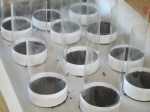
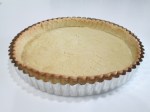
I used, in various combinations, olives, roasted red peppers, asparagus, tomato, several herbs and gorgonzola,  cream, and parmesan cheeses. For these tart shells I used my standard tart recipe formed using small deep tart molds. Once the pastries were assembled I broiled them just long enough to melt, or at least soften the cheese. I apologize for not having a photo of the finished pastries. They… disappeared somehow after they were removed from the oven. Odd.

Asparagus and cream cheese pastry: Steamed asparagus was marinated in a mixture of balsamic vinegar, chives, parsley and tarragon then drained and patted dry.  Softened cream cheese coated the bottom of the shell, about 1/4″ thick, salt and pepper to taste and cut spears of asparagus laid across the top.

Olive and roasted red pepper pastry: A layer of crumbed gorgonzola cheese covered the bottom of the shell. A large olive was placed in the middle of the shell, on top of the cheese. A roasted red pepper was sliced lengthwise to about 1/2″ wide and wrapped around the olive.

Tomato and cheese pastry: Fill the bottom of the shell with a 1/4″ thick layer of shredded parmesan cheese. Place a thin slice of cherry tomato on top of the cheese, coat with a little more parmesan cheese and top with a piece of fresh basil. (From my garden 🙂 )

Party Tarty

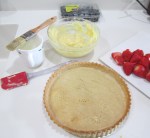
In preparation of our family dinner in a week, and in celebration of receiving my new tart pan I made a “practice” berry tart. It consists of a tart shell, using the same recipe as used before, creme patisserie, as before and strawberries and blue berries. I did make the creme pat a bit firmer (doubled the corn starch) to assure it will cut properly (like a pumpkin pie) and support the weight of the berries.

To keep the bottom of the tart from becoming soggy (no one likes a soggy bottom), paint it with a thin coat of melted butter and refrigerate until it has set (about 15 min.)  I also brushed the entire tart with melted apple jelly to give it that extra shine. The finished tart can be kept in the refrigerator for up to 2 days. The baked, unfilled tart shell can be wrapped in plastic and frozen for 2-3 months.

completed-tart


Ahh… ahh… Choux

No, I don’t have a cold. It is cold here, below freezing at dawn, but it warming to the high 40’s to mid 50’s in the afternoon. When the sun is out it is beautiful. When its raining… well there is nothing like a 40 deg rain to keep one inside and baking.

Normally, I make my cream puffs with choux, creme pat and chocolate ganache. I thought this time I would make a lighter pastry with sweet chocolate and vanilla whipped cream filling, and with deference to the season, decided to stack them like a snowman. (Full disclosure: I saw them on the final of The Great American Baking Show and thought they looked amazing and I never have a problem with the baked choux sticking to the parchment paper like Amanda Faber did. Hmmm.)template

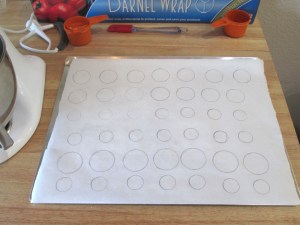
I drew a template of circles 1.75″ and 0.75″ diameter on one side of a piece of parchment
paper. The paper was then placed, pencil side down on a double thick cookie sheet and set aside.

Choux Pastry

INGREDIENTS:

  • ½ c (65 grams) AP flour
  • ½ tsp granulated white sugar
  • ¼ tsp salt
  • 4 tbsp (55 grams) unsalted butter, cut into pieces
  • ½ c (120 ml) water
  • 2 large eggs, lightly beaten
  • 1 large egg yolk beaten with 1 tbl water to glaze (optional

METHOD

  1. Preheat oven to 400o F (200o C) and place rack in center of oven.
  2. In a bowl whisk the flour with the sugar and salt.
  3. Place the butter and water in a saucepan over medium high heat and bring to a boil.cooling-choux
  4. Remove from heat and, with a wooden spoon, add the flour mixture, all at once, and stir until combined. It will look like mashed potatoes. Return saucepan to the heat and stir constantly until the dough comes away from the sides of the pan and forms a thick smooth ball (about 1-2 minutes). The dough will film the bottom and sides of the saucepan and make cleaning a pain.
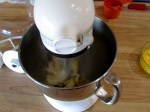
  5. Transfer the dough to an electric mixer and beat on low speed to release the steam from the dough (about 1 minute). Once the dough is lukewarm start adding the lightly beaten eggs (dough will piped-chouxseparate and then come together) and continue to mix until you have a smooth thick paste (dough will fall from a spoon in a thick ribbon).
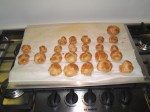
  6. Place the dough in a pastry bag fitted with a large plain tip and pipe disks, alternating sizes onto the parchment lined baking
    sheet. (Hold the bag at a 90-degree angle and pipe disks.) Alternate sizes so you don’t end up with all large or small disks. If baked-chouxdesired, with a pastry brush, gently brush the tops of the dough with the lightly beaten egg.
  7. Bake for 15 minutes and then reduce the oven temperature to 350o F (180o C).
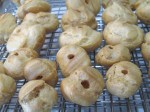
  8. Remove from oven, pierce an end of each éclair with a small skewer to release the holes-in-chouxinterior steam.

Chocolate Whipped Cream

INGREDIENTS

  • 2 cups heavy cream
  • 1/4 cup cocoa powder
  • 1/2 cup powdered sugar

METHOD

  1. Place a metal mixing bowl and beaters in the freezer for 15 minutes.
  2. Remove the bowl from the freezer. Add the heavy cream, cocoa powder, and powdered sugar, and beat with an electric mixer for 4-5 minutes, or until stiff peaks form / it’s scoop-able with a spoon and holds its shape.
  3. Place leftovers in a container and store in the fridge for up to 3 days.

Sweet Vanilla Whipped Cream

INGREDIENTS

  • 1 cup heavy cream
  • 2 tablespoons confectioners’ sugar
  • 1/2 teaspoon vanilla extract

METHOD

  1. Pour the cream into a well-chilled bowl and add the sugar and vanilla.
  2. Using an electric hand mixer or balloon whisk, beat the cream to the desired consistency.
  3. For soft peaks, the cream will be just thick enough to hold its shape in soft billows.
  4. For stiffly beaten cream, the beaters or whisk wires will leave distinct traces on the cream and stand in firm peaks when the beaters are lifted.

ASSEMBLY

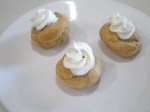
  1. Fill large puffs with chocolate whipped cream and small ones with vanilla.
  2. Pipe a swirl of vanilla whipped cream on top of the large puff
  3. Place small, filled puff on top of large one using the swirl of whipped cream as a binder.
  4. Drizzle with ganache
  5. Top with a berry, if you have any. A dab of whipped cream piped on top would be good also.completed-choux-dessertchoux-showing-filling


In His Cap And Called it Macarons

I am sure I once posted making Macarons before, but if I did, I cannot find it. If anyone happens across it, please let me know. I hate to think of it wandering around the ethereal web, homeless, begging for a cup of sugar (confectioners of course.)

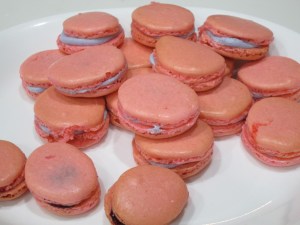
I am talking macarons, not macaroons. These are the almond flour confection with the “feet” not the shredded coconut cookie type. I made macarons-2these with two different fillings, buttercream for Amy and blackberry jam because I had some extra blackberries in the fridge and I like blackberries. Plus, we thought they would travel better than other pastries.

I use a modified version of the Food Network’s macaron recipe and technique.

INGREDIENTS

  • 1¾ cups confectioners’ sugar
  • 1 cup almond flour
  • 3 large egg whites, at room temperature
  • ¼ teaspoon cream of tartar
  • Pinch of salt
  • ¼ cup caster sugar
  • 2 to 3 drops gel food coloring (see below)
  • ½ teaspoon vanilla, almond or mint extract

METHOD

Cookie

  1. Preheat the oven to 300 degrees F using the convection setting. Line a large double-thick baking sheet with parchment paper that you drew 1¾” circles about ¾” apart and flipped clean side up. Measure the confectioners’ sugar and almond flour by spooning them into measuring cups and leveling with a knife. Transfer to a bowl; whisk to combine.
  2. Sift the sugar-almond flour mixture, a little at a time, through a fine-mesh sieve into a large bowl, pressing with a rubber spatula to pass through as much as possible. It will take a while, and up to 2 tablespoons of coarse almond flour may be left; just toss it. Sift a second time.
  3. Beat the egg whites, cream of tartar and salt with a mixer on medium speed until frothy. Increase the speed to medium high; gradually add the superfine sugar and beat until stiff and shiny, about 5 more minutes.
  4. Transfer the beaten egg whites to the bowl with the almond flour mixture. Draw a rubber spatula halfway through the mixture and fold using a figure 8 pattern until incorporated, giving the bowl a quarter turn with each fold. Be sure the spatula goes all the way to the bottom in incorporate all the dry mixture.
  5. Add any food coloring and/or extract. Continue folding and turning, scraping down the bowl, until the batter is smooth and falls off the spatula in a thin flat ribbon, 2 to 3 minutes.
  6. Transfer the batter to a pastry bag fitted with a ¼ -inch round tip. Holding the bag vertically and close to the baking sheet, pipe 1¾ -inch circles (24 per sheet). Firmly tap the baking sheets twice against the counter to release any air bubbles.
  7. Let the cookies sit at room temperature until the tops are no longer sticky to the touch, 15 minutes to 1 hour, depending on the humidity. Slip another baking sheet under the first batch (a double baking sheet protects the cookies from the heat).
  8. Bake until the cookies are shiny and rise 1/8 inch to form a “foot,” about 20 minutes. Bake time is everything, too long and they will discolor, too short and they will be soft inside.
  9. Transfer to a rack to cool completely.
  10. Peel the cookies off the mats and sandwich with a thin layer of filling.

Berry Filling

  1. Puree berries in a food processor
  2. Sieve puree to remove seeds and solids
  3. Equal amounts (weight) of sieved berry puree and granulated sugar.
  4. Boil in a small saucepan until mixture reaches 225 F, stirring frequently to keep from burning.
  5. Cool jam until it is thick enough to pipe, or spread but not flow.

Do You Know the Way to Canelé?

do-you-know-the-way-to-san-jose-sheet-musicA canelé is a small French pastry flavored with rum and vanilla with a soft and tender custard center and a dark, thick caramelized crust. It takes the shape of small, striated cylinder up to five centimeters in height with a depression at the top. Originally a specialty of the Bordeaux region of France, today it is widely available in pâtisseries in France and abroad.

I had my first canelé in Seattle while visiting Neil and Maureen this past December. It was delicious and I knew I would make them soon. I started researching recipes and equipment when I returned home. Traditional canelé molds are copper to facilitate heat transfer and provide an even caramelized crust. At about $24 each, I decided to opt for the modern silicone mold version ($15 for a sheet of 8 molds.) Supposedly, the crust is more difficult to caramelize and more likely to be uneven.

Adapted from ChezPim, basically her recipe and technique with some of my words and comments.

Ingredients

  • 500g (2c) whole milk
  • 50g (3½ tblsp) butter
  • 1 vanilla bean or 3-4 tsp. vanilla extract
  • 100g (¾c +1 tblsp) AP flour
  • 250g (2c) un-sifted powdered sugar
  • 1 tsp sea salt
  • 2 large fresh eggs
  • 2 large egg yolks
  • ¼c rum (optional)
  • 20g (¾oz) beeswax cut into small chunks (using a hot knife will make your life easier)
  • 20g (¾oz or 1½ tablespoons) butter, cut into small chunks

Method

  1. Make the batter – 2 days before you plan to bake the canelés.
    1. Place the milk, butter, and vanilla bean (cut in half and scrape the seeds into the
      canale-liquid-ingredients

      Liquid Ingredients

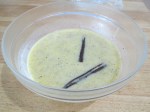
      pot) over medium heat and bring to a boil. If you want to be precise it should be 183F. Remove from heat and let cool down while you get to the other ingredients. Measure and then sift together the flour, powder sugar and salt.

    2. Use your fingers, or a spatula and press the eggs and yolks through a strainer into the dry ingredients to mix them without incorporating air.
    3. When the milk/butter/vanilla mixture is just a bit warm but not so hot ~120F or so, remove the vanilla bean halves. Don’t throw them away
      Dry Ingredients

      Dry Ingredients

      though, instead put them in another bowl of about the same size. Pour the warm milk mixture into the bowl containing the dry ingredients, and gently stir together until well-blended. You’ll see plenty of lumps in the batter, but that’s fine for now. I use a wooden spoon to mash the large lumps against the side of the bowl to break them up.

    4. Strain the lumpy batter (through a fine-mesh strainer) into the bowl you put the vanilla bean in earlier, pressing the lumps through until you get a
      Batter

      Final Batter

      totally lump-free batter. Add the rum and stir until combined. Cover the bowl with plastic wrap (no need to press the plastic right over the surface of the batter) and place in the fridge to rest for 48 hours. Stir once after 24 hours and put it back in the fridge to continue to rest the second 24 hours.

  2. Coat the silicone molds:
    1. Place the molds in the hot oven for a few minutes to warm.
    2. Melt equal amounts of beeswax + butter in a small pan set in nearly boiling water.

      melted-wax-and-butter

      Melted Wax and Butter Mixture

    3. Stir occasionally until melted. Keep mixture warm as it will set up quickly,
  3. With a pastry brush, (don’t use a good one, it will be ruined. I bought a silicone bristle brush from which the wax can be cleaned,) paint the hot beeswax + butter mixture on the warm mold. Brush mostly on the side of the molds, the wax will drip a little down to the bottom on its own. If you brush all the way to the bottom you’ll end up with a thick pool of wax on the bottom of the mold. Brush a thin coating such that you can see the mold through it.
  4. After coated, freeze the molds for ~10 minutes, you want
    Coated Silicone Mold

    Coated Silicone Mold

    them to be very cold when they go into the oven. Keep the batter cold too, this will keep the moist, custardy interior.

  5. When you’re ready to bake, fill each cavity almost to the top. Place the mold on the middle rack of your preheated oven.
  6. Bake them for 15 minutes at 450F (preheated at 475F) then lower the temperature after you put the molds in the oven) then an additional 40 minutes at 375F, turning the molds every 15 minutes to ensure even baking.
  7. The canelé batter will expand over the molds, but only
    Baking Caneles

    Baking Caneles

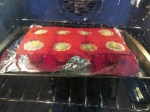
    slightly. If you see the massive poufs (Pim’s word, but a good one), especially around the first 10-20 minutes take the whole baking sheet out of the oven and put it outside for a few minutes, the poufs should calm down and settle back into the molds. When the batter settles back into the molds, put them back in the oven to continue baking. (Make sure you pause the timer when the molds are outside the oven and restart it when you put it back so you could keep track of the actual baking time.)

    caneles

    Baked Caneles

Nearly Neapolitan Mousse Cake

As Nearly Headless Nick cannot join the hunt because of a technicality, this dessert is only nearly a Neapolitan Mousse Cake due to a couple of technicalities. Picky, picky picky.
neapolitanish-cake-3

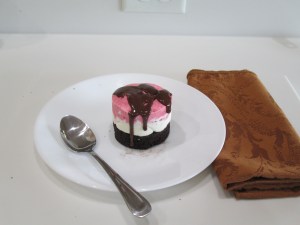
The chocolate ice cream base is actually almond chocolate cake. the vanilla ice cream is white chocolate mousse, much like a white chocolate ganache but lighter and airier as the cream is whipped, and the strawberry ice cream is raspberry mousse, because I like raspberries.

I have to be honest, this dessert takes some time and patience. Experimenting with the cake recipe (two tries), making the mice, mousses, err… white and pink fillings took 2 or three recipes each adjusting the amount of pectin, when to add it, the amount of whipped cream and how much to whip it. The whipped cream for the raspberry has to be whipped to firm peaks while the white chocolate should be soft peaks. I have removed gelatin from my pantry and replaced it with pectin. Gelatin is easier and fine if you like processed skin, bones, and connective tissues of animals such as domesticated cattle, chicken, pigs, and fish. I don’t. Pectin is sourced from fruit and vegetable peels. I am sure there are some nasty processing steps, but at least it didn’t start with Bessie or Babe or Miss Piggy.

The almond cake uses almond flour instead of food processor ground baked almonds. Its easier and I had some. The batter is pretty low viscosity but don’t worry, it about doubles in thickness in the oven. After cut, wrap the cake disks in plastic and they will stay fresh for 2 or 3 days so you can make them ahead.

I ordered some 3 mil acetate sheets online. I cut them to size (10 x 41/2″), cut 10 paper bands to hold the acetates in place around the cake. This obviated (not obliviate, we want to remember this recipe) the requirement to tape the acetate. I hope to use them again.

The vanilla mousse sets quickly so work with some speed. Varying the whipping time – Tied to the Whipping Post – can create a thinner mousse, but too short a time can make the mousse dense. I like to pipe the mice, mousses, errr… fillings so I can control the thickness of each layer.

The raspberry fruit has the most powerful flavor, but is the trickiest to make just right. Pectin requires sugar and acid to cross link. Pectin’s structure binds with water in an acid environment and sugar increases pectin’s ability to gel. The lemon juice (I used key lime juice, it was in the fridge) provides the acid and the berries and sugar provide the sugar environment. Vary the amount of each and when to add them. The method below worked well for me.

Neapolitan Mousse Cake

CHOCOLATE ALMOND CAKE

INGREDIENTS

  • 200 g (¾ cup + 2 tablespoons) unsalted butter
  • 30 g (¼ cup) unsweetened cocoa
  • 60 g (½ cup) plain (all-purpose) flour
  • ½ teaspoon baking powder
  • Pinch of salt
  • 120 g (1 cup) almond flour
  • 225 g (1 cup) caster (superfine) sugar
  • 5 large egg whites, room temperature
  • 1½ teaspoons pure vanilla extract

METHOD

  1. Preheat oven to 180° C (350° F). Line rimmed jelly roll pan with non-stick baking paper or silicone baking mat. Be sure to line the sides as well.
  2. In small saucepan, melt butter over medium-low heat, occasionally swirling pan, until it begins to brown and smells nutty, about 5 minutes. Remove from heat and set aside to cool.
  3. Meanwhile, using fine mesh sieve, sift cocoa two times. Then sift together cocoa (for a third time), flour, almond flour and sugar, baking powder and salt into mixing bowl.
  4. Add egg whites, one at-a-time, whisking until just combined after each addition (do not over mix).
  5. Stir the vanilla into the cooled butter.
  6. Gradually pour the vanilla-butter in a thin, steady stream into the batter, whisking to just combine. (Kitchenaid with beater on level 2)
  7. Pour the batter into the prepared jelly roll pan.
  8. Bake until a cake tester inserted in the center of the cakes comes out clean, about 22 minutes. Poke the cake gently, the depression of your finger should bounce back.
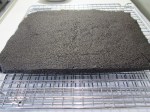
  9. Remove from oven and transfer to wire rack. Let stand 5 minutes, transfer cake to wire rack. Let stand until cooled completely.
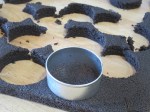
  10. Using a 2½” ring cutter, cut 10 round mini cakes from the cooled sheet cake.
  11. Line rimmed baking sheet with non-stick baking paper or silicone baking mat. Arrange cakes on baking sheet, spacing 2½ cm (1-inch) apart.

 VANILLA MOUSSE

 INGREDIENTS

  • 200 g white chocolate, cut fine
  • 350 g heavy whipping cream

METHOD

  1. Melt the chocolate in a small bowl in the microwave. Heat 30 sec, then check the chocolate and stir. Heat another 30 seconds and stir again. Heat 15 seconds and stir. The chocolate should be liquid but not boiling. If more time in required keep reducing the time by 5 sec and check. Do not over cook.
  2. Whip the heavy cream until it forms soft peaks. If you overwhip the chocolate/cream mixture will set to quickly and will not form smooth even layers.
  3. Gently fold the liquid chocolate into the whipped cream using a figure 8 pattern. Be sure to scrape the bottom and sides of the bowl.
  4. Add to a piping bag and fill the acetate cylinder with about an inch of vanilla mousse.

RASPBERRY MOUSE

INGREDIENTS

  • 2 tablespoons fresh lemon juice
  • 1 teaspoon powdered pectin
  • 175 g fresh raspberries (about 1 pint)
  • 2½ tablespoons sugar
  • ½ cup cold heavy cream

METHOD

  1. Place lemon juice in a small bowl and sprinkle with pectin. Let sit until pectin softens, 3 minutes.
  2. In a blender, puree raspberries until smooth, scraping down bowl as needed.
  3. Pour through a fine-mesh sieve into a measuring cup, pressing on solids (you should have about 1/3 cup of puree); discard solids.
  4. In a small saucepan, combine raspberry puree and 2½ Tbsp sugar over medium. Cook until bubbles form at edge. Add pectin mixture and cook, stirring constantly, just until gelatin dissolves, about 1 minute. Transfer mixture to a small bowl and let cool to room temperature, 20 minutes.
  5. In a large bowl, using an electric mixer, beat cream and 1 Tbsp sugar on medium-high until firm peaks form, about 4 minutes. Do not over mix.
  6. With a rubber spatula, gently fold in raspberry puree mixture in 3 parts until combined.
  7. Add raspberry mousse to a piping bag and fill the acetate cylinders with about an inch of mousse.
  8. Refrigerate until set, about 2 hours (or up to overnight).

 DARK CHOCOLATE GANACHE

 INGREDIENTS

  • 120 ml (½ cup) heavy cream, 35%
  • 113 g (4 ounces) dark chocolate, 70%

METHOD

  1. In a small saucepan, bring cream and corn syrup just to boil (small bubbles beginning to form around the sides of the pan) over medium heat, stirring until corn syrup is dissolved.
  2. Meanwhile, finely chop the chocolate and place in small bowl.
  3. Pour the cream mixture over the chocolate and let stand, 2 minutes. You may not need all the cream. I pour some to just wet the chocolate, wait a minute and stir. If it is too thick, I add more cream, too thin, more chocolate.
  4. Using a flexible spatula, gently stir together beginning in the center of the bowl gradually working toward the edges pulling in as much as chocolate as possible until the mixture is smooth, glossy and combined well.

 Assembling Mousse Cakes

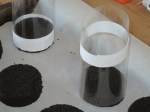
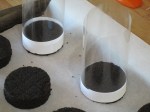
  1. To make acetate collars, cut ten 10 x 4 ½” strips of acetate paper or non-stick baking paper. Also cut 20 1” x 8½” pieces of paper for use as bands to secure the acetate. Wrap one collar around the base of each cake keeping the base flush with the baking sheet. Slide paper band down to base to secure the acetate collar. Return to baking sheet. Cover loosely with a sheet of plastic wrap.
  2. Prepare Vanilla Mousse.
  3. Evenly divide the vanilla mousse between each acetate collar. (The layers should be no more than 2½ cm or 1-inch high.) Cover the cakes with a couple of sheets of plastic wrap (don’t secure too tightly otherwise the collars will lose their shape).
  4. Transfer the cakes on the baking sheet to the refrigerator. Let chill until firm, about 2 hours.
  5. When vanilla mousse layer is firm, prepare Raspberry Mousse.
  6. Remove the cakes from the refrigerator.
  7. Evenly divide the strawberry mousse between each acetate collar. (Again, the layers should be no more than 2½ cm or 1-inch high.) Again, cover cakes with plastic wrap.
  8. Place the cakes in the freezer. Let chill until firm.
  9. Remove the cakes from the freezer and immediately remove collars. (I recommend
  10. Removing collars immediately after removing cakes from the freezer because removal is much easier when the cakes are firm. It makes for best presentation too.)
  11. Spoon a heaping tablespoon of chocolate ganache in the center (onto the surface) of each cake, gently coaxing the ganache to the edges, leaving a 6 mm (¼-inch) border. Chill, uncovered, in the refrigerator until thawed, about 15 minutes.
  12. To serve, transfer each cake to a dessert plate, and top each cake with raspberry.

 

Stand Back and Take Your Hands Off My DONUTS!

You probably don’t know just how much Homer Simpson and I have in common. We both live (or lived) in a city named Springfield. He drinks Duffs beer and I use Duff’s cake decorating products. Homer works at a nuclear power plant and I studied Radiation Science in grad school, and we both love DONUTS.img_0004

Yesterday morning was donut day in the 1y Kitchen.  I had a recipe for yeast donuts and Emeril’s recipe (modified) for raspberry jelly donut filling, plus, I had extra crème pat and chocolate ganache waiting in the fridge from some tartlets I made for a party last Sunday which were perfect for a few Boston Cream dessert donuts. What could possibly go wrong with this?

Notes to self:

  1. Check ingredient quantities in the pantry before starting. It may save a quick trip to the market while dough is rising, such as sugar for coating donuts while still hot.
  2. If you are totally out of sugar, save yourself a trip and buy two bags. You will need it eventually.
  3. Make the jelly filling while the donuts are rising. It will need to cool.
  4. Nuke the left-over ganache. You can add a little hot and heavy cream and sugar to sweeten. Mix thoroughly to dissolve the sugar. (Use confectioners or casting sugar, it will be easier to dissolve.)
  5. Add extra egg whites to the container in the fridge. You will want to make more pavlovas soon

Jelly Donuts

Ingredients:

  • 2 Tbsp active dry yeast
  • ½ c milk (100oF – 110oF)
  • ⅓ c sugar (rounded, not level)
  • 2¼ c all-purpose flour
  • 3 large egg yolks
  • 2 Tbsp room temperature unsalted butter
  • 2 Tsp salt
  • 3 c vegetable oil
  • 1 c fresh raspberry jam

Method

  1. Place yeast, warm milk, and 1 teaspoon sugar in a small bowimg_0001l. Set aside until foamy, about 10 minutes.
  2. Place flour in a large bowl. Create a well in the center and add eggs, yeast mixture, ¼ cup sugar, butter, and salt. Using a wooden spoon, stir dough starts to come together and is sticky. Flour a work surface and knead until dough is smooth, soft, and bounces back when poked with a finger, about 8 minutes (add more flour if necessary). Place in a lightly oiled bowl; cover with plastic wrap. Set in a warm place to rise until doubled, 1 – 1½ hours.img_0002
  3. Lightly flour a work surface, roll dough to ¼“thick. Using a 2½” round cutter, cut as many rounds as you can. I rolled the extra into small balls (< 1” diameter) and made donut holes. Cover with plastic wrap; let rise 15 minutes. They didn’t rise much, but they will puff up in the hot oil.
  4. In medium saucepan over medium heat, heat oil until a deep-frying thermometer registers 370 degrees. Using a slotted spoon, or skimmer, carefully slip 2 rounds into oil. Fry until golden, about 40 seconds. Turn doughnuts over; fry until golden on other side, another 40 seconds. Using a slotted spoon, or skimmer, transfer to a paper-towel-lined baking sheet. Roll in sugar while warm. Fry all dough, and roll in sugar.img_0003
  5. Fill a pastry bag fitted with a #230 tip with jam. Poke the pastry tip into and end of the donut, pipe about 2 teaspoons jam into doughnut. Repeat with remaining doughnuts.

Fresh Raspberry Donut Filling

Ingredients

  • 6 oz fresh raspberries
  • ⅔ c water (⅓ added to raspberries, ⅓ for cornstarch below)
  • 1 c granulated sugar
  • 1 Tbsp of citric juice (I used Key Lime juice as we had some in the fridge)
  • 3 Tbsp cornstarch dissolved in ⅓ cup of water (There is a total of ⅔ cups of water)

Method

  1. In a saucepan combine the raspberries, water, sugar, and lemon juice. Bring to boil and simmer for 15-20 minutes or until the raspberries have broken down.
  2. Remove the mixture from the heat and strain with a fine mesh sieve.
  3. Return the stained mixture to the heat. (There should be about 2 cups of mixture.)
  4. Dissolve the cornstarch in ⅓ cup of water.
  5. Whisk the slurry into the raspberry mixture.
  6. Bring the mixture back to a boil then simmer for 5 more minutes, stirring occasionally.
  7. Remove from heat and cool completely. It will thicken into a thin jelly.

Boston Cream Donutsimg_0006

  1. Follow above directions substituting filling the donuts with crème pat instead of jelly
  2. Dip one flat side of the donut into warmed ganache and set aside to dry.

Pavlova is Dancing in the Street

“They’ll be laughing and singing, music swinging
Dancing in the street”

Ballet dancing, actually. Specifically, Anna Pavlova, Russian prima ballerina who is most recognized for the creation of the role The Dying Swan. We saw pavlovas made on GBBO yesterday and as I have made meringue cups for years, this seemed like a natural extension. (Plus, I had egg whites left in the fridge from making crème pat earlier this week.)

The recipe was created in either Australia or pavlova_0001New Zealand and is a favorite around Christmas in the summer. Wait! Is it a Christmas treat, or a summer treat? Isn’t that a North American oxymoron? Ah, well, it is Christmas Eve, therefore, this time, it is a Christmas treat. (I just realized, I could have used the blueberries and made it a Chanukah treat in Israeli colors of white and blue.)

pavolva_0004Deceptively easy and insidiously versatile. You can top your pavlova with berries, nuts, chocolate, mocha, fruit, lemon curd or as King
Mongkut of Siam was fond of saying “etcetera, etcetera, etcetera.” It often depends what is in the fridge or what season it is, or whatever floats your current boat.


Ingredients

  • Meringue:
    • 1½ teaspoons vanilla extract (clear to keep the meringue very white)
    • ½ teaspoon cream of tartar
    • 1½ Tbsp cornstarch
    • 1½ cups granulated sugar
    • ¾ cup (6 ounces, about 6) large egg whites, preferably room temperature
    • Pinch salt
  • Topping:
    • 2 pints fresh or frozen berries
    • 1/4 cup sugar
  • Whipped Cream for topping

Method

  1. Place rack in the middle of the oven and preheat the oven to 275°. Line a large baking sheet with parchment paper.
  2. Stir the cornstarch into the sugar in a small bowl.
  3. In a large bowl of a heavy-duty mixer, fitted with whisk attachment, whip egg whites, cream of tartar and salt, starting on low, increasing incrementally to medium speed until soft peaks/trails start to become visible, and the egg white bubbles are very small and uniform, approximately 2 to 3 minutes.
  4. Increase speed to medium-high, slowly and gradually sprinkling in the sugar-cornstarch mixture. A few minutes after these dry ingredients are added, slowly pour in the vanilla. Increase speed a bit and whip until meringue is glossy, and stiff peaks form when the whisk is lifted, 4 to 5 minutes.
  5. Pipe the meringue into 8-10 large round bowl like mounds that are 3 inches wide on a baking sheet lined with parchment paper or a silicon liner. (I used a large 1M piping tip.) Leave an indentation in the middle of the mound for holding the filling once meringue is baked.
  6. Place baking sheet in the oven. Reduce oven temperature to 250°F. Bake for 50-60 minutes, or until the meringues are crisp, dry to the touch on the outside, and white — not tan-colored or cracked. The interiors should have a marshmallow-like consistency. Check on meringues at least once during the baking time. If they appear to be taking on color or cracking, reduce temperature 25 degrees, and turn pan around.
  7. Gently lift from the baking sheet and cool on a wire rack. Will keep in a tightly sealed container at room temperature, or individually wrapped, for up to a week if your house is not humid.
  8. Served topped with your favorite filling – lemon curd, raspberry or blueberry sauce, and freshly whipped cream, etc, etc, etc.

Sauce or Filling Directions

If you want to make a berry sauce, heat a couple pints of fresh or frozen berries in a medium saucepan with about a quarter cup of sugar. (I used a 4:1 berry to sugar ratio.)  Heat on medium heat, stirring once or twice, for about 5 to 10 minutes, depending on how much the berries are falling apart. Remove from heat and let cool.

Biscuits – Revisited

I made buttermilk biscuits again this morning and added a few pictures to this old post. For second breakfast I tried one with just butter to QC check the biscuit flavor and one with home made blackberry jam, just because I could.

Biscuits, a.k.a. “breakfast” are delicious and are best with a dab biscuit_0002of butter, or butter and jam, or just jam, or with bacon and eggs, or… You get the idea.

Wikipedia defines: “A biscuit in the United States and parts of Canada, and widely used in popular American English, is a small baked good with a firm browned crust and a soft interior. They are made with baking biscuit_0003powder or baking soda as a chemical leavening agent rather than yeast. They are similar to British scones or the bannock from the Shetland Isles.”

Biscuits, soda breads, and cornbread, among others, are often referred to collectively as “quick breads,” to indicate that they do not need time to rise before baking.

 INGREDIENTS

  • 3 cups all purpose flour
  • 2 tablespoons sugar
  • 4 teaspoons baking powder
  • 1 teaspoon salt
  • 1 teaspoon baking soda
  • 3/4 cup (1 1/2sticks) chilled unsalted butter, cut into 1/4-inch pieces
  • 1 cup buttermilk

METHOD

  1. Preheat oven to 425°F.
  2. Whisk flour, sugar, baking powder, salt and baking soda in large bowl to blend. Using fingertips, rub 3/4 cup chilled butter into dry ingredients until mixture resembles coarse meal. Add buttermilk and stir until evenly moistened.
  3. Using 1/4 cup dough for each biscuit, drop biscuits onto baking sheet, spacing 2 inches apart.
  4. Bake until biscuits are golden brown on top, about 15 minutes. Cool slightly. Serve warm.

Savory Gougeres

As mentioned elsewhere Frances and Daniel prefer savory to bleu-cheese-gougers_0007sweet. Not that they don’t like sweet but somehow they escaped our kitchens of sweets iniquity to be more sensible and healthier eaters than their parents. Not that we don’t like savory, but c’mon, we are talking sweets here.

bleu-cheese-gougers_0008


Anyway, they are not fans of goat or brie cheeses (I am) but do like bleu cheese, so I decided to make some bleu cheese filled gougeres with a caramel glaze topped with a little sea salt. This combination of flavors balanced very nicely.


INGREDIENTS

  • FOR THE GOUGERES
    • 1 cup water
    • 1 stick unsalted butter, cut into small pieces
    • 1 teaspoon sugar
    • Table salt
    • 1¼ cups all-purpose flour
    • 4 large eggs, plus 1 large egg white if needed
    • Vegetable oil cooking spray
    • Coarse salt, for sprinkling
  • FOR THE BLUE CHEESE FILLING (MAKES ABOUT 1 CUP)
    • 140g crumbled blue cheese
    • 283g mascarpone cheese
    • 2 tablespoons heavy cream
    • Freshly ground pepper
  • FOR THE CARAMEL
    • 1 cup sugar
    • 1½ cup water

DIRECTIONS

  1. Make the gougeres: See and follow recipe for pate a choux
  2. Make the blue cheese filling:
    1. Beat blue cheese and mascarpone in the clean bowl of a mixer on medium-low speed until well combined.
    2. Reduce speed to low, and beat in heavy cream and 1/2 teaspoon pepper.
  3. Transfer filling to a pastry bag fitted with a plain 1/8-inch round tip. Insert tip into bottom of each gougere, and fill.
  4. Make the caramel:
    1. Prepare an ice-water bath. Bring sugar and water to a boil in a small saucepan, swirling pan and brushing down sides with a wet pastry brush to prevent sugar crystal from forming.
    2. Cook, without stirring, until caramel turns dark amber, about 10 minutes.
    3. Remove from heat, and set saucepan in ice-water bath to stop sugar from cooking.
    4. Immediately dip the top of each gougere into caramel, and sprinkle with a pinch of coarse salt. (If the caramel hardens as you work, reheat over very low heat until it loosens.)