Honey, I Shrunk the Cake

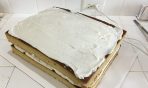
completed cakeI asked Neil what kind of birthday cake he would like us to eat for him, as we will be unable to be with him on his actual birthday, yet what kind of birthday would it be without a cake, and why waste a cake if I am going to make one anyway? Whew!

He asked for an 8 Layer Honey Cake. After doing a (very) little research, I found a good recipe with instructions on Natshakitchen.com. The only modification I made was to reduce the size (diameter) of the cake as there will only be 3 or 4 people partaking. I didn’t reduce the size of the recipe so simply made two small (6″) cakes. (Please don’t ask about the disposition of the second cake.)layer with frosting

One mistake I made was to not roll the dough out to the specified 1/8″ thick. (Mine were closer to 1/4″.) I also found the frosting was too thin. Next time I would use less sour cream and more sugar, or let it set overnight in the refrigerator.

cakes1

8 Layer Honey Cake (Medovik)

INGREDIENTS

Cake Layers Ingredients:

  • 4 Tbsp (1/4 cup) honey
  • ¾ cup granulated sugar
  • 2 Tbsp unsalted butter
  • 3 large eggs, beaten with a fork
  • 1 tsp baking soda
  • 3 cups all-purpose flour (I used unbleached, organic)

Sour Cream Frosting Ingredients:

  • 32 oz sour cream
  • 2 cups powdered sugar
  • 1 cup heavy whipping cream

For the topping:

  • ½ lb Fresh Berries, optional

METHOD

How to Make the Cake Layers:

  1. Add ¾ cup sugar, ¼ cup honey and 2 Tbsp unsalted butter to a medium sauce pan and melt them together over medium/low heat, whisking occasionally until sugar is melted (5-7 mins). Don’t put them over high heat or they may scorch to the bottom.
  2. As soon as the sugar is dissolved, remove from heat and while it’s still hot, add in your beaten eggs in a slow steady stream while whisking vigorously until all of your eggs are incorporated (whisk constantly so you don’t end up with scrambled eggs).
  3. Whisk in the baking soda until no lumps remain, then fold in your 3 cups flour ½ cup at a time with a spatula until the dough reaches a clay consistency and doesn’t stick to your hands. Mine took exactly 3 cups flour (measured precisely, scraping off the top of the cup).
  4. Cut the dough into 8 equal pieces and move on to the next step right away (these roll out best when the dough is still warm)
  5. On a well-floured surface, roll each piece out into a thin 9″ circle (about ⅛” thick). You can sprinkle the top with a little flour too to keep dough from sticking to your rolling pin. Place a 9″ plate or base from a springform mold over your rolled dough and trace around it with a pizza cutter to get a perfect circle. (I used a 6″ cake pan and “punched” out each disk. Be sure to use plenty of flour to keep the dough from sticking.) Keep the scraps for later. Transfer the dough to a large sheet of parchment paper and bake 2 at a time at 350˚F for 4-5 minutes or until golden. Transfer to a wire rack and let cool completely before stacking. Repeat with remaining layers.
  6. Finally bake the scraps separated evenly on a re-used sheet of parchment. Once the scraps are baked, cooled and firm, you can crush them with a rolling pin or pulse them in a food processor until you have fine crumbs.

How to make the frosting:

  1. Beat 1 cup heavy cream until fluffy and stiff peaks form (1-2 min on high speed).
  2. In a separate bowl, whisk together 32 oz sour cream with 2 cups powdered sugar.
  3. Fold the whipped cream into the sour cream and you have your frosting.
  4. Refrigerate until ready to use. I suggest overnight to firm up the frosting.

Assembling your Cake:

  1. Spread about ⅓ cup frosting on each cake layer (don’t skimp on it since the cake needs to absorb some of the cream to become ultra soft.
  2. Press the cake layers down gently as you go to keep the layers from having air gaps.
  3. Frost the top and sides with the remaining frosting.
  4. Dust the top and sides with your breadcrumbs, then cover with plastic wrap and refrigerate overnight.
  5. This cake needs time to absorb some of the cream and soften, so be patient. It’s worth the wait!


Retirement is Loafing… NOT!

I admit it. I have a bread machine. I was consistently underwhelmed by the results from Whitebread1this device. Currently, it is in storage in the garage. I also have a KitchenAide mixer with a dough hook and am very pleased with the consistently good results from this device. It both mixes the ingredients and does 90% of the kneading. It would probably do all the kneading but there is something satisfying about having your hand on, and in the dough, feeling it develop the gluten into a soft, resilient ball.
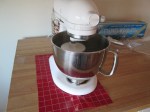
Here is a tip: if, while using your stand mixer to IMG_0029knead bread, it walks across the table, put a silicone baking liner under the mixer. I buy a Cooks Essentials 24″ x 72″ roll every year or so.
After a long search (and many test bakes) for a “go to” white sandwich bread recipe I found one on, of all places, the back of a bag of  Gold Medal flour, duh! I have changed the Method a little, but held pretty close to the Ingredients. I did try substituting butter for the shortening, no big difference, but don’t leave it out. I tried both bread and AP flour, and prefer bread. (I am making bread… why would I not use bread flour?)


INGREDIENTS

  • 6 to 7 cups Gold Medal™ all-purpose flour* or Better for Bread® bread flour
  • 3 Tbl sugar
  • 1 Tbl salt
  • 2 Tbl shortening – NOTE: 1 Tbl shortening weighs 13g, easier to weigh than spoon
  • 4 1/2 tsp quick active dry yeast (2 packages regular)
  • 2 ¼ cups very warm water (120° to 130°F)
  • 2 Tbl butter or margarine, melted, if desired

METHOD

  1. In large bowl, with the dough hook, stir 3 1/2 cups of the flour, the sugar, salt, shortening and yeast until well mixed. Add warm water. Beat  on low speed 1 minute, scraping bowl frequently. Beat on medium speed 1 minute, scraping bowl frequently. Stir in enough remaining flour, 1/2 cup at a time, to make dough easy to handle, not very sticky.
  2. Increase the speed to medium, KitchenAide (4 or 5) and knead for 7 minutes.
  3. Place dough on lightly floured surface. Knead until dough is smooth and springy.
  4. Spray large bowl (I use a dough rising bucket with snap on top) with canola, or other sprayable oil. Place dough in bowl, turning dough to grease all sides. Cover bowl loosely with plastic wrap (if using the bucket, spray the lid also) and let rise in warm place 40 to 60 minutes or until dough has doubled in size. (I use the proofing setting on my oven. This is a little higher temperature than recommended but the results justify the process.) Dough is ready if indentation remains when touched.
  5. Spray the bottoms and sides of two 8×4-inch or 9×5-inch loaf pans with cooking spray.
  6. Gently push fist into dough to deflate. Divide dough in half. (I find I end up with two 750g dough. Gently flatten each half with shaping into a 18×9-inch rectangle on lightly floured surface. (I used to use a rolling pin, but I prefer the texture by treating the dough more gently and not deflating too much.) Roll dough up, beginning at 9-inch side. Press with thumbs to seal after each turn. Pinch edge of dough into roll to seal and form a tight seal. Pinch each end of roll to seal. Fold ends under loaf. Place seam side down in pan. Here is another point of option. You can either brush loaves lightly with butter a this point, or for a crustier crust, don’t. Cover loosely with plastic wrap and let rise in warm place 35 to 50 minutes or until dough has doubled in size.
  7. Move oven rack to low position so that tops of pans will be in center of oven. Heat oven to 425°F.
  8. Bake 25 to 30 minutes or until loaves are deep golden brown and sound hollow when tapped. For the crusty crust, add a baking pan below the bread and pour a cup of water into the hot pan when you put the bread in to bake. Remove the pan and water after 10 minutes and let the bread continue to bake.
  9. Remove from pans to wire rack. For a softer, but still chewy crust brush loaves with butter, otherwise leave them dry; cool.


What the Focaccia Are You Talking About?

Or, you say tomato and I say potato.

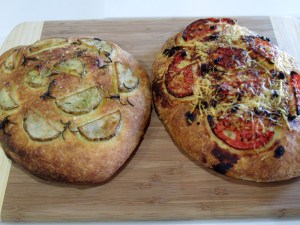
I was flipping through Paul Hollywood’s bread book and saw his focaccia bread, both the Focaccia Pugliese with Tomatoes and Garlic and Potato Focaccia Pugliese. I never made focaccia before and felt these two might be a good beginning. Plus, I craftily asked Fran to put an extra potato in the shopping cart yesterday.

Pugliese is very similar to ciabatta with large holes in the crumb and a very chewy texture. It was interesting that some recipes called for no, or at least minimal kneading, others require typical 7-10 minutes of kneading and still others want extensive kneading, even during the rise to develop even more gluten for a chewier texture.  I chose minimal and it developed an excellent, chewy loaf with a good crunchy crust. The stand mixer really does not care how long you knead.focaccia

My strategy was to make one recipe of bread dough, divide it in half and use one for the tomato and the other for the potato.

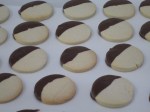
img_0023I also made 2 dozen chocolate dipped short bread cookies, but they were not part of this post. Just a picture for proof.

BREAD INGREDIENTS

  • 4 cups bread flour
  • 1 tbl salt
  • 2 tsp fast acting yeast
  • 1 1/4 cup water

TOMATO TOPPING INGREDIENTS

  • Thin slices of tomato (I used about 1/2 tomato)
  • 1 tsp crushed garlic
  • Sea Salt – as needed
  • Parmesan Cheese – as needed
  • Olive oil – as needed

POTATO TOPPING

  • Thin slices of potato (I used about 1/3 a potato, new potatoes would be better if you had them.)
  • 3-4 sprigs of rosemary from your backyard garden, which you still have to cover every
    night to protect from the frost.
  • Sea Salt – as needed
  • Olive oil – as needed

METHOD

  1. Add all the bread ingredients to a stand mixer equipped with the bread hook. Mix to form a good dough. If you were going to knead the dough keep the mixer running at speed 4 for 7-8 minutes until the dough becomes smooth and elastic.
  2. Cover the mixer bowl and place in the proofing drawer of your beautiful double wall oven. It’s nice having two ovens. I used the top oven to bake the 3 baguettes I made first while proofing the focaccia, (focaccias, focaccii?) the lower.
  3. After and hour of proofing and the dough has at least doubled in size, remove from
    the oven and gently tip onto a lightly floured surface.
  4. Cut the dough in half and place each half on a parchment paper covered large baking sheet, or two smaller sheets.
  5. Gently, using your fingers form each piece of dough into a rough circle about 1/2″ thick.
  6. Punch your fingers into the dough making a rough wavy surface.
  7. Arrange the potato slices, rosemary and sea salt on one and sprinkle and rub
    with olive oil.
  8. Arrange the tomato slices on the other piece of dough and sprinkle with sea salt, garlic, olive oil and cheese.
  9. Push the tomato and potato sliced down inside the dough as much as possible so the dough will rise up around, engulfing the slices.
  10. Place the doughs back in the proofing oven for another hour, or until at least doubled.
  11. Preheat the oven to 425 F convection and bake for 20-25 min until golden brown.
  12. Best eaten warm, but damn, not bad after it has cooled either.

Won’t You Play with My… Kanellängd… a Ling

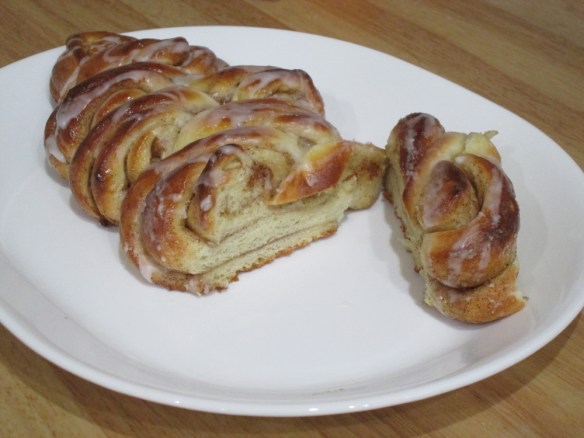
As you may know, had you read my previous blogs, I am a big fan of GBBO. A couple of weeks ago, Paul directed the contestants to make a Kanellängd as part of the Technical Challenge. It looked so good (when he demonstrated the technique) I had to try. The contestants did not have the advantage of seeing Paul make this which resulted in varying degrees of success, so I had a big step up. Theirs did not look all that appealing, mine was outstanding, in both looks and taste. (kanellangd-1Luckily, I have long arms and can pat myself on the back easily and often.) Sadly, I only made a half a Kanellängd, not sure of the final result. More sadly, a half loaf of Kanellängd is only enough for QC, snack and breakfast. Next time a full Kanellängd loaf, to have enough to share.
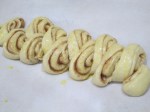
Kanellängd? Think cinnamon bun but not as sticky and made in a loaf. Kanellängd is akin to the Kanelbullen but is a plaited loaf and may be cut with a bread knife or simply torn at the thin spine of the plait, while  Kanelbullen is the individual cinnamon bun. The house smelled like cinnamon all afternoon, which isn’t a bad thing.  Try this, you won’t be sorry.img_0021

INGREDIENTS

  • For the dough
    • 38g/1½ oz unsalted butter, melted
    • 125ml/4½ fl oz full-fat milk, warmed
    • 225g/ ½ lb strong plain bread flour, plus extra for dusting
    • ½ tsp ground cardamom
    • 5g salt
    • 5g packet instant yeast
    • 20g/ ¾ oz caster sugar
    • 12g (¼) free-range egg, beaten (approximately ¾ tbsp)
  • For the filling
    • 5g/1½ oz unsalted butter, softened
    • ½ tsp vanilla paste
    • ½ tbsp ground cinnamon
    • 38g/1½ oz caster sugar
    • 12g (¼) free-range egg, beaten (approximately ¾ tbsp), for brushing
  • For the sugar syrup
    • 50g/1¾oz caster sugar
  • For the icing
    • 150g/5½ oz icing sugar
    • ½ satsuma, finely grated zest only

METHOD

  1. Melt the butter and gently warm the milk in a saucepan.
  2. Tip the flour and cardamom into a large mixing bowl and add the salt to one side of the bowl and the yeast to the other. Add the butter, milk, sugar and egg and turn the mixture round with your fingers. Continue to mix until you have picked up all the flour from the sides of the bowl. Use the mixture to clean the inside of the bowl and keep going until you have a soft dough.
  3. Tip the dough onto a lightly floured surface and begin to knead. Keep kneading for 10–12 minutes. Work through the initial wet stage until the dough starts to form a soft, smooth skin. When your dough feels smooth and silky, put it into a lightly oiled bowl. Cover and leave to rise for 30–40 minutes, until doubled in size.
  4. While the dough is rising, make the filling. Cream the butter and vanilla paste together in a bowl until soft and spreadable. In a separate bowl mix the cinnamon and sugar together.
  5. Line a baking sheet with baking paper. Turn the dough onto a lightly floured surface and knock it back. Roll out the dough into a rectangle, about 25x35cm/10x14in. Turn the dough 90 degrees if necessary, so you have a long edge facing you. Tack the back edge to the work surface, pushing down with your fingers, sticking the dough to the work surface.
  6. Spread the butter mixture evenly over the dough and sprinkle with the cinnamon sugar. Roll up the dough tightly like a Swiss roll, using the tacked edge to create tension. Place on the prepared tray.img_0011
  7. Using a clean pair of sharp scissors, cut the roll into 7 slices (approximately 2cm/¾in each) almost all the way through. (It’s important to cut almost all the way though, otherwise it is difficult to lay alternate slices opposite each other and on their sides.) Pull each slice out to alternate sides and press down gently with your hands. Put the tray inside a clean plastic bag and leave to prove for 20–25 minutes, or until the dough springs back if you prod it lightly with your finger. Do not over prove.kanellangd-10-min-bake
  8. Preheat the oven to 220C/425F. Brush the loaf with beaten egg and bake for 20–25 minutes until risen and golden-brown. Cover with aluminum foil after 10 minutes if it’s browning too quickly.
  9. For the sugar syrup, tip the sugar and 50ml/ 1¾ fl oz water into a small pan and bring to the boil stirring until the sugar has melted. Boil until reduced by kanellangd-10-min-bake-tentedhalf.
  10. For the icing, mix the icing sugar with enough water to make a thin icing, then stir in the satsuma zest. (I forgot the zest. No problem, it didn’t need it.)
  11. Place the loaf on a wire rack to cool. Brush with the sugar syrup then drizzle over the icing. Leave to cool completely.kanellangd-with-syrup-coat

kanellangd-cut-dough


Cheesy Pinwheels

Perfect for a cool, rainy wild card NFL Saturday, or anytime! Easy, quick and delicious.

Ruffles and Macarons's avatarruffles & macarons

There’s only one word I can think of when I bite into these delicious nuggets… YAAAAAS!!!

You only need 4 ingredients for these super easy cheesy bites!

View original post 192 more words

Brioche

While visiting Neil and Maureen in Seattle last weekend Maureen had a brioche roll at breakfast. On the spot, I knew I had to add this to my recipe catalog.

For those of you who are unfamiliar with brioche, it is a pastry of

brioche-1

Five 1/6ths Dough and Three 1/48ths

French origin that is like a highly-enriched bread whose high egg and butter content give it a rich and tender crumb, light and slightly puffy. It has a dark, golden, and flaky crust, accentuated by an egg/cream wash applied after proofing. Let me tell you, this bread is a
lot of work. Unless you like melt in your mouth, buttery, delicious bread I would urge to run, not walk away.

As usual, I adapted a number of online recipes to make this one.

brioche-2

Finished, Cooling Brioche

INGREDIENTS

Dough Starter (Sponge):

  • 29½ g room temperature water
  • 12½ g sugar:
  • 1 teaspoon Dry Yeast
  • 71 g unbleached all-purpose flour
  • 1 large egg

Flour mixture:

  • 156 g unbleached all-purpose flour
  • 25 g sugar
  • 16 g dry yeast
  • 3 g salt
  • 2 large eggs
  • 113 g very soft unsalted butter

Egg Glaze (if making a large loaf, glaze is optional)

  • 1 large egg yolk
  • cream or milk: 1 teaspoon

PREPARATION

  1. One day or up to 2 days ahead, make the dough. In the mixer bowl, place the water, sugar, instant yeast, flour, and egg. Whisk by hand until very smooth, to incorporate air, about 3 minutes. The sponge will be the consistency of a very thick batter.  Scrape down the sides of the bowl and set it aside, covered with plastic wrap.
  2. Combine the ingredients for the flour mixture and add to the sponge. In a small bowl, whisk the flour with the sugar and yeast. Then whisk in the salt (this keeps the yeast from coming in contact with the salt, which would kill it). Sprinkle this mixture on top of the sponge. Cover it tightly with plastic wrap and let it stand for 1½ to 2 hours at room temperature.
  3. Mix the dough. Add the 2 cold eggs and mix with the dough hook on low (#2 KitchenAid ) for about 1 minute or until the flour is moistened. Raise the speed to medium (#4 KitchenAid) and beat for 2 minutes.
    1. Scrape the sides of the bowl with an oiled spatula and continue beating for about 5 minutes longer or until the dough is smooth and shiny but very soft and sticky. It will mass around the dough hook but not pull away from the bowl completely.
    2. Add the butter by the tablespoon, waiting until each addition is almost completely absorbed before adding the next tablespoon, beating until all the butter is incorporated. The dough will be very soft and elastic and will stick to your fingers, but don’t add more flour at this point; it will firm considerably after chilling.
  4. Let the dough rise. Using an oiled spatula or dough scraper, scrape the dough into a 2-quart dough rising container or bowl, greased lightly with cooking spray or oil. Lightly spray or oil the top of the dough and cover the container with a lid or plastic wrap. The dough will rise a lot, be sure your container is at least 3x as big as the original unrisen dough. Allow the dough to rise until doubled, 1 1/2 to 2 hours.
  5. Chill the dough. Refrigerate the dough for 1 hour to firm it; this will prevent the butter from separating.
    1. Gently deflate the dough by stirring it with a rubber scraper or spatula, and return it to the refrigerator for another hour so that it will be less sticky and easier to handle.
  6. Deflate the dough and allow it to rest, chilled. Turn the dough out onto a well-floured surface and roll it into a rectangle, flouring the surface and dough as needed to keep it from sticking. The exact size of the rectangle is not important. (Mine was about 6″ x 12″.) Give the dough a business letter turn, brushing off any excess flour, and again press down or roll it out into a rectangle. Rotate it 90 degrees and give it a second business letter turn and round the corners. Dust it lightly on all sides with flour. Wrap it loosely but securely in plastic wrap and then place it in a large zip-seal bag. Refrigerate for at least 6 hours or up to 2 days to allow the dough to ripen (develop flavor) and firm.
  7. Shape the dough and let it rise. Remove the dough from the refrigerator and gently press it down to deflate it. Cut the dough into 16 pieces (roughly 60g each). Without a scale, the easiest way to divide the dough evenly is to lightly flour your hands and press it into a long brick. Cut it in half, then in half, then in half, then in half until there are 16 pieces.
    1. Cut each of the 16 pieces into thirds or about 20g each and tuck three of the little pieces into a greased cupcake pan. (Next time I would make each of the smallest pieces about 10-15 g and make more, smaller brioche.)
    2. Cover the pan loosely with oiled plastic wrap and let rise (ideally at 75° to 80°F, I used my proofing oven) until the edges of the dough reach the tops of the molds, about 1 hour.
  8. Preheat the oven. Preheat the oven to 425°F 1 hour before baking. Have an oven shelf at the lower level and place a baking stone or baking sheet on it before preheating.
  9. Glaze and bake the brioche. Lightly beat together the egg yolk and cream for the glaze. Brush the top of the brioche with the egg glaze, being careful not to drip any on the side of the pans, or it will impede rising. Allow it to dry for 5 minutes and then brush a second time with the glaze.
    1. Set the cupcake pan on a baking sheet  Bake for 10 to 15 minutes, or until an instant-read thermometer inserted into the center will read about 190°F.
  10. Cool the brioche. Remove the brioche from the oven and pan onto a wire rack. Turn top side up and allow them to cool until barely warm.
  11. Note: The small brioche can be reheated in a 350°F oven for 5 minutes.

Keith’s Brownies

If you are looking for an outstandingimg_0003 brownie try those Chef Keith makes at Cooks & The Cork in Coral Springs. For the nearly 10 years that we have known him, and eaten his food, his brownies have been Fran’s favorites while mine were a distant second. Having been taken into his confidence (and now living in img_0001California and sworn to secrecy) here is my attempt at his recipe Keith recently shared with me.

Not overly sweet, but decadently moist and chocolatey.

Chefsteps Bagels

An obscure passage in Genesis states “And God said: let there be bagels, and there were. And it was good.” I found and joined the website Chefsteps.com this weekend. One of their detailed recipes describes how to make homemade bagels. Go to their website and search for bagels for the procedure. While making bagels at home is a relatively long process much of it is waiting for the dough to rise, or cool or knead in the mixer. I estimate it required 1-2 hours of actual man (person) time to make them. It required about 20 total hours with all the resting, rising and cooling, most of it being overnight.

I had to make one substitution and one modification to the published recipe. I did not have malt syrup to add to the boiling water. Instead I used molasses. I could have used honey, but the comments said this produces more of a “Montreal” bagel. The molasses was spot on. Also, to increase the pH of the water I used baked baking soda.  Baking baking soda (I could have worded this differently, but this was more fun to write) drives out water and carbon dioxide, reducing the positive charge, thereby making the baking soda more alkali and more similar to lye. This enhances the maillard reaction which provides the crunchy, slightly blistered brown bagel surface.


Grace’s Baptism Cake

Saturday October 28, 2016 was our granddaughter Grace’s baptism. completed-cakeAround 60 family members and friends attended at a Catholic church in Roseville for a short but meaningful service, then gathered at Frances and Daniel’s for brunch. I was asked to provide a cake for 60 people. (This may be the largest cake I have made.) The specific request was for a layer cake with chocolate mousse filling and a quilted finish.
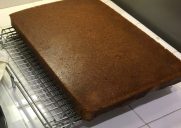
For 60 servings the cake needed to be about 4″ high and 11″ x 15″. Knowing I would lose a little from the edges to square the sides I assumed there would be at least a few sheetcakepeople who do not eat cake (friends of Marie Antionette, no doubt) and I could get away with this size. Therefore I needed two sheet cakes. (Note: about 10 slices were left at the end of the event.)
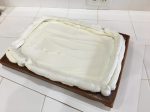
To have a decent thickness of mousse separatinbuttercream-dam-4g the cake layers I built a dam of crusting buttercream around the edges of the top crumb coated cake. Crusting buttercream has a little more body and will keep the mousse in place. Add a tablespoon of meringue powder to the confectioners sugar to make regular buttercream into crusting buttercream. After the second sheet cake is cool, add the buttercream-dam-2mousse to the damned 🙂 bottom cake. Top with the second layer, crumb coat the entire cake and refrigerate. stacked-layersA cold cake is easier to trim to make nice square edges and setting the mousse will retard the effects the moisture will have on the fondant coating.
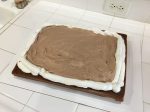

I used an electric knife to trim the edges of the cake prior to covering with fondant. After trimming crumb coat the nice, straight smooth edges of the cake. stacked-and-cut-layers

I rolled out a 17″ x 22″ piece of fondant to have enough to cover the cake. Once it was covered and smoothed, 45 degree crisscrossed lines were embossed into the sides of the cake. Then it was dusted with pearl luster to add a little sparkle to the fondant and little pink rosettes were piped into each intersection of the quilt pattern.

Egraces-cake-quiltingarlier in the week I made the pink orchid, cross and text backing from gumpaste.graces-orchid I purchased the text from a company that makes sugar images and pasted it onto the backing gumpaste.

YELLOW SHEET CAKE – SERVES 60

INGREDIENTS:

  • 4 1/2 cups (570g) all-purpose flour
  • 2 teaspoon baking soda
  • 1 teaspoon salt
  • 2 cup (460g) unsalted butter, softened
  • 3 3/4 cups (700g) granulated sugar
  • 4 large eggs, at room temperature
  • 4 teaspoons pure vanilla extract
  • 1 cup (240g) sour cream, at room temperature
  • 2 cup (480ml) whole milk, at room temperature

DIRECTIONS:

  1. Preheat oven to 350°F (177°C). Generously grease and lightly flour a 12×17 inch half sheet/jelly roll pan. The pan should be at least 2″ deep. Set aside.
  2. Whisk the flour, baking soda, and salt together in a large bowl. Set aside. Using a handheld or stand mixer fitted with a paddle attachment, beat the butter on high speed until smooth and creamy – about 1 minute. Add the sugar and beat on high speed for 3 full minutes until creamed together. The mixture should be a light yellow color. Scrape down the sides and up the bottom of the bowl with a rubber spatula as needed. On medium-high speed, add 1 egg at a time, beating well after each addition until both are mixed in. On high speed, beat in the vanilla extract and sour cream. Scrape down the sides and up the bottom of the bowl with a rubber spatula as needed.
  3. With the mixer running on low speed, add the dry ingredients to the wet ingredients alternating with the milk. Start and end with the dry ingredients. Mix each addition just until incorporated. Do not overmix this batter. The batter will be smooth, velvety, and slightly thick.
  4. Spread the cake batter into the prepared pan. Smooth it out into a thin, even layer. Bake for 20-22 minutes (less for a half recipe or 35-40 minutes for a double. Actual times depend on pan used, less time for shallow pan, more for deeper, or until the top is lightly browned and a toothpick inserted in the center comes out clean. Make sure you rotate the cake pan once or twice during bake time if your oven has hot spots. Remove from the oven and allow the cake to cool in the pan placed on a wire rack. As the cake is cooling, make the frosting.
  5. Make ahead tip: Cake can be made 1 -2 days in advance, covered tightly at room temperature.

BUTTERCREAM FROSTING – I made several batches of this frosting

INGREDIENTS

  • 4 cups of powdered sugar (or 1 box)
  • 1 Cup (2 sticks) of softened butter
  • 2-3 teaspoons of vanilla
  • 1-2 tablespoons of milk
  • Violet food coloring

INSTRUCTIONS

  1. Add powdered sugar to mixing bowl.
  2. Add softened sticks of butter
  3. Add vanilla. If you want white buttercream use clear imitation vanilla.
  4. Add 1 tbsp of milk.
  5. Beat on low until powdered sugar is incorporated. Then move mixer up to medium-high speed. Scrape sides and bottom of bowl often. When completely mixed the frosting may appear dry.
  6. Add more milk, a little bit at a time until frosting is the proper consistency.
  7. Again, for white frosting now add a little violet food coloring. I use the end of a toothpick and add just a little at a time. Mix thoroughly.

CHOCOLATE MOUSSE

INGREDIENTS

  • 4 egg yolks
  • ¼ cup sugar
  • 1 cup whipping (heavy) cream
  • 1 package (6 ounces) semisweet chocolate chips
  • 1 ½ cups whipping (heavy) cream

DIRECTIONS

  1. Beat egg yolks in small bowl with electric mixer on high speed about 3 minutes or until thick and lemon colored, then gradually beat in sugar.
  2. Heat 1 cup whipping cream in 2-quart saucepan over medium heat until hot. Temper the eggs by gradually (i.e. slowly, a little at a time) stirring (rapidly) at least half of the hot whipping cream into egg yolk mixture; stir back into hot cream in saucepan. Cook over low heat about 5 minutes, stirring constantly, until mixture thickens (do not boil). Stir in chocolate chips until melted. Cover and refrigerate about 2 hours, stirring occasionally, just until chilled.
  3. Beat 1 ½ cups whipping cream in chilled medium bowl with electric mixer on high speed until stiff. By hand fold chocolate mixture into whipped cream to not collapse the whipped cream. Pipe or spoon mixture into serving bowls. Immediately refrigerate any remaining dessert after serving.

Caramelized Pineapple/Mango Salsa Blackened Choose Your Fish

Let’s start with the elephant in the room. Let’s put it right out front. Fran and I are not huge fans of fish. Living in South Florida the occasional fish dinner is inevitable and recently we have weakened to the level where we make a point of having fish for dinner once per week, and, believe it or not, actually order it out when we dine at a restaurant. In an effort to unfishy the fish I like to season it with a blackening spice and often grill it on the BBQ. Tonight, however , was blackened pan seared Chilean Sea Bass on a bed of romaine lettuce covered with a carmelized pineapple and mango salsa.  All gone!

Put a couple tablespoons of EVO in a medium sized frying pan. Add brown sugar and melt together. Once the sugar is almost melted (be very careful, its easy to burn whenCarmelized Mango Salsa Sea Bass
it’s just EVO and sugar and you might have to start over… start over… crap!) add the drained pineapple and stir a lot.  When warm, add diced fresh mango, a glass of red wine, and simmer until just bubbling then transfer to a small saucepan and set on a warm burner. Technically, there should have been onion added to the brown sugar EVO mixture to produce caramelized onion, but a) we didn’t have any onion and b) we don’t like onion much, so I opted for caramelized pineapple.

Liberally coat both sides the fish with your spice of choice, transfer to the now empty, but still medium hot fry pan, adding a little EVO. Tent the fish with some aluminum foil, cook for 4 min on the first side (thank you Daniel for your expert advice) then flip as the flesh turns white. Add a tablespoon, or so, of water with a couple of minutes left and re-tent immediately. When you think it is done, cook for an extra 30-45 seconds. (I do not like rawish fish. It is almost as bad as rawish chicken.)

Here are the ingredients. (Note I didn’t use any measuring devices. Measurements are all approximate)

  • 2 tablespoons olive oil
  • 1/4 cup diced onion (if you have one and like onion)
  • 3 tablespoons brown sugar
  • 1 mango, diced
  • 1/2 (15 ounce) can pineapple chunks, drained
  • 1/4 cup red wine
  • 2 tablespoons olive oil
  • 4 (4 ounce) fish steaks (Mine was Sea Bass, about an inch thick)
  • salt and ground black pepper to taste
  • 1/4 cup blackening seasoning