Unknown's avatar

About Dave Oney

Dave Oney was born mid last century in Middlebury, Vermont. He received his BS in Chemistry and worked as a polymer chemist in Massachusetts and New Jersey. He became a microscopist (someone who studies little bitty things using a microscope) and photomicrographer (someone who photographs little bitty things) before settling into a 35-year career in technical sales of scientific imaging equipment (the science of digitally recording itty bitty things, sending the image to a computer for analysis.) He designed and created a number of products contributing to this field. He is (was) proficient in several computer languages and is currently working on mastering English. After making a few more paradigm shift career changes Dave and his wife, Fran, retired and moved closer to their children and granddaughters and now live in the foothills of the Sierra Nevadas.

ET Call Home

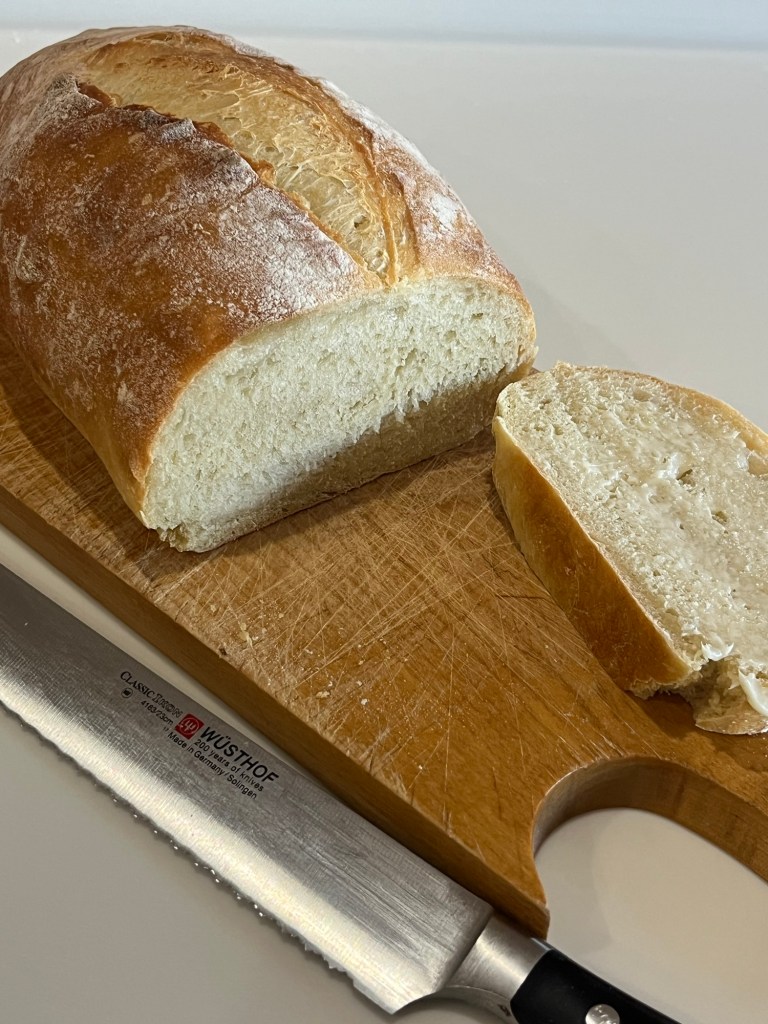
Another winning recipe from King Arthur Baking – Everything No-Knead Bread.

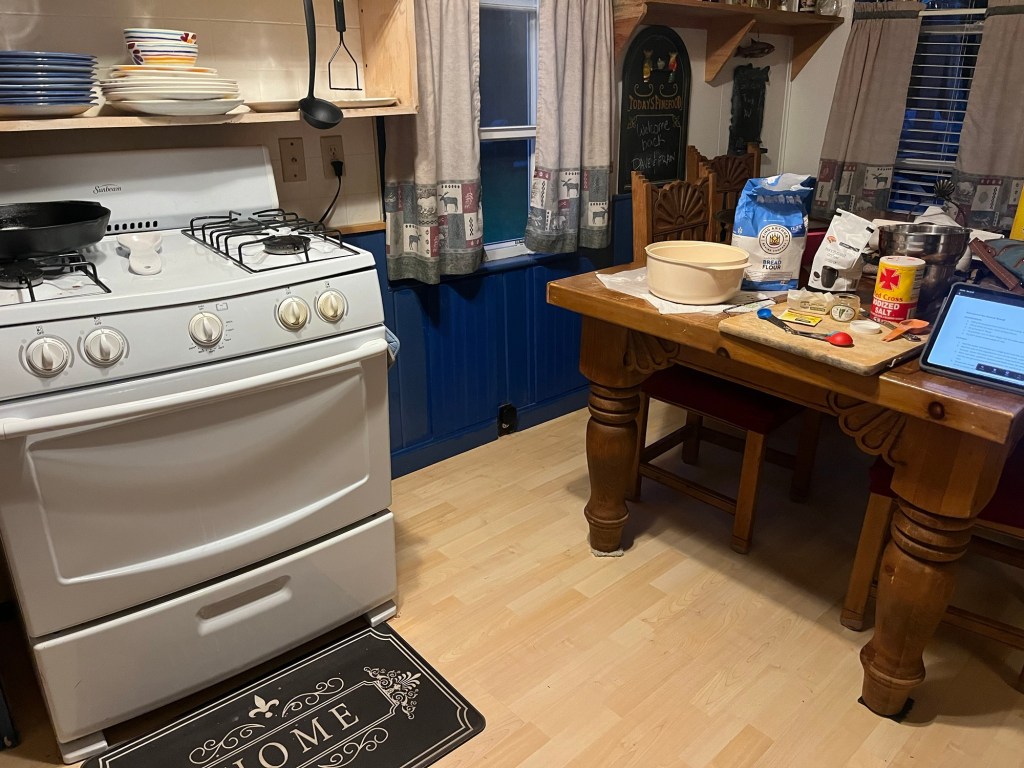
What’s nice about this bread is how easy it is to prepare and bake. It has a fantastic flavor and texture. It took about 30minutes to mix the ingredients (by hand), before it fermented, covered for 8 hours. It’s shaped, popped into a Dutch oven to proof for 1.5 – 2 hours, then baked for about an hour. That it! (Check the proofing by using the poke test. The first loaf was over proofed after 2 hours.)

No Knead Everything Bread – KAB

INGREDIENTS

Dough
• 2 1/4 c (510g) water, cool
• 5 1/2 c (660g) Unbleached Bread Flour
• 1/2 tsp instant yeast
• 2 tsp (12g) table salt
• 2 Tbl (18g) Everything Bagel Topping
• 2 Tbl (25g) olive oil
Topping
• 1 Tbl Everything Bagel Topping

METHOD

  1. Weigh your flour; or measure it by gently spooning it into a cup, then sweeping off any excess. Mix the dough ingredients in a large bowl to make a sticky dough. Or beat in a stand mixer for 3 minutes.
  2. Cover with plastic wrap, and let rest at room temperature overnight, or for at least 8 hours; the dough will become bubbly and rise quite a bit, so make sure it’s in a large bowl.
  3. Lightly grease a 14″ to 15″ long lidded stoneware baker, or 9″ to 10″ round lidded baking crock. Our bread baking crock and bread pot are both great choices.
  4. Turn the dough onto a generously floured surface; the dough will be slack. To shape the loaf, fold the dough over onto itself using a bench knife or well-floured hands. Because the dough is slightly sticky, it’s best to work quickly.
  5. Place the dough in the prepared pan, smooth side up.
  6. Cover and let rise at room temperature for about 2 hours, until a slight indentation remains when you poke it with your finger.
  7. Just before baking, spritz or brush the dough with water and sprinkle with about 1 tablespoon Everything topping over the dough. Using kitchen scissors, make several 1/2″ deep cuts in a decorative pattern on the top of the dough to allow the bread to expand.
  8. Replace the lid on the pot and put it in a cold oven; set the temperature to 450°F.
  9. Bake the bread for 50 minutes (start the timer once the bread goes into the oven), then remove the lid and continue to bake for another 5 to 10 minutes, until it’s deep brown in color, and a digital thermometer inserted into the center registers about 205°F.
  10. Remove the bread from the oven, turn it onto a rack, and cool before slicing.

KAB Recipe of 2024!

I received a personalized email from King Arthur Baking (along with probably a million other customers) proclaiming their selection of the recipe of the year for 2024. How could I resist.?

There were two interesting techniques that I never used in cookies. The first was making brown butter. This adds a rich caramel taste. The other was tangzhong, which is used in many Japanese breads to provide a soft, fluffy texture.

I never made brown butter before (but will again) and was an unsure when it was “done.” The recipe states it will foam near the end, but it also foams near the beginning. The second foam is very fine and if you stir the butter and you can see the browned butter with some bits stuck to the bottom of the pan.

I also formed the dough into balls before refrigerating overnight. It seemed like s sensible step.

Chocolate Chip Cookies – Supersized, Super Soft from KAB

PREP-45 mins: BAKE-15 to 22 mins: TOTAL-1 day 1 hr: YIELD-16 to 17 large (4″) cookies or 28 medium (3″) cookies

INGREDIENTS
• 2 cups (426g) light brown sugar, packed
• 2 teaspoons table salt
• 16 tablespoons (226g) unsalted butter, cut into 1″ pieces
• 1/2 cup (113g) milk, whole preferred
• 2 3/4 cups (330g) King Arthur Unbleached Bread Flour, divided
• 2 large eggs, cold from the refrigerator
• 1 tablespoon King Arthur Pure Vanilla Extract
• 1 3/4 teaspoons baking powder
• 1/4 teaspoon baking soda
• 2 cups (340g) semisweet chocolate, preferably 60% to 65% cocoa content*
*Use chopped wafers or bars for best results; if using chocolate chips, chop them roughly before incorporating. (My chocolate chips were small so I didn’t chop them.)

METHOD

  1. In a large bowl, combine the brown sugar and salt. Set aside.
  2. To brown the butter: In a saucepan over medium-high heat, melt the butter. After several minutes, the butter will sizzle and may spatter. Continue to cook the butter, swirling the pan regularly, for about 5 to 7 minutes, until it’s a dark golden brown color and brown bits start collecting at the bottom of the pan; the butter will have stopped sizzling and may also have a layer of foam on the surface.
  3. Once the butter is browned, immediately pour it over the sugar mixture (be sure to scrape out the brown bits at the bottom) and whisk vigorously to combine; this helps dissolve the sugar slightly and creates the shiny surface of the baked cookies. (The mixture will stay lumpy and won’t become smooth at this point.) Set the empty saucepan aside to cool slightly.
  4. To make the tangzhong: In the same saucepan used to brown the butter, combine the milk with 3 tablespoons (23g) of the bread flour and whisk until no lumps remain.
  5. Place the saucepan over low heat and cook the mixture, stirring regularly with a whisk and then a flexible spatula, until it’s thickened, paste-like, and starts to come together into one mass, about 2 to 3 minutes.
  6. Remove from the heat and transfer directly to the bowl with the butter and sugar. Whisk until mostly smooth; some lumps of the tangzhong mixture are OK.
  7. Add the eggs and vanilla and continue whisking until smooth.
  8. Weigh or measure the remaining 2 1/2 cups plus 1 tablespoon (307g) bread flour by gently spooning it into a cup, then sweeping off any excess. Add the bread flour to the bowl with the butter and sugar, then add the baking powder and baking soda. Using a whisk or flexible spatula, stir until well combined and no dry spots remain.
  9. Place the bowl, uncovered, in the refrigerator and allow it to cool for 10 to 15 minutes.
  10. While the batter is cooling, use a serrated knife to roughly chop the chocolate into coarse pieces. Avoid chopping the chocolate too fine, as small pieces will melt when mixed into the dough.
  11. Remove the dough from the refrigerator and fold in the chopped chocolate. (Dough weighs 1440g. This will make sixteen 90g cookies before baking.)
  12. Return the dough to the refrigerator for 1 – 2 hours.
  13. Remove the dough from the refrigerator and form the dough into 85g to 90g balls, (50g for small cookies,) flatten slightly with the palm of your hand to about 3” diameter circles, cover and return to the refrigerator for 24 to 72 hours to allow the flavors to intensify.
  14. To bake the cookies: When you’re ready to bake, remove the chilled cookie dough from the refrigerator and let it rest at room temperature for about 10 to 15 minutes to allow it to warm up slightly. Meanwhile, preheat the oven to 350°F with a rack in the center.
  15. Arrange the cookie dough balls on parchment-lined baking sheets, them 3″ to 4″ apart. (Five dough balls fit perfectly on a half-sheet pan. The 90g cookies can be arranged in a 2-1-2 pattern; the 50g cookies can be arranged in a slightly staggered 4 x 2 pattern.) For consistently shaped cookies, roll each piece of dough into a smooth ball before baking.
  16. Bake the large (90g) chocolate chip cookies for 18 to 22 minutes or the smaller (50g) cookies for 15 to 18 minutes, until the edges are set and the cookies are browned, rotating the pan halfway through baking to ensure even browning. (For best results, bake one pan of cookies at a time.) Remove the cookies from the oven and let them rest on the baking sheets until cool enough to handle, at least 15 minutes.

Storage information: Store leftover chocolate chip cookies, covered, for up to 5 days; their slightly crispy edges will soften and the cookies will maintain a soft texture. Freeze baked cookies for longer storage.

Blueberry/Lemon Drizzle Cake

Always a fan of Chef Jacques Pepin who scores a home run again with this cake. It’s easy to make, the directions are spot on and it’s delicious to boot!

My only change was to substitute 1/2 cup of yogurt for 1/2 cup of sour cream. Who knew a container of yogurt was only 1/2 cup?

Blueberry Cake —Cake Chef Jacques Pepin

Active time: 15min Total Time: 2 hours

INGREDIENTS

  • 1 ½ c plus 1 Tbl AP flour divided.
  • 2 tsp baking powder
  • 3 large eggs
  • 1 c granulated sugar
  • ½ c plain yogurt (or 1 c yogurt and no sour cream)
  • ½ c sour cream (or 1 c sour cream and no yogurt)
  • ½ tsp salt
  • ½ tsp vanilla
  • ½ c vegetable oil
  • 2 tsp lemon zest
  • 1 ½ c fresh or frozen blueberries
    Lemon Glaze/Syrup
  • 3 Tbl lemon juice
  • 1 c sifted confectioner’s sugar

    METHOD
  1. Preheat the oven to 350F
  2. Grease the sides and bottom of a loaf pan
  3. Sift together all dry ingredients for the bread
  4. In a large bowl, mix together all the moist ingredients
  5. Slowly add in the dry ingredients
  6. In a separate bowl, add the Tbl of flour to the blueberries and toss to coat the fruit.
  7. Fold gently into the batter
  8. Pour the batter into the prepared pan
  9. Bake for 50 to 55 minutes. If a toothpick comes out clean the bread is done
  10. Remove from the oven and let cool for 10 minutes
  11. Remove loaf from pan and allow to cool on a cooling rack
  12. In a small saucepan on low heat, add the powdered sugar to the lemon juice and let it dissolve.
    Simmer for 3 minutes
  13. Using a toothpick, poke holes all over the loaf, top and sides
  14. Use a pastry brush to brush the lemon syrup on the top and the sides.

Fudge – Not Like What Mom Made

I made a recipe for chocolate fudge that was totally different from my Mom’s. (To be fair it did use chocolate.)

It wasn’t bad, but it wasn’t Mom’s either. This new recipe was smooth, silky, and not too sweet, like what you buy in a good chocolate shop.

Mom’s, or to be more accurate, Better Housekeeping’s, is sweet, a bit grainy and significantly more work. (Beating at the end to achieve the correct viscosity for it to still pour, but harden properly is always a challenge.)

It was a good exercise and it’s always a fun to try new recipes, but Mom always liked her’s best, (an homage to Tommy Smothers) and so do QC and me.

Chocolate Fudge –
with Sweetened Condensed Milk

INGREDIENTS
• 350 g (12 oz) 54% dark chocolate chips
• 397 g (14 oz) sweetened condensed milk
• 20 g (1 tbsp) unsalted butter
• ½ tsp vanilla extract
• 1 pinch of sea salt

METHOD

  1. Line an 8” square cake pan with parchment paper.
  2. Place all the ingredients in a saucepan chopped chocolate, sweetened condensed milk, softened butter, vanilla extract, and sea salt.
  3. On low heat, let the preparation melt completely while stirring from time to time with a spatula.
  4. Immediately pour the preparation into the prepared pan.
  5. Cover with plastic wrap and let cool completely in the refrigerator for at least 2-3 hours.
  6. When the chocolate fudge has completely cooled, remove it from the cake pan and cut into 1” squares.

Chocolate Fudge –
Good Housekeeping’s and Mom’s

INGREDIENTS

• 4 c sugar
• 1 1/3 c milk
• ¼ c corn syrup
• ¼ tsp salt
• 4 oz unsweetened baking chocolate
• ¼ c butter
• 2 tsp vanilla

METHOD

  1. Grease bottom and sides of 8-inch square pan with butter.
  2. In 3-quart saucepan, cook sugar, milk, corn syrup, salt and chocolate over medium heat, stirring constantly, until chocolate is melted and sugar is dissolved. Cook, stirring occasionally, to 234°F on candy thermometer or until small amount of mixture dropped into cup of very cold water forms a soft ball that flattens when removed from water; remove from heat. Stir in butter.
  3. Cool mixture without stirring to 120°F, about 1 hour. (Bottom of saucepan will be lukewarm.) Add vanilla. Beat vigorously and continuously 5 to 10 minutes, using wooden spoon, until mixture is thick and no longer glossy. (Mixture will hold its shape when dropped from a spoon.)
  4. Spread in pan. Let stand about 1 hour or until firm. Cut into 1-inch squares.

Christmas ‘23 – Like No Other

Covid sucks. No sense in beating around the bush, Covid just plain sucks. It totally disrupted our holiday today, and tomorrow and…

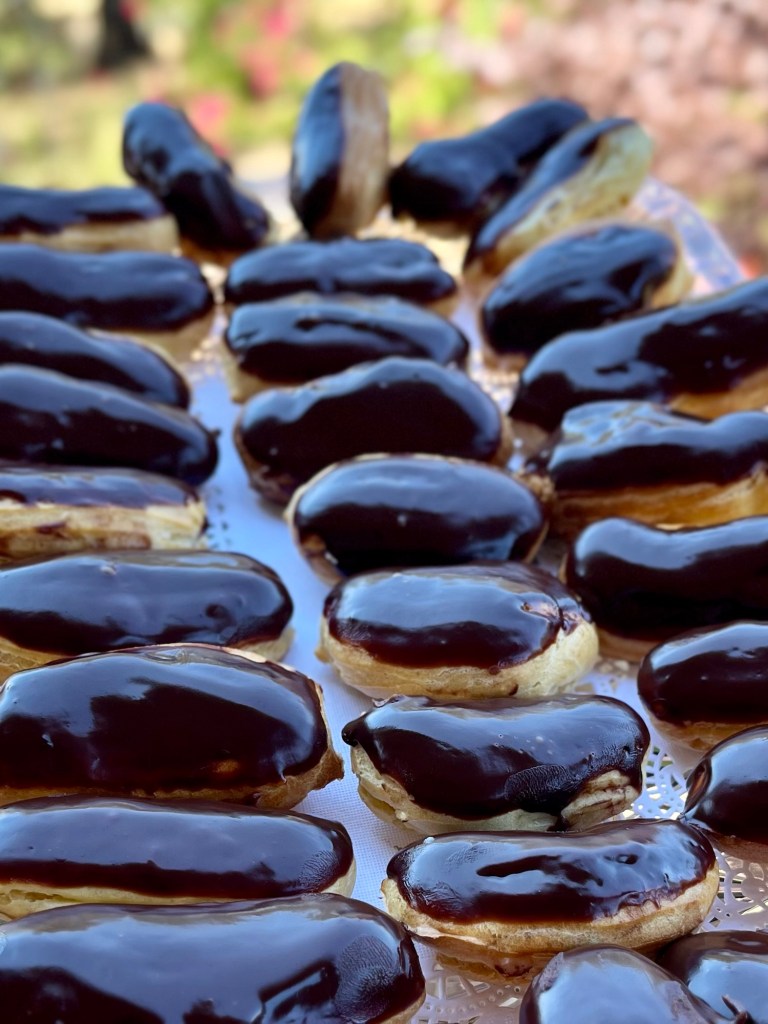
We were invited to a family dinner tonight and I was asked if I could bring my dinner rolls and one of my desserts, to which I said “Of course!” I decided to make rolls in the shape of a Christmas tree and eclairs suitable for a Christmas dinner.

When I contacted our relative and begged off due to possible Covid exposure she said I shouldn’t bring the rolls and dessert. I told her how I was looking forward to baking and making them and would be very disappointed to not be able to. (I dropped them off this afternoon.)

I know her husband loves the my eclairs so I modified my usual ones to be “Christmasy.” I glazed a few with my normal dark chocolate and made colored white chocolate for the rest, I reserved some of the white chocolate glaze and colored it using oil based food coloring. I “painted” the faces etc and realized in the future I need to make the eclairs larger to have a larger “canvas” to paint on. I call this “Tim Burton’s Eclairs for Christmas” eclairs.

Christmas Tree Dinner Rolls

INGREDIENTS
• 488 g (2 cups) warm milk
• 2 tablespoons instant dry yeast
• 50 g white granulated sugar
• 2 teaspoons salt
• 6 tablespoons salted butter softened
• 2 large eggs
• 750-850 g (6-7c) all-purpose flour
• 1 tablespoon melted butter
• 1 egg and 1 Tbl water for an egg wash
• ½ c fresh cranberries – choose the most uniform
• Several sprigs fresh rosemary.
• ½ c water
• 1 ½ c sugar, divided 1:½

METHOD

  1. In the Pro600 stand mixer bowl, combine and mix all ingredients except the flour. (This is to remind me to use my larger mixer.)
  2. Add in 5 ½ cups of flour. Using a dough hook, turn the mixer on and increase speed slowly to keep the flour from flying all over. Slowly add the remaining flour until the dough pulls away from the sides of the bowl. (I watch the bottom of the bowl and add flour until the dough just comes clean from the bottom.) Once the dough clears, knead for 8 minutes. The dough mixture should be sticky and soft.
  3. Transfer the dough to a lightly greased bowl. (I dump the dough on the counter, spray the stand mixer bowl with some olive oil and return the dough, cover and let rise 45 – 60 minutes, until doubled.)
  4. Form the the dough into into 45g balls.
  5. Arrange the balls into 8 rows, 3 for the base of the tree, then 7, 6, 5, 4, 3, 2, 1.
  6. Reserved one ball to shape the star. (I used a star cookie cutter.)
  7. Cover and let rise 45 – 60 min.
  8. Preheat oven to 375⁰F 15 minutes before the end of the final proof.
  9. Mix egg and water to make an egg wash and lightly brush the rolls.
  10. Bake the rolls for 12 to 14 minutes, until lightly browned.
  11. Remove rolls from oven and brush with melted butter. Best when served warm. To cool, let rest in the pan for 15 minutes then transfer to a wire rack. Once cooled completely, store in a plastic bag.

Sparkling sugar cranberries and Rosemary

  1. Wash cranberries and put in a heat proof bowl
  2. Bring the water and 1 c sugar to a simmer
  3. Let the mixture cool for 5 minutes then pour over the cranberries
  4. Cool for 1-2 hours in the fridge.
  5. Strain the berries and let dry
  6. Roll in granulated sugar, spread on parchment paper and let dry
  7. Repeat with the rosemary

Pinball Wizard

This week was our son, Neil’s, birthday. He is a coffee Q Grader, cat owner and competitive pin ball player. This cake was in honor of one of his many accomplishments?

It’s based on my extreme chocolate cake, shortbread cookies and added a new meringue buttercream frosting. It was a relatively small cake so the decorations were somewhat oversized, but overall it was acceptable.

The red and white is royal icing. The black and yellow is fondant.

Swiss Meringue Buttercream – From Sally’s Baking Addiction

INGREDIENTS
• 6 large egg whites (approximately 230g)
• 2 cups (400g) granulated sugar
• 1 and 1/2 cups (3 sticks; 350g) unsalted butter, softened but still cool (60°F and firm) and cut into Tbsp size pieces
• 2 teaspoons pure vanilla extract
• 1/8 teaspoon salt

METHOD

  1. Make sure all the tools you are using are completely cleaned, dried, and grease-free. A quick wipe with a little lemon juice or white vinegar is very helpful.
  2. Separate the eggs 1 at a time into a small bowl, then transfer to the metal stand mixer bowl. Repeat with the remaining egg whites. This way, if a yolk breaks in one of them, you don’t waste the whole batch.
  3. Whisk sugar into the egg whites, then set the bowl over a saucepan filled with two inches of simmering water over medium heat assuring the bottom of the egg whites bowl don’t touch the water.
  4. Whisk the whites and sugar constantly until sugar is dissolved and mixture has thinned out, about 4 minutes. The mixture will be thick and tacky at first, then thin out and be frothy white on top. To test that it’s ready, you can use your finger, or an instant read thermometer. Lightly and quickly dip your finger (it’s very hot, be careful) and rub the mixture between your thumb and finger. You shouldn’t feel any sugar granules. If using a thermometer, the temperature should read 160°F (71°C).
  5. Don’t let it cool down to start this next step– it’s important to begin mixing while it is still warm. On medium-high speed, beat the mixture until stiff glossy peaks form and the meringue is no longer warm to the touch, at least 10-15 minutes. On particularly humid days, this has taken me up to 17-18 minutes. If it’s still not reaching stiff peaks, stop the mixer, place the bowl–uncovered–in the refrigerator for 10 minutes, then return to the mixer and continue beating until stiff peaks form.
  6. If the bowl and meringue still feel warm, wait until both cool to room temperature (around 70°F (21°C)) before adding the butter in the next step. Feel free to place it in the refrigerator. A warm bowl and meringue will melt the butter.
  7. Switch the stand mixer to the paddle attachment. On medium-high speed, add the butter 1 Tablespoon at a time. Wait for the butter to fully mix in before adding the next Tablespoon. After all the butter has been added, turn the mixer down to medium speed and fully beat in the vanilla and salt, about 30 seconds.
  8. Add any color the beat until uniform. (Gel food coloring only.)
  9. Your Swiss meringue buttercream should be thick, creamy, and silky smooth.

Notes
Too Thick or Too Thin:

  1. If your meringue has separated, curdled, or is too thick at any point after you mix in all of the butter, place the mixture in your heat-proof bowl back over a pot of 2 inches of simmering water.
  2. Without stirring, let the edges of the meringue warm up and become liquid (the center of the meringue will still be solid), about 1-2 minutes.
  3. Remove from heat and return to the mixer. Beat meringue on low speed for 30 seconds, then switch to medium-high speed and beat until smooth, about 2 minutes. Works every time.
  4. If your mixture has become too thin and soupy after you add the butter, place the entire bowl in the refrigerator (covered or uncovered, doesn’t matter) for 20 minutes to cool down, then return it to the mixer and beat on medium-high speed until thickened. Any longer than this will solidify the butter, so only refrigerate in 20 minute spurts. If it’s still soupy, place back in the refrigerator for longer before re-whipping again.

Mini Remnant Chocolate Cakes

If you follow me you likely know I am a Vermonter and anyone from New England is known to be… um… frugal. I made some baseball cakes this week and when the cake rises in the hemispherical molds there is a portion that needs to be trimmed off. Well, I am not one to waste anything, especially chocolate cake.

I made what QC termed mini chocolate cakes from the remnants. Really all I did was to make some White Meringue Frosting and cover the tops of the cakes and add a few sprinkles. Easy, peasy.

White Meringue Frosting

INGREDIENTS

  • ¾ cup (170 g) confectioner’s sugar
  • 3 large egg whites
  • 2 Tbl cold water
  • 1 tsp lemon juice
  • 1 ½ tsp vanilla extract

METHOD

  1. Place all ingredients in the stand mixer bowl and whisk until well combined.
  2. Chose a saucepan large enough so the mixer bowl will rest on the rim but not touch 1-2” of water in the saucepan.
  3. Once the water is almost boiling, place the mixer bowl on the saucepan and whisk the mixture. Turn the burner to low. The water should be not quite boiling. The mixture must not boil. Whisk until all the sugar is dissolved or you will end up with a grainy looking frosting. Check to see if it has reached 160-170⁰ F.
  4. Place the bowl in the kitchen mixer with the whisk attachment on. Whisk the meringue frosting until stiff peaks forms and has a glossy look. This can take up to 12 -15 minutes or more. But don’t over-beat. You will beat air into the frosting. It needs to be easily spreadable
  5. When the white meringue frosting is ready, if desired it can be colored with food gel colors. This frosting will crust over time, but the center of the frosting swirl will still be thick and fluffy.
  6. Cakes and cupcakes with white meringue frosting can be stored in the refrigerator for two days.

Tip: Makes enough to frost 12 cupcakes. If using it on cupcakes, use a plastic piping bag and a large piping tip for great cupcake swirls

It Ain’t Over Till It’s Over

Yesterday was Fran’s (a.k.a. QC’s) birthday and for any who know her she feels Dani Rojas had it almost right: “Baseball is life” but Dani, American football is a close second.

To celebrate. I decided to make personalized, individual baseball birthday cakes. I had 2 1/2 inch silicone hemisphere molds but thought they would be too small a piece of cake so I bought two 3” ones. (In hindsight, the smaller ones were probably adequate, but would be more difficult to decorate.)

Due to the need to keep the cakes cold this is a pretty long procedure. It required about 6 hours total.

Extreme Chocolate Cake Baseballs

Makes five 3” spherical cakes

INGREDIENTS
• For Cake: 3 cups white sugar
• 2⅔cups all-purpose flour
• 1¼ cup unsweetened cocoa powder
• 2¼ teaspoons baking soda
• 2¼ teaspoons baking powder
• 1½ teaspoon salt
• 3 eggs
• 1½ cup milk
• ¾ cup vegetable oil
• 3 teaspoons vanilla extract
• 1½ cup boiling water
For Buttercream: 2 stick softened butter
• 2cup icing sugar
• 4-6 Tbl milk
For Raspberry Buttercream: 1 stick softened butter
• 1 cup icing sugar
• 2-3 Tbl milk
• 6 oz fresh raspberries
For White Chocolate Ganache: 450g White Chocolate
• 110g (½ cup) heavy cream
• ~1 tsp white food coloring
For the Black Royal Icing: 1c (120g) confectioners’ sugar, sifted.
• 1 Tbl meringue powder (not plain egg white powder)
• 3 drops black food coloring
• 1 Tbl Black Cocoa
• 2-3+ Tbl room temperature water
For the Red Royal Icing: 1 c (120g) confectioners’ sugar, sifted.
• 1 Tbl meringue powder (not plain egg white powder)
• 3+ drops red food coloring
• 2-3+ Tbl room temperature water

METHOD

  1. Preheat oven to 350F (175C). Spray two 3” cell diameter silicone molds with Pam For Baking or equivalent. Line a 9×11” jelly roll pan with parchment paper.
  2. Make the cake: In a stand mixer bowl, stir together the sugar, flour, cocoa, baking soda, baking powder and salt. Add the eggs, milk, oil and vanilla, mix for 3 minutes. Stir in the boiling water by hand.
  3. Use a 1/3 measuring cup to fill each well two thirds full.
  4. Pour remaining batter into jelly roll pan and spread to flatten.
  5. Bake for ~25 minutes in the preheated oven, until a toothpick inserted comes out clean or 205 internal temp. Do NOT let the internal temp exceed 205 deg F or the cakes will be overdone.
  6. Cool for 10 minutes before removing from silicon molds to cool completely.
  7. Remove he cakes from the molds and refrigerate for 30 minutes to firm up the cakes.
  8. Set small sheet cake aside to be used as a base for the baseballs when serving.
  9. While the cakes are cooling make the raspberry buttercream:
    a. Make Raspberry Syrup: Heat 170g of raspberries in a small saucepan with two Tbl sugar and heat until boiling.
    b. When the raspberries are very tender mash them to break them into a sauce.
    c. Sieve the raspberries to remove the seeds and pulp and return to heat to reduce by half then cool.
    d. Make Raspberry Buttercream: Mix the butter and icing sugar and raspberry syrup. Add more milk as required to make the buttercream soft and easily spreadable. Beat at high speed until the buttercream is smooth and well mixed. (You may need to add the additional milk to achieve the desired viscosity as the cake will be very tender and fragile.)
  10. Form and assemble the cake balls: With a sharp knife cut the top of each hemisphere to flatten and create a small hole in each cake (I used a melon scoop)
    a. Fill the hole in each hemisphere and cover half of the cakes with buttercream
    b. Mate each coated hemisphere with an uncoated one and return to fridge to set the buttercream.
  11. Make vanilla and grass-green buttercream: Repeat making raspberry buttercream but substituting milk for raspberry syrup. Divide the buttercream 4::1. Color the larger amount with green food coloring to use to decorate the sheet cake later.
    a. Use the vanilla buttercream to fill any holes around the circumference of the cake ball and crumb coat each ball. (I dipped the ball in a thin buttercream and used gloved hands to smooth.)
    b. Return to the fridge to set the buttercream.
  12. Make the white chocolate ganache: The ganache must be pourable but thick enough to cover each ball with a smooth coating.
    a. Fill a saucepan with water to about 2 inches deep.
    b. Place a metal or glass bowl over the warm water. Make sure the bowl does not touch the water.
    c. Place the chocolate and cream in the bowl and stir frequently. When the chocolate is almost completely melted, remove it from the heat and let the rest of the chocolate melt while it sits off the heat. Add white food coloring until the desired level of whiteness is achieved and mix well. If there is any un-melted chocolate let it rest until all the chocolate melts. As long as the mixture is warm, the chocolate will continue to melt.
  13. To coat the balls: Place each cold ball on a stable surface that will keep them in place.
    a. Smooth the cold balls with gloved hands.
    b. Pour the white ganache over each ball, covering completely. Allow the chocolate to harden at room temperature, or in for fridge.
    c. If desired re-coat the balls by chilling them and repeat from step #12.
  14. Make the Black Royal Icing: Combine confectioners’ sugar, meringue powder, black food coloring, black cocoa and 2 Tbl of water in a large bowl.
    a. Using a hand mixer or a stand mixer fitted with a whisk attachment, beat icing ingredients together on high speed for 1.5 – 2 minutes.
    b. When lifting the whisk up off the icing, the icing should drizzle down and smooth out within 5-10 seconds. If it’s too thick, beat in more water a few drops at a time.
    c. I usually need 3 Tbl but on particularly dry days, I use up to 4-5 Tbl.
    d. Keep in mind that the longer you beat the royal icing, the thicker it becomes. If your royal icing is too thin, just keep beating it to introduce more air OR you can add more confectioners’ sugar.
    e. Remember the icing has to flow through a very small piping tip so it cannot be to thick. If it’s too thin it will run (for reference, see my photos)
  15. Make the Red Royal Icing: Sift confectioners’ sugar and meringue powder into a large bowl and add 2 Tablespoons of water.
    a. Add half the water after sifting the sugar. Add the remaining water or more, checking flow consistency of the icing is what you want for piping etc.
    b. Using a hand mixer or a stand mixer fitted with a whisk attachment, beat icing ingredients together on high speed for 1.5 – 2 minutes.
    c. When lifting the whisk up off the icing, the icing should drizzle down and smooth out within 5-10 seconds. If it’s too thick, beat in more water a few drops at a time. If your royal icing is too thin, just keep beating it to introduce more air OR you can add more confectioners’ sugar.
    d. When applied to cookies or confections in a thin layer, icing completely dries in about 2 hours at room temperature, quicker in the fridge.
  16. Decorating the baseballs: Use black royal icing to draw the seams of the baseball. (I suggest doing one ball at a time, returning to the fridge between piping steps.) I wanted each person’s name written in script on each baseball using the black royal icing.
    a. After all the names and seams are piped and the black royal icing is setting in the fridge, clean the piping pen and fill with red royal icing.
    b. Remove the baseballs from the refrigerator, one at a time, and pipe the red stitches in the traditional baseball style.
    c. Return the baseballs to the fridge but bring them to room temperature an hour before serving.
  17. Make turf: Cut small sheet cakes into 3×3” squares and pipe green buttercream covering each square using a Wilton 233 piping tip or equivalent. Center each baseball cake on a piece of turf.

Apple Pie for Freezing

A month ago, QC and I went to Apple Hill to buy some, wait for it,… apples! This is our traditional trip up past Placerville. It’s a nice drive up and we take a backroad home through the Sierra Nevada foothills. It looks a lot like Vermont.

I made a couple of dozen pints of applesauce, (we like applesauce.) and had leftover apples, beyond those we ate. I found a recipe for an apple pie designed to be prepared and frozen (for up to 2 months.) I also have a nice pie crust recipe I never used so along with the apples, the time was ripe. If you do not over-mix the fats and dry ingredients and do not over-work the dough the crust will be very flaky and delicious like this one.

Unfortunately, I couldn’t wait the full two months to complete the test, and baked it today, almost exactly one month from freezing. (Next time I will make two pies.)

Apple Pie Ready for Freezing

PIE CRUST
• 2 ½ cups (315g) all-purpose flour plus more for shaping and rolling
• 1 teaspoon salt
• 6 Tablespoons (85g) unsalted butter, chilled and cubed
• 2/3 cup (130g) vegetable shortening, chilled
• ½ cup (120ml) ice cold water

INGREDIENTS – PIE FILLING
• 6 c thinly sliced, peeled apples (6 medium)
• ¾ c sugar
• 3 Tbl all-purpose flour
• ¾ tsp ground cinnamon
• ¼ tsp salt
• ⅛ tsp ground nutmeg
• 1 tsp lemon juice

METHOD CRUST

  1. Whisk the flour and salt together in a large bowl.
  2. Add the butter and shortening. Use a pastry cutter, cut the butter and shortening until it looks like coarse gravel. (A few larger bits of fat are OK). In this step, you’re only breaking up the cold fat into tiny little flour-coated pieces; you’re not completely incorporating it. Do not overwork the ingredients.
  3. Measure ½ cup (120ml) of water in a cup. Add ice. Stir it around. From that, measure ½ cup (120ml) of water, since the ice has melted a bit. Drizzle the cold water in, 1 Tablespoon (15ml) at a time, and stir with a silicone spoon after every tablespoon has been added. Stop adding water when the dough begins to form large clumps. Do not add any more water than you need.
  4. Transfer the pie dough to a floured work surface. Using floured hands, fold the dough into itself until the flour is fully incorporated into the fats. The dough should come together easily and should not feel overly sticky. Avoid overworking the dough. If it feels a bit too dry or crumbly, dip your fingers in the ice water and then continue bringing dough together with your hands. If it feels too sticky, sprinkle on more flour and then continue bringing dough together with your hands. Form it into a ball. DO NOT OVERWORK THE DOUGH!
  5. Use a sharp knife to cut it in half. If it’s helpful, you should have about 1 lb, 8 oz dough total (about 680g). Gently flatten each half into 1-inch-thick discs using your hands.
  6. Wrap each tightly in plastic wrap. Refrigerate for at least 2 hours and up to 5 days.
  7. After the dough has chilled for at least 2 hours roll it out, one crust at a time, keeping the other in the refrigerator until you’re ready to roll it out. Lightly flour the work surface, rolling pin, and your hands, and sprinkle a little flour on top of the dough. Use gentle-medium force with your rolling pin on the dough—don’t press down too hard on the dough. When rolling dough out, start from the center and work your way out in all directions, turning the dough with your hands as you go. Between passes of the rolling pin, rotate the pie crust and even flip it, to make sure it’s not sticking to your work surface. Sprinkle on a little more flour if it’s sticking; don’t be afraid to use a little more flour. Roll the dough into a very thin 12-inch circle. Your pie dough will be about 1/8 inch thick, which is quite thin. Visible specks of butter and fat in the dough are perfectly normal and expected.
  8. Carefully roll one end of the circle of dough gently onto the rolling pin, rolling it back towards you, slowly peeling it off the work surface as you go. Pick it up, and carefully roll it back out over the top of the pie dish.

METHOD – PIE FILLING

  1. Place 1 pie crust in 9-inch disposable foil or metal pie plate (do not use glass). Press crust firmly against side and bottom of pie plate.
  2. In large bowl, gently mix filling ingredients; spoon into crust-lined pie plate.
  3. Top with second crust. Wrap excess top crust under bottom crust edge, pressing edges together to flute and seal.
  4. Tightly wrap unbaked pie in 3 layers of plastic wrap, making sure all sides of pie are completely sealed and unexposed.
  5. When ready to bake pie, heat oven to 450°F. Remove frozen pie from freezer; cut a few slits in top crust and place in oven. Do not thaw pie.
  6. Bake 25 minutes. Reduce oven temperature to 375°F; bake 40 to 50 minutes longer or until crust is golden brown and apples are hot and soft when pricked with a fork. If necessary, tent the edges of the pie to reduce darkening and bake in 10-minute periods until the internal temperature of the pie is 190 – 200°F.

1 Apple and 3 Bananas a Day…

We returned from Kauai VERY early this morning. When I staggered into the kitchen I found three VERY ripe banana and a very (small case on purpose) soft apple in our produce rack. Instantly, I thought apple-banana bread.

This recipe is an amalgam of several I found online. One note: my brown sugar was very clumpy so I ran it through a sieve before adding it to the other dry ingredients. I was able to break up the clumps with my fingers.

Apple-Banana Bread

INGREDIENTS
• 260 g (1¾ c) AP flour
• ¾ tsp baking soda
• ¼ tsp salt
• 75 g (⅓ c) granulated sugar
• 110 g (⅔ c) light brown sugar
• ¼ tsp cinnamon
• ¼ tsp nutmeg
• 2 eggs
• ⅔ c butter (very soft)
• 3 Tbl milk
• 3 small/medium bananas (mashed)
• 1 large apple (peeled, cored, chopped)

METHOD

  1. Mix together flour, baking soda, salt, sugar and spices.
  2. Blend in eggs, butter, and milk.
  3. Stir in banana and apple.
  4. Pour batter into greased loaf pan.
  5. Bake at 350F for about 1 hour or until toothpick test comes out clean. (Internal temperature was 193F.)
  6. Rest in the loaf pan for 10 minutes, then on a cooling rack until room temperature (if you can wait that long.)