Classic Bruschetta

It’s nearly time for another QC Cadre gathering. We welcomed new neighbors last month and will introduce them to the Cadre in a couple of weeks. The menu is under development and practice bakes are underway.

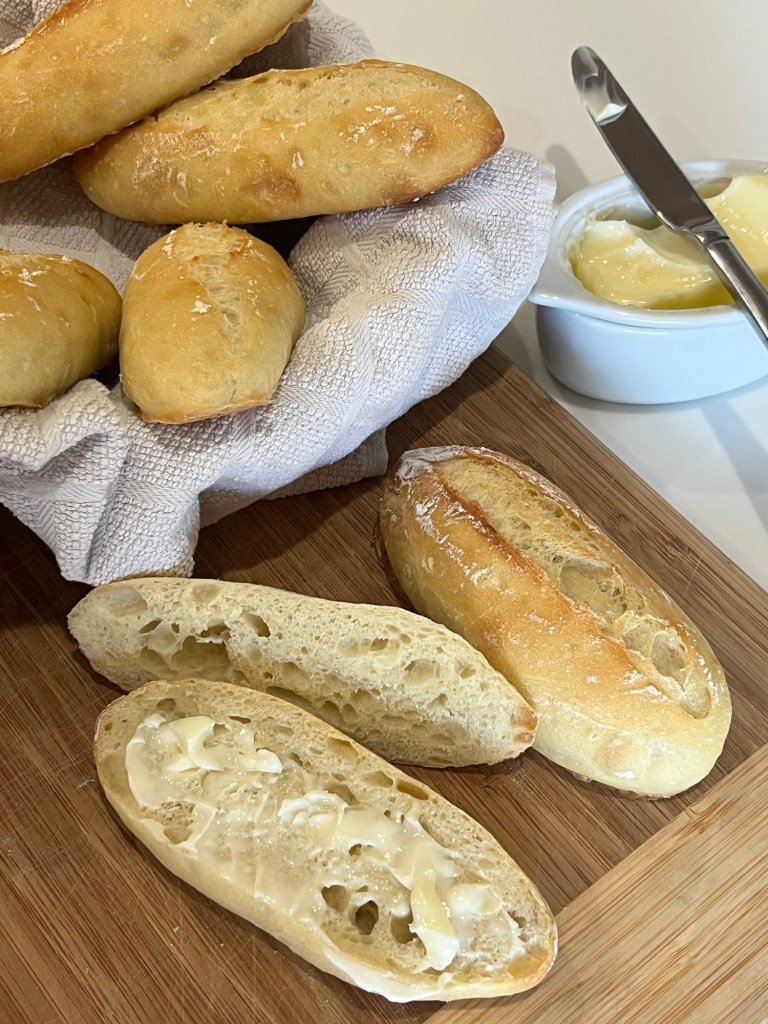
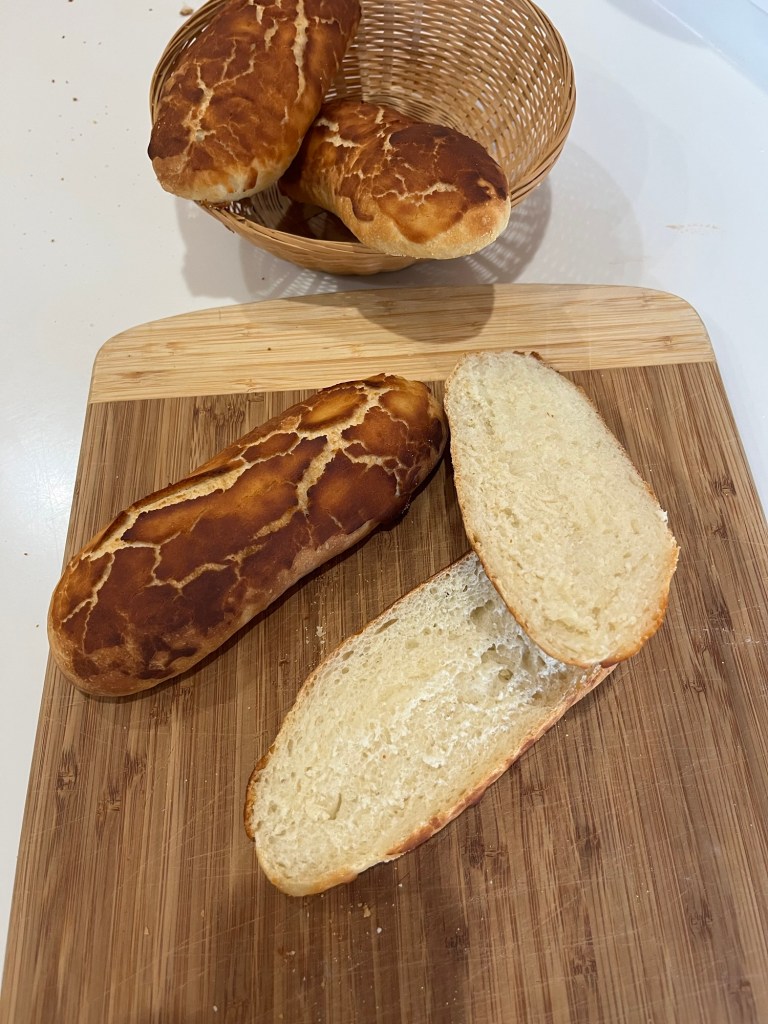
Yesterday I made baguettes in anticipation of today’s bruschetta. I made baguettes several times in the past, but none recently. (They came out great this time too.)

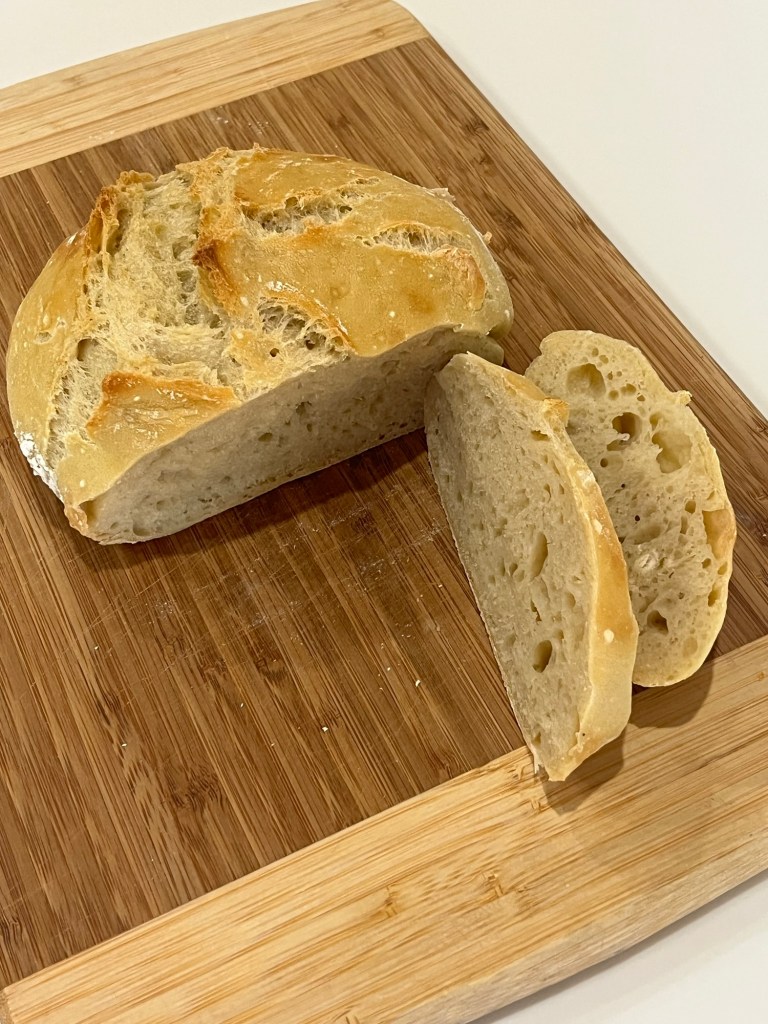
This morning I made the marinated tomato topping (along with an artisan bread for sandwiches etc.) It was delicious. Next time I will chop the browned garlic. I changed the recipe to reflect this alteration.

Classic Bruschetta

INGREDIENTS
FOR THE TOMATOES
• 2 Tbl extra-virgin olive oil
• 1 clove garlic, thinly sliced
• 2 large tomatoes, diced
• 1/8 c. (2 Tbl) thinly sliced basil
• 1 Tbl balsamic vinegar
• ½ tsp kosher salt
• Pinch of crushed red pepper flakes

FOR THE BREAD
• ½ large baguette, sliced ¼” thick on the bias
• Extra-virgin olive oil, for brushing
• 1 clove garlic, halved

METHOD

  1. Preheat oven to 400°.
  2. In a medium skillet over medium-low heat, heat oil. Add garlic and cook until lightly golden, 2 to 4 minutes, then remove from heat and let cool, then chopped.
  3. In a large bowl, toss together tomatoes, basil, vinegar, salt, and red pepper flakes. Add garlic and oil and toss to combine. Let marinate for 30 minutes.
  4. Meanwhile, toast bread: Brush bread on both sides lightly with oil and place on large baking sheet. Toast bread until golden, 10 to 15 minutes, turning halfway through. Let bread cool for 5 minutes, then rub tops of bread with halved garlic cloves.
  5. Spoon tomatoes on top of bread just before serving.

Daniels recipe: fresh basil and tomatoes, olive oil, salt, good quality balsamic, toasted baguette with olive oil, topped with fresh Parmesan

White Sandwich Bread

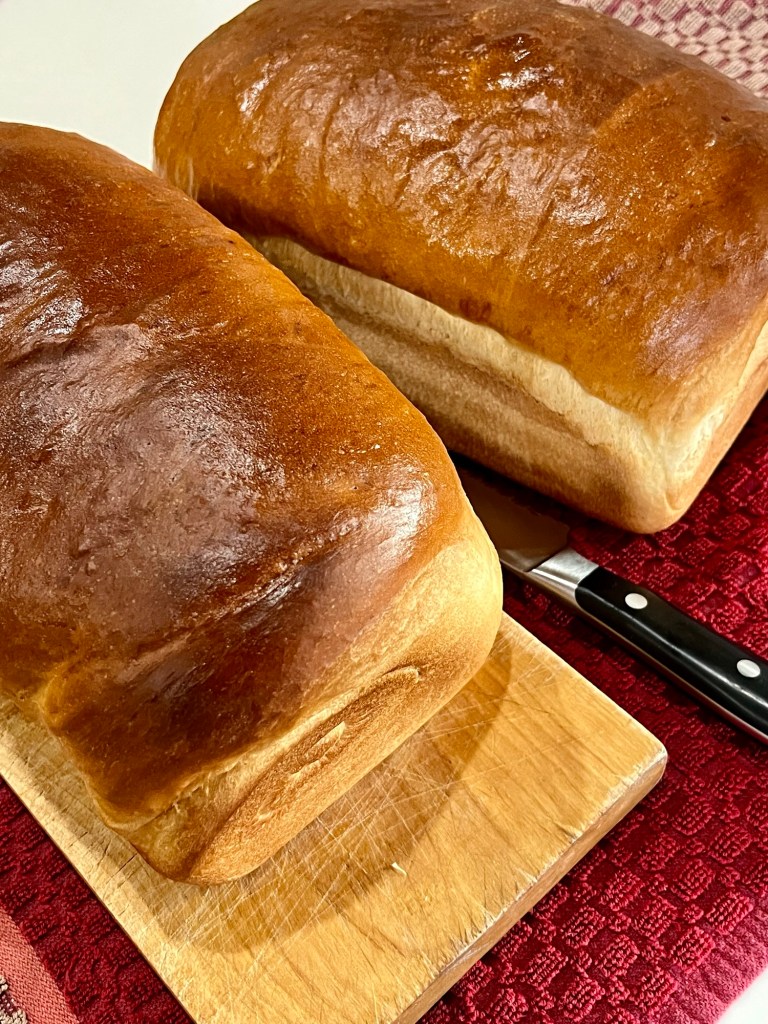
It’s been a while since I made any basic, traditional sandwich bread, but that ended this afternoon.

At 3:30 we decided to have BLT’s for dinner, except we didn’t have any bread. In her infinite wisdom QC said, “It’s only 3:30. Can’t you make bread before dinner?” Usually I start baking around 6am, but in a crisis I can be flexible.

We bought some “B” at the market this noon, and had one “T” left over from our favorite roast beef wraps. (Flour tortillas, mayo, lettuce, tomato, roast beef and in QC’s case, cheese and in mine pickled jalapeños.) My garden lettuce is starting to bolt and grew very tall over the last week, so it needs to be eaten right away, hence the “L” in our sandwich. (I gave “stalks” of lettuce to the QC Cadre.) The head lettuce has another week or two.

I used to make this bread as my standard, until I found the artisan breads that have nicer crust and crumb.

Bread – White Gold Medal Recipe

INGREDIENTS
2 Loaves
Bread flour • 6 to 7 cups
Sugar • 3 Tbl
Salt • 1 Tbl
Shortening • 2 Tbl
Yeast • 4 ½ Tsp
Warm water • 2 ¼ cups (120° to 130°F)

METHOD

  1. In large bowl, stir ½ of the flour, the sugar, salt, shortening and yeast until well mixed. Add warm water. Beat with electric mixer on low speed 1 minute, scraping bowl frequently. Beat on medium speed 1 minute, scraping bowl frequently. Stir in enough remaining flour, 1 cup at a time, to make dough easy to handle.
  2. Place dough on lightly floured surface. Knead about 10 minutes or until dough is smooth and springy. Grease large bowl with shortening. Place dough in bowl, turning dough to grease all sides. Cover bowl loosely with plastic wrap and let rise in warm place 30 to 40 minutes or until dough has doubled in size. Dough is ready if indentation remains when touched.
  3. Grease bottoms and sides of 8×4-inch or 9×5-inch loaf pans with shortening or spray with cooking spray.
  4. Gently push fist into dough to deflate. Divide dough in half. Flatten each half with hands or rolling pin into 18×9-inch rectangle on lightly floured surface.
  5. Roll dough up tightly, beginning at 9-inch side. Press with thumbs to seal after each turn. Pinch edge of dough into roll to seal. Pinch each end of roll to seal. Fold ends under loaf.
  6. Place seam side down in pan. Brush loaves lightly with butter. Cover loosely with plastic wrap and let rise in warm place 20 to 30 minutes or until dough has doubled in size.
  7. Move oven rack to low position so that tops of pans will be in center of oven. Heat oven to 425°F.
  8. Bake 20 to 30 minutes or until loaves are deep golden brown and sound hollow when tapped and internal temperature is 195 deg. (Tent the bread with aluminum foil if the brown too soon.) Remove from pans to wire rack. Brush loaves with butter; cool.

New Bread Recipe to Try Today

If you know, or follow me, you know I am always looking for new recipes, even if I already use a great one. Case in point is the No-Knead Artisan Bread I found a PreppyKitchen.com. It’s wonderful bread with a nice crunchy crust and soft, chewy interior and excellent flavor. Plus it is easy to make, uses few dishes and only takes a couple of hours. However, I do often find alternate recipes and occasionally give one a try. Hence, today’s experiment.

I found a recipe called “Homemade 25 Minute Bread” and made a loaf exactly following the instructions (even though I knew they were wrong.) At this point I am an experienced bread baker and am comfortable with my abilities to distinguish what will work and what will not, but you never know. I bake to learn.

I modified the published recipe, and for expediency used a stand mixer rather than kneading by hand. I enjoy hand kneading, (when I have the time,) but I was making 2 sequential loaves this morning, before I made a batch of rough puff pastry, and watched the RBC Heritage Golf Championship.

The basic difference in the two breads involves handling the dough. The original specified a 5 minute hand knead until the dough was “smooth and elastic.” I increased the kneading time to 8 minutes so it would just about pass the windowpane test. It also only had a 10 minutes “rise” rather than a full “normal” proof, which was 45 minutes at ~90°F. It also did not suggest a lame or sharp knife slash. This gives the dough someplace to expand rather than burst through the sides of the loaf during baking.

The published recipe resulted in a very dense, not very pleasant loaf. ( I see French toast in my future.) The altered recipe was much lighter. While the crumb was very similar it was light and soft with a good crust. The final result is, back to PreppyKitchen!

I renamed the recipe “Homemade 45-Minute Bread – Dede’s Version. It’s slightly more accurate. (The time does not include proofing time.)

Homemade 25-Minute Bread

INGREDIENTS :
• 360g 3 cups all-purpose flour
• 15g 1 tablespoon sugar
• 15g 1 tablespoon salt
• 11g 1 tablespoon instant yeast
• 236g 1 cup warm water (110°F)
• 23g 2 tablespoons olive oil

METHOD

  1. In a large mixing bowl, combine the flour, sugar, salt, and instant yeast. Mix well.
  2. Add the warm water and olive oil to the dry ingredients. Stir until a dough forms.
  3. Knead the dough on a floured surface for about 5 minutes until smooth and elastic.
  4. Preheat your oven to 425°F.
  5. Shape the dough into a ball and place it in a lightly greased bowl. Cover with a clean towel and let it rise for 10 minutes.
  6. After the dough has rested, punch it down and shape it into a loaf or divide it into smaller rolls.
  7. Place the shaped dough onto a baking sheet lined with parchment paper.
  8. Bake for 15-20 minutes or until the bread is golden brown and sounds hollow when tapped on the bottom.
  9. Allow to cool slightly before slicing and serving.

Homemade 45-Minute Bread – Dede’s Version

INGREDIENTS :
• 360g 3 cups all-purpose flour – Divided
• 15g 1 tablespoon sugar
• 15g 1 tablespoon salt
• 11g 1 tablespoon instant yeast
• 236g 1 cup warm water (110°F)
• 23g 2 tablespoons olive oil

METHOD

  1. In a stand mixer bowl, combine the flour (less 4 Tbl) , sugar, salt, and instant yeast. Whisk well.
  2. Add the warm water and olive oil to the dry ingredients. Stir with a dough hook until a dough forms.
  3. Knead the dough for about 10 minutes until smooth and elastic. The dough is very sticky. Add the reserved flour one tablespoon at a time until the sides of he bowl begin to clean.
  4. Shape the dough into a ball and place it in a lightly greased bowl. Cover with a clean towel and let it rise for 45 minutes. The dough weighs ~684g at this point
  5. Preheat your oven to 425°F.
  6. After the dough has rested, punch it down and shape it into a loaf or divide it into smaller rolls.
  7. Place the shaped dough onto a baking sheet lined with parchment paper.
  8. Slash with a lame or knife
  9. Bake for 15-20 minutes or until the internal temperature is ~195⁰F and bread is golden brown and sounds hollow when tapped on the bottom.
  10. Allow to cool slightly before slicing and serving.

Seven-Strand Plaited Wreath

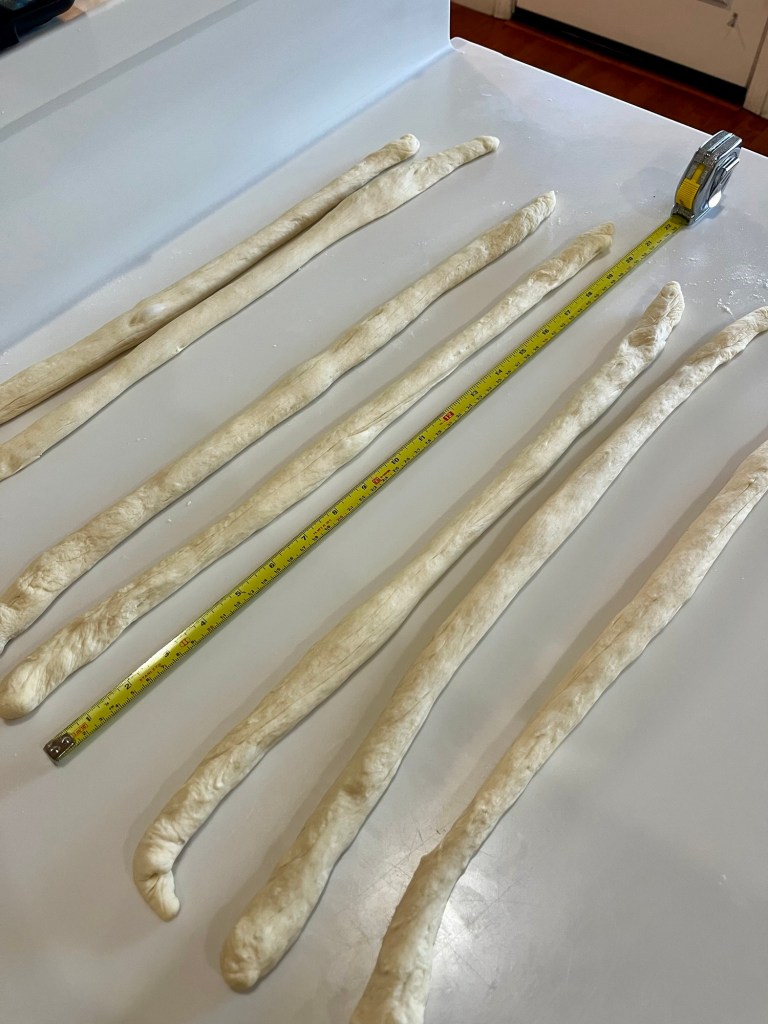
Mostly I followed Paul Hollywood’s recipe. I wanted a larger wreath so I extended each strand by a few inches. I plan to add some Easter eggs to the center for our brunch next Sunday. Hopefully there is room enough for an egg for each kids in attendance.

Paul Hollywood’s Seven-Strand Plaited Wreath

INGREDIENTS
• 500g bread flour
• 7g fast-action dried yeast
• 10g fine salt
• 340ml of water
• 1½ tbsp olive oil, plus extra for greasing
• 1 egg, lightly beaten with a pinch of salt

METHOD

  1. Make the dough. Place the flour in a large mixing bowl. Add the yeast and salt, and stir to mix.
  2. Pour three-quarters (225ml) of the water into the flour mixture. Add the olive oil and mix by hand until combined, then mix in the rest of the water to form a dough.
  3. Turn out the dough onto a lightly floured work surface and knead by hand for about 10 minutes, until the dough looks silky and stretchy. Place the dough in a lightly oiled mixing bowl. Cover with a tea towel and leave to rise for about 45 minutes, until doubled in size.
  4. Turn out the dough onto a lightly floured work surface again and knead it to knock it back. Shape the dough into a ball. It should weigh ~930 g. Divide the ball into 7 equal pieces, (~133g each) then roll each piece into a strand about 80cm long.
  5. Make the plait. Lay out the strands on a lightly floured work surface like an octopus, with the legs fanned out from a central, top point, stretching towards you. Stick all the ends at the central point to the work surface with your thumb. Take the outside strand on the right and cross it over 3 strands towards the middle while gently stretching it, then take the outside strand on the left and cross it over 3 strands towards the middle. Stretching the strands makes a slightly tighter braid.
  6. Repeat this process, always taking the outside strand (first on the right and then on the left) and crossing it over 3 strands into the middle until you have plaited all of the strands.
  7. Shape the plait. Trim each end of the plait to neaten, then form the plait into a wreath, pinching the ends together to join them and tucking the join underneath to give a neat finish. Trim enough off so the join is about the same diameter as the rest of the plait. Optionally put a small oven safe bowl in the center of the wreath to maintain the size and shape. As a treat roll the end trimmings into a ball and bake on the same sheet as the wreath. Don’t forget to egg wash it.
  8. Place on the parchment paper lined baking tray, then into a proving bag and leave the shaped loaf to prove for 45 minutes, until almost doubled in size.
  9. Heat the oven to 425°F. Brush the top of the loaf with the beaten egg and bake for 25 minutes, until golden brown, and the loaf sounds hollow when tapped underneath.

We Have A Winner, Winner, Chicken Dinner

Sorry, no chicken or dinner here,

FB posted this Rustic No Knead Rosemary Garlic Bread by Jacques Pepin. I made a few changes to the method (as if I know more than M. Pepin.)

I followed the ingredients as published and the bread was fantastic, but next time I will increase the amount of garlic. All changes have been incorporated in the recipe below.

I did a stretch and fold before shaping the loaf, This is a 100% hydration bread and has little structure before baking, i.e it is very soft, wet, and hard to handle.. There was no reference to scoring the bread, but on reviewing the published photo realized it was scored with large cross cuts. (Next time, which will be very soon.)

My baking time was also much longer (nearly double) what was published. My modifications are incorporated below.)

Rustic No Knead Rosemary Garlic Bread – Jacques Pepin

INGREDIENTS
• 360g (3 c) AP flour
• 1 tsp salt
• 1 tsp active dry yeast
• 355g(1 ½ c) warm water (about 105-115⁰ F)
• 5 cloves garlic, minced
• 2 Tbl olive oil
• 1 Tbl chopped fresh rosemary
• ¼ c grated Parmesan cheese

METHOD

  1. In a large bowl, whisk together the flour, salt, and yeast.
  2. Add the warm water, minced garlic, and olive oil to the flour mixture. Stir with a wooden spoon until a shaggy dough forms.
  3. Cover the bowl with plastic wrap and let the dough rest at room temperature for 12-18 hours.
  4. Preheat oven and prepare dough: Preheat oven to 450⁰ F .
  5. Sprinkle a light coating of flour around the edge of the bread and use your fingers to lightly tuck the flour into the edge of the dough. With floured fingers (you may need to re-flour your fingers after each time you touch the bread) stretch and fold the bread, turning 90⁰ and repeat a total of 10-12 stretch and folds to make the dough firmer and easier to handle. Turn the dough out onto a lightly floured surface and gently shape it into a loaf.
  6. Lightly oil a 10-inch cast iron skillet or coat with nonstick spray, sprinkle with cornmeal. Score a large cross in the bread with a lame or sharp knife.
  7. Place the loaf in the skillet for 30-40 minutes, checking the internal temperature every 5 minutes after the first 20, or until golden brown and cooked through.
  8. While the bread is still warm, brush with melted butter and sprinkle with chopped rosemary and Parmesan cheese.
  9. Let the bread cool slightly before slicing and serving. Try this with an oil and vinegar dip.

You Can Take The Boy Out Of Vermont…

I saw this recipe on FB and was, of course, compelled to make a loaf.

It’s a pretty easy bake and results in a very nice tasting bread with a good whole wheat crumb and texture. Next time will double the amount of maple syrup (costly, but worth it) or add the maple sugar to the top (I didn’t have any.)

Vermont Maple Oatmeal Bread


INGREDIENTS
• 1 ¼ cups boiling water
• 1 cup rolled oats
• ¼ cup (78g) maple syrup or ½ cup maple sugar
• 1 tablespoon unsalted butter
• 1 ½ teaspoons salt
• ½ teaspoon cinnamon
• ½ teaspoon maple flavor optional
• 2 teaspoons instant yeast
• 1 cup whole wheat flour
• 2 cups all-purpose flour
METHOD

  1. In a large mixing bowl, combine boiling water, oats, maple syrup (or maple sugar), butter, salt, cinnamon, and maple flavor if using. Stir and let cool to lukewarm.
  2. Once cooled, add yeast, whole wheat flour, and all-purpose flour. Stir until a rough dough forms.
  3. Knead the dough until smooth and elastic, about 10 minutes by hand or 7 minutes with a machine.
  4. Transfer to a lightly greased bowl, cover, and let rise for 60 to 90 minutes until puffy and nearly doubled in size.
  5. Gently deflate the dough and shape it into an 8-inch log. Place in a lightly greased 8 ½” x 4 ½” loaf pan.
  6. Cover and let the loaf rise until it crowns about 1 inch over the rim of the pan, about 60 to 90 minutes.
  7. Preheat the oven to 350°F (175°C).
  8. If desired, brush the top with water and sprinkle with maple sugar. Bake for 35 to 40 minutes, tenting with foil after 15 minutes to prevent over-browning. The interior should reach 190°F (88°C).
  9. Remove from the oven, let cool in the pan for 5 minutes, then transfer to a wire rack to cool completely before slicing.
    NOTES
  10. For a more pronounced maple flavor, increase the maple syrup slightly and reduce the water accordingly.
  11. This bread is excellent toasted with butter or cream cheese. – Store in an airtight container at room temperature for up to three days or freeze for longer storage.

Recovering From a Disaster

Not often, but on rare occasion I have a baking disaster. Yesterday I wanted blueberry muffins and unfortunately used an old recipe. Apparently, there was a major error in the recipe as after two attempts I binned the results (along with the recipe) and headed to my go-to baker, Sally McKenny. (“Binned” is a term from GBBO where whatever didn’t work is tossed in the trash.)

I wisely turned to Sally’s blueberry muffin recipe and they were overwhelmingly endorsed by the QC Cadre. (For any who do not know, the QC Cadre is composed of a number of my neighbors who volunteered to sample and review my bakes.)

If you can ignore the dropped berry scones and artisan no-knead rolls in the background, here are the blueberry muffins. I cannot recommend them strongly enough.

Scottish Oatcakes and Tangzong Artisan Bread

I wasn’t going to mention the artisan bread (as seen in the background) I made this morning, but I added a twist to the recipe. I use the Tangzong technique fairly often, but hadn’t used it on artisan bread. The standard method yields a bread that is 9.5 out of 10, so what is the point?

Tangzong pre-gelatinizes the starch in the flour, allowing it to absorb twice as much water than with cool water. Since there’s less free (unabsorbed) water in the dough, it’s less sticky and easier to knead plus it stays fresh longer, not that that is an issue here, over the past 2 weeks I made the artisan loaf every 2 or 3 days. For variety I did occasionally change from boule to batard.

I also made Scottish Oatcakes this morning. I read an article about them, which is all it ever takes for me. The bake resulted in 16 crisp “biscuits” (as cookies are called in the UK.) They be a nice change from all the cookies (but don’t worry, plenty of cookies coming up. I am doing another fund raiser in March and need to practice, practice, practice.)

Artisan Bread with Tangzong

INGREDIENTS

  • 450g (3 ¾ c) bread flour divided (For Italian Bread use AP flour))
  • 2 ¼ teaspoons instant yeast
  • 10g (1 ¾ tsp) kosher salt 
  • 360g (1 ½ c) warm water between 120°F and 130°F (360 grams)

METHOD

  1. In a large mixing bowl, whisk flour, yeast, and salt to combine.  Measure water into a small bowl
  2. Tangzong: Transfer 3 tablespoons of the measured flour and ½ cup of the measured milk or water into a saucepan and set over medium-high heat.
  3. Cook the mixture, whisking constantly until it thickens into a thick slurry (~1 minute.)
  4. Transfer the cooked mixture to a bowl until cool to lukewarm, then add remaining flour, milk (or water), and other dough ingredients combine with a dutch dough which until the mixture is very sticky, and no lumps of flour remain.
    1. Cover and place in a proofing oven until doubled in size, about 1 to 1 ½ hours.
  5. Preheat the oven to 450°F. Place a large dutch oven with a lid in the oven for at least 30 minutes.
  6. Using lightly floured hands, reach down one side of the dough to the bottom of the bowl, pull up, and stretch the edge of the dough over the center toward the opposite side. Turn the bowl 90 degrees and repeat the folding and turning, working in a circle around the dough until the dough starts to hold its shape, about 8 to 10 rotations. Pinch any seams together at the center of the dough ball.
  7. Turn out the dough onto a lightly floured surface, placing it seam side down. Shape into a boule or batard, depending on the intended use. Transfer the dough onto parchment paper lined banneton and sprinkle with flour. Loosely cover with plastic wrap or a tea towel for 10 minutes while the oven heats to 450°F. Place a large dutch oven with a lid in the oven while it preheats.
  8. Using a sharp knife or bread lame, cut a slit about ¼-inch deep across the top of the dough. Very carefully place the dough with the parchment paper directly into the preheated Dutch oven. Cover with the lid.
  9. Bake for 20 minutes. Remove the lid and bake until deeply golden brown and the internal temperature is about 195°F (~15 to 17 minutes more.) Carefully remove the bread from the Dutch oven using the parchment paper to help, and place on a wire rack to cool for at least 20 minutes before slicing

 

Tangzong

Tangzong pre-gelatinizes the starch in the flour, allowing it to absorb twice as much water than with cool water. Since there’s less free (unabsorbed) water in the dough, it’s less sticky and easier to knead

METHOD

  1. Measure out the total amount of flour and milk specified in the recipe.
  2. Transfer 3 tablespoons of the measured flour and ½ cup of the measured milk or water into a saucepan and set over medium-high heat.
  3. Cook the mixture, whisking constantly until it thickens into a thick slurry (~1 minute.)
  4. Transfer the cooked mixture to a bowl until cool to lukewarm, then add remaining flour, milk (or water), and other dough ingredients and proceed with the original recipe method.

Scottish Oatcakes

INGREDIENTS
• 226g quick-cooking oats (2 ½ c)
• 1 tsp kosher salt
• ¼ tsp baking soda
• 66g (6 Tbl) melted clarified butter
• ¾ c hot water, around 200ºF (93ºC)

METHOD

  1. In a medium bowl, stir oats, salt, and baking soda to combine. Add melted clarified butter or ghee to oat mixture and, using a flexible spatula, toss to evenly coat oats with fat. Add hot water and stir until mixture begins to thicken, 30 – 60 seconds. Let sit until oat mixture has hydrated and is slightly sticky, about 5 minutes.
  2. Using a flexible spatula, scrape oat mixture onto a 18×13” piece of parchment. Top with another 18×13” piece of parchment so oat mixture is sandwiched between and, using a rolling pin, roll oat mixture to ¼ “thick. Grab both ends of the parchment, set onto a 18×13” rimmed baking sheet, and freeze until mixture is firm but pliable, about 30 minutes. Line two 18×13” rimmed baking sheet with parchment; set aside.
  3. While the mixture is chilling adjust oven racks to second-from-top and second-from bottom positions and preheat to 350ºF (175ºC). 350ºF or 325ºF convection
  4. Set a clean piece of parchment on your kitchen counter. Remove oatcake mixture from freezer. Peel off top layer of parchment, then invert oatcake mixture onto prepared sheet of parchment. Using a 3-inch round cookie cutter, cut out 16 oatcakes. (Scraps can be rerolled, frozen, and punched out into additional oatcakes.) Transfer oatcakes to prepared baking sheets, spacing them about 1 inch apart, and bake until crispy and lightly browned, 30 to 35 minutes. Remove from oven and let cool completely before serving or storing.

Clarified Butter

INGREDIENTS
• 230g (2 sticks) unsalted butter, cubed

METHOD

  1. In a small saucepan, melt butter over medium-high heat.
  2. Continue to cook over medium-high heat; an even layer of white milk proteins will float to the surface.
  3. Bring to a boil; the milk proteins will become foamy.
  4. Lower heat to medium and continue to gently boil; the milk proteins will break apart.
  5. As butter gently boils, milk proteins will eventually sink to the bottom of the pot, and the boiling will begin to calm and then cease. Adjust heat as needed to continue boiling off water without scorching milk solids.
  6. Once boiling has stopped, pour butter through a cheesecloth-lined strainer or through a coffee filter into a heatproof container to remove browned milk solids.
  7. Let cool, then transfer to a sealed container and refrigerate until ready to use. Clarified butter should keep at least 6 months in the refrigerator.


No-Knead Honey Oat Bread

Well, Sally did it again. I subscribe to the sallysbakingaddiction.com mailing list. Along with its featured content it contains links to other enticing bakes and I found one yesterday. First of all “no-knead” always catches my attention. It requires much less hands on action. “Oat” is a second tick in the box as I bought oats at Costco a couple of weeks ago and have lots and lots and lots to use. And finally, “honey” is my go-to sweetener. Plus, the smallest amount Costco sells is three jars!

This is a 92% hydration bread (360g water::390g flour) so do not expect it to behave like the way a 65% hydration bread will. The dough is so soft the lame (or knife) tears it, rather than cuts. You cannot tension the surface as you can with lower hydration bread, but I found freezing it for 30 minutes before baking then slashing helped.

All that being said, this is a delicious honey oat bread. (I am eating a QC test slice right now.) The hint-o-cinnamon sets it off perfectly. (To confirm the evaluation, I had to have a second slice.)

No-Knead Honey Oat Bread

https://sallysbakingaddiction.com/no-knead-homemade-honey-oat-bread/print/76423/
(Modified for my use.)

INGREDIENTS
• 390g (3 c) bread flour
• 85g (1 c) old-fashioned whole oats
• 1½ tsp Platinum Yeast from Red Star or any instant or active dry yeast
• 1½ tsp salt
• ½ tsp ground cinnamon
• 360g (1 ½ c water, close to room temperature at about 70°F (21°C)
• 128g (6 Tbl) honey
• 25g (30ml or 2 Tbl) vegetable oil (or other neutral tasting oil)

METHOD

  1. The evening before baking: In a large ungreased bowl, whisk 3 cups (390g) bread flour, the oats, yeast, salt, and cinnamon together. Set aside. In a medium bowl or large liquid measuring cup, whisk the water, honey, and oil together. Pour water mixture into flour mixture and gently stir together with a dutch dough whisk, silicone spatula or wooden spoon to combine. Dough will be heavy and very wet/sticky. Do not overwork dough.
  2. 1st rise: Cover the dough tightly with plastic wrap or aluminum foil and set on the counter at room temperature for 12-18 hours. (See note if you need to extend this time.) You want it to almost double in size during this time.
  3. Gently shape: Turn the dough out onto a lightly floured work surface and, using lightly floured hands, shape into a ball as best you can. Transfer dough to a large piece of parchment paper. Lift the parchment paper and dough up and place it all into a banneton (oval or round depending on the shape of your dutch oven.) Using a very sharp knife or bread lame, gently score an X into the top. Cover dough lightly with plastic wrap and leave alone for 30 minutes. (The dough is very slack, typical of a 90+% hydration bread. To firm the surface of the dough I put it, still in the banneton, into the freezer for 30 minutes, then slashed it.
  4. Bake: Heat the oven, with dutch oven and lid inside, to 425°F (218°C) for 30 minutes. After 30 minutes place the dough inside the dutch oven by lifting it up with the parchment paper and sticking it all–the parchment paper included–inside the pot.
  5. Cover with the lid. Bake for 30 minutes with the lid on. Carefully remove the lid and continue baking for 10-12 more minutes or until the bread is golden brown. The bread is done when an instant read thermometer reads the center of the loaf as 195°F (90°C).
  6. Remove dutch oven from the oven, carefully remove the bread, and allow to cool on the counter for 30 minutes before breaking/slicing/serving.
  7. Cover leftover bread and store at room temperature for up to 3 days or in the refrigerator for up to 10 days.

NOTES

  1. Make Ahead Instructions: This recipe is wonderful for making ahead because the 1st rise time (step 2) is so long. If needed, you can extend the 1st rise time by letting the dough rest in the refrigerator instead of at room temperature for up to 18 hours. Then, after refrigerating, let the dough sit at room temperature to warm and rise, about 4-6 hours. You want it to mostly double in size during this time. Do not extend these times further because the dough may begin to deflate.
  2. Freezing Instructions: Prepare recipe through step 4 and feel free to use a disposable loaf pan since it will be going into the freezer. Cover loaf tightly and freeze for up to 3 months. On the day you serve it, let the loaf thaw and rise for about 5 hours at room temperature. Bake as directed. You can also freeze the baked bread loaf. Allow the bread to cool completely and then freeze for up to 3 months. Thaw in the refrigerator or at room temperature and reheat if/as desired.
  3. If You Want to Top with Oats or Cinnamon-Sugar: If you want to top the dough with oats prior to baking, carefully brush the dough after the 2nd rise (step 5) with 1 egg white beaten with 1 Tbsp water, and then sprinkle 2 Tbsp of oats on top. (The oats do not stick without the egg white and the bread will no longer be egg-free by doing this.) You can skip the egg white/oats and sprinkle cinnamon-sugar on top instead. Combine 1 Tablespoon granulated sugar and 1/8 teaspoon cinnamon. Sprinkle on top of the loaf right before baking.

Whole Wheat Bread – Sally

Sally, owner and author of Sallysbakingaddiction.com, writes her blog to teach newbies and help oldies with their baking. I usually modify her recipes for my own personal, selfish use. For more details and tips and tricks refer to Sally and not me.

This is a beautiful bread with chewy crust and soft tender interior. I did use 50:50 whole wheat and bread flours in the sponge.

Whole Wheat Bread – Sally

INGREDIENTS
Sponge
• 1 cup (240ml) water, warmed to about 110°F (43°C)
• ⅓ cup (80ml) whole milk, warmed to about 110°F (43°C)
• 2 ¼ teaspoons (7g) active dry or instant yeast
• 2 cups (260g) whole wheat flour
• Optional: 130g (1 c) whole wheat flour and 130g (1 c) bread flour
Dough
• 3 Tablespoons (63g) honey
• 3 Tablespoons (43g) RT unsalted butter,
• 1 teaspoon fresh lemon juice (or apple cider vinegar)
• 1 ⅓ cups (173g) whole wheat flour (plus more as needed
• 1 and 1/4 teaspoons salt
• optional oat topping: 1 beaten egg white + 1 Tablespoon whole oats

METHOD

  1. Prepare the sponge: In a large bowl or the bowl of your stand mixer, whisk the water, whole milk, and yeast together. Add the 2 cups (260g) flour and stir with a spatula or wooden spoon until a thick batter forms. Cover lightly and allow to double in size at room temperature, about 60–90 minutes. Sometimes this can take up to 2 hours.
  2. Add the remaining dough ingredients including the honey, butter, lemon juice, remaining flour, and the salt. With a dough hook attachment or using a spatula or wooden spoon (and some arm muscle!), beat on medium speed/mix until the dough comes together and pulls away from the sides of the bowl, about 3 minutes. If the dough seems too wet to a point where kneading (next step) would be impossible, beat in more flour 1 Tablespoon at a time until you have a workable dough. Dough should be soft and a little sticky, but still manageable to knead with lightly floured hands. It took 4 Tbl added a minute or so apart for the dough to clear the sides of the mixer bowl and knead properly.
  3. Knead the dough: Keep the dough in the mixer and beat for an additional 8–10 full minutes or knead by hand on a lightly floured surface for 8–10 full minutes. If the dough becomes too sticky during the kneading process, add 1 more Tablespoon of flour at a time to make a soft, slightly tacky dough. Do not add more flour than you need; you do not want a dry dough. After kneading, the dough should still feel a little soft. Poke it with your finger—if it slowly bounces back, your dough is ready to rise and/or do a “windowpane test” to see if your dough was adequately kneaded.
  4. 1st rise: Lightly grease a large bowl with oil or nonstick spray. Place the dough in the bowl, turning it to coat all sides in the oil. Cover the bowl and allow the dough to rise in a proofing oven or other warm environment for 1.5–2 hours or until about double in size.
  5. Grease a 9×5-inch loaf pan.
  6. Shape the dough: When the dough is ready, punch it down to release the air. Lightly flour a work surface, your hands, and a rolling pin. Roll the dough out into a large rectangle, about 8×15 inches. It does not have to be perfect—in fact, it will probably be rounded on the edges. That’s ok! Roll it into an 8-inch log and place in the prepared loaf pan, seam side down.
  7. 2nd rise: Cover shaped loaf. Allow to rise until it’s about 1 inch above the top of the loaf pan, about 45–60 minutes.
  8. Adjust oven rack to a lower position and preheat oven to 350°F (177°C). It’s best to bake the bread towards the bottom of the oven so the top doesn’t burn.
  9. Optional oat topping: If you want to add the optional oat topping, add it right before baking the bread. With a pastry brush, brush the risen loaf with egg white, then sprinkle the oats on top.
  10. Bake the bread: Bake for 36–40 minutes, or until golden brown on top. If you notice the top browning too quickly, loosely tent the pan with aluminum foil. (I usually add it around the 20-minute mark.) To test for doneness, if you gently tap on the loaf, it should sound hollow and the center of the loaf is 195–200°F (90–93°C). Remove from the oven and allow bread to cool for a few minutes in the pan on a cooling rack before removing the bread from the pan and slicing. Feel free to let it cool completely before slicing, too.
  11. Cover leftover bread tightly and store at room temperature for up to 1 week.

Notes

  1. Freezing Instructions: Prepare recipe through step 6. Place shaped loaf in a greased 9×5-inch loaf pan or disposable loaf pan, cover tightly, and freeze for up to 3 months. On the day you serve it, let the loaf thaw and rise for about 4–5 hours at room temperature. Bake as directed. You can also freeze the baked bread loaf. Allow the bread to cool completely, then freeze for up to 3 months. Thaw in the refrigerator or at room temperature, then reheat as desired.
  2. Overnight Instructions: Prepare the recipe through step 6. Cover the shaped loaf tightly and refrigerate for up to about 15 hours. At least 3 hours before you need the bread the next day, remove from the refrigerator, keep covered, and allow to rise on the counter for about 1–2 hours before baking. Alternatively, you can let the dough have its 1st rise in the refrigerator overnight. Prepare the dough through step 3, then cover the dough tightly and place in the refrigerator for up to 12 hours. Remove from the refrigerator and allow the dough to fully rise for 2 more hours. Continue with step