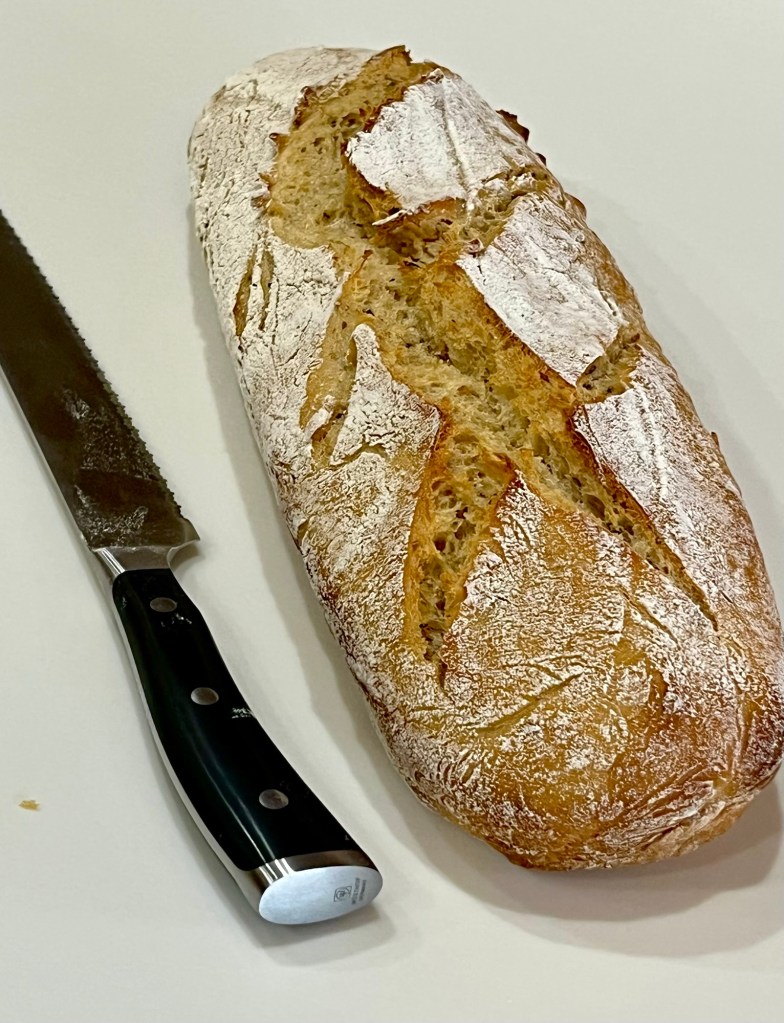
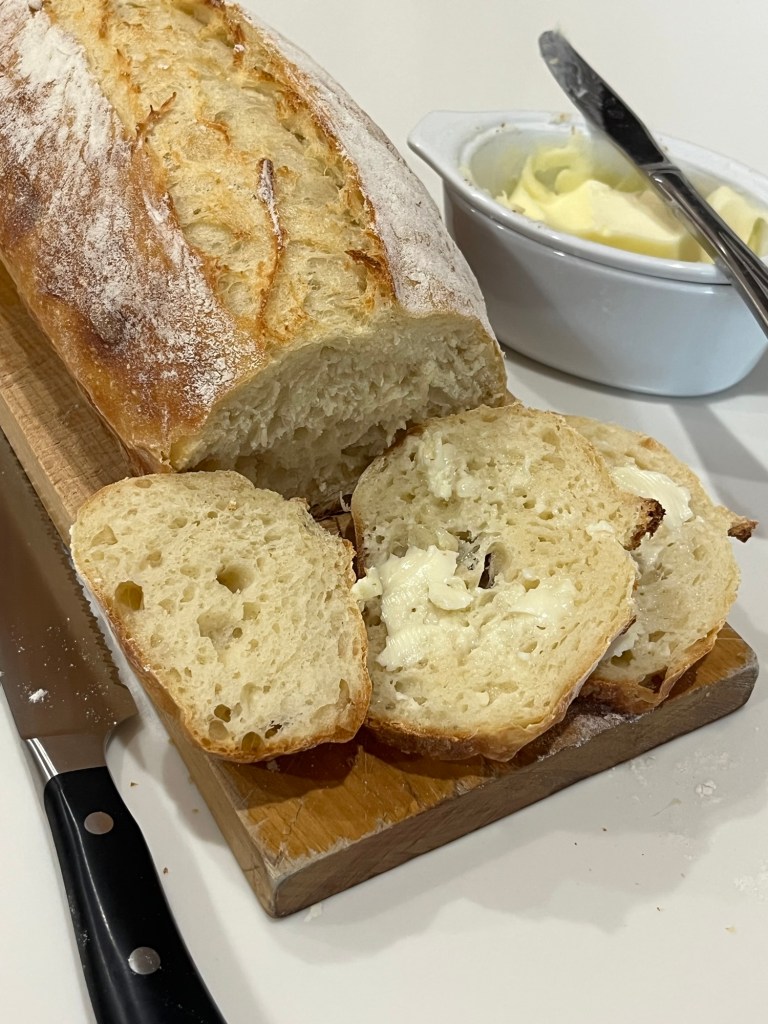
We love a good rye bread with soft, chewy interior and crisp, crunchy crust. If you do also, this breads for you.
It’s simple to make, it’s the first overnight rise that takes time. Combining the ingredients takes 15-20 minutes, then rise for 2 hours. Refrigerate overnight and the next day let it rise at room temperature for 2-3 hours, then bake for ~30 minutes.
Light Rye Bread – KAB
INGREDIENTS
• 340g (1 ½ c) lukewarm water • 280g (2 ⅓ c) bread flour • 163g (1 ½ c) light rye flour • 28g ( ¼ c) nonfat dry milk • 1 ½ tsp table salt • 1 ½ tsp instant yeast • 1 ½ tsp Deli Rye Flavor, optional • 25g (2 Tbl) vegetable oil • 1Tbl caraway seeds
METHOD
Place the water in the bowl of a stand mixer.
Combine the flours with the remaining ingredients with the warm water. Mix until there are no dry spots and all of the flour is moistened. The texture of the dough will be soft and sticky due to the pumpernickel flour.
Cover the bowl and let the dough rise at room temperature for 2 hours. Then refrigerate overnight, or for up to 48 hours.
Grease your hands, and scoop the dough out onto a lightly greased or floured work surface. Shape it into a ball or boule and place it, smooth side down, in a floured brotform. Let the dough rise, covered, for 2 to 3 hours.
About 45 minutes before the end of the rising time, preheat the oven to 450°F with an appropriate Dutch oven.
When the loaf is fully risen, remove the hot Dutch oven bottom from the oven, carefully grease it, and tip the risen ball of dough into it. Make several slashes in the dough. Cover with the lid, and place it on a middle rack in the oven.
Bake the bread for 25 minutes. Check the interior temperature with a digital thermometer. When fully baked it should register at least 195°F. If not, remove the lid and bake for an additional 5 to 10 minutes until the loaf should be lightly browned.
Remove the bread from the oven and turn it out of the crock onto a rack. Cool for several hours before slicing.
What do to with extra berries and heavy cream screaming to be used? Berry Drop Scones, of course. I made a recipe using the extra blueberries and being a raspberry-a-holic I made another recipe with some freshly acquired raspberries.
This is my go -to recipe for any variety of berry scones. (These are my favorites.) They are also great to freeze and when the urge hits, thaw on the top of a toaster.
Berry Drop Scones
INGREDIENTS
2 ½ cups (312g) all-purpose flour
1 tablespoon baking powder
3/4 teaspoon kosher salt
1/3 cup (67g) sugar
Zest of 1 small lemon (or orange or lime)
½ cup (115g) unsalted butter, chilled and cut into cubes
150-175g berries. Use any berries that you like.
1 cup heavy cream + extra if required
Coarse or turbinado sugar for topping
Makes about a dozen 3” scones
METHOD
Preheat oven to 400. Line a baking sheet with parchment paper.
In the bowl of a food processor, add the flour, baking powder, salt, sugar and zest. Pulse a few times to incorporate.
Add the cubed butter and pulse to incorporate. The mixture should resemble very coarse sand.
Empty the flour mixture into a mixing bowl. Add the cream and stir until just barely incorporated. Add additional cream by the tablespoon to help the dough come together
Gently fold in the berries. (It’s fine if the raspberries or blackberries break up a little – it adds a nice pink stain to the dough.) The dough should just be moist, not wet, but also not crumbly or powdery looking. If it looks too dry, add a tablespoon of cold water.
Spoon the dough into 12 equally sized pieces on the parchment lined baking sheet. Sprinkle some coarse or turbinado sugar over the top, if desired.
Bake for 16-19 minutes, rotating the pan halfway through. The scones should be lightly golden and cooked through. I rotate the pan after 10 minutes
Cool in the pan for 5-10 minutes then carefully remove to a cooling rack.
I had the occasion to provide some desserts for an event last week. I chose Sally’s apple hand pies with salted caramel and mini blueberry amuse-bouche cheesecakes. Both were delicious. The cheesecake is an amalgamation of several other bakes I previously made, so I think I can now safely say “adapted” from Sally’s.
Apple Hand Pie – Sally
INGREDIENTS • Homemade Pie Crust (makes 2 crusts, use both) • 300g (3 medium apples, 2 ½ c) peeled and diced into small bite-size pieces • 70g (⅓ c) granulated sugar • 28g (2 Tbl) unsalted butter • 1 tsp ground cinnamon • 1/4 tsp ground nutmeg • 1/4 tsp ground allspice • egg wash: 1 large egg beaten with 1 Tablespoon (15ml) milk • homemade salted caramel for topping
METHOD Preliminary note:
You can shape the hand pies whatever shape you want. I use a 3”round cookie cutter for the bottom crust and a 3 ½ “ for the top. The larger top crusts allows more filling for each pie.
The crust:
Prepare my pie crust recipe through step 5. The dough must chill for 2 hours in the refrigerator.
The filling:
Combine the diced apples, granulated sugar, butter, cinnamon, nutmeg, and allspice together in a medium saucepan or skillet over low-medium heat. While occasionally stirring, bring to a simmer. Allow to simmer for 2 minutes. Remove from heat and allow to cool uncovered at room temperature for 30 minutes.
Roll out the pie dough: On a lightly floured work surface, roll out one of the discs of chilled dough (keep the other one in the refrigerator). Turn the dough about a quarter turn after every few rolls. At any sign of sticking, sprinkle some flour underneath then keep rolling. Roll out until it’s about 1/8” thick. Using your cookie cutter, cut into circles and put the circles into the refrigerator. Form a ball with the scraps and roll out into a thin sheet and put into the refrigerator for 10 minutes. Then roll the chilled dough into a 1/8” thin sheet and cut into circles. Place cut circles in the refrigerator to keep cold. The colder the shaped dough, the easier it is to work with. Repeat with 2nd pie dough and refrigerate cut circles using the other size cookie cutter for at least 15 minutes before filling the hand pies.
Meanwhile, preheat oven to 375°F (191°Can ). Line two large baking sheets with parchment paper or silicone baking mats. Fill the hand pies:
Leaving the smaller, bottom crusts in the fridge and using a sharp knife, cut two parallel slits into the larger circles. These are the top crusts. (The slits act as vents to allow steam to escape as the hand pies bake.) Arrange the smaller circles about 3 inches apart on prepared baking sheets. These are the bottom crusts. Place about 2 tablespoons of filling in the center of each bottom crust. (Or however much fits while leaving the edges bare.) Paint the edge of the bottom crust with water then place top crust on top. Press your fingers all around the edges to seal, then crimp the pie crust edges with a fork. If the hand pies lost some shape, use your hands to form a round circle again. It’s OK if some filling juice is leaking out. Lightly brush the top of the pie crust with egg wash mixture. Sprinkle with coarse sugar, if desired.
At this point the hand pies can be baked, but if they don’t feel cool to touch anymore, freeze for 10 minutes before baking. The colder they are going into the oven, the better they’ll hold their shape.
Bake for about 28–32 minutes or until they’re golden brown on top and around the edges. Rotate pans halfway through baking. Remove from the oven and allow the hand pies to cool on the baking sheets for 5 minutes, then transfer to a wire rack to cool until ready to handle. You can serve warm or at room temperature. If desired, serve with a drizzle of warm salted caramel.
Cover leftovers and store in the refrigerator for up to 5 days. Notes
Make Ahead / Freezing Instructions: A couple ways to make ahead of time! a. The pie crust dough can be prepared ahead of time and stored in the refrigerator for up to 5 days or in the freezer for up to 3 months. Thaw in the refrigerator before using. b. Filling can also be prepared ahead of time. Cover tightly and store in the refrigerator for up to 2 days. Prepared filling can be frozen up to 3 months. Thaw in the refrigerator before using. c. Assembled and unbaked hand pies can be covered and refrigerated for up to 3 days or frozen for up to 3 months. If frozen, no need to thaw before baking; simply add an extra couple minutes of bake time. d. Baked hand pies can be frozen for up to 3 months. Thaw in the refrigerator, then bring to room temperature before serving.
Cheesecakes – Mini No-Bake
INGREDIENTS Graham Cracker Crust • 240 g (2 c) graham cracker crumbs (about 16 full sheet graham crackers) • 67 g (⅓ c) packed light or dark brown sugar • 113 g (½ c; 8 Tbl; 1 stick) unsalted butter, melted Filling • 240 (1 c) cold heavy cream or heavy whipping cream • 452 g (16 oz) RT full-fat brick cream cheese • 67 g (⅓ c) granulated sugar • 30 g (2 Tbl) RT sour cream • 1 tsp fresh lemon juice • ½ tsp pure vanilla extract optional: your desired toppings (see recipe Note)
METHOD Crust:
Line two standard 12-count mini muffin pans with cupcake liners. Make sure you have room in your refrigerator for three pans. (You refrigerate them in step 6.)
Use a food processor to pulse the graham crackers into fine crumbs. Pour crumbs into a medium bowl and stir in the brown sugar and melted butter until combined. Mixture will have the consistency of wet sand. Spoon tsp of the crust mixture into each cupcake liner and use the back of the spoon to pack it down tightly. (The bottom of the liner should have 1/8” of packed crust.)
Bake the crusts for 5 minutes in a 350°F (177°C) oven. The crusts are a little sturdier this way. Let the warm crusts cool for 10 minutes before adding the filling on top. Make Filling:
Place metal stand mixer bowl and whisk in freezer for 30 minutes before proceeding. Whip the cold heavy cream into stiff peaks on medium-high speed, about 2-3 minutes. Set aside.
Using a hand mixer or a stand mixer fitted with a whisk or paddle attachment, beat the cream cheese and granulated sugar together on medium speed until smooth and creamy. Scrape down the sides and up the bottom of the bowl with a silicone spatula as needed. Add the sour cream, lemon juice, and vanilla extract. Beat on medium-high speed until smooth and combined, about 1 minute. Make sure there are no large lumps of cream cheese. If there are lumps, keep beating until smooth.
With a silicone spatula, fold the whipped cream into the cheesecake filling until combined. This takes several turns of your rubber spatula. Combine slowly as you don’t want to deflate all the air in the whipped cream.
Use piping bag to transfer the filling on top of the crusts. Pipe about 2 Tablespoons of filling over each crust. Fit your piping bag with a large star or round piping tip, then transfer the filling to the bag and pipe. Use the back of a spoon to smooth the tops so they are flat.
Refrigerate the mini cheesecakes in the pans for at least 3 hours and up to 2 days. If refrigerating for longer than 3 hours, cover with plastic wrap.
Keep refrigerated until ready to serve. Serve with optional toppings (see recipe Note). The cheesecakes begin to soften and stick to the liners after about 30–60 minutes at room temperature.
Cover and store leftover mini cheesecakes in the refrigerator for up to 5 days. NOTES
Make Ahead & Freezing Instructions: The mini cheesecakes can be made 1-2 days in advance and refrigerated for up to 2 days before serving, as noted in step 6. Another way to prep these mini no-bake cheesecakes is to freeze them. Refrigerate them as directed in step 6, then remove them from the muffin pan (keep the liners on them) and line in a single layer in a large freezer-friendly container. Cover tightly and freeze for up to 3 months. Thaw in the refrigerator for at least 24 hours before serving.
Optional Toppings: Right before serving, you can add toppings to the mini cheesecakes. You can also add the following toppings after the cheesecakes have chilled in the refrigerator for just 1–2 hours (step 6), then store the topped cheesecakes in the refrigerator for the remaining time. Use 3/4 cup strawberry sauce divided over each chilled mini cheesecake. (Spoon about 1/2 Tablespoon over each.) And/or use 1 cup mixed berries, plus a few mint leaves, divided over each for additional garnish. Instead of strawberry sauce, try the same amount of lemon curd, apple butter, or your favorite fruit preserves. You can also top with chocolate ganache. I recommend spooning a little over each mini cheesecake before refrigerating so the ganache can set up too.
Lemon Juice: Lemon juice brightens up the flavor. This cheesecake does not taste like lemon. For lemon flavored mini no-bake cheesecakes, replace the sour cream with 2 Tablespoons fresh lemon juice (in addition to the 1 teaspoon lemon juice that it already calls for) and add 2 teaspoons lemon zest.
Room Temperature Ingredients: Bring the cream cheese and sour cream to room temperature before beginning. Room temperature ingredients guarantee a smooth cheesecake filling. Beating cold ingredients together will result in a chunky cheesecake filling. (The heavy cream, however, MUST be cold in order to whip into stiff peaks.)
Strawberry Sauce
INGREDIENTS • 1 Tablespoon cornstarch • 3 Tablespoons (45ml) warm water • 1 lb strawberries, hulled and sliced in half (you can use frozen; don’t thaw) • Zest and juice from 1/2 small lemon • 1/4 cup (50g) granulated sugar
METHOD
Whisk the cornstarch and water together until all the cornstarch has dissolved. (I just use a fork to mix—very easy.)
Place the cornstarch mixture, along with the rest of the ingredients, into a small saucepan over medium heat. Using a wooden spoon or rubber spatula, stir the mixture as it cooks. Break up some of the strawberries as you stir. For smoother sauce blend the strawberries in advance.
Bring it to a simmer and allow to simmer for 5 minutes, stirring constantly. After 5 minutes, remove pan from the heat and allow to cool. The mixture will thicken as it cools.
You can serve the sauce warm before it cools completely if desired, or store in the refrigerator for up to 1 week. Strawberry topping will be thick after refrigeration, so microwave for 15 seconds or warm on the stove to thin out, if desired.
Every time I make this no-knead artisan bread I confirm it is the best loaf I ever made, and this mornings bake is no exception. There are only 4 ingredients and they come together, including weighing, in 10 minutes, then an hour ferment, followed by a stretch and fold and shape for 10 minutes and baked for 20 minutes. (10 minutes with Dutch Oven cover on and ~10 more minutes uncovered to brown and create a great crust) until internal temperature is 190-200F.
There is nothing exciting about a simple chicken salad sandwich, unless the bread was fresh from the oven and the lettuce was picked in the backyard minutes before eating, then it is exciting and special.
The bread is my standard artisan boule. I planted the lettuce in early September and it’s ready for harvest. Gotta love it.
It’s been a while. I was on whatever retired people call an extended trip, when “vacation” seems wrong somehow. To me, vacation is an excused absence from work, even if you are self employed.
Anyway, it’s a new month and Sally has a new challenge. This month it is the above mentioned bread with savory fillings. This is my first attempt at a savory bread, but am a huge pizza fan.
I will admit I was skeptical about this bake. I thought “PIzza Bread” was a bit of a stretch, but, WOW, was I wrong. It is delicious and the texture is perfect AND it tastes like pizza. This is both and winner and keeper.
Vacation Photo (not part or the contest)Pizza BreadSliced Pizza Bread
Crusty No-Knead Pizza Bread with Hot Honey Butter – Sally
INGREDIENTS • 40g (3⅓ c) bread flour, plus more as needed for shaping and pan • 2 tsp instant or active dry yeast • 2 tsp Kosher salt • 1 tsp granulated sugar • 2 tsp dried oregano • 1 tsp dried basil • 1 ½ tsp garlic powder • ¼ tsp crushed red pepper flakes, optional • 135g (~1 heaping c) 43g chopped pepperoni+ 34g sun-dried tomatoes, and 52g + 52g olives + 2 Tbl grated jalapeños • 113 (1 c) shredded mozzarella cheese • 360g (1 ½ ) water, close to room temperature at about 70°F (21°C) Optional Hot Honey Butter • 113G ( ½ c; 8 Tbl) unsalted RT butter • 63g (3 Tbl) honey • 1 Tbl confectioners’ sugar • ⅛–¼ tsp flaky sea salt or coarse salt • pinch of crushed red pepper flakes, to taste
METHOD
In a large mixing bowl, whisk together the flour, yeast, salt, sugar, oregano, basil, garlic powder, and crushed red pepper (if using). Using a silicone spatula, mix in the chopped add-ins (pepperoni, sun-dried tomatoes, olives) and mozzarella cheese. Pour in the water and gently mix together using a Dutch whisk. Shape into a ball.
Cover the bowl tightly with plastic wrap or aluminum foil and set on the counter at room temperature. Allow to rise for 3 hours. The dough will just about double in size, stick to the sides of the bowl, and have a lot of air bubbles. Place the risen dough, still covered, in the refrigerator for at least 12 hours and up to 3 days. The dough will puff up during this time, but may begin to deflate after 2 days. That’s normal.
Turn the dough out onto a lightly floured work surface and, using generously floured hands, shape into a ball as best you can. It doesn’t have to be perfect. Transfer the dough to a large piece of parchment paper. (Large enough to fit inside your pot and one that is safe for high heat. Place the ball of dough with parchment paper, seam side down, inside a medium-size banneton so the dough doesn’t spread out as it rests. Cover and let it rest for 30 minutes.
During this rest, preheat the oven to 450°F (232°C). Place a 6-quart or larger Dutch oven (with the lid) or heavy-duty pot in the oven for 30 minutes so that it’s extremely hot before the dough is placed inside.
After 30 minutes, using a very sharp knife or bread lame (some even use kitchen shears), score the dough with an X, about 1/2 inch deep. Remove the Dutch oven from the oven and carefully place the scored dough inside by lifting it up with the parchment paper and placing it all—the parchment paper included—inside the pot. Cover with the lid.
Bake for 25 minutes with the lid on. Carefully remove the lid and continue baking for around 10–15 minutes more until the bread is golden brown. The bread is done when an instant-read thermometer reads the center of the loaf as 195°F (90°C).
Remove pot from the oven, carefully remove the bread from the pot, and allow to cool on a cooling rack for at least 20 minutes before slicing. Because of the heavy add-ins and cheese, this bread is flatter than most boules. But this just means a higher crust to interior ratio! Slice and serve with homemade hot honey butter, if desired.
Make the hot honey butter: In a large bowl using a handheld mixer or stand mixer fitted with a paddle attachment, beat the butter on medium speed until completely smooth and creamy, about 1 minute. Add the remaining ingredients, starting with only 1/8 teaspoon of salt and a small pinch of red pepper flakes. Beat on medium-high speed until completely smooth, about 1 minute. Scrape down the sides of the bowl with a silicone spatula and beat again as needed to combine. Taste. Add more salt and/or crushed red pepper flakes if desired.
Store leftovers loosely covered at room temperature for up to 3 days or in the refrigerator for up to 1 week. Tightly cover leftover hot honey butter and store at room temperature for up to 2 days or in the refrigerator for up to 2–3 months.
It’s a challenge to find a granola bar that doesn’t melt when golfing in the summer where the temperature can be over 100 degrees
I made these peanut butter granola bars with rolled oats, honey, peanut butter and eggs. While it hasn’t been over 98 this month these bars held up.
Predominantly peanut butter flavor I added raisins and the bars held up to the heat.
Peanut Butter Granola Bars
INGREDIENTS • 3 cups old-fashioned rolled oats • 3/4 cup peanut butter • 1/3 cup honey or maple syrup • 1/2 cup mini chocolate chips (optional) • 2 whole eggs • Optional add-ins: pinch of salt (omit if peanut butter is salted), walnuts, pecans, almonds, chia, sunflower, or pumpkin seeds, or dried fruit
METHOD
Preheat oven to 350℉.
In a large bowl, combine all ingredients and mix well. *If your peanut butter is solid at room temperature, heat it for 10-15 seconds to make it a more drizzly consistency before adding to the mix.
Line a 9×9 inch baking dish or pan with parchment paper. This makes it much easier to remove the bars from your dish once baked.
Transfer the mixture to the prepared dish or pan. Very firmly press the mixture into the pan in an even layer — the firmer you press, the better the bars will stick together. If you’re using chocolate chips, sprinkle them on top, then press them down into the bars.
Bake for 15-17 minutes or until the center is baked through and the edges are just starting to brown. Start checking at 14 minutes, as all ovens are different.
Remove from the oven and place pan on a cooling rack.
Let the bars cool completely (this is important) before cutting into 16 squares with a sharp knife
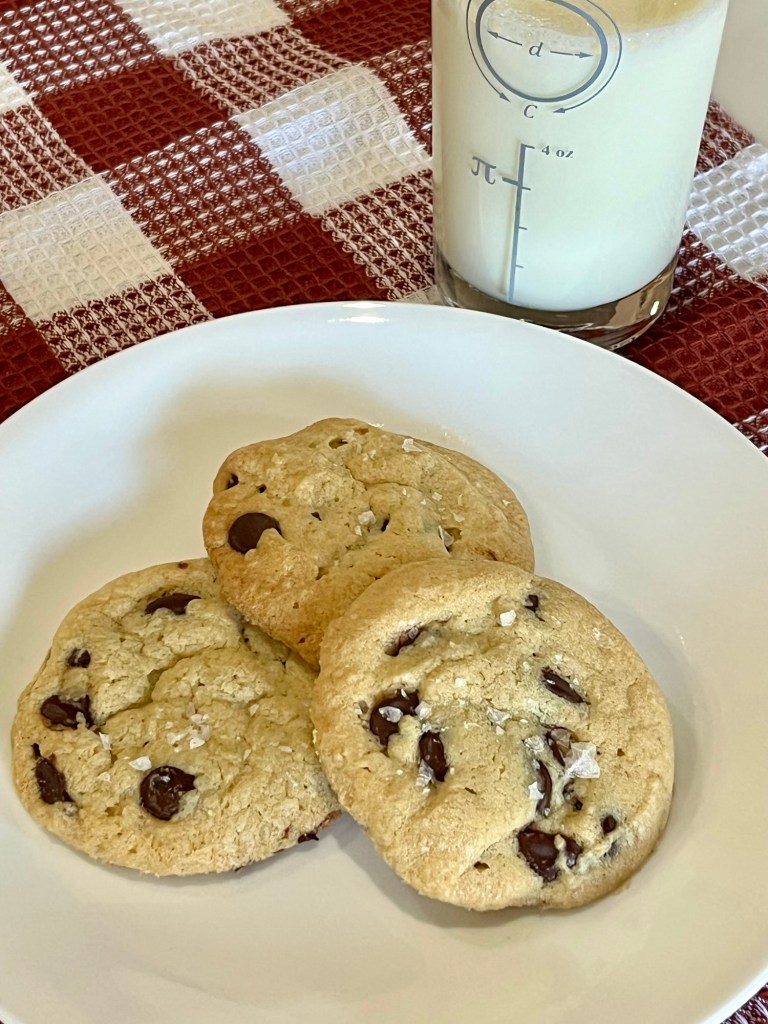
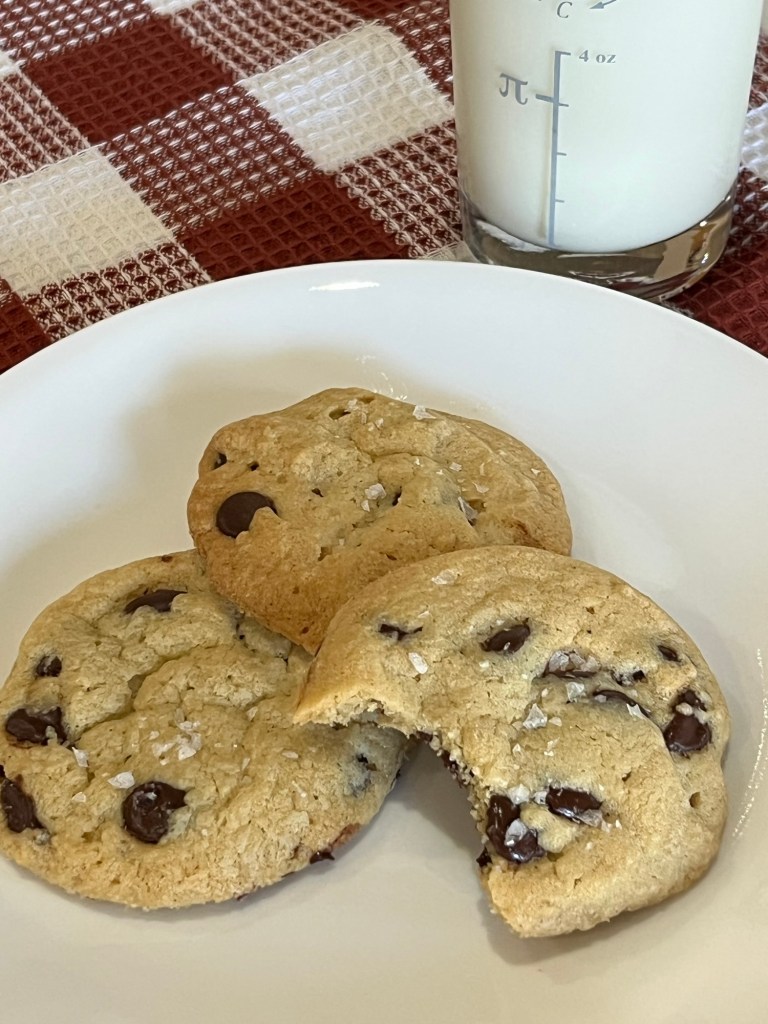
Wanting to try something different than my standard chocolate chip cookie, I made these. I never used tahini before and found they had a pleasant, nutty flavor. Kinda like a very mild peanut butter.
The cookies were crispy, (maybe overbaked a couple of minutes?) front weighted with chocolate, as if that were a problem, delicious and worthy to be made again (and again.)
Salted Tahini Chocolate Chip Cookies
INGREDIENTS Yield: 18 to 24 cookies • 113g (8 Tbl) RT unsalted butter • 120g (½ c) tahini, well stirred • 200g (1 c) granulated sugar • 1 large RT egg • 1 egg RT yolk • 1 tsp vanilla extract • 150g (1 c + 2 Tbl) all-purpose flour • ½ tsp baking soda • ½ tsp baking powder • 1 tsp kosher salt • 230g (1¾ c) chocolate chips or chunks, bittersweet or semisweet • Flaky salt, like Maldon
METHOD
In the bowl of an electric mixer fitted with the paddle attachment, cream butter, tahini and sugar at medium speed until light and fluffy, about 5 minutes. Add egg, egg yolk and vanilla and continue mixing at medium speed for another 5 minutes.
Sift flour, baking soda, baking powder and kosher salt into a large bowl and mix with a fork. Add flour mixture to butter mixture at low speed until just combined. Use a rubber spatula to fold in chocolate chips. Dough will be soft, not stiff. Refrigerate at least 12 hours (or freeze for 2 hours); this ensures tender cookies.
When ready to bake, heat oven to 325⁰F and line a baking sheet with parchment paper or nonstick baking mat. Use a medium. ice cream scoop or spoon to form dough into 18 to 24 balls.
Place the cookies on the baking sheet at least 3 inches apart to allow them to spread. Bake 13 to 16 minutes until just golden brown around the edges but still pale in the middle to make thick, soft cookies. As cookies come out of the oven, sprinkle sparsely with salt. Let cool at least 20 minutes on a rack.
I had some over ripe bananas and not being one to thrown them out (or eat them) I looked for a use for over ripe bananas. Sally once again to the rescue!
Everything she said about them is true. Very nice banana flavor and delicious cream cheese frosting. As it contains bananas, which is a traditional breakfast food, and cream cheese, which is a natural on breakfast bagels, I advertised this cake as a breakfast dessert with a clear conscience.
QC Cadre comments were: “Cake is to die for” (hope not!); “Very Delicious”; “The cake is so moist and good and that frosting is fabulous. Very breakfasty.”
Banana Cake – Sally
INGREDIENTS Banana Cake • 345g (1 ½c) mashed bananas (about 4 medium or 3 large bananas) • 375g (3 c) all-purpose flour (spooned & leveled) • 1 tsp baking powder • 1 tsp baking soda • ½ tsp ground cinnamon • ½ tsp salt • 170g (¾ c;12 Tbl) unsalted butter, softened to room temperature • 200g (1 c) granulated sugar • 100g ( ½ c) packed light or dark brown sugar • 3 large eggs, at room temperature • 2 tsp pure vanilla extract • 360 g (1 ½ c) buttermilk, at room temperature* Cream Cheese Frosting • 226 (8 oz) full-fat brick cream cheese, softened to room temperature • 113g ( ½ c; 8 Tbl) unsalted butter, softened to room temperature • 360g (3 c) confectioners’ sugar, plus an extra 1/4 cup if needed • 1 tsp pure vanilla extract • ⅛ tsp salt
METHOD
Preheat the oven to 350°F (177°C) and spray a 9×13-inch pan. Make the cake:
Mash the bananas using stand mixer with paddle on high speed for 1 minutes. Set mashed bananas aside.
Whisk the flour, baking powder, baking soda, cinnamon, and salt together. Set aside.
Using a handheld or stand mixer fitted with a paddle attachment, beat the butter on high speed until smooth and creamy—about 1 minute.
Add both sugars and beat on high speed for 2 minutes until creamed together. Scrape down the sides and up the bottom of the bowl with a rubber spatula as needed.
Add the eggs and the vanilla. Beat on medium-high speed until combined, then beat in the mashed bananas. Scrape down the sides and up the bottom of the bowl as needed. With the mixer on low speed, add the dry ingredients in three additions alternating with the buttermilk and mixing each addition just until incorporated. Do not over-mix. The batter will be slightly thick and a few lumps is OK.
Spread batter into the prepared pan. Bake for 45–50 minutes. Baking times vary, so keep an eye on yours. The cake is done when a toothpick inserted in the center comes out clean. If you find the top of the cake is browning too quickly in the oven, loosely cover it with aluminum foil.
Remove the cake from the oven and set on a wire rack. Allow to cool completely. After about 45 minutes, I usually place it in the refrigerator to speed things up. Make the frosting:
In a large bowl using a handheld or stand mixer fitted with a paddle or whisk attachment, beat the cream cheese and butter together on high speed until smooth and creamy. Add 3 cups confectioners’ sugar, vanilla, and salt. Beat on low speed for 30 seconds, then switch to high speed and beat for 2 minutes. If you want the frosting a little thicker, add the extra 1/4 cup of confectioners sugar (I add it). Spread the frosting on the cooled cake. Refrigerate for 30 minutes before serving. This helps sets the frosting and makes cutting easier.
Cover leftover cake tightly and store in the refrigerator for 5 days.
Bilbo and Frodo lived in the Shire, in the village of Hobbiton, in their home called Bag End. For those who don’t know their last name was Baggins and Bag End was a play on their name. While I love both the books and movies, I actually prefer Bag Uette. No one lives there, but everyone loves them anyway.
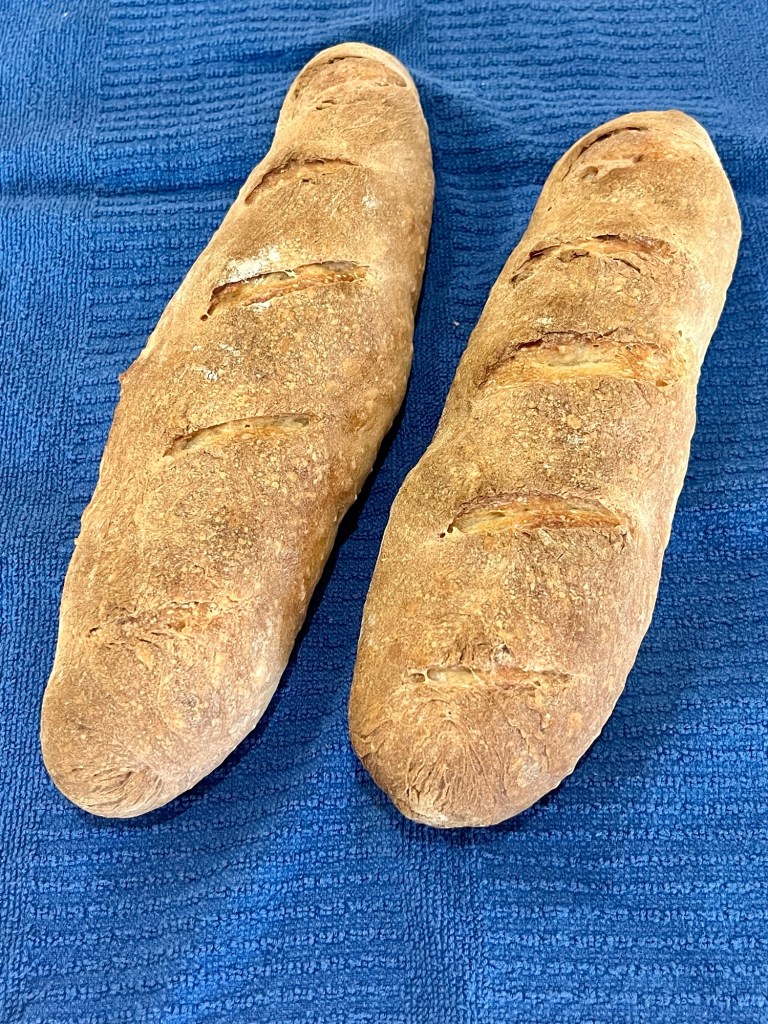
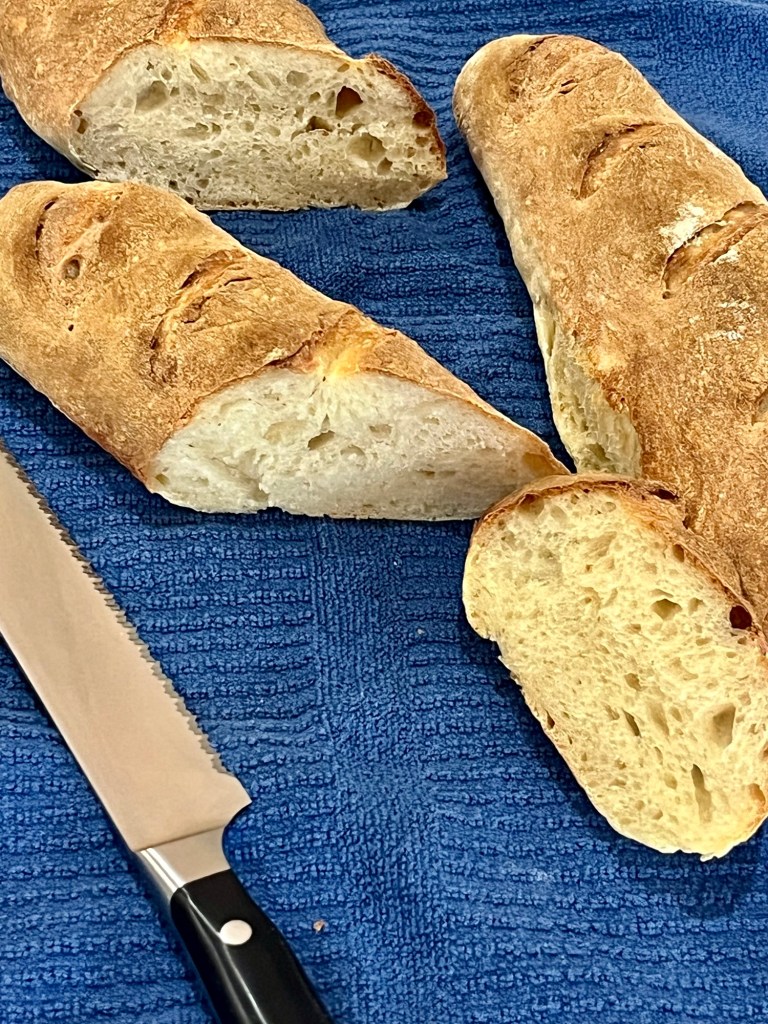
These are classic French Baguettes made with AP flour for the soft interior and baked hot for the crisp crust. They require at lease 12 hours of fermentation so it’s best to start it the night before you plan to devour them.
Baguettes Classic French
INGREDIENTS
• 500 g all purpose flour • 360 g water • 10 g salt • 3 g instant yeast about 1 tsp • 25 g honey about 1 Tbsp
METHOD
Mix all ingredients in a bowl, cover with a plastic wrap and let rest for 15 minutes.
Over a period of 1½ hours, do 3 sets of stretch and folds, flipping the dough upside down after each set.
Cover the bowl with a plastic wrap and place in refrigerator overnight for about 12-14 hours.
Turn the dough on a lightly floured work surface. Divide into 3 equal parts and shape into rectangles each ~10 inches long. Cover and let rest for 45-60 minutes.
Preheat the oven to 500F, with a baking stone positioned in the upper half the oven and a bread pan filled with hot water on the bottom rack.
Stretch each dough rectangle slightly and fold into a cylinder, sealing the seams as you roll. Using your hands, roll the cylinders gently stretching them from the center towards the ends to desired length, about 14-15 inches.
Place on a lightly floured couche, seam side up. Cover and proof at a room temperature for about 30-60 minutes, or until the dough has sufficiently proofed. Press dough with a finger. If it springs back slowly it is sufficiently proofed.
Transfer the baguettes to a piece of parchment paper, seam side down and dust off excess flour. Using a bread lame, a sharp knife or a razor blade, make 5 diagonal scores on each baguette. When scoring, use a swift and firm motion to ensure nice and clean cuts.
Open the oven, taking caution not to get burned by steam, and slide the baguettes and parchment paper off onto the baking stone. Close the oven and reduce temperature to 475F. Bake for 15 minutes.
Remove the water pan, rotate the baguettes, drop the temperature to 450F and continue baking for another 15 minutes or until deep golden brown.