Nearly Neapolitan Mousse Cake

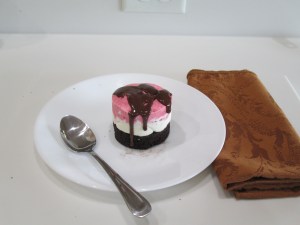
As Nearly Headless Nick cannot join the hunt because of a technicality, this dessert is only nearly a Neapolitan Mousse Cake due to a couple of technicalities. Picky, picky picky.
neapolitanish-cake-3

The chocolate ice cream base is actually almond chocolate cake. the vanilla ice cream is white chocolate mousse, much like a white chocolate ganache but lighter and airier as the cream is whipped, and the strawberry ice cream is raspberry mousse, because I like raspberries.

I have to be honest, this dessert takes some time and patience. Experimenting with the cake recipe (two tries), making the mice, mousses, err… white and pink fillings took 2 or three recipes each adjusting the amount of pectin, when to add it, the amount of whipped cream and how much to whip it. The whipped cream for the raspberry has to be whipped to firm peaks while the white chocolate should be soft peaks. I have removed gelatin from my pantry and replaced it with pectin. Gelatin is easier and fine if you like processed skin, bones, and connective tissues of animals such as domesticated cattle, chicken, pigs, and fish. I don’t. Pectin is sourced from fruit and vegetable peels. I am sure there are some nasty processing steps, but at least it didn’t start with Bessie or Babe or Miss Piggy.

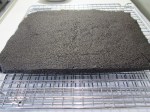
The almond cake uses almond flour instead of food processor ground baked almonds. Its easier and I had some. The batter is pretty low viscosity but don’t worry, it about doubles in thickness in the oven. After cut, wrap the cake disks in plastic and they will stay fresh for 2 or 3 days so you can make them ahead.

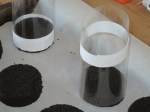
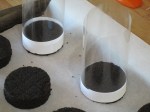
I ordered some 3 mil acetate sheets online. I cut them to size (10 x 41/2″), cut 10 paper bands to hold the acetates in place around the cake. This obviated (not obliviate, we want to remember this recipe) the requirement to tape the acetate. I hope to use them again.

The vanilla mousse sets quickly so work with some speed. Varying the whipping time – Tied to the Whipping Post – can create a thinner mousse, but too short a time can make the mousse dense. I like to pipe the mice, mousses, errr… fillings so I can control the thickness of each layer.

The raspberry fruit has the most powerful flavor, but is the trickiest to make just right. Pectin requires sugar and acid to cross link. Pectin’s structure binds with water in an acid environment and sugar increases pectin’s ability to gel. The lemon juice (I used key lime juice, it was in the fridge) provides the acid and the berries and sugar provide the sugar environment. Vary the amount of each and when to add them. The method below worked well for me.

Neapolitan Mousse Cake

CHOCOLATE ALMOND CAKE

INGREDIENTS

  • 200 g (¾ cup + 2 tablespoons) unsalted butter
  • 30 g (¼ cup) unsweetened cocoa
  • 60 g (½ cup) plain (all-purpose) flour
  • ½ teaspoon baking powder
  • Pinch of salt
  • 120 g (1 cup) almond flour
  • 225 g (1 cup) caster (superfine) sugar
  • 5 large egg whites, room temperature
  • 1½ teaspoons pure vanilla extract

METHOD

  1. Preheat oven to 180° C (350° F). Line rimmed jelly roll pan with non-stick baking paper or silicone baking mat. Be sure to line the sides as well.
  2. In small saucepan, melt butter over medium-low heat, occasionally swirling pan, until it begins to brown and smells nutty, about 5 minutes. Remove from heat and set aside to cool.
  3. Meanwhile, using fine mesh sieve, sift cocoa two times. Then sift together cocoa (for a third time), flour, almond flour and sugar, baking powder and salt into mixing bowl.
  4. Add egg whites, one at-a-time, whisking until just combined after each addition (do not over mix).
  5. Stir the vanilla into the cooled butter.
  6. Gradually pour the vanilla-butter in a thin, steady stream into the batter, whisking to just combine. (Kitchenaid with beater on level 2)
  7. Pour the batter into the prepared jelly roll pan.
  8. Bake until a cake tester inserted in the center of the cakes comes out clean, about 22 minutes. Poke the cake gently, the depression of your finger should bounce back.
  9. Remove from oven and transfer to wire rack. Let stand 5 minutes, transfer cake to wire rack. Let stand until cooled completely.
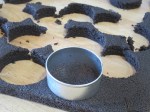
  10. Using a 2½” ring cutter, cut 10 round mini cakes from the cooled sheet cake.
  11. Line rimmed baking sheet with non-stick baking paper or silicone baking mat. Arrange cakes on baking sheet, spacing 2½ cm (1-inch) apart.

 VANILLA MOUSSE

 INGREDIENTS

  • 200 g white chocolate, cut fine
  • 350 g heavy whipping cream

METHOD

  1. Melt the chocolate in a small bowl in the microwave. Heat 30 sec, then check the chocolate and stir. Heat another 30 seconds and stir again. Heat 15 seconds and stir. The chocolate should be liquid but not boiling. If more time in required keep reducing the time by 5 sec and check. Do not over cook.
  2. Whip the heavy cream until it forms soft peaks. If you overwhip the chocolate/cream mixture will set to quickly and will not form smooth even layers.
  3. Gently fold the liquid chocolate into the whipped cream using a figure 8 pattern. Be sure to scrape the bottom and sides of the bowl.
  4. Add to a piping bag and fill the acetate cylinder with about an inch of vanilla mousse.

RASPBERRY MOUSE

INGREDIENTS

  • 2 tablespoons fresh lemon juice
  • 1 teaspoon powdered pectin
  • 175 g fresh raspberries (about 1 pint)
  • 2½ tablespoons sugar
  • ½ cup cold heavy cream

METHOD

  1. Place lemon juice in a small bowl and sprinkle with pectin. Let sit until pectin softens, 3 minutes.
  2. In a blender, puree raspberries until smooth, scraping down bowl as needed.
  3. Pour through a fine-mesh sieve into a measuring cup, pressing on solids (you should have about 1/3 cup of puree); discard solids.
  4. In a small saucepan, combine raspberry puree and 2½ Tbsp sugar over medium. Cook until bubbles form at edge. Add pectin mixture and cook, stirring constantly, just until gelatin dissolves, about 1 minute. Transfer mixture to a small bowl and let cool to room temperature, 20 minutes.
  5. In a large bowl, using an electric mixer, beat cream and 1 Tbsp sugar on medium-high until firm peaks form, about 4 minutes. Do not over mix.
  6. With a rubber spatula, gently fold in raspberry puree mixture in 3 parts until combined.
  7. Add raspberry mousse to a piping bag and fill the acetate cylinders with about an inch of mousse.
  8. Refrigerate until set, about 2 hours (or up to overnight).

 DARK CHOCOLATE GANACHE

 INGREDIENTS

  • 120 ml (½ cup) heavy cream, 35%
  • 113 g (4 ounces) dark chocolate, 70%

METHOD

  1. In a small saucepan, bring cream and corn syrup just to boil (small bubbles beginning to form around the sides of the pan) over medium heat, stirring until corn syrup is dissolved.
  2. Meanwhile, finely chop the chocolate and place in small bowl.
  3. Pour the cream mixture over the chocolate and let stand, 2 minutes. You may not need all the cream. I pour some to just wet the chocolate, wait a minute and stir. If it is too thick, I add more cream, too thin, more chocolate.
  4. Using a flexible spatula, gently stir together beginning in the center of the bowl gradually working toward the edges pulling in as much as chocolate as possible until the mixture is smooth, glossy and combined well.

 Assembling Mousse Cakes

  1. To make acetate collars, cut ten 10 x 4 ½” strips of acetate paper or non-stick baking paper. Also cut 20 1” x 8½” pieces of paper for use as bands to secure the acetate. Wrap one collar around the base of each cake keeping the base flush with the baking sheet. Slide paper band down to base to secure the acetate collar. Return to baking sheet. Cover loosely with a sheet of plastic wrap.
  2. Prepare Vanilla Mousse.
  3. Evenly divide the vanilla mousse between each acetate collar. (The layers should be no more than 2½ cm or 1-inch high.) Cover the cakes with a couple of sheets of plastic wrap (don’t secure too tightly otherwise the collars will lose their shape).
  4. Transfer the cakes on the baking sheet to the refrigerator. Let chill until firm, about 2 hours.
  5. When vanilla mousse layer is firm, prepare Raspberry Mousse.
  6. Remove the cakes from the refrigerator.
  7. Evenly divide the strawberry mousse between each acetate collar. (Again, the layers should be no more than 2½ cm or 1-inch high.) Again, cover cakes with plastic wrap.
  8. Place the cakes in the freezer. Let chill until firm.
  9. Remove the cakes from the freezer and immediately remove collars. (I recommend
  10. Removing collars immediately after removing cakes from the freezer because removal is much easier when the cakes are firm. It makes for best presentation too.)
  11. Spoon a heaping tablespoon of chocolate ganache in the center (onto the surface) of each cake, gently coaxing the ganache to the edges, leaving a 6 mm (¼-inch) border. Chill, uncovered, in the refrigerator until thawed, about 15 minutes.
  12. To serve, transfer each cake to a dessert plate, and top each cake with raspberry.


Pavlova is Dancing in the Street

“They’ll be laughing and singing, music swinging
Dancing in the street”

Ballet dancing, actually. Specifically, Anna Pavlova, Russian prima ballerina who is most recognized for the creation of the role The Dying Swan. We saw pavlovas made on GBBO yesterday and as I have made meringue cups for years, this seemed like a natural extension. (Plus, I had egg whites left in the fridge from making crème pat earlier this week.)

The recipe was created in either Australia or pavlova_0001New Zealand and is a favorite around Christmas in the summer. Wait! Is it a Christmas treat, or a summer treat? Isn’t that a North American oxymoron? Ah, well, it is Christmas Eve, therefore, this time, it is a Christmas treat. (I just realized, I could have used the blueberries and made it a Chanukah treat in Israeli colors of white and blue.)

pavolva_0004Deceptively easy and insidiously versatile. You can top your pavlova with berries, nuts, chocolate, mocha, fruit, lemon curd or as King
Mongkut of Siam was fond of saying “etcetera, etcetera, etcetera.” It often depends what is in the fridge or what season it is, or whatever floats your current boat.


Ingredients

  • Meringue:
    • 1½ teaspoons vanilla extract (clear to keep the meringue very white)
    • ½ teaspoon cream of tartar
    • 1½ Tbsp cornstarch
    • 1½ cups granulated sugar
    • ¾ cup (6 ounces, about 6) large egg whites, preferably room temperature
    • Pinch salt
  • Topping:
    • 2 pints fresh or frozen berries
    • 1/4 cup sugar
  • Whipped Cream for topping

Method

  1. Place rack in the middle of the oven and preheat the oven to 275°. Line a large baking sheet with parchment paper.
  2. Stir the cornstarch into the sugar in a small bowl.
  3. In a large bowl of a heavy-duty mixer, fitted with whisk attachment, whip egg whites, cream of tartar and salt, starting on low, increasing incrementally to medium speed until soft peaks/trails start to become visible, and the egg white bubbles are very small and uniform, approximately 2 to 3 minutes.
  4. Increase speed to medium-high, slowly and gradually sprinkling in the sugar-cornstarch mixture. A few minutes after these dry ingredients are added, slowly pour in the vanilla. Increase speed a bit and whip until meringue is glossy, and stiff peaks form when the whisk is lifted, 4 to 5 minutes.
  5. Pipe the meringue into 8-10 large round bowl like mounds that are 3 inches wide on a baking sheet lined with parchment paper or a silicon liner. (I used a large 1M piping tip.) Leave an indentation in the middle of the mound for holding the filling once meringue is baked.
  6. Place baking sheet in the oven. Reduce oven temperature to 250°F. Bake for 50-60 minutes, or until the meringues are crisp, dry to the touch on the outside, and white — not tan-colored or cracked. The interiors should have a marshmallow-like consistency. Check on meringues at least once during the baking time. If they appear to be taking on color or cracking, reduce temperature 25 degrees, and turn pan around.
  7. Gently lift from the baking sheet and cool on a wire rack. Will keep in a tightly sealed container at room temperature, or individually wrapped, for up to a week if your house is not humid.
  8. Served topped with your favorite filling – lemon curd, raspberry or blueberry sauce, and freshly whipped cream, etc, etc, etc.

Sauce or Filling Directions

If you want to make a berry sauce, heat a couple pints of fresh or frozen berries in a medium saucepan with about a quarter cup of sugar. (I used a 4:1 berry to sugar ratio.)  Heat on medium heat, stirring once or twice, for about 5 to 10 minutes, depending on how much the berries are falling apart. Remove from heat and let cool.

a, b, c, d… eCLAIRS!

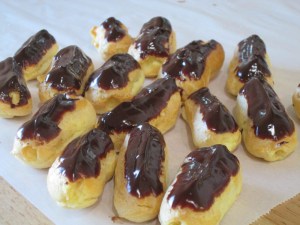
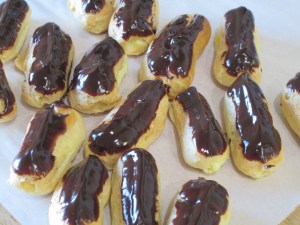
Yesterday morning I made a couple of dozen savory gougères to take to Daniel and Frances as part of a family brunch. The pate à choux came out so beautiful and is so easy to make I thought, perhaps taking some sweet pastries would be a good idea also. While Frances and Daniel like savory, Kathy, Fran and I really do like sweet. Oh yeah, I also made some Christmas and Chanukah cookies on Friday and might as well bring those along too. There were too many for just Fran and me. Well, not too many but…eclair_0002

All the “how to” instruction videos and tutorials stress that you should make all the eclairs uniform size by drawing a template on the backside of some parchment paper. I say, who cares? It’s not like these are for sale, they are for personal consumption and if the eclairs are 2, 2½ or 3″ long, well, I really don’t care.

eclair_0001


Anyway, I made about 4 dozen of these little bits ‘o heaven and took over half to the brunch, heh, heh, heh.

The pate à choux (or just choux) uses one saucepan and the stand mixer, the crème pâtissèrie (creme pat) uses the same saucepan, a sieve and a bowl, and the ganache the same saucepan and a low sided bowl for dunking the filled eclairs in the chocolate. Easy! The most time consuming part of making eclairs is the drying of the choux after the initial bake. I use this time to prepare the creme pat and ganache and to clean up from making the choux.

Ingredients

  • Choux Pastry:
    • ½ c (65 grams) AP flour
    • ½ tsp granulated white sugar
    • ¼ tsp salt
    • 4 tbsp (55 grams) unsalted butter, cut into pieces
    • ½ c (120 ml) water
    • 2 large eggs, lightly beaten
  • Glaze: (optional)
    • 1 large egg, lightly beaten
  • Pastry Cream:
    • ½ c sugar
    • ¼ c corn starch
    • Pinch salt
    • 2 c whole milk
    • 4 egg yolks
    • 2 Tbl butter
  • Chocolate Glaze:
    • 2 ounces (55 grams) semisweet
    • chocolate, finely chopped
    • ¼ c (60 ml) heavy “whipping” cream (cream with 35% butterfat content)
    • ¼ tsp pure vanilla extract
    • ½ tbsp light corn syrup (or golden syrup or glucose)

Method

  1. Choux Pastry:
    1. Preheat oven to 400o F (200o C) and place rack in center of oven.
    2. In a bowl whisk the flour with the sugar and salt.
    3. Place the butter and water in a saucepan over medium high heat and bring to a boil.
    4. Remove from heat and, with a wooden spoon, add the flour mixture, all at once, and stir until combined. It will look like mashed potatoes. Return saucepan to the heat and stir constantly until the dough comes away from the sides of the pan and forms a thick smooth ball (about 1-2 minutes). The dough will film the bottom and sides of the saucepan and make cleaning a pain.
    5. Transfer the dough to an electric mixer and beat on low speed to release the steam from the dough (about 1 minute).
    6. Once the dough is lukewarm start adding the lightly beaten eggs (dough will separate and then come together) and continue to mix until you have a smooth thick paste (dough will fall from a spoon in a thick ribbon).
    7. Place the dough in a pastry bag fitted with a large plain tip and pipe oblongs of dough (about 3/4 inch (2 cm) wide) onto the parchment lined baking sheet. (When piping hold the bag at a 45-degree angle.) If desired, with a pastry brush, gently brush the tops of the dough with the lightly beaten egg.
    8. Bake for 15 minutes and then reduce the oven temperature to 350o F (180o C).
    9. Remove from oven, pierce an end of each éclair with a small skewer to release the interior steam.
    10. Continue to bake for a further 25 minutes or until the shells are a nice amber color and when split, are almost dry inside. Remove from oven and place on a wire rack to cool.
  2. Pastry Cream:
    1. Whisk eggs and milk together and add to all other ingredients (except vanilla) to a medium saucepan.
    2. Bring to boil whisking constantly
    3. Cook until thickened (it will look lumpy, its ok)
    4. Sieve lumpy mixture into a bowl and add 1 tsp vanilla, mix thoroughly
    5. When incorporated, cover with plastic directly on the cream and cool.
  3. Chocolate Glaze:
    1. Place the chocolate in a heatproof bowl.
    2. Heat the cream just until boiling and immediately pour it over the chocolate.
    3. Gently stir until the chocolate has melted.
    4. Stir in the vanilla extract and corn syrup, mixing to ensure incorporation.
  4. To complete:
    1. Fill a piping bag equipped with a filling tip (such as Wilton 230). Inject crème pat into the hole you made to allow the steam to escape. When you feel the side of the éclair begin to bulge, the éclair is full.
    2. Dip the top of each éclair into the warm, thin ganache and set on a piece of waxed or parchment paper to dry. (I use the parchment paper previously used to line the baking sheet.)

It’s Kim’s Birthday! It’s Joe’s Birthday!

Invited to the family birthday celebration of the dynamic duo of daughter Kim and father Joe (parental, not priestley type father), I asked if I could bring a couple of varieties of pastries I was working on that day. I was making some tartlets in recognition of the Mandarin Orange Festival recently held in this area. I also wanted to make ganache/caramel/sea-salt tartlets. Also, having just binge watched several seasons of The Great British Bake Off with Fran I was compelled to try my hand at a roulade. I told Kim I would bring those that were successful. Disasters never leave home.

I have a nice, easy recipe for tartlet shells and used it to make a dozen, six small 2½”  and six img_0003larger 3″ diameter, wanting more surface areaimg_0001 for the orange slices. Because the oranges are very sweet and the creme de Patisserie is likewise sweet, I wanted to add something to balance. I added the zest of three small mandarin oranges to the creme pat to add just a little bitter to the mix. (Hindsight – use 3 slices,  not 5. Even small slices were too big/many.)
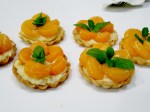
Sadly, the ganache did not set (too much hot cream initially, and not enough time to img_0005correct it before the party.) Happily, I had some extra creme pat so I could substitute some img_0006blackberry tarts for the ganache/caramel/sea-salt ones originally planned. (Remember, disasters stay home.)

Back to the GBBO binge.  A roulade is a rolled sponge cake filled with something. Think Swiss Roll but without the chocolate and yodelling. I filled mine with cream cheese frosting, a blackberry reduction and fresh blackberries, hence extra blackberries for tartlets above.

I made a genoise sponge, taking a bit of a risk having never attempted one. A genoise is a sponge cake that is leavened naturally with eggs using the foaming method which is the gentle warming of the eggs with sugar and beating them until they are foamy and thick. After baking and while still warm the sponge is dusted with confectioners sugar, rolled up in parchment paper and left to cool. While waiting for it to cool, I made the berry reduction and cream cheese frosting. The reduction is simply mixing equal weights berry and sugar and cook over medium heat until boiling for a few minutes, until it starts to thicken. The cream cheese recipe, while equally simple is below. Once the two spreads are ready, carefully unroll the now cooled sponge, coat with both layers, lay a dozen or so fresh berries on the fillings and re-roll, this time without the parchment paper.  Refrigerate until the filling is set, dust the top with more confectioners sugar, trim the edges to a clean line and serve.

Note: I am slowly converting recipes to weight and want to be consistent with units but am too damned lazy to convert existing recipes until I need to.

Tartlet Shell
Ingredients

  • 50 g cold butter cut into small cubes
  • 100 g all-purpose flour
  • 30 g icing
  • ¼ tsp vanilla
  • ⅛ tsp salt
  • 1 egg – ½ for the dough and the other ½ reserved for an egg wash

Method


  1. Mix butter with sugar
  2. Add salt then vanilla
  3. Add egg
  4. Stir in flour. Mix by hand until incorporated
  5. Cover with plastic and refrigerate for 30 min

Then:

  1. Butter tartlet pans, or use non-stick pans
  2. Roll dough to about ⅛” thick
  3. Lay over tart mold and press into all crevices
  4. Roll top to cut off excess
  5. Prick holes in bottom and sides of formed dough
  6. Fill tarts with pastry weights (I put beans in a cupcake paper and remove 5 minutes before the end of the bake.)
  7. Paint edges of the tartlet with the egg wash.
  8. Bake in preheated oven 350 deg F (175 C) for 15 min
  9. Immediately remove from pans and cool on a wire rack

Creme Patisserie (Creme Pat to us philistines)
Ingredients

  • ½ cup sugar
  • ¼ cup corn starch
  • Pinch salt
  • 2 cups whole milk
  • 4 egg yolks

Method

  1. Whisk eggs and milk
  2. Add 2 Tbl butter
  3. Bring to boil whisking constantly
  4. Cook until thickened (it will look lumpy, its ok)
  5. Sieve into a bowl
  6. Add and stir 1 tsp vanilla
  7. Cover with plastic directly touching the cream
  8. Refrigerate

Cream Cheese Filling
Ingredients

  • 1/4 cup butter, softened
  • 4 oz cream cheese
  • 2 cups confectioner sugar
  • 1 tsp vanilla extract

Method

  1. Add all the ingredients to a bowl and beat it with the whisk attachment to make as light, airy and spreadable as possible.
  2. Easy, huh?

Genoise Sponge
Ingredients

  • 3 large eggs
  • 3 large egg yolks
  • Pinch of salt
  • ¾ cup sugar
  • ½ cup cake flour (spoon flour into dry-measure cup and level off)
  • ¼ cup cornstarch

Method

Set a rack in the middle level of the oven and preheat to 350 degrees. Butter a jelly roll pan, line it with parchment paper, and butter that too.

  1. Half-fill a medium saucepan with water and bring it to a boil over high heat. Lower the heat so the water is simmering.
  2. Whisk the eggs, yolks, salt, and sugar together in the bowl of a heavy-duty mixer. Place over the pan of simmering water and whisk gently until the mixture is just lukewarm, about 100 degrees (test with your finger or play with your infrared thermometer, which is what I do). Attach the bowl to the mixer and, with the whisk attachment, whip on medium-high speed until the egg mixture is cooled (touch the outside of the bowl to tell) and tripled in volume. The egg foam will be thick and will form a slowly dissolving ribbon falling back onto the bowl of whipped eggs when the whisk is lifted.
  3. While the eggs are whipping, stir together the flour and cornstarch.
  4. Sift one-third of the flour mixture over the beaten eggs. Use a rubber spatula to fold in the flour mixture, making sure to scrape all the way to the bottom of the bowl on every pass through the batter to prevent the flour mixture from accumulating there and making lumps. Repeat with another third of the flour mixture and finally with the remainder. There is a balance between incorporating all the flour mixture and deflating the egg mixture. Be thorough but careful.
  5. Scrape the batter into the prepared pan and smooth the top.
  6. Bake the gênoise for about 25 minutes, or until well risen, deep gold, and firm to the touch. Do not over bake it.  Also, do not over fill the pan. Very thick genoise is more difficult to roll.
  7. Immediately use a small pairing knife to loosen the cake from the sides of the pan. Invert the cake onto a rack, then reinvert onto another rack and let the cake cool right side up on the paper. Remove the paper when the cake is cool.

Storage:

Wrap in plastic wrap and refrigerate for several days, or double wrap and freeze for up to a month


Gougere

Gougeres are baked savory choux cheese pastries. The cheese is typically Gruyere and, as this was my first attempt at this pastry, I wanted to follow the recipe exactly. (I actually found them a little bland and will use a sharp cheddar next time.) I added a little flavor to them by piping some whipped cream inside, which, while bastardizing the savory gougere, did increase the flavor.

img_0013The recipe I used did not include the step to dry the choux after the bake. Typically, after the first bake at 425 F, each piece of pastry is punctured and returned to the over forimg_0009 another 30 min at 375 F. This lets the steam out of the inside of the pastry and gives them that little crispness usually found it cream puffs or eclairs.

Ingredients

  • 1 cup water
  • 1 pinch kosher salt
  • ½ cup unsalted butter, cut up
  • 1 cup flour
  • 4 eggs, lightly beaten
  • 1 cup cheese, Gruyere or sharp cheddar

Method

  1. Boil: Heat water, salt and butter to a boil
  2. Mix: Dump in flour, all at once. Stir with a wooden spoon to a big soft lump that looks something like mashed potatoes. Stir another minute to cook the flour.
  3. Beat: Scrape dough into the bowl of a stand mixer fitted with the paddle attachment. Beat on medium, slowly pouring in eggs. Sprinkle in ¾ cup cheese. Dough will look like vanilla pudding.
  4. Shape: Scrape dough into a piping bag fitted with a plain ½ inch tip. Pip about 48 1-inch diameter mounds onto parchment lined baking sheets. Sprinkle remaining cheese on the top of the little lumps
  5. Bake: Slide pans into a 400o oven, bake until gougeres are golden and puffed, about 20 minutes. Pull one out, break open and check. Inside should be steamy and creamy but not wet. If need be, bake another minute.
    1. NOTE: My correction would be to puncture each pastry and place back in the oven at reduced heat. The initial oven temperature should be 425 F then turned down to 375 F as soon as you put the pastries in.
    2. They are done when they are golden brown and sound hollow when tapped with a fingernail.
    3. Puncture each pastry (I use a wooden chop stick) followed by another few min at 300 F. Break one open and check that the inside is dry.
    4. Transfer to a wire rack to cool.
  6. Serve: Delightful plain, or use a paring knife to slip the bottom and stuff with any savory morsel – even a pistachio, chunk of brie or whip of salami.

Ivory and Ebony

black-and-white-cookies-1 black-and-white-cookies-finalI love black and white cookies and I wish I could make them, oh wait, I did make them. I like to eat the white side first and save the chocolate side for dessert dessert.

They are pretty easy to make and very easy to eat (see procedure above.) I substituted keylime juice for lemon, as that is all I had on hand. I might also try confectioners sugar rather than caster’s sugar. The white was a bit grainy. Also, I read somewhere to use milk rather than water for the frosting. They white frosting was slightly translucent and milk should make it opaque.

Ingredients

  • ⅓ cup unsalted softened butter
  • ½ cup white sugar
  • 1 egg
  • 1 teaspoon lemon juice
  • 1¼ cups all-purpose flour
  • 1½ teaspoons baking soda
  • ½ teaspoon salt
  • ⅓ cup well shaken buttermilk
  • ½ teaspoon vanilla extract
  • 1½ cups bakers or casting or confectioners sugar
  • ⅓ cup boiling water, or maybe very hot milk
  • 1 teaspoon light corn syrup (Note: 1 teaspoon corn syrup weighs 20 grams. I find it easier to weigh viscous liquids then pour and measure.)
  • ¼ cup dark cocoa powder

Directions

  1. Preheat oven to 350 degrees F (176 degrees C). Draw 2” diameter circles about 3” apart on parchment paper and place drawn side down on a baking sheet.
  2. In a medium bowl, cream together butter and sugar until smooth. Beat in the egg then stir in lemon juice. Combine the buttermilk and vanilla. Combine all-purpose flour, baking powder, and salt; gradually add to the blended mixture alternating with the milk/vanilla solution stirring well after each addition. Start and end with the dry ingredients.
  3. Pipe 2” diameter disks of the dough on prepared baking sheets.
  4. Bake until edges begin to brown, about 20 to 30 minutes. Cool completely on a wire rack.
  5. Boil a cup or so of water in a small sauce pan. Place casting sugar in small, heat-safe mixing bowl. Gradually stir corn syrup and in enough boiling water to the sugar to make a thick, spreadable mixture. Err on the side of caution because a too-thin frosting is hard to undo. Leave remaining boiling water on the stove.
  6. With a small angled spatula, coat half the cookie with the white frosting. Try to divide the middle of the cookie with a straight line. Set the half-frosted cookie on a wire rack placed over waxed paper to catch any dripped frosting.
  7. Put the bowl over a small pan containing barely boiling water (double boiler style.) Stir in the chocolate. Warm mixture, stirring frequently, until the chocolate melts. Remove from heat. (Return to heat if frosting thickens too much to spread.)
  8. While preparing the chocolate frosting the white frosted cookies should cooled and set enough to allow you to pick them up without the white frosting running. Coat the other half of the cookie with chocolate and set back on the wire rack.

Grace’s Baptism Cake

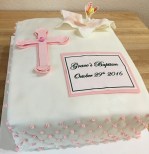
Saturday October 28, 2016 was our granddaughter Grace’s baptism. completed-cakeAround 60 family members and friends attended at a Catholic church in Roseville for a short but meaningful service, then gathered at Frances and Daniel’s for brunch. I was asked to provide a cake for 60 people. (This may be the largest cake I have made.) The specific request was for a layer cake with chocolate mousse filling and a quilted finish.
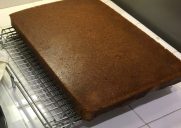
For 60 servings the cake needed to be about 4″ high and 11″ x 15″. Knowing I would lose a little from the edges to square the sides I assumed there would be at least a few sheetcakepeople who do not eat cake (friends of Marie Antionette, no doubt) and I could get away with this size. Therefore I needed two sheet cakes. (Note: about 10 slices were left at the end of the event.)
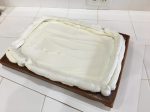
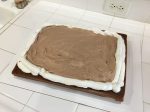
To have a decent thickness of mousse separatinbuttercream-dam-4g the cake layers I built a dam of crusting buttercream around the edges of the top crumb coated cake. Crusting buttercream has a little more body and will keep the mousse in place. Add a tablespoon of meringue powder to the confectioners sugar to make regular buttercream into crusting buttercream. After the second sheet cake is cool, add the buttercream-dam-2mousse to the damned 🙂 bottom cake. Top with the second layer, crumb coat the entire cake and refrigerate. stacked-layersA cold cake is easier to trim to make nice square edges and setting the mousse will retard the effects the moisture will have on the fondant coating.
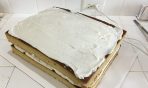
I used an electric knife to trim the edges of the cake prior to covering with fondant. After trimming crumb coat the nice, straight smooth edges of the cake. stacked-and-cut-layers

I rolled out a 17″ x 22″ piece of fondant to have enough to cover the cake. Once it was covered and smoothed, 45 degree crisscrossed lines were embossed into the sides of the cake. Then it was dusted with pearl luster to add a little sparkle to the fondant and little pink rosettes were piped into each intersection of the quilt pattern.

Egraces-cake-quiltingarlier in the week I made the pink orchid, cross and text backing from gumpaste.graces-orchid I purchased the text from a company that makes sugar images and pasted it onto the backing gumpaste.

YELLOW SHEET CAKE – SERVES 60

INGREDIENTS:

  • 4 1/2 cups (570g) all-purpose flour
  • 2 teaspoon baking soda
  • 1 teaspoon salt
  • 2 cup (460g) unsalted butter, softened
  • 3 3/4 cups (700g) granulated sugar
  • 4 large eggs, at room temperature
  • 4 teaspoons pure vanilla extract
  • 1 cup (240g) sour cream, at room temperature
  • 2 cup (480ml) whole milk, at room temperature

DIRECTIONS:

  1. Preheat oven to 350°F (177°C). Generously grease and lightly flour a 12×17 inch half sheet/jelly roll pan. The pan should be at least 2″ deep. Set aside.
  2. Whisk the flour, baking soda, and salt together in a large bowl. Set aside. Using a handheld or stand mixer fitted with a paddle attachment, beat the butter on high speed until smooth and creamy – about 1 minute. Add the sugar and beat on high speed for 3 full minutes until creamed together. The mixture should be a light yellow color. Scrape down the sides and up the bottom of the bowl with a rubber spatula as needed. On medium-high speed, add 1 egg at a time, beating well after each addition until both are mixed in. On high speed, beat in the vanilla extract and sour cream. Scrape down the sides and up the bottom of the bowl with a rubber spatula as needed.
  3. With the mixer running on low speed, add the dry ingredients to the wet ingredients alternating with the milk. Start and end with the dry ingredients. Mix each addition just until incorporated. Do not overmix this batter. The batter will be smooth, velvety, and slightly thick.
  4. Spread the cake batter into the prepared pan. Smooth it out into a thin, even layer. Bake for 20-22 minutes (less for a half recipe or 35-40 minutes for a double. Actual times depend on pan used, less time for shallow pan, more for deeper, or until the top is lightly browned and a toothpick inserted in the center comes out clean. Make sure you rotate the cake pan once or twice during bake time if your oven has hot spots. Remove from the oven and allow the cake to cool in the pan placed on a wire rack. As the cake is cooling, make the frosting.
  5. Make ahead tip: Cake can be made 1 -2 days in advance, covered tightly at room temperature.

BUTTERCREAM FROSTING – I made several batches of this frosting

INGREDIENTS

  • 4 cups of powdered sugar (or 1 box)
  • 1 Cup (2 sticks) of softened butter
  • 2-3 teaspoons of vanilla
  • 1-2 tablespoons of milk
  • Violet food coloring

INSTRUCTIONS

  1. Add powdered sugar to mixing bowl.
  2. Add softened sticks of butter
  3. Add vanilla. If you want white buttercream use clear imitation vanilla.
  4. Add 1 tbsp of milk.
  5. Beat on low until powdered sugar is incorporated. Then move mixer up to medium-high speed. Scrape sides and bottom of bowl often. When completely mixed the frosting may appear dry.
  6. Add more milk, a little bit at a time until frosting is the proper consistency.
  7. Again, for white frosting now add a little violet food coloring. I use the end of a toothpick and add just a little at a time. Mix thoroughly.

CHOCOLATE MOUSSE

INGREDIENTS

  • 4 egg yolks
  • ¼ cup sugar
  • 1 cup whipping (heavy) cream
  • 1 package (6 ounces) semisweet chocolate chips
  • 1 ½ cups whipping (heavy) cream

DIRECTIONS

  1. Beat egg yolks in small bowl with electric mixer on high speed about 3 minutes or until thick and lemon colored, then gradually beat in sugar.
  2. Heat 1 cup whipping cream in 2-quart saucepan over medium heat until hot. Temper the eggs by gradually (i.e. slowly, a little at a time) stirring (rapidly) at least half of the hot whipping cream into egg yolk mixture; stir back into hot cream in saucepan. Cook over low heat about 5 minutes, stirring constantly, until mixture thickens (do not boil). Stir in chocolate chips until melted. Cover and refrigerate about 2 hours, stirring occasionally, just until chilled.
  3. Beat 1 ½ cups whipping cream in chilled medium bowl with electric mixer on high speed until stiff. By hand fold chocolate mixture into whipped cream to not collapse the whipped cream. Pipe or spoon mixture into serving bowls. Immediately refrigerate any remaining dessert after serving.

Pate a Choux #1

Rising from the depths of a cold caught in Seattle a week ago, I decided to try my luck at baking pate a choux, the basis for pastries such as creme puffs or eclairs. I found several recipes and decided on one from The Kitchn (thekitchn.com). I made small profiteroles with pastry cream (recipe also from The Kitchn) instead of ice cream. My execution of this recipe produced a nice flaky, although not fully risen pastries which were easily filled with pastry cream and dipped in a hardening ganache. The mini eclairs I piped on the same sheet did not rise at all and were discarded.First Pate a Choux 2

I tried a second recipe which used one baking temperature for baking, finishing and drying. These did not rise nearly as well as The Kitchn recipe.

While the shape was less than ideal, the flavor was excellent. Trying again next weekend. The shape as to be the result of having too much or too little water in the batter prior to baking. The water turns to steam which “inflates” the dough.

Summertime, And The Livin’ is Easy

It’s summertime again. Actually, it is the end of May and summer is still 3 weeks away but if you live in South Florida summer began months ago. I needed a cake for a dinner party this weekend and said to myself, “Self, what springs to mind when you think about summer?” After a moment, I replied, “Well, after a long hot winter I want to fall into a cool, refreshing cake that shrieks summer.” I decided on a Watermelon Cake. It doesn’t taste like watermelon (it is actually a white cake dyed reddy/pink) but sure looks like one. IMG_1421[1]

Bake the cake in a greased and flowered Wilton Egg Pan (because I own one.) Fill the pan to within an inch of the top and be sure to put a cookie sheet under it while baking as it will overflow the pan. My oven is slow so I baked it for an hour at 350 F. Remove from the oven and let cool completely. Trying to remove the cake while warm will destroy it.

After the cake is completely cool, (I know, the cake is very cool, but in this case I mean the temperature) cut the excess cake along the edge of the Egg Pan to make a perfectly flat side then turn it out onto a wire rack. If necessary loosen the edges of the cake from the pan with a flexible spatula.

Frost the cake with a heavy IMG_1422[1]layer of white crusting butter cream frosting (I made a double recipe of the below) and place in the freezer. When the frosting is set, about an hour, coat with another layer of white frosting making it as smooth as possible, returning to the freezer. This makes the thicker white watermelon rind. While the twice white frosted cake is again setting add some green food coloring to the remaining frosting. This green should be the background green of the watermelon, not the dark green lines. Add a little additional milk to reduce the viscosity, or to the non-scientists among us, reduce the “thickness.” After the frosting on the cake is set, smooth a layer of the light, thinner green frosting over the entire cake and return to the freezer. After the now light green cake is set, remove from the freezer and smooth the surface. I like to use a latex gloved hand wetted by holding it under the faucet. A bowl of water would also work but then you have to clean another bowl. You will have to clean and re-wet your hand a few times to smooth the entire cake. Once the light green frosted cake is smooth, guess what? Return it to the freezer to set.
IMG_1427[1]Remove the smooth light green frosted cake from the freezer and paint the dark green stripes. I used Duff green airbrush dye and a 3/8″ brush (because I own them.) If you are the artistic type with a good eye and imagination this is no biggie. If you are the more analytical, fallen chemist type, set your iPad with a picture of a watermelon next to your cake and copy to the best of your limited artistic ability.

BTW, here is a tip I found online: to disperse the chocolate chips and not have them settle to the bottom of the cake batter mix them into the flour mixture being sure the are well coated with flour. This seems to help them “float” in the cake batter as it bakes.

Here is another tip: don’t let the cake with the thick frosting warm up in the car ride to your party. Soften or melted rind signficantly affects the overall impression of the cake.

Recipe: Heavenly White (Watermelon Colored) Cake

Ingredients

  • 2 3/4 cups sifted cake flour
  • 4 teaspoons baking powder
  • 3/4 teaspoon salt
  • 4 egg whites ( or substitute)
  • 1 1/2 cups white sugar
  • 3/4 cup butter
  • 1 cup milk
  • 1 teaspoon vanilla extract
  • 1/2 cup of chocolate chips
  • Red dye

Directions

  1. Measure sifted flour, baking powder, and salt; sift together three times.
  2. Add chocolate chips and mix being sure the chips are well coated with the flour mixture
  3. In a mixing bowl, beat egg whites until foamy. Add 1/2 cup sugar gradually, and continue beating only until meringue will hold up in soft peaks. Add red dye to approximate a watermelon color.
  4. Cream butter or margarine. Gradually add remaining 1 cup sugar, and cream together until light and fluffy. Add sifted ingredients alternately with milk a small amount at a time, beating after each addition until smooth. Add red food dye until the same watermelon pinky/red is achieved. Mix in flavorings. Add colored meringue, and beat thoroughly into batter.  Pour into well greased and floured Egg Pan.
  5. Bake at 350 degrees F (175 degrees C) for about 60 minutes. Check the springiness of the cake after about 45 min. Guess when it is done (when the depression caused by your finger is anti-depressed, or springs back up.) Leave the cake in pans until completely cool, then trim the bumpy puffed up cake above the rim of the Egg Pan and remove and transfer to a wire rack.

Basic Crusting Butter Cream

Ingredients:

  • 1/2 cup solid high ratio shortening
  • 1/2 cup butter softened
  • 1 tablespoon of meringue powder
  • 1 teaspoon Clear Vanilla Extract (or extract of choice)
  • 4 cups sifted confectioners’ sugar (approx. 1 lb.)
  • 2 tablespoons milk
  • Green food color (add after cake is frosted with the white frosting)

In large bowl, cream shortening and butter with electric mixer. Add vanilla and milk. Gradually add sugar, one cup at a time, beating on a slow speed. Scrape sides and bottom of bowl often. Keep bowl or covered with a damp cloth until ready to use. Refrigerated in an airtight container, this icing can be stored 2 weeks. Don’t overwhip or it will bring air to the icing and is impossible to smooth. If you have a kitchen Aid use white attachment, not whip attachment.


Meringue Cups, Not Hwy 66 – Revisited

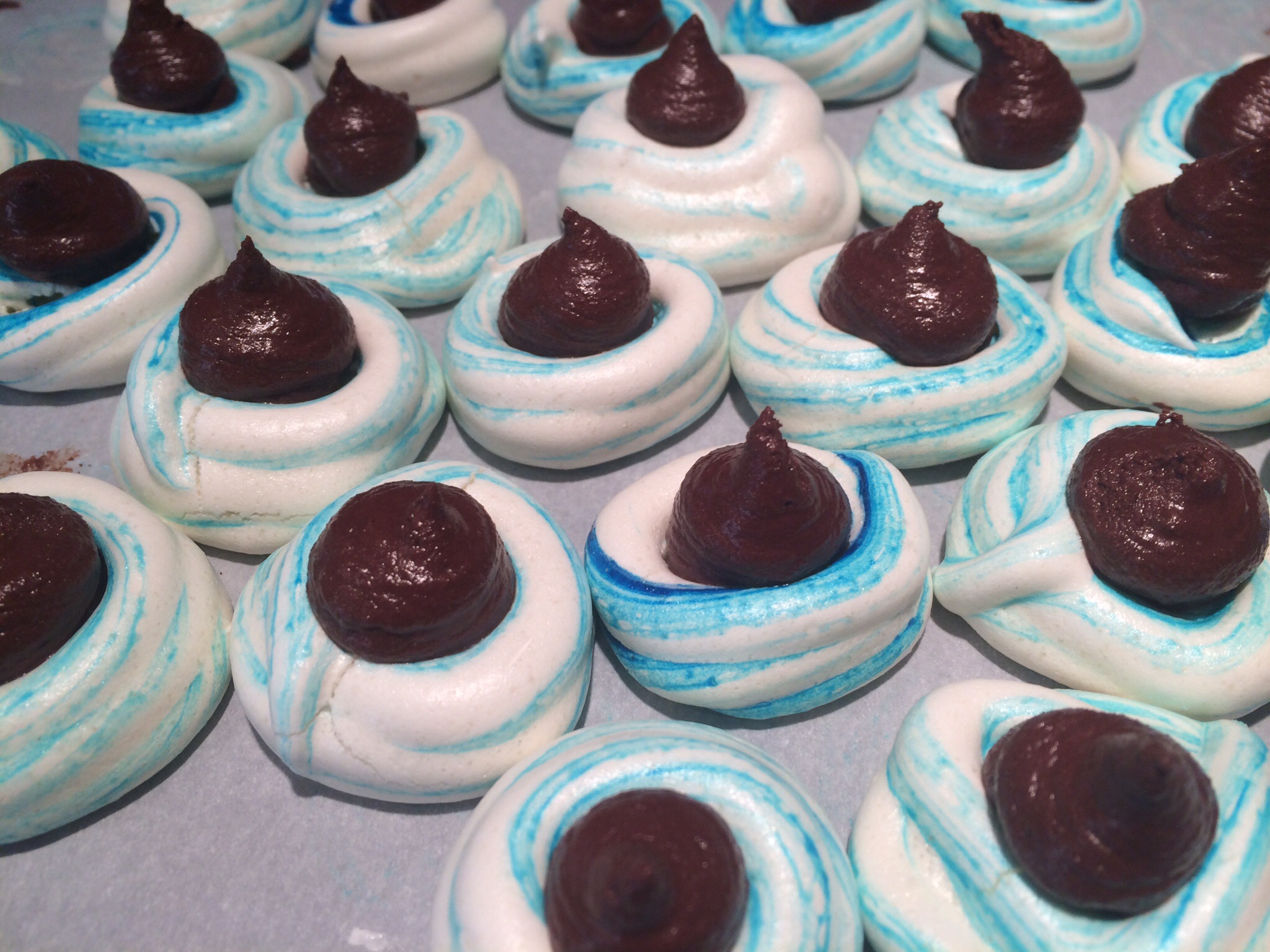
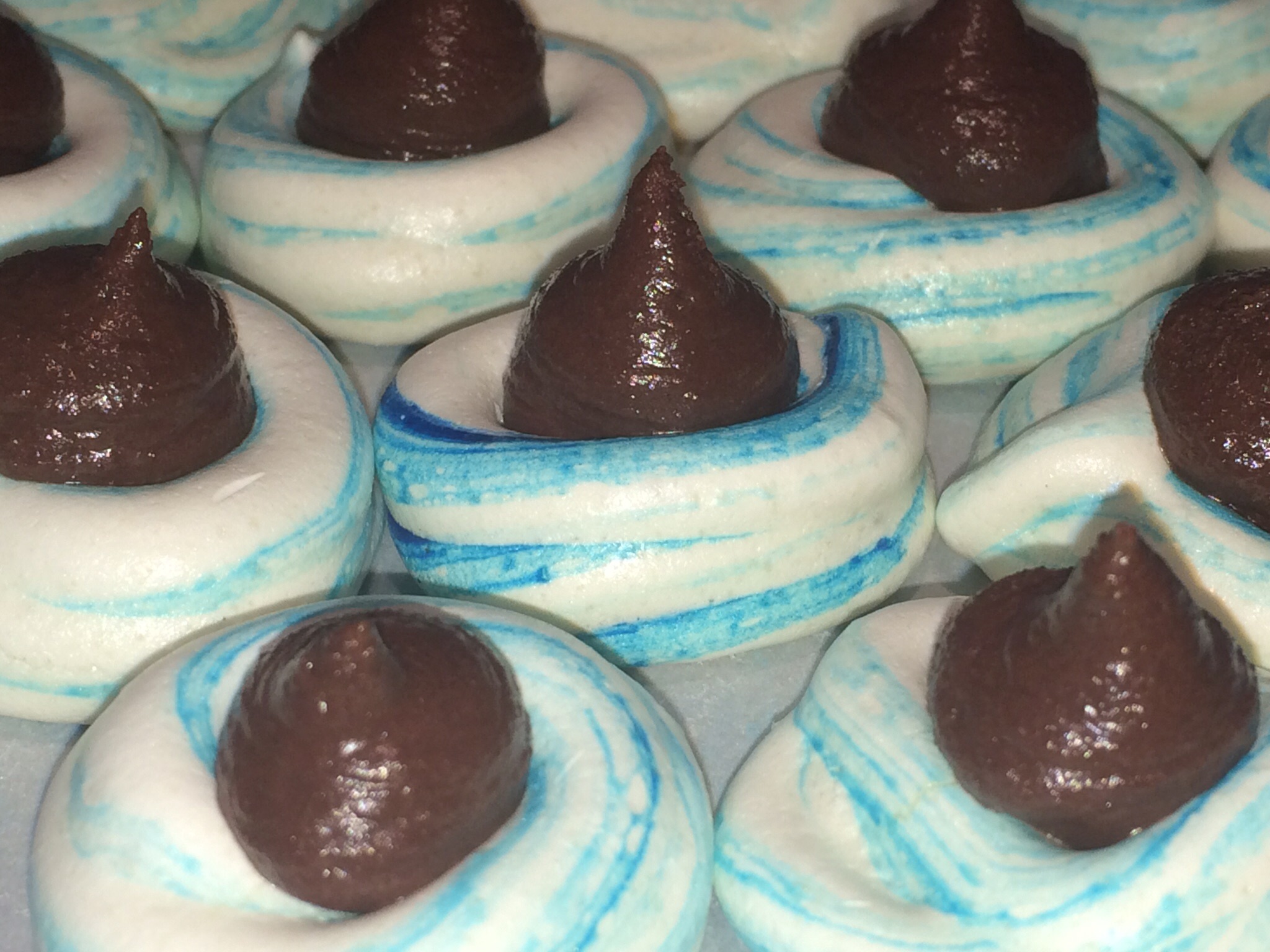
I had the occasion to make a batch of meringue cups today and thought I would try a variation to the ganache filling I typically use. While researching another recipe on Allrecipies I saw that if, after the unsweetened, grated chocolate (4 oz) is melted in the just barely boiling heavy cream (1/2 cup) the mixture is allowed to cool to room temperature, then whipped soundly (about the head and shoulders), it will become a lighter whipped ganache which is easy to pipe into designs, or as in my case bitter kisses. The sweetness of the meringue cup paired with the bitter chocolate results in a well balanced treat.image image

(After taking the picture i decided to add some blue sugar crystals to sweeten the meringue cups up a bit. Obviously, it’s up to you)