Dave Oney was born mid last century in Middlebury, Vermont. He received his BS in Chemistry and worked as a polymer chemist in Massachusetts and New Jersey. He became a microscopist (someone who studies little bitty things using a microscope) and photomicrographer (someone who photographs little bitty things) before settling into a 35-year career in technical sales of scientific imaging equipment (the science of digitally recording itty bitty things, sending the image to a computer for analysis.) He designed and created a number of products contributing to this field. He is (was) proficient in several computer languages and is currently working on mastering English.
After making a few more paradigm shift career changes Dave and his wife, Fran, retired and moved closer to their children and granddaughters and now live in the foothills of the Sierra Nevadas.
So what is a person to do with two very over-ripe bananas? Throw them out? I think not! Being both thrifty and whimsical I found an easy recipe for banana bread and at QC’s request added some raisins. In hindsight, I should have added more raisins. Next time I will use a whole cup instead of half. (Below recipe modified)
As I write this post I am eating a slice of the Raspberry Swirl Pound Cake. It really is pretty good!
The recipe called for two tablespoons of sugar to be sprinkled on the top of the loaf prior to baking. This added a nice crunch and caramelization to the loaf. However, one tablespoon would probably be adequate. (Below recipe modified.)
Banana Raisin Bread
INGREDIENTS • 2 cups flour • 2 teaspoons baking powder • 1 teaspoon salt • 3⁄4 cup sugar • 2 eggs • 1⁄4 cup oil • 1⁄4 cup milk • 1 teaspoon vanilla • 2 ripe bananas, mashed • 1 cup raisins • 1 tablespoon sugar
METHOD
Preheat oven to 350F
Mix dry ingredients in a mixing bowl.
Mix wet ingredients in another bowl.
Combine wet and dry ingredients.
Pour in loaf pan sprayed with baking spray with flour and sprinkle with 2 tablespoons sugar.
Sometime around my birthday our Florida BFF send me a packet of recipes she culled from a selection of magazines. This Raspberry Swirl Pound Cake caught my eye, however, the first attempt hit the bin after QC rated it thumbs down. (Mfg agreed.)
I modified the original recipe from FoodNetwork by swapping out the AP flour for cake flour. This reduced the gluten to make a softer, lighter cake. Pound cake is not expected to be light and airy, but let’s be honest, dense, wet, stodgy cake is not terribly pleasant. I also substituted caster sugar for the cane sugar, reduced the oven temperature from 350F to 325F, increased the number of egg yolks by 2 and eliminated the almond extract. (QC and I do not like almond extract.) The final result was deemed presentable!
Raspberry-Swirl Pound Cake
INGREDIENTS Cake • 226g (2 sticks) salted butter, at room temperature, plus more for the pan • 198 (1 ¾ cups) cake flour, plus more for the pan • 6-oz fresh raspberries • 2 tablespoons seedless raspberry jam • 248g (1 cup plus 2 tablespoons) caster sugar, divided • 3 large eggs, plus 3 egg yolk, at room temperature • ¼ cup heavy cream • 1 1/8 teaspoons pure vanilla extract • 4 drops red gel food coloring (or enough to make an intense pink color) Glaze • ½ cup confectioners’ sugar • 2 tablespoons heavy cream for topping (more to thin if necessary) • 1/8 teaspoon vanilla • Crushed freeze-dried raspberries, for topping
METHOD
Make the pound cake:
Preheat the oven to 325˚. Spray the bottom and sides of a 9-by-5-inch loaf pan with Baker’s Joy, then line with parchment paper in two overlapping strips, leaving an overhang. Butter the parchment and lightly dust with flour, tapping out the excess.
Combine the fresh raspberries, jam, 2 tablespoons cane sugar and 1/4 cup water in a medium saucepan over medium heat. Cook, stirring and smashing the berries with a wooden spoon, until thickened, 10 to 15 minutes. Remove from the heat and strain through a fine-mesh sieve into a medium bowl, pressing with a rubber spatula. Let cool.
Whisk the eggs, egg yolks, 1/4 cup heavy cream and 1 teaspoon vanilla extract in a medium bowl until slightly foamy; set aside.
Beat the butter and remaining 1 cup caster sugar in a large bowl with a mixer on medium speed until well combined, 1 to 2 minutes. Scrape down the bowl and increase the mixer speed to medium high. Beat until pale and fluffy, 6 to 7 more minutes.
Reduce the mixer speed to low and beat in the flour until just combined.
Gradually add the egg mixture and beat until combined. Scrape down the bowl, increase the speed to medium and beat until smooth and fluffy, 15 to 30 seconds.
Scoop 3/4 cup batter into the bowl with the raspberry sauce and stir in the red food coloring. Transfer half of the remaining plain batter to the prepared pan and top with half of the raspberry batter; swirl together with a knife. Repeat and swirl the batters together again.
Bake until the top springs back when gently pressed and a toothpick inserted into the center comes out clean, 1 hour 10 minutes to 1 hour 20 minutes. (205 F internal temperature)
Transfer to a rack and let cool 15 minutes in the pan. Lift the cake from the pan and remove the parchment; return to the rack to cool completely.
Make the Glaze
Combine the confectioners’ sugar, 2 tablespoons heavy cream and the remaining 1/8 teaspoon each vanilla and almond extracts in a medium bowl and whisk until smooth; thin with the remaining 1 tablespoon heavy cream, if needed.
Spoon the glaze over the cooled cake and sprinkle with freeze-dried raspberries. Let set at least 20 minutes.
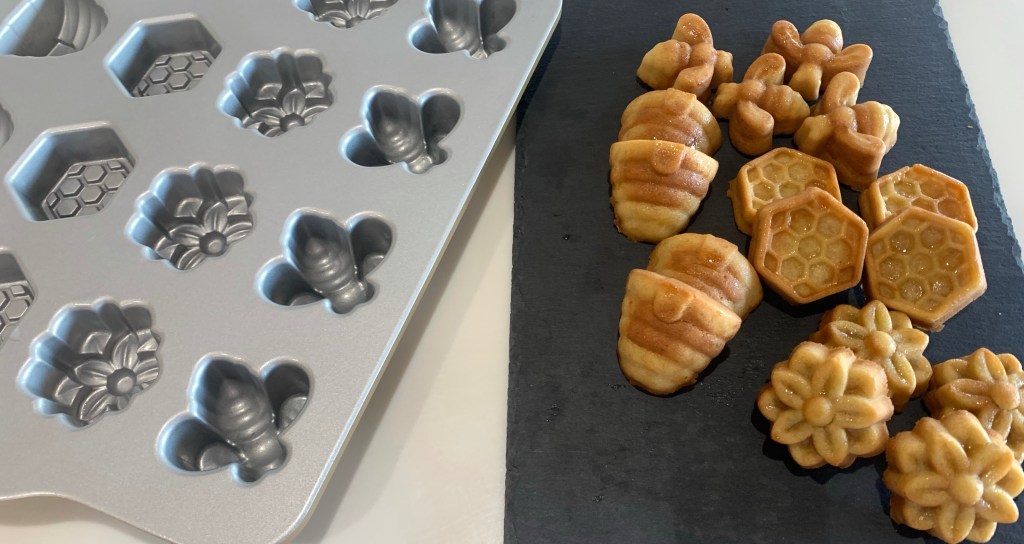
While on vacation last month, and at King Arthurs Bake shop, I learned a new word—Cakelets! I had absolutely no reason for buying a Nordicware Cakelet pan and, back home, tried it this morning for the first time. I used the Noricware recipe for Honey Chamomile Cakelets as a control for future bakes.
The recipe was simple and easy to follow, although I made a couple of changes and converted the volume measurements to weight. (I moved making the simple syrup to the beginning as reducing the liquid to a syrup takes a while and the cakelets should be coated while warm.) I find it’s convenient to measure most ingredients (such as honey) by weight. A cup of honey weighs 340g and a tablespoon weight 21g. Put your bowl directly on the scale and weight the required amount. Less mess and more accurate!
There was about twice as much honey syrup than required, so it’s quantity could be reduced by half. The cakelets released from the pan perfectly and maintained all the detail. I was very pleased with the result. The cakelets were strong honey which overpowered the chamomile but that is easily adjusted. I wonder how these would be with either a mirror glaze, or perhaps dipped in tempered chocolate. Hmmmm.
HONEY CHAMOMILE BEE CAKELETS
Recipe from Nordicware
INGREDIENTS • 177ml (¾ cup) water • 3 chamomile or jasmine tea bags • 115g ( ½ cup) butter, softened (best to let come to room temp) • 150g (¾ cup) granulated sugar • 126g (6 tbsp) honey • ¼ tsp vanilla extract • 1 large egg + 1 large egg yolk • 218g (1 ¾ cups) all-purpose flour • ¼ tsp salt
After my success with the whole wheat bread yesterday I bit the bullet and created my own pumpernickel bread recipe based on what I learned yesterday and two other recipes. The results were excellent. (Whew!)
INGREDIENTS • 2 ½ cups warm water (100°-110°F) • ¼ cup vegetable oil • 2 Tbl molasses • ¼ cup honey • 3 ½ cups (400g) pumpernickel flour • 2 Tbl unsweetened cocoa powder • ¼ cup Vital Wheat Gluten • 1 Tbl lemon juice • 1 ½ tbl (13.5g) instant yeast • 1 tsp (6g) salt • 2-3 cups (240-360g) bread flour • rolled oats (for dusting loaves)
METHOD
In the bowl of a stand mixer fitted with a dough hook, stir together water, oil, molasses, and honey until mixed well.
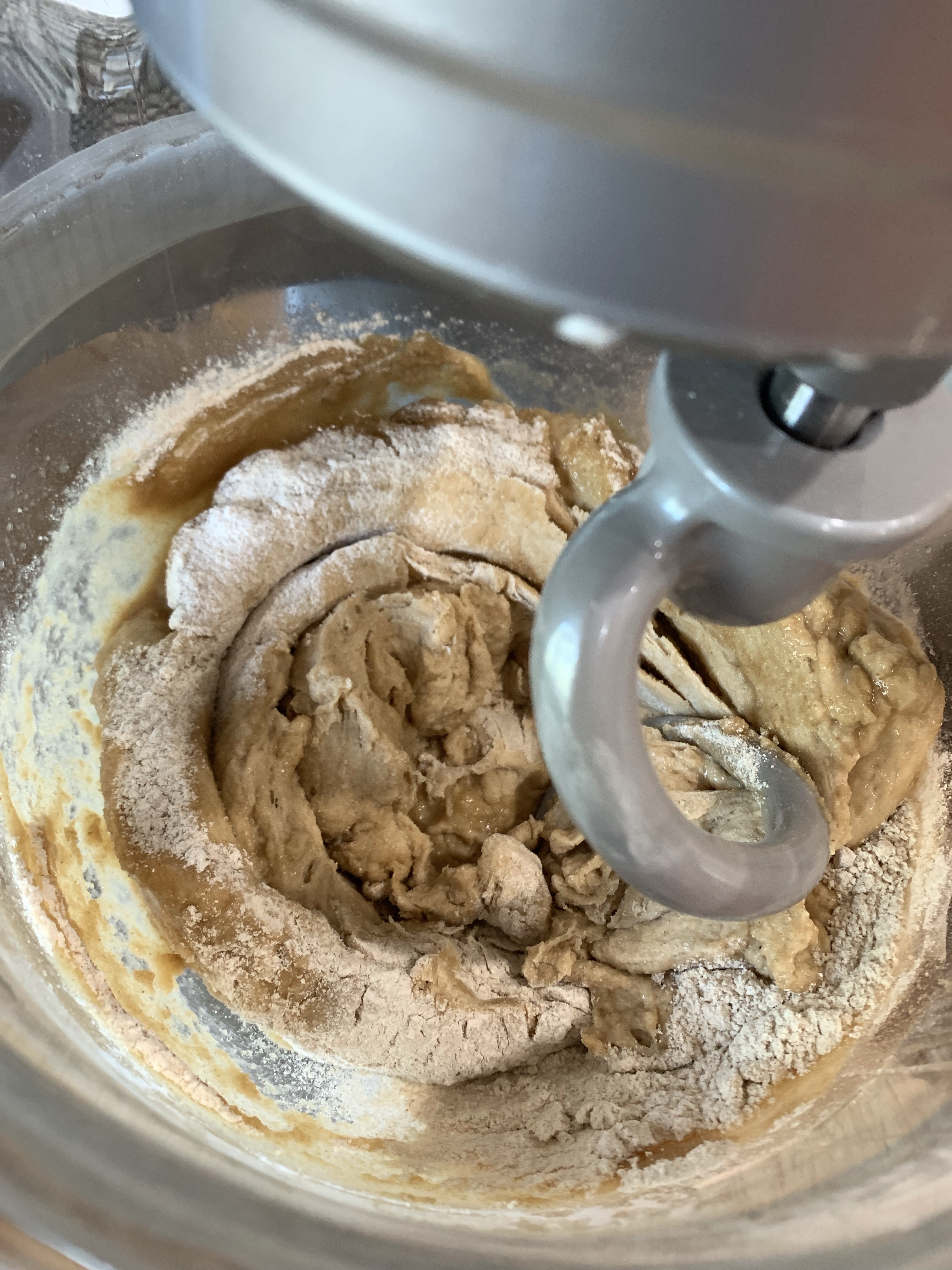
Add pumpernickel flour to water mixture.
Add cocoa, yeast, and salt, Vital Wheat Gluten, lemon juice and stir until blended.
Let mixture sit for 10 minutes.
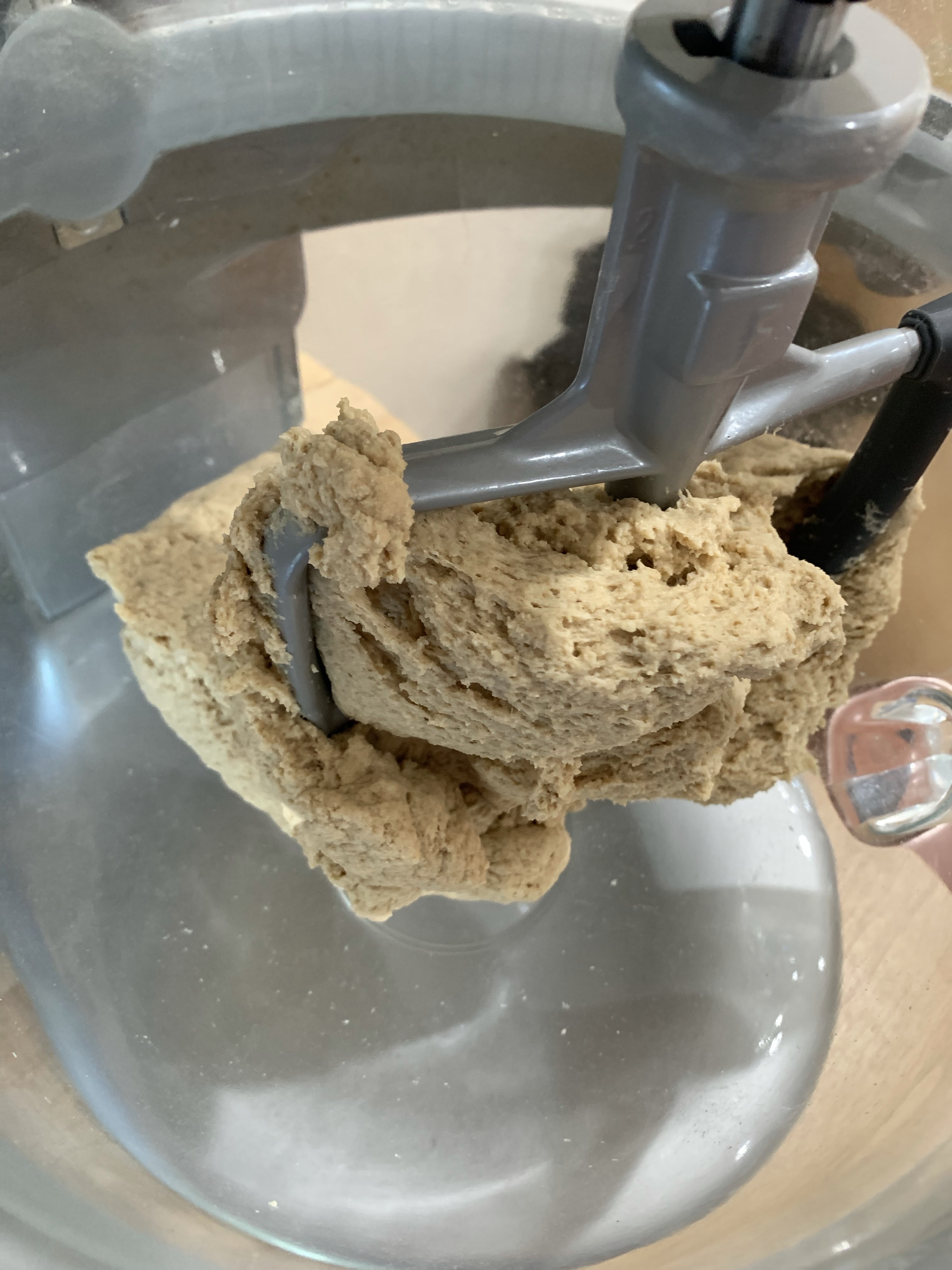
Stir in bread flour, one cup at a time, until dough clings to hook and almost clears the sides of mixer, about 3-4 minutes.
Continue to knead with the dough hook for 6-8 minutes
Turn dough out on a lightly greased counter and knead by hand for 5-8 minutes until the dough is smooth and supple.
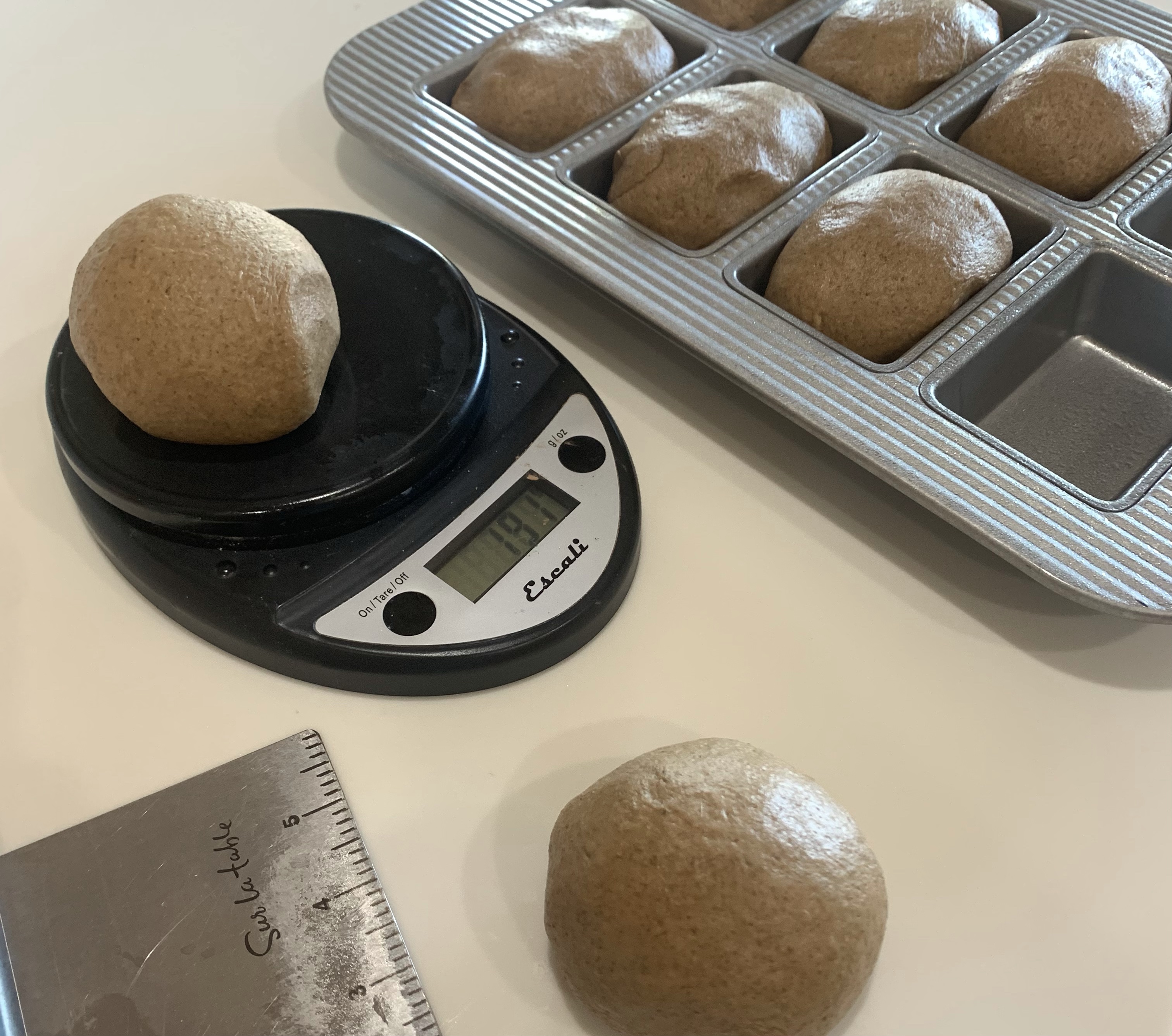
Divide dough by weight into 8 equal portions. Mine were 192 g each.
Place each portion into a mini loaf pan and dust with rolled oats.
Allow dough to rise in until it is about 1 inch above the the edge of the pan, about 30-60 minutes. Take note of how high the bread is before starting proof. Mine was almost an inch to begin and I let it rise to 1 1/2 to 2”. There was a lot of oven spring also.
Toward the end of the rising time, preheat oven to 350 F.
Bake at for 18-25 minutes. (Internal temp should be 190-200 deg. F)
While on vacation I stopped by King Arthurs store in Norwich, Vermont. They had lots of real cool stuff that I didn’t need, so only bought a shopping cart full. One pan that I didn’t need and bought was their mini-loaf pan. There will be more cool stuff to come.
I have a new recipe for soft, light, fluffy whole wheat bread. I rarely have any luck in making whole wheat bread light and fluffy, but keep trying.
This pan was excellent and the recipe even better. I believe one ingredient and two method instructions make the difference. The ingredient is Vital Wheat Gluten. I use this with any flour that doesn’t have high gluten content such as wheat, pumpernickel, etc. I needed to replenish my supply and luckily the KAF store had it in stock. (OK, this was one thing I needed.) The two method steps that helped were to let the dough rest for 15 minutes before adding the balance of the flour and second, after the mixer finishes kneading the dough, give it a 5-10 minute hand kneading.
INGREDIENTS • 5-6 cups whole wheat flour • 1 1/2 tablespoons instant yeast • 1/4 cup vital wheat gluten (see note) • 2 3/4 cups warm water • 1 tablespoon lemon juice (bottled or fresh) • 1/3 cup oil • 1/3 cup honey • 1 tablespoon salt
METHOD
In the bowl of a stand mixer fitted with the dough hook, mix together 3 cups of the whole wheat flour, yeast, and gluten. Add the warm water and mix well. Cover the bowl and let the mixture rest for 10-12 minutes.
Add the lemon juice, oil, honey, and salt. Mix on low speed.
With the mixer running on low speed, continue adding flour 1/2 cup at a time until the dough pulls away from the sides of the bowl (don’t over-flour! A little stickiness is ok as long as the dough forms a ball and doesn’t leave a lot of residue on your fingers).
Let the mixer knead the dough for 5-6 minutes until the dough is soft and smooth.
Turn the dough onto a lightly greased counter and divide in eights. (I found each loaf to be 159 g.) Shape each half into a taut loaf and place in a lightly greased mini-loaf pan (8 loaves per pan.)
Cover the loaf pan and let the loaves rise until they are 1-2 inches above the edge of the loaf pan.
Preheat the oven to 350 degrees F. Make sure an oven rack is in the middle/center position. Bake the loaves for 28-32 minutes until golden and baked through (an instant-read thermometer should register 180-190 degrees in the center of the loaf).
Turn the bread onto a wire rack. Brush the tops with butter, if desired. Let cool completely.
NOTES Letting the Dough Rise: this bread recipe does not require the dough to rise before being shaped into loaves and letting the loaves rise in the bread pans. However, if you find your bread is a little dense after baking and cooling, letting the dough rise after kneading may help with that, as well as making sure the dough isn’t over floured.
Vital Wheat Gluten: is often found in the baking aisle at the grocery store (near the flour). Many brands of vital wheat gluten have Vitamin C added; those are ok to use in this recipe. I buy mine at KAF.
RASPBERRY/PLUM JAM
Left: Simmering Fruit. Center: Spider Strainer Removing Skins. Right: Gel Test
INGREDIENTS • 1 lb raspberries (454 grams) • 3 lbs plums , sliced and pits removed (leave skins on) (1360 grams) (picked from our tree) • 5 cups granulated sugar (1000 grams) • ½ cup bottled lemon juice (120 ml) • Zest of 1 orange (picked from neighbors tree)
METHOD
Combine the raspberries, sliced plums, sugar, lemon juice, and orange zest in a large heavy-bottomed pot. Place over medium high heat and stir frequently as the sugar dissolves and the fruit begins to release its juices.
Continue to cook, stirring frequently as the jam simmers and thickens. Skim any foam off of the surface with a spoon.
While the jam is simmering, remove plum skins with a spider strainer. Clean the strainer often to reduce the amount of jam removed.
Place a plate in the freezer and when the jam thickens wipe a little on the plate and return to the freezer for 2 minutes. Repeat until the jam stops running and has the consistency you want. Mine heated to 220 deg F.
Once the jam is reduced and thickened, remove from heat and ladle jam into sterilized jars. Top with a lid and screw on with a ring. This recipe made 7 half pints.
Process jars in a water bath for 10 minutes (15 minutes for 5,000+ ft elevation). Remove from water bath and let cool. Check that lids have sealed by pressing down into the center of each one. It should not move.
Store jam in a cool dry place like a pantry and consume within 1 year.
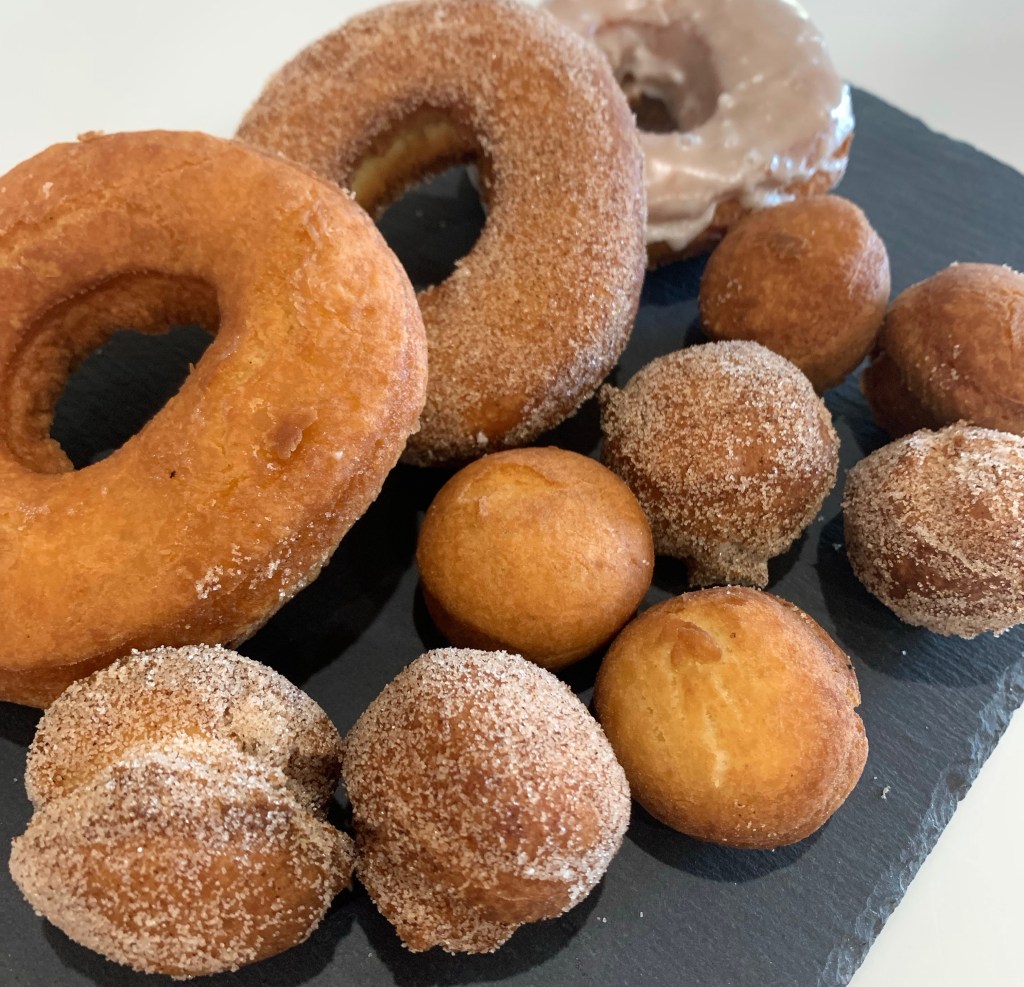
My QC department stumbled across a new recipe for cake donuts. “Maybe you would like to try it sometime.” Now if that isn’t throwing the gauntlet down, I don’t know what is.
This recipe makes about a dozen so topped a third of them with vanilla glaze and coated a third with cinnamon/sugar. They were excellent. The plain have always been my fav’s.
Be sure to keep the temperature as close to 350 deg F as you can. Adjust the temperature if need be between batches. I could fit 4 donuts at a time into my large skillet. My temperature was a little hot for the first few donut holes so they turned dark before the centers were fully cooked. Temperature is very important!
INGREDIENTS • 1 ½ cup sugar, divided • 1 teaspoon salt • ½ teaspoon nutmeg • 1 tablespoon baking powder • 2 eggs • ¼ cup unsalted butter, melted • 1 cup whole milk • 4 cups flour • Oil (for frying) • 2 tablespoons cinnamon Glaze (to glaze 5 or 6 donuts) • 1 Cup confectioners sugar • 3 Tbl Whole cream • ½ tsp vanilla
METHOD
In a large bowl, combine one cup of sugar, salt, nutmeg, and baking powder.
Add the eggs, melted butter, and milk to the bowl, then mix.
Add the flour to the dough, beating well until everything is combined. Cover the dough with plastic wrap and refrigerate for one hour.
Remove the dough from the fridge. In a large frying pan or Dutch oven, heat about one inch of oil to 360 degrees Fahrenheit.
While the oil heats, roll out the dough to about ½ inch thickness on a well-floured surface. Use a donut cutter to cut out circles in the dough. If you don’t have a donut cutter, you could use a biscuit cutter or glass, then a bottle cap for the donut hole. Continue rolling out the dough and cutting out donuts until there’s no dough remaining.
Gently drop the donuts into the hot oil in batches, making sure not to overcrowd the pan. Cook each side for approximately two minutes, until golden brown, then flip over. Remove the cooked donuts from the oil and place them on a paper towel-lined plate.
In a small bowl, combine ½ cup of sugar and cinnamon. Dip the donuts in the cinnamon-sugar mixture before serving.
Glaze
Warm cream (or milk) until steam rises from the surface
Add vanilla
Whisk in sugar until incorporated
Dip donuts into glaze and set aside to cool and harden about 30 minutes.
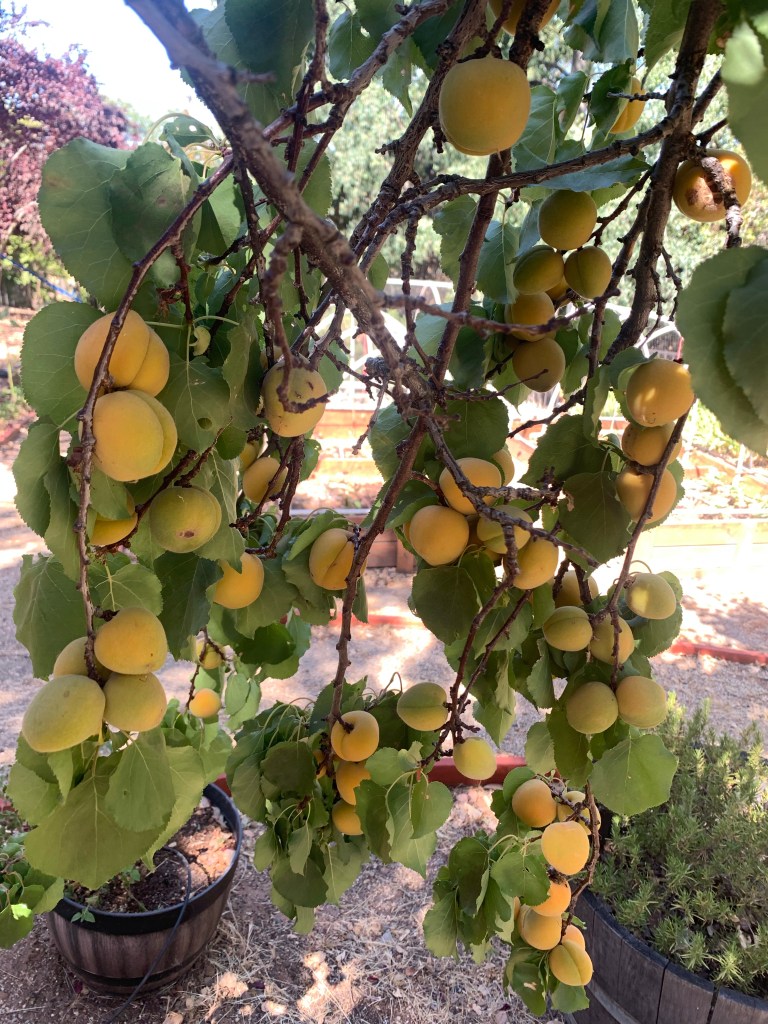
‘Tis the season for apricots to ripen. Actually, it seems a little early this year. I topped and pruned our apricot tree this winter and it paid off. The limbs are full of fruit and I am picking about 6 dozen a day off the ground. (I put down tarps to protect them when they fall.) We will probably start the real picking this weekend.
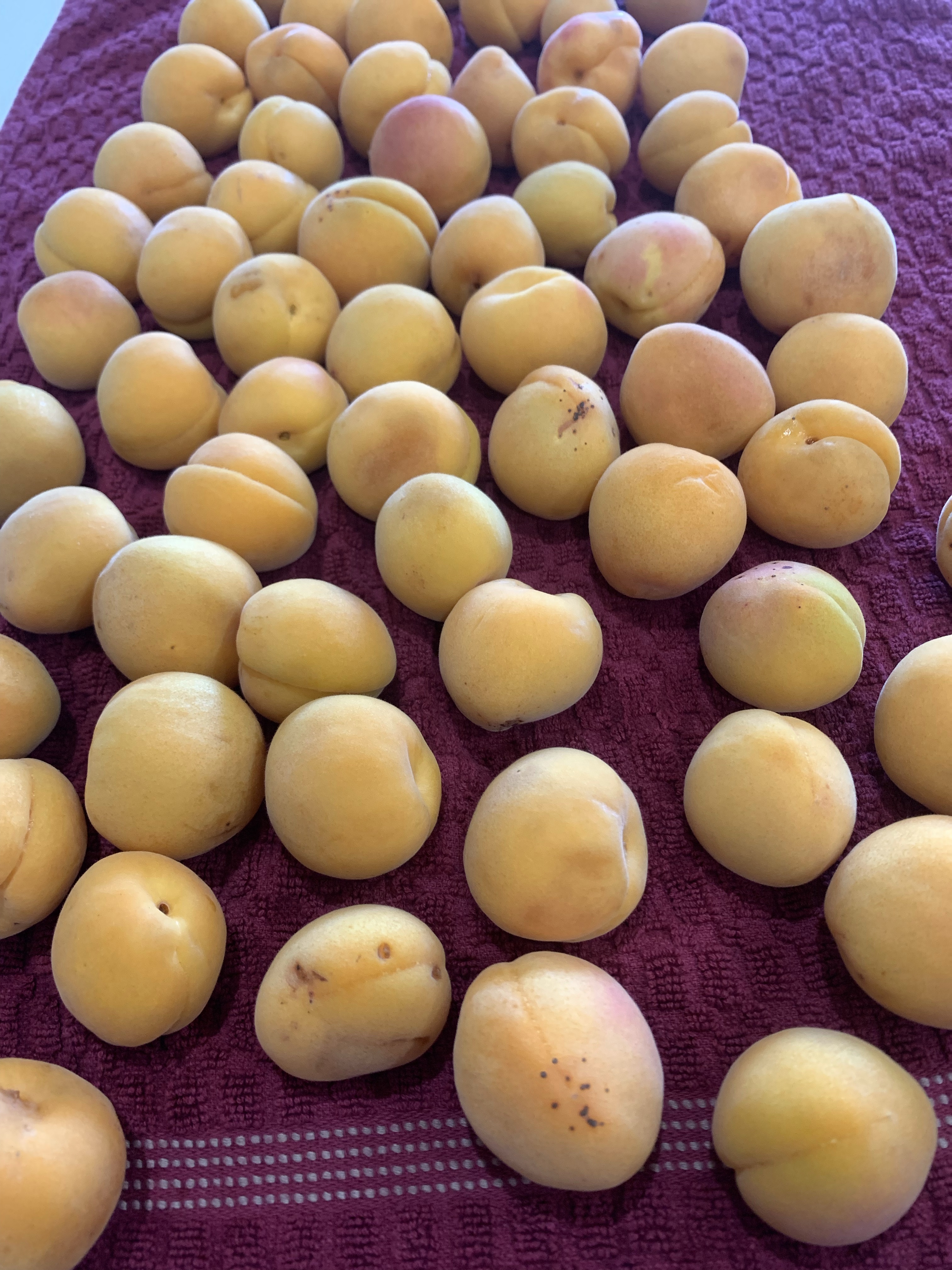
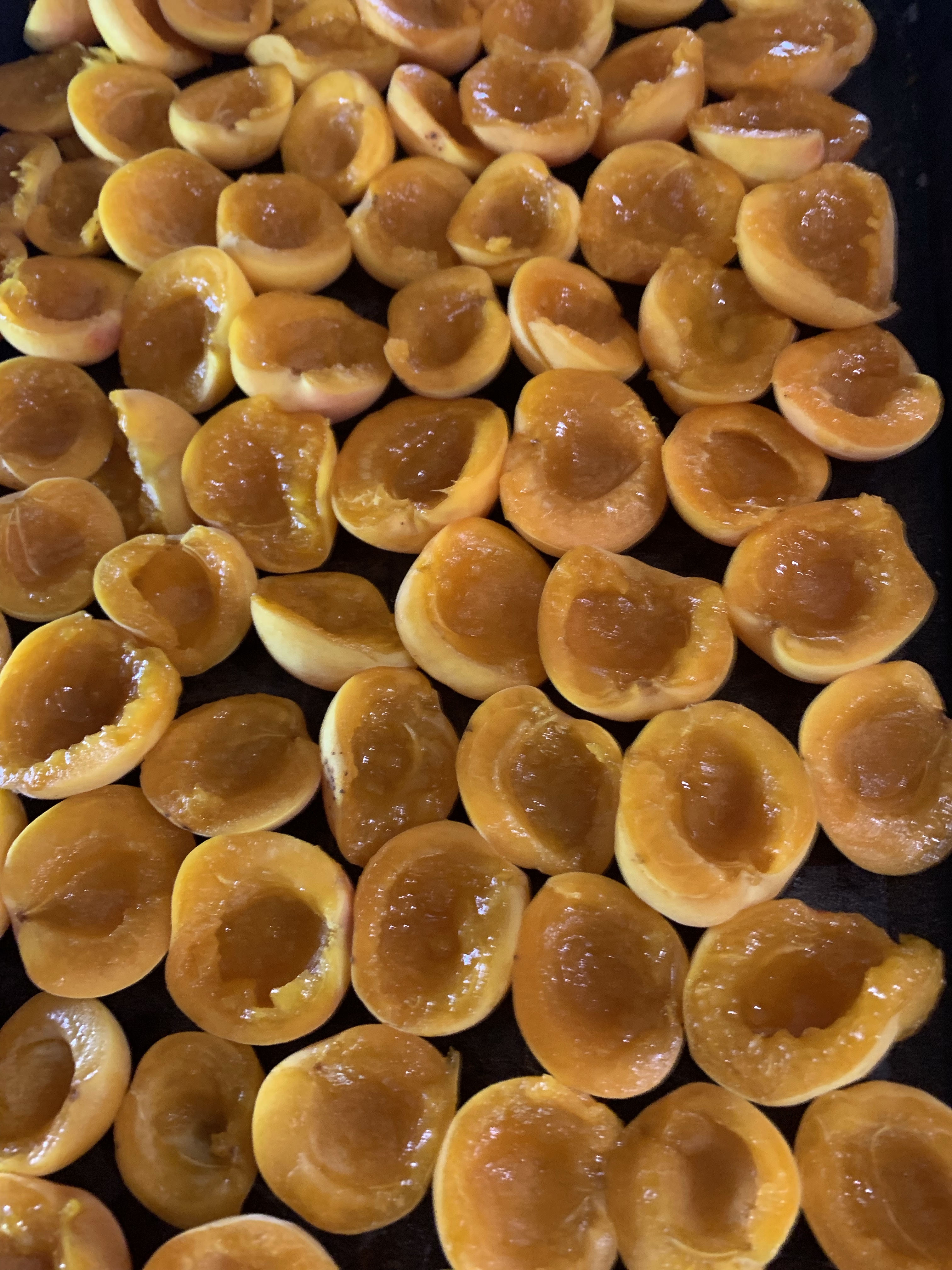
I froze 3 dozen yesterday, gave away 3 dozen today and picked up another 4 dozen just now. They were washed dried and sliced in half to remove the pit. Then arranged on a baking sheet and put into the freezer for a day. After they are frozen solid, I transfer them to freezer ziplock bags for storage until I can use them
I am thinking apricot pies, tarts or maybe apricot smoothies. I am guessing I have “harvested” 10% of the crop. Yumm!!
I am making my granddaughters birthday cake. Like so many girls she is really into unicorns, hence a Unicorn Cake. This will be a three tier cake, 10”, 8” and 6”. The 6” layer will have a unicorn cake topper and a multicolored flowing mane down the back. Check out that post in a few days.
The base will be my Extreme Chocolate Cake (my favorite) and the center will be a Heavenly White Cake, which is a blend between white and angel food cake. Again, stop back next week for details
Right now I am describing the strawberry cake recipe that I adapted from my Heavenly White Cake. The trick to this cake lies in the strawberry puree reduction. Placed sliced strawberries in a food processor and pulse until it is a puree. Place the puree in a small saucepan and with occasional stirring, reduce to about half the volume. This will take 30 – 40 minutes. Cover and place in the fridge until cool, (Overnight would be fine.)
I also added 1/4th tsp of strawberry extract to enhance the flavor. Any more would make it taste artificial. The Heavenly White Cake uses a cup of plain milk (I use 2% low calcium as that is what we stock in the home.) For the strawberry version I added 1 Tbl of vinegar to 1/2 cup of milk. This makes a pseudo buttermilk. I also added 1/4 cup of heavy cream hoping the final cake would be moist. The 1/2 cup strawberry reduction added the balance of the liquid.
For my test cake this recipe made two 6” and one 5” round cakes, 2” high. They required about 30 minutes to bake. I checked it using the spring back test, clean tooth pick check and measuring the center of the cake to be 210 deg F.
Overall, I was pleased with the moisture, flavor and texture of the cake. Combined with the Heavenly White and Extreme Chocolate cakes, marshmallow fondant and buttercream frosting, it should be a Unicorn Spectacular!
Heavenly Strawberry Cake
INGREDIENTS • 2¾ cups sifted cake flour • 4 teaspoons baking powder • ¾ teaspoon salt • 4 egg whites • 1½ cups white sugar • ¾ cup butter • ½ cup milk (add 1 Tbl vinegar to make “Buttermilk” equivalent milk) • ¼ cup heavy whipping cream • 1 teaspoon vanilla extract • ¼ tsp strawberry extract • ¼ tsp red food coloring • ~250 g diced strawberries
METHOD
The day before baking: Puree strawberries and reduce to ½. This will take 20-30 minutes. Place in the refrigerator, covered, overnight.
Measure sifted flour, baking powder, and salt; sift together three times.
In a mixing bowl, beat egg whites until foamy. Add 1/2 cup sugar gradually, and continue beating only until meringue will hold up in soft peaks.
Cream butter or margarine. Gradually add remaining 1 cup sugar, and cream together until light and fluffy. Add sifted ingredients alternately with milk a small amount at a time, beating after each addition until smooth. Mix in flavorings. Add meringue, and beat thoroughly into batter.
Whisk in ½ cup of puréed strawberries.
Add ¼ tsp red food coloring, mixing well. (Optional)
Spread batter in a 15 x 10 x 1 inch pan which has been lined on the bottom with parchment paper.
Bake at 350 degrees F (175 degrees C) for 30 to 35 minutes. Cool cake in pan 10 minutes, then remove from pan and transfer to a wire rack to finish cooling. This cake may also be baked in two 9 inch round pans for 30 to 35 minutes, or in three 8 inch round pans for 25 to 30 minutes.
I love berries, all kinds of berries, but far and away raspberries are my favorite. I saw a recipe for sugar free strawberry mousse and modified it to a raspberry mouse. Feel free to change it back or re-modify to whatever berries you have on hand.
This simple mousse is quick and easy to make. After my initial try I would suggest making the berry puree and chill it before folding it into the whipped cream. Also, be sure to beat the cream into very stiff peaks. I would also chill the bowls in which you will store/serve the mousse. All these precautions will help keep the mousse firm. Don’t worry if you don’t. It will still be fresh and delicious.
Sugar Free Raspberry Mousse
INGREDIENTS
• 354g raspberries (3/4 pound) • 100g Splenda • 238g whole or whipping cream (cold) • extra raspberries for topping
METHOD
Clean and slice the raspberries, In a blender or food processor add the raspberries, Splenda and puree. Remove 1/2 a cup of puree and set aside.
Place serving bowls in the refrigerator to chill before filling.
In a cold bowl add the cream and beat until very stiff peaks form. Then fold in the remaining puree (not the 1/2 cup) gently.
Divide the 1/2 cup of puree between the 4 small/medium glasses and top with the raspberries mousse.
Refrigerate for approximately 1 hour or even over night if desired. Top with fresh raspberries and serve.
We love shortbread cookies, and we love chocolate. Combining the two is a step from ecstasy. Also, this gave me the excuse… I mean opportunity… to use the hexagonal cookie cutters Fran (aka QC) bought me.
Using hexagonal cutters reduces dough waste as there are no gaps between each cut.
Hexagonal Cookie Cutters with the one used on the lower right.
L: Rolled out, cut dough. R: Cut cookies on baking tray.Shortbread Cookies surrounded by Raspberry Hand Pies.
Shortbread Cookies
INGREDIENTS • 3/4 pound unsalted butter, at room temperature • 1 cup sugar, plus extra for sprinkling • 1 teaspoon pure vanilla extract • 3 ½ cups all-purpose flour • ¼ teaspoon salt • 6 to 7 ounces very good semisweet chocolate, finely chopped
METHOD
Preheat the oven to 350 degrees F.
In the bowl of an electric mixer fitted with a paddle attachment, mix together the butter and 1 cup of sugar until they are just combined. Add the vanilla.
In a medium bowl, sift together the flour and salt, then add them to the butter-and-sugar mixture. Mix on low speed until the dough starts to come together. Dump onto a surface dusted with flour and shape into a flat disk. Wrap in plastic and chill for 30 minutes.
Roll the dough 1/2-inch thick and cut with a 3 by 1-inch finger-shaped cutter. Place the cookies on an ungreased baking sheet and sprinkle with sugar. Bake for 20 to 25 minutes, until the edges begin to brown. Allow to cool to room temperature.
When the cookies are cool, place them on a baking sheet lined with parchment paper. Put 3 ounces of the chocolate in a glass bowl place over a pan of boiling water. Turn the burner down to simmer and heat with stirring until the chocolate is nearly all melted. Stir vigorously until the chocolate is smooth and slightly cooled; stirring makes it glossier.
Drizzle 1/2 of each cookie with just enough chocolate to coat it.