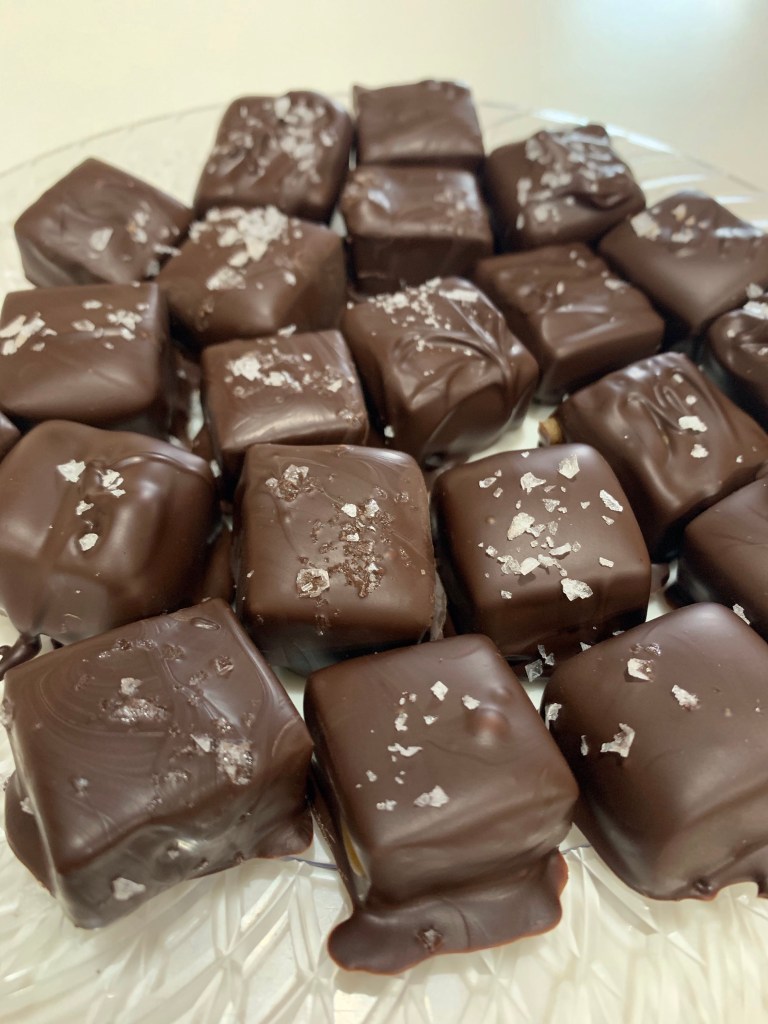
So, what do you do as you are waiting for your dinner rolls to proof? Well, If you have an 11 pound bag of chocolate, 60 pieces of 1”x1” caramel, making salted chocolate covered caramels is a good way to pass the time.
I cut the caramels a day ago, tempered the chocolate, dipped and drained the coated caramel and sprinkled some Maldon flaked sea salt on each.
The chocolates were setting as the first proof of the rolls completed. The proofed dough weighed 1,553 grams, so to make 24 rolls, each had to weigh about 63 g. I weighed each, formed them into a small ball and rolled them on the counter to tension the surface of the roll.
I arranged them 4×6 in a glass baking tray and baked at 375 deg until the internal temperature was 180 deg. (about 20 min.) Once out of the oven, a light brush with melted butter and boom. Excellent dinner rolls! The recipient and methods for both the dinner rolls and chocolates are found elsewhere in this blog.
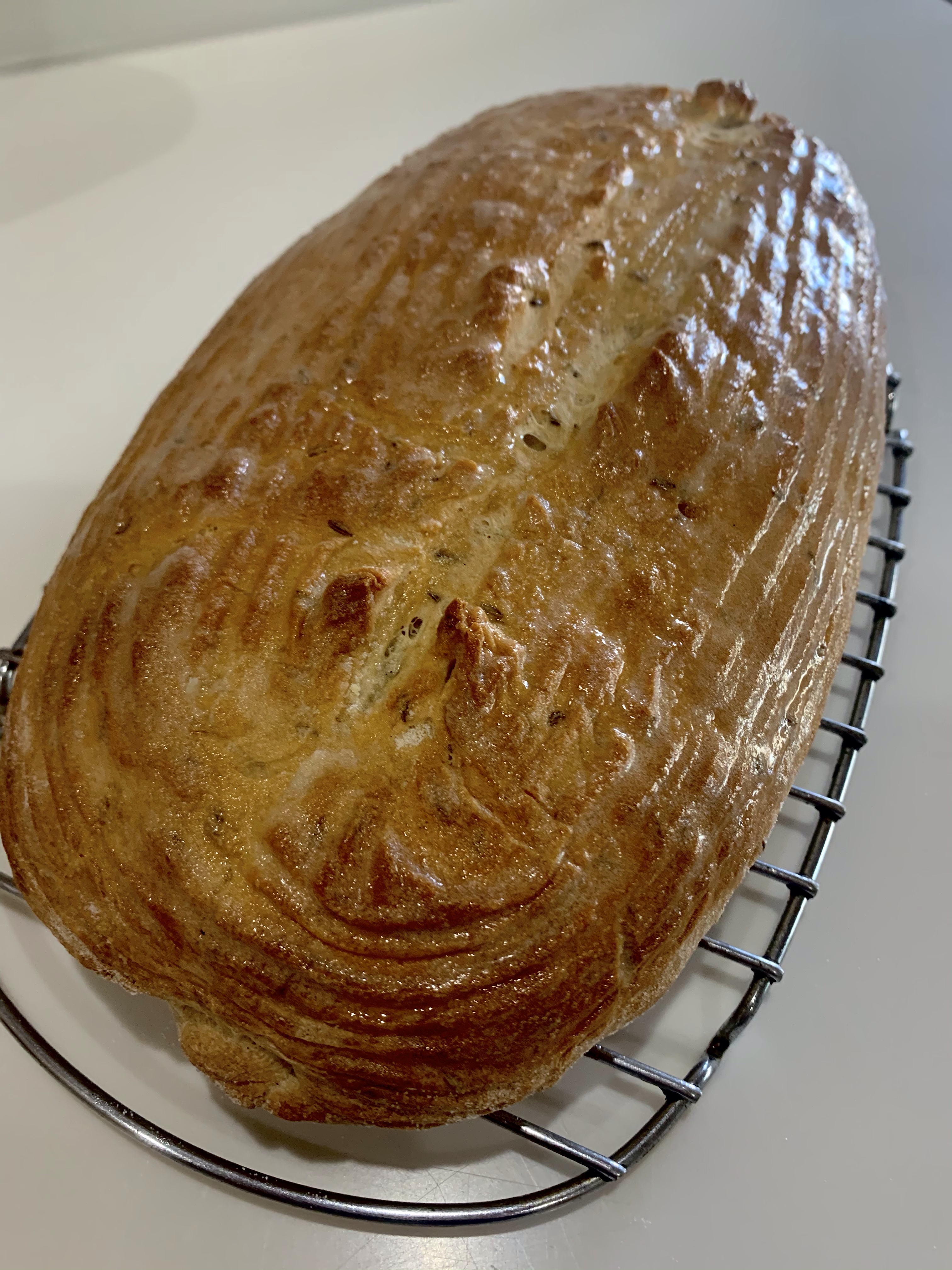
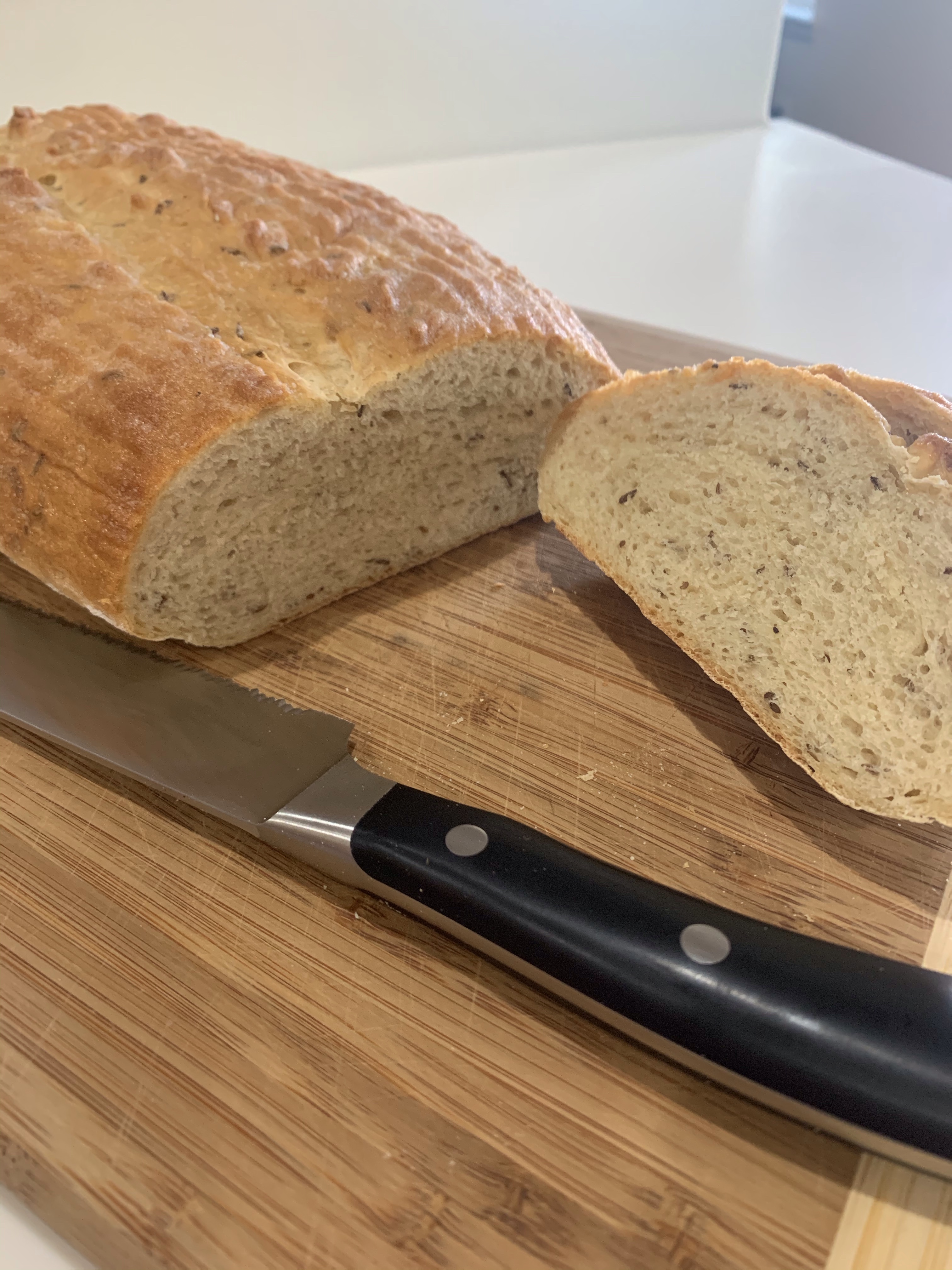
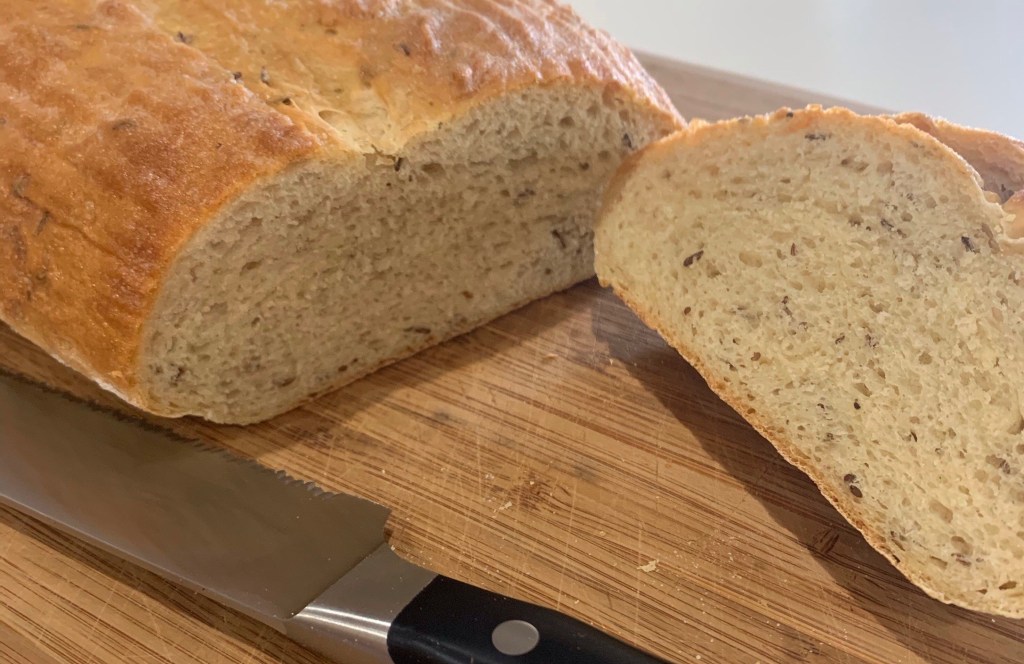
I was going to continue the experiment with Part 3, but wanted to try this new recipe I found at ayearinbread.blogspot.com. It’s interesting as it uses bread flour, molasses and citric acid. It had a good flavor, crumb and a great crust. Oh, I also needed to make a few (3) loaves of white sandwich bread for PB&J lunches. The oddest thing happened with the white bread. Two of the loaf rose nice and round, but one fell. No idea.
• INGREDIENTS • rye flour 1 c 146 g • bread flour 2 1/4 c 330g • instant yeast 1 tsp • wheat gluten 1 1/2 tbsp • citric acid (sour salt) 1/4 tsp • caraway seeds 2 tbsp 20g • molasses 1 1/2 tbsp • butter melted 1 tbsp • table salt 3/4 tsp • water 1 c + 2 tbsp 256 g
Egg Wash • egg 1 • water 1 tbsp
METHOD
In the bowl of a stand mixer using the paddle attachment, mix together the yeast, gluten, citric acid, caraway seeds, rye flour, and 2 cups (280g) of bread flour. Add salt and mix in. (Note, the salt is added after mixing the original ingredients to minimize it’s direct contact with the yeast, which it can kill).
In a measuring cup, mix together water, molasses, and butter using a small whisk. With the motor running at low speed, pour liquid into dry ingredients. Once moistened, switch to the dough hook and finish blending. The dough should be moist and sticky, add just enough additional flour, a tablespoon at a time, to have dough clear the sides of the bowl. Increase speed to medium and knead for eight minutes. (Note, dough will clear sides but stick to bottom, scrape it up with a rubber spatula every couple of minutes.)
Scoop dough onto a lightly floured surface and knead lightly a few times then form into a ball. Place the dough in a bowl sprayed with cooking oil, spritz top with oil, and cover tightly with plastic wrap. Allow to rise until doubled in bulk — about 1 1/2 hours.
Gently deflate dough, scoop onto a lightly floured surface, fold a few times, and allow to relax for about five minutes. Shape dough into a loaf and place on a piece of parchment on your peel or on a baking sheet. Lightly spritz tops with oil and cover with plastic. Allow to rise until doubled in size, about 1 hour. In the meantime, heat oven to 400F (200C) and place rack in center position. (Note: it’s important to give the oven a long preheat before baking, particularly if you’re using a baking stone.)
Whisk together egg and 1 tablespoon of water in a small bowl. Brush loaf with egg wash and bake for 15 minutes. Rotate rack front to back and continue baking 15 to 20 minutes until golden brown. The interior should read 190F on an instant read thermometer.
Oops! I used the pumpernickel flour but forgot to use First Clear instead of AP flour. The plan was to use the best combination of ingredients to make the best loaf of rye bread.
I made two small free form boules. They held their shape really well.
Maybe tomorrow I will read my own instructions all the way through before baking. The results were pretty darn good today, though!
As I said in Part 1, this variation will simply substitute First Clear Flour for the White Rye in Part 1. I added an egg/water wash to this loaf to increase the color of the bread. I did not coat the finished warm bread with butter, which darkened the Part 1 loaf. I also baked it in the bottom of a Dutch Oven to help keep its shape. (No real difference.) I won’t publish the recipe again, just go to Part 1 and make the change noted above.
Part 2 Rye Bread
Manufacturing reports the crumb may be a little better. The holes are slightly larger and more evenly distributed. The crust is a little chewier and darkened just about right. The rise was higher. QC has yet to report.
Part 3 will substitute Rye Bread Improver for the Vital Wheat Gluten. I am thinking Part 4 will be the winner of Parts 1-3 and substituting pumpernickel flour for the other rye flour. Stay tuned.
Fran and I are self quarantining so we can join Daniel and Frances’s “pod” for Christmas and New Years. To pass the days I decided to experiment with variations of rye bread recipes. KAB has a good, basic caraway seed rye bread recipe, which I used as a starting place. (Recipe below.)
Following the recipe as written resulted in a well risen, soft rye bread with a good crumb. Today’s roast beef sandwich with lettuce, jalapeños and lettuce was excellent.
The first variation is to replace the white rye flour with first clear flour. In case you were wondering first clear flour is what remains after milling patent flour. It compensates for the low gluten content of rye flour. It is the traditional flour used in Jewish bakeries and adds loftier rise and better chew. This variation will be in the next post, The Rye Experiment, Part 2.
No, I didn’t have to buy anything for this experiment. Here is a picture of my specialty flour cupboard. Standard flours (AP, bread, whole wheat, pumpernickel,) are kept in a separate storage unit.
Caraway Rye Bread KAB
https://www.kingarthurbaking.com/recipes/caraway-rye-bread-recipe INGREDIENTS • 1 cup (227g) lukewarm water • 1 cup (106g) white rye, medium rye, or pumpernickel flour • 4 teaspoons (14g) sugar • 2 1/4 teaspoons instant yeast • 1/2 cup (113g) sour cream (low-fat is fine; please don’t use nonfat) • 1 to 2 tablespoons (7g to 14g) caraway seeds, to taste • 1 1/2 teaspoons salt • 2 1/3 cups (280g) King Arthur Unbleached All-Purpose Flour or First Clear Flour • 3 tablespoons (25g) vital wheat gluten or rye bread improver, optional, for best rise
METHOD
In a medium-sized mixing bowl or the bowl of your stand mixer, combine the water, sugar, rye flour and yeast, mixing to form a soft batter. Let the mixture rest for 20 minutes; this allows the rye flour to absorb some of the liquid, making the dough easier to knead.
Add the remaining ingredients, and mix and knead the dough together — by hand, mixer or bread machine — until it’s fairly smooth. The nature of rye dough is to be sticky, so don’t be tempted to add too much flour.
Place the dough in an oiled bowl or large (8-cup) measure, cover, and let it rise until noticeably puffy, 60 to 90 minutes.
Gently deflate the dough, knead it briefly, and shape it into two smooth oval or round loaves; or one long oval loaf. Place them on a lightly greased or parchment-lined baking sheet.
Cover the loaves, and let them rise until they’re noticeably puffy, about 90 minutes. Towards the end of the rise, preheat the oven to 350°F.
Just before they go into the oven, spritz the loaves with water, and slash them about 1/2″ deep. The oval loaves look good with one long, vertical slash; the rounds, with two or three shorter slashes across the top.
Bake the loaves for 35 to 40 minutes, or until an instant-read thermometer inserted into the center reads 205°F to 210°F. The single, larger loaf will bake for 45 to 50 minutes. If the bread appears to be browning too quickly, tent it lightly with foil after 25 minutes of baking.
Remove the loaves from the oven, and transfer them to a rack. While still warm, brush them with melted butter, if desired; this will keep their crust soft.
I am sure most of you are experts at making and baking Parker House Rolls, but I saw a recipe from KAB a week before Thanksgiving and thought I would give them a try.
Making the enriched dough is pretty standard, although this recipe calls for 50g of potato flour. Substituted in any yeast bread potato flour increases the moisture content. Along with the egg and milk this results in a smoother enriched dough than you would expect from 55% hydration bread. (100* weight liquid/weight flour.)
Forming the rolls is what makes the Parker House Rolls distinctive. The dough is rolled out, folded and cut into 3” portions. (See METHOD below for exact steps.) Butter painted onto the inside of the rolled dough, plus the additional butter coating the finished product after baking makes these moist, tender and very buttery. Easy to do and delicious.
Cut lengthwise and folded
Measured and cut
Finished cutting
In the pan, loose edge down
Finished Rolls
Parker House Rolls
INGREDIENTS • 3 cups (361g) King Arthur Unbleached All-Purpose Flour • 2 ½ teaspoons instant yeast • 3 tablespoons (39g) sugar • 1 ¼ teaspoons salt • ¼ cup (50g) potato flour or 3/4 cup (50g) dried potato flakes • 3 tablespoons (43g) butter • 1 cup (227g) milk • 1 large egg • 3 ½ to 4 tablespoons (50g to 57g) butter, melted; for brushing on rolls
METHOD
In a large mixing bowl, or in the bowl of an electric mixer, combine all of the ingredients (except the 3 ½ to 4 tablespoons (50 to 57g) melted butter at the end), mixing to form a shaggy dough. Note: to speed the rising process, whisk together the milk and egg, and heat gently just enough to remove the refrigerator chill; then add to the remaining ingredients.
Knead the dough, by hand (10 minutes) or by machine (7 to 8 minutes) until it’s smooth.
Place the dough in a lightly greased bowl or 8-cup measure (so you can track its rising progress). Allow it to rise for 90 minutes; it’ll become quite puffy, though it probably won’t double in bulk. Note that the dough takes quite awhile to get going; after 1 hour, it may seem like it’s barely expanded at all. But during the last half hour, it rises more quickly.
Transfer the dough to a lightly greased work surface. Divide it in half. Working with one half at a time, roll or pat the dough into an 8″ x 12″ rectangle.
Brush the dough all over with a light coating of the melted butter. You’ll have butter left over; you’ll need it for the other half of the dough, as well as for brushing on top of the baked rolls.
Cut the dough in half lengthwise, to make two 4″ x 12″ rectangles. Working with one rectangle at a time, fold it lengthwise to about ½” of the other edge, so the bottom edge sticks out about ½” beyond the top edge. You’ll now have a rectangle that’s about 2 ¼ ” x 12″. Repeat with the other piece of dough.
Cut each of the rectangles crosswise into four 3″ pieces, making a total of 8 folded rolls, each about 2 ¼” x 3″. Flip the rolls over (so that their smooth non-folded side is facing up), and place them in a lightly greased 9″ x 13″ pan. Repeat with the remaining piece of dough, making 16 rolls in all. You’ll arrange 4 rows of 4 in the pan, with the longer side of the rolls going down the longer side of the pan. Gently flatten the rolls to pretty much cover the bottom of the pan.
Cover the pan, and let the rolls rise for about 45 minutes to 1 hour, until they’re puffy but definitely not doubled. Towards the end of the rising time, preheat the oven to 350°F.
Bake the rolls for 20 to 25 minutes, until they’re golden brown and feel set.
Remove them from the oven, and brush with the remaining melted butter. Pull them apart to serve.
I saw a video for this bread on Cookist. I found a recipe and a comment at the bottom said it was not very bananaee (my word) and they were correct. Hence, Hint ‘O Banana. It is a very nice soft loaf and easy to make. I am wondering if I upped the amount of banana in the dough if it would increase the bananaee flavor. It really is a good bread just the way it is, but if you were expecting overwhelming banana flavor, like in a traditional banana bread, you will be disappointed. Definitely NOT your, your Mama’s or your Grammies’ banana bread!
This loaf also provided the opportunity to buy two new baking pans. Great for oblong cakes, cheese cakes, bread etc.
The bread has a very mild banana flavor. I wish I weighed the banana before mashing it into the dough. It was a small one. Next time I will try two small ones or one large one and adjust other liquids. I think I will modify the method to incorporate a tangzhong. Stay tuned.
Banana Bread Loaf
INGREDIENTS • 350 g Bread Flour • 30 g Caster Sugar • 1 tsp salt • 2 Tbl Milk Powder • 1 very ripe banana • 1 egg • 70 ml milk • ½ tsp yeast • 40 g unsalted butter, cubed.
METHOD
Sift flour into mixing bowl of stand mixer and add dry ingredients and mix
Mash banana and add to mixing bowl
Whisk egg and milk together then add to bowl
Add yeast
Mix on medium with dough hook until stiff dough is formed. Add additional milk if necessary
Add cubed butter, a piece at a time, continue on mixing speed 2 for 20 min
Knead by hand, form into a ball, tension surface
Let rise, covered for 60 min
Knock down dough, flatten into an oval and divide in half
Flatten, do envelope fold, turn 90 deg and repeat envelope fold
Form into a ball, tension surface
Cover and let rest 15 minutes
Butter bread trays
Roll each ball out about 6-8” long, roll up into a batard, pinch seams and ends closed
Roll under curved fingers slightly to tension. Don’t apply pressure.
Cut into 1” wide pieces, but not all the way through, keeping loaf together Should be about 10 pieces
Pick up carefully and place into bread pan
Cover and let rise 60 minutes
Bake at 350 for 17-20 minutes until internal temp is 195-200F
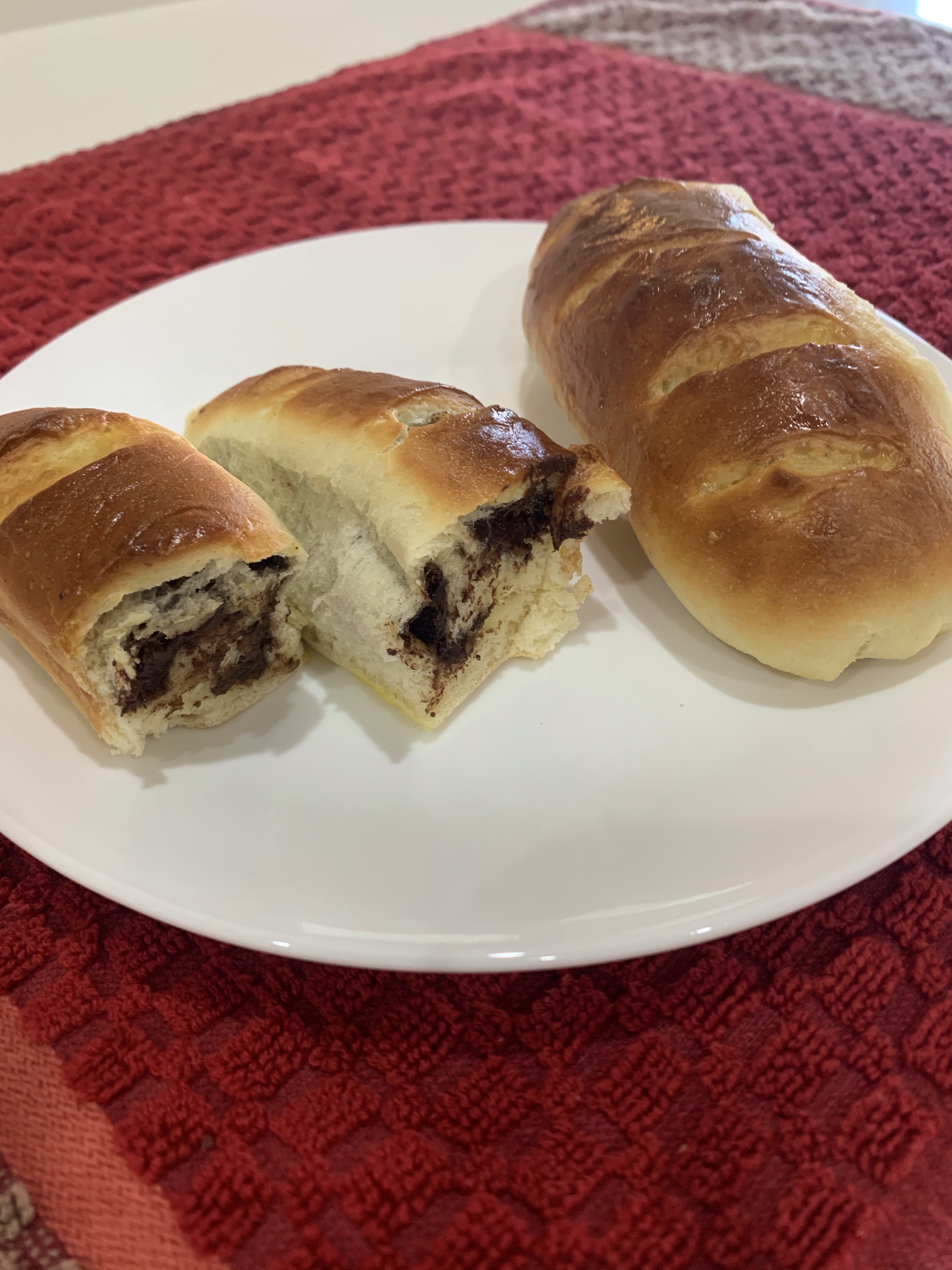
I saw a picture of an elongated bread roll, like a hot dog roll, but slashed with a lame and the slashes were filled with lemon curd before baking. Well, I couldn’t find the recipe so decided to create my own. This is the first time I have stepped out of my chemist-trained-recipe-following comfort zone.
I also decided, since I don’t really care for lemon curd, I would instead roll chocolate ala pain au chocolat but using an enriched bread dough instead of puff pastry. This was also an excuse to use some of the 11# of chocolate I bought a couple of weeks ago.
Finished Roll
Fresh From Oven
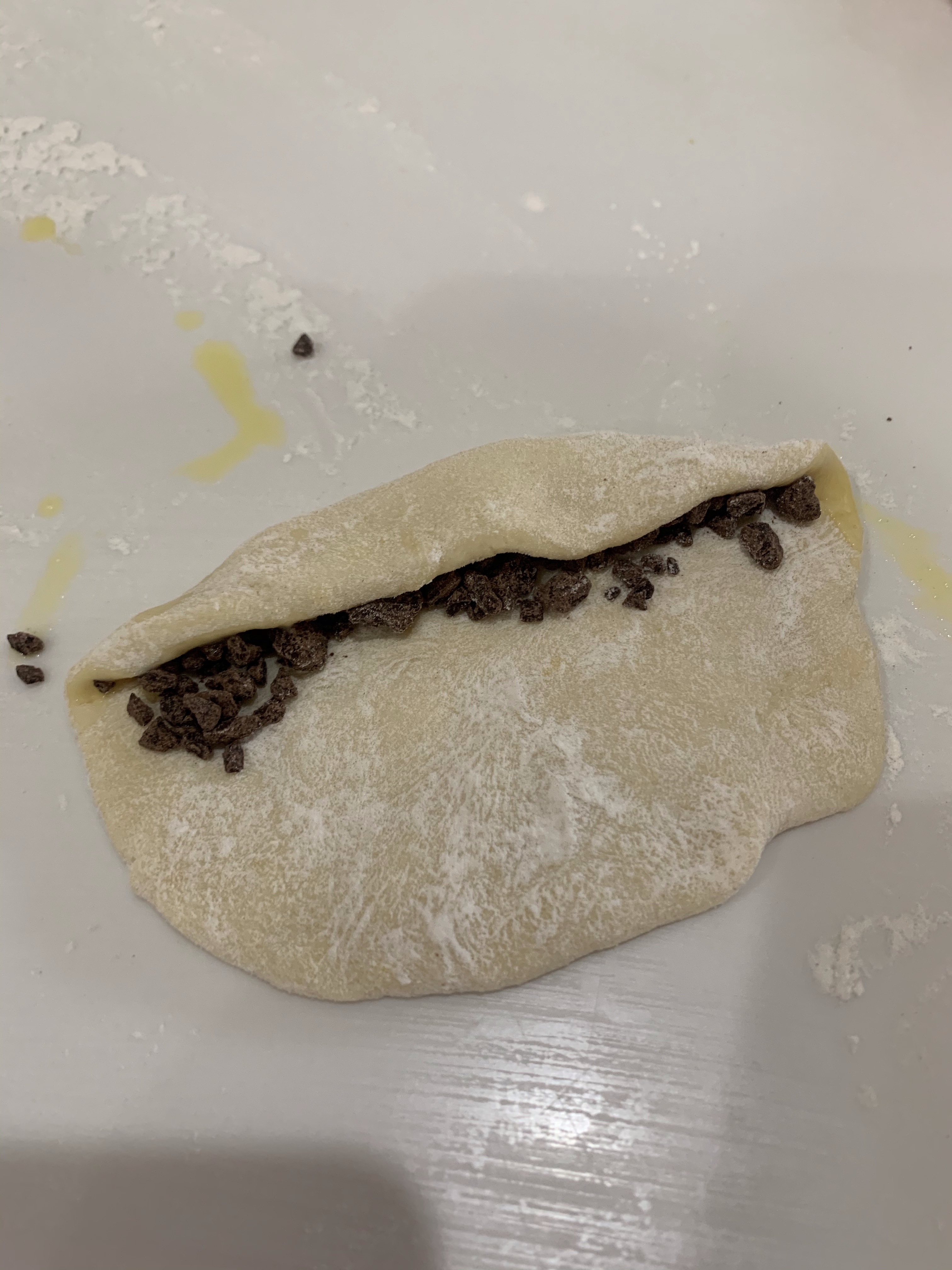
Rolled Dough
1st Stripe of Chocolate
Rolled over Chocolate
Ready for Fridge
Ready for Oven
The photos more or less follow the method below.
The QC department suggested a less bitter chocolate (64% cacao) and sparkling sugar topping (good suggestion.) QC will have to live with 64% as I do have 11 pounds. Manufacturing suggested no chop the chocolate so small. Something the size of chocolate chips should melt fine and be easier to handle.
Chocolate Filled Bread Buns
INGREDIENTS • 2 teaspoons active dry yeast • 1 cup barely warm milk • 3 cups all-purpose flour • 2 tablespoons butter, melted • 3 tablespoons sugar • 1 teaspoons salt • 2 eggs, one for dough, one for egg wash • 1 tablespoon orange zest • 165g, about 1 cup (4-6 ounces) bittersweet chocolate chopped fine (pulse in a food processor)
METHOD
In a large mixing bowl, sprinkle the yeast over the warm milk and let sit for 5 minutes.
Add 2 tablespoons melted butter, sugar, salt, egg, and orange zest. Stir until blended and fragrant.
Add 3 cups of flour and mix until the dough comes together. It will be sticky! On a lightly floured surface knead the dough until soft and elastic (about 8 minutes), adding more flour to keep the dough from sticking if necessary. Do not add too much flour! The dough will become more workable the longer you knead. Or, if you have a standing mixer, knead the dough with the dough attachment for 5-7 minutes, or until elastic.
Transfer the kneaded dough to a lightly oiled bowl. Cover with plastic wrap and a clean kitchen towel. Let the dough rise in a warm area until it doubles in size, about 2 hours.
Punch dough down, divide into 12 equal portions, and shape each portion into a round ball. Flatten into an oval then roll to ¼ “ thick rectangle.
Place a stripe of chocolate ½ “ from long end of rectangle. Roll to cover chocolate and place a second stripe of chocolate. Roll up and seal edges and all seams.
Place rolls a on baking sheet coated lightly with cooking spray. Cover with a kitchen towel and let it rise for another 20 minutes.
Preheat oven to 400 degrees F.
Slash diagonally 4x with lame.
Brush 1 egg wash over the rolls. Sprinkle with coarse sparkling sugar.
Bake for 8-12 minutes or until lightly browned. Serve warm or at room temperature.
Most basic bread is easy to make. There are a few that require extra steps, rises, shaping, etc. but basic bread is… well… basic. Mix, rise, shape, rise, bake.
I made a few changes to the recipe published by Cookist. Some of them were just language or style differences but a couple were more involved. I use instant yeast so I provided the conversion factor from cake to instant. I knead in a stand mixer so referenced it. I added how long to knead and to tension the loaf before the final rise. I added more description on how to shape the loaf.
INGREDIENTS • 2 cups water • 1 tsp sugar • 8g ( 2 ½ tsp) instant yeast • 5 cups AP flour • 1 tsp salt • 2 tbsp oil
METHOD
Pour water into a stand mixer bowl, add sugar and yeast. Mix.
Add flour and salt. Mix. Let rise for 15 minutes.
Add sunflower (or other) oil and knead about 8 minutes.
Let rise covered until doubled.
Divide the dough into two parts.
Form a boule from each part, the press out into an oval, roll into a batard
Tension the battery by rolling on a clean surface, cupping your fingers around the bread and rolling the batard back and forth not allowing it to lengthen.
Place on a baking sheet. Let rise until doubled.
On each bread make an incision, paint with milk. Place a cup of hot water on a baking sheet. Cookist’s video showed slashing the bread by cutting in small short strokes rather than one long cut. It worked really well. I will have to try on other bakes.
Bake for 40 minutes at 180 °C / 350 °F until internal temperature reaches 195-200°F.
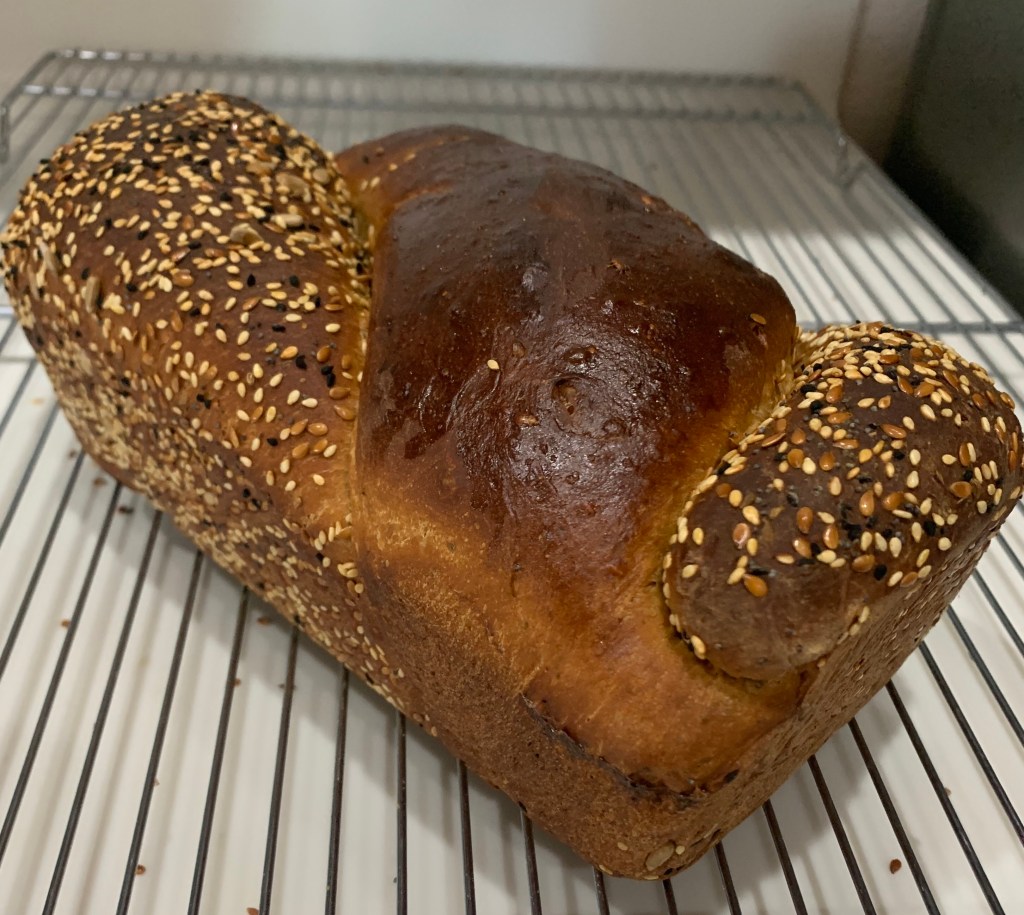
I receive King Arthur Baking Company’s magazine and always peruse the products and recipes. This month there was a beautiful picture of their Molasses Multi-Seed Bread and decided to give it a try.
I discovered two things. More seeds are better and try different time/temperature combinations. I made it as directed and the final loaf was overdone, although the internal temp was just 195°F. Next time I will either drop the temp a little, maybe to 350°F or 325°F. I will also tent it with foil earlier. This time, my first attempt, I tented it for the final 10 minutes, but it was too late.
I may also need to buy a tea loaf pan. The standard 4” x 9” was really to small for the bread to be shaped correctly. The 12” x 4” tea loaf, as specified by KAB would be better. Maybe… let it rise (second rise) on a French bread pan. I may try that before investing in a tea loaf pan that I would use infrequently.
Molasses Multi Seed Bread
INGREDIENTS • 3/4 cup (170g) warm milk, 105° to 110°F • 1/2 cup (113g) warm water, 105° to 110°F • 2 tablespoons (28g) butter, melted and slightly cooled • 1 cup (113g) King Arthur White Whole Wheat Flour • 2 1/2 cups (300g) King Arthur Unbleached Bread Flour • 1/8 teaspoon ascorbic acid, optional • 2 teaspoons instant yeast or active dry yeast • 1 1/2 teaspoons salt • 1/4 cup (85g) molasses • 3/4 cup (129g) Artisan Bread Topping, divided METHOD
To make the dough: In the bowl of your stand mixer, combine all the ingredients except the bread topping. Mix and knead with a dough hook for about 8 minutes until a smooth, slightly sticky dough forms, adding a tablespoon of flour if needed. With a minute or so left, knead in 1/4 cup of the topping.
Place the dough in a lightly greased bowl, cover, and let it rise until puffy, 1 to 1 1/2 hours.
To shape the bread: Deflate the dough and divide it in half; roll each half into a 12” rope. Roll one of the ropes in the remaining topping. Be sure the rope is VERY well covered with seeds. When it rises the seeds will separate.
Pinch the ends of the ropes together and twist one over the other, pinching them together at the opposite end.
Transfer the dough to a lightly greased tea loaf pan or similar long loaf pan (12″ x 4″). Cover and let rise until the bread domes 1” above the edge of the pan, about 1 hour. Toward the end of the rising time, preheat your oven to 375°F.
Uncover the loaf and egg wash the un-seeded rope.
Bake for 32 to 36 minutes, or until a digital thermometer inserted into the center registers 190°F. The bread was too dark with this time/temp setting. (Drop temp to 350°F and tent the bread with foil after 20 min or so, before it turns dark.)
Remove the bread from the oven and place the pan on a rack for 5 minutes. Tilt the bread out of the pan and return it to the rack to finish cooling completely.
Store bread, well wrapped, at room temperature for several days; freeze for longer storage.